
Energy Consumption and Cost of Air Conditioners

by Tyler Castle
Updated: September 15, 2026
12.3 min read
Key Points of This Article:
- Air conditioners significantly increase summer electricity use, with cooling accounting for about 12% of a typical household’s annual energy consumption.
- Window units cool single rooms with lower operating costs, while central air systems cool entire homes but use more electricity despite higher efficiency ratings like SEER.
- AC energy use depends on factors such as wattage, Btu capacity, run time, home size, insulation quality, humidity, and overall system maintenance.
- Households can reduce cooling costs by choosing high efficiency units, maintaining equipment, adjusting thermostat settings, improving ductwork, using timers, and adopting additional cooling strategies.
Looking to reduce your electricity bill? A great way to cut costs is to analyze your electricity usage when temperatures are at their highest or lowest. That means finding more efficient ways to stay warmer in the winter and cooler in the summer. Summer efficiency is especially important because, according to the Energy Information Administration (EIA), that’s when electricity prices are usually the highest due to increase in demand and the use of costly energy production sources to meet that demand.
One of the biggest reasons electricity costs spike in the summer is due to the higher use of air conditioners and central air to beat the heat. The Department of Energy estimates that around 12% of a typical household’s energy use is just for cooling (though that number reached a high of 19% during the 2020 COVID-19 lockdown). Thanks to the fluctuating expense of electricity in summer, the cost of staying cool can add up.
So, if you want to lower your electricity bill in the summer, is it more effective to use central air or a window AC unit? And are there ways you could make either method more energy efficient?
This post looks at the cost of electricity when using air conditioners and offers some tips on how to keep your wallet from overheating.
What is the difference between a window and central air conditioner?
Beyond their obvious size differences, window air conditioners and central air conditioners differ in how they function with slight variations and use different efficiency measurements. Both units contain two sets of metal coils, with one collecting heat from inside the house and the other dispersing it outside.
Window AC Units
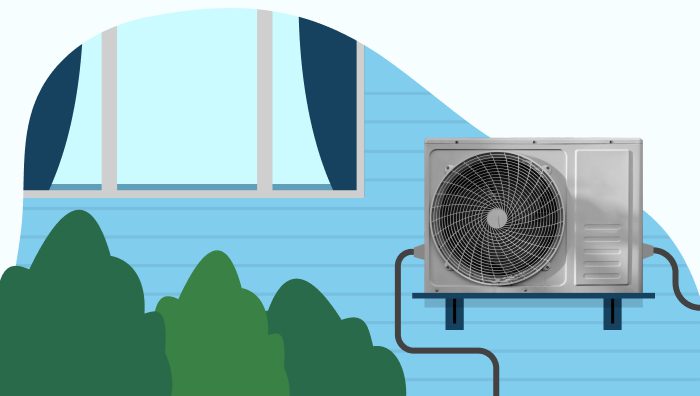
Window air conditioners are considered stand-alone AC units because both of their metal coils are contained within the same housing unit.
With their compact design, window air conditioners are designed to cool a single room or similarly smaller space. Due to the lower amount of energy they draw, window AC units are less expensive to operate than central units, even though they are generally less efficient overall.
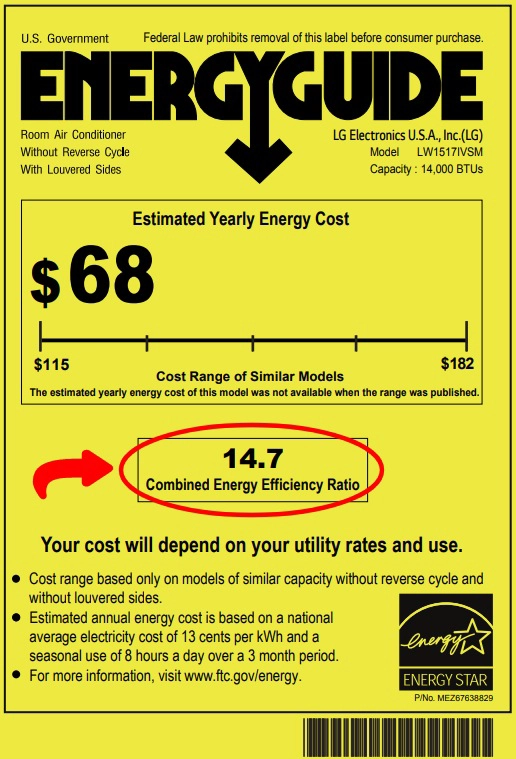
The efficiency of a window AC unit is measured in its Combined Energy-Efficiency Ratio (CEER), which considers the energy drawn both when the compressor is running and when it’s in standby mode. If you are able to look up a window AC unit’s EnergyGuide label, you will likely see the CEER rating displayed as a number between 8 and 15. The higher the CEER rating, the more efficient the air conditioner.
Determining how many watts an air conditioner uses
Most modern air conditioners will have an EnergyGuide that displays its estimated energy usage and cost (based on average electricity costs). However, if you don’t have the EnergyGuide sticker, you can use your kilowatt power to estimate your costs.
Your AC unit may list its kilowatt usage in the owner’s guide. If your AC unit doesn’t list its wattage, there are a few ways you can try to obtain an estimate:
- You can use an electricity usage monitor to see exactly how many kWh the AC unit is drawing. These monitors usually plug directly into a power outlet and will display the wattage once an appliance is plugged in and turned on.
- You can also calculate the wattage by multiplying the voltage (in volts) by the current (in amps) that the air conditioner uses. For example, if the air conditioner runs on 120 volts and draws 10 amps of current, then the wattage would be 1,200 watts.
- If you know the AC unit’s size in Btus, then you can get an idea of how many watts of power it needs to run by dividing the Btu by three. For example, a 20,000-Btu air conditioner would have a wattage of around 6,000 or 6kWh.
If you’re crunching numbers to determine your wattage, be aware that the maximum possible wattage of an air conditioner isn’t the actual amount of energy it is always consuming. AC units use more energy to start than they actually do to run, and even less at lower speeds or energy-saver modes. Air conditioners typically turn on and run for about 15 to 20 minutes at least twice an hour to cool a room. Throughout a cycle, an AC unit may use about only two-thirds of its maximum listed wattage.
How much does it cost to run an air conditioning unit?
If your operating costs aren’t listed on the AC unit, then you can multiply your air conditioner’s kWH average value by the kWh usage rate charged by your utility company. Keep in mind that:
- These calculations really only apply to basic, single-speed air conditioners
- How much power your unit needs depends on the area you intend to cool down
To give you an idea of what to expect, here’s a simple example. Let’s estimate that window AC units use about 500 to 1,000 watts per hour and central air systems use between 3,000 and 5,000 watts of power.
At the U.S. average cost of 16.21 cents per KwH, here’s what it would cost to run different-sized air conditioner units, assuming each unit runs only for a total of eight hours a day.
Cost to Run a Window Air Conditioning Unit
(at U.S. Average of 16.21 cents per kWh)
| For 1 day (8 hours) |
For 1 week (7 days) |
For 1 month (30 days) |
For 1 year (120 days) |
|
|---|---|---|---|---|
| 500 watts | $0.65 | $4.54 | $19.45 | $77.81 |
| 1,000 watts | $1.30 | $9.08 | $38.90 | $155.62 |
Cost to Run an Central Air Conditioning Unit
(at U.S. Average of 16.21 cents per kWh)
| For 1 day (8 hours) |
For 1 week (7 days) |
For 1 month (30 days) |
For 1 year (120 days) |
|
|---|---|---|---|---|
| 3,000 watts | $3.89 | $27.23 | $116.71 | $466.85 |
| 5,000 watts | $6.48 | $45.39 | $194.52 | $778.08 |
Here’s a comparison of electricity costs for different states based on their average kWh charges. This should give you an idea of your expected energy use to power an air conditioner over the course of a year — assuming you’re running the AC for about eight hours a day for only four months out of the year.
Cost to Run an Air Conditioner for 120 Days in Different U.S. States*
| Michigan 19.06 cents per kWh |
Pennsylvania 18.43 cents per kWh |
Ohio 16.01 cents per kWh |
Illinois 15.83 cents per kWh |
Indiana 15.17 cents per kWh |
|
|---|---|---|---|---|---|
| 1,000 watts | $182.98 | $176.93 | $153.70 | $151.97 | $145.63 |
| 3,000 watts | $548.93 | $530.78 | $461.09 | $455.90 | $436.90 |
| 5,000 watts | $914.88 | $884.64 | $768.48 | $759.84 | $728.16 |
*costs are based on EIA estimation of average kWH as of October 2023.
Understand that the true cost of how much electricity an AC unit uses depends on its overall efficiency. An AC unit’s CEER or SEER number will show you the efficacy of the unit’s cooling capacity relative to how much electricity in watts the air conditioner uses to cool an area. An air conditioner with a higher CEER or SEER rating can generate quite a lot of electricity savings over time compared to less efficient models.
What makes an AC bill so high?
If you’re seeing spikes in your energy bill when running your air conditioner, there are a few reasons for the increase in costs.
- Air conditioners are rather power-intensive appliances and use more wattage on average than other appliances such as hair dryers, space heaters, or even refrigerators.
- The hotter it is outside, the harder your AC units will have to work to cool a home. This is especially true during stretches of high humidity. Air conditioners, especially smaller window units, aren’t great at pulling humidity out of the air — for that you’ll want to run a dehumidifier.
- If you live in a larger house with an open floor plan, or an older house with less-efficient insulation, your air conditioner will need to work harder to generate the Btus necessary to cool the area down.
- An older air conditioner will be less efficient, especially if it hasn’t been cleaned or maintained properly over the years. AC units with dirty filters or blocked airflows need to work harder and will therefore need to draw more energy.
- We also tend to use more electricity in the summer. For many areas of the country, summer brings higher energy demand as more people stay inside to use their air conditioning and other electronics and appliances. This increase in demand can cause the market price of electricity to increase, so if you are on a variable-rate utility plan, you’ll likely see an increase in your electricity rate for the summer.
FAQs
Why does my air conditioner use so much electricity?
Air conditioners consume a lot of electricity due to the energy-intensive process of heat transfer they must perform to cool indoor spaces. Air conditioners must draw in warm indoor air, cool it by passing it over refrigerant-filled coils that absorb the heat, and then recirculate the chilled air back into the room. This cycle requires substantial power for the compressor, which circulates the refrigerant, and for fans that move the air. Maintaining lower temperatures during hot and muggy weather greatly increases the demand on these systems, leading to higher electricity use.
How do I find the wattage of my air conditioner?
Some models of air conditioners will have a product sticker that tells you how many watts the machine uses. If your model’s sticker is missing that information, you can look up the user manual to find the wattage. In cases where the manufacturer doesn’t provide the unit’s wattage, you can estimate the wattage either by multiplying the unit’s voltage by the current (in amps) or by dividing its maximum Btu usage by three.
What is a conditioner’s SEER rating?
An air conditioner’s SEER or Seasonal Energy Efficiency Ratio rating is a measurement of how efficient an AC unit is for an entire season by calculating different seasonal outputs. Higher SEER ratings indicate higher energy efficiency. As AC units have become more efficient and as the government has updated its efficiency standards, the SEER rating range has changed over time. Today, the expected range for modern AC units ranges from 13 SEER to 24 SEER.
Does central air use more electricity than window units?
Due to their larger size, central air units will need to use more electricity than window AC units. While window AC units are only suitable for cooling down a single room, central air conditioning units are meant to cool down an entire house.
How can I save on costs with my air conditioner?
If you’re looking to stay cool and reduce costs, there are steps you can take to ensure your house is cooled more efficiently. Here are some helpful tips you need to know to save on cooling costs no matter which type of air conditioner you use.
- Purchase an AC unit with a high efficiency rating. If you’re purchasing a new AC unit, look for one with the highest CEER / SEER rating possible. The higher the rating, the more efficient the air conditioner, which means it requires less electricity for its cooling power.
- Schedule regular maintenance for your air conditioner. The more you run an air conditioner, the better chance you have of dirt, pollen, dust, and other debris clogging the fins, filters, and coils. Be sure to clean your AC units every season to allow for unrestricted air flow. Your AC unit may also be low on refrigerant, so consider hiring a professional technician to inspect older units that aren’t cooling properly.
- Adjust the setting on your AC units. The cooler your set temperature, the harder your AC unit has to work. Rather than cranking it down to the low 70s, set the AC unit to 78 degrees — it’s considered the ideal temperature that balances energy savings and comfort.
- If you have central air, check your air ducts. Central air units circulate cool air throughout the series of metal ducts in your home. If you have an older home you may be losing some of your cooler air through the ductwork. Ask a licensed HVAC technician to check that the ductwork was properly installed, to test if there are any leaks or blockages, and to inspect for any damage.
- Use a timer or settings to automatically turn off your air conditioner. The longer an AC unit runs, the more electricity it consumes. Modern air conditioners — both central air and window units — will have automatic settings to turn off after a set amount of time or when the area reaches a specified temperature. Using these automatic presets can ensure you’re not wasting electricity.
- Determine when to use central air vs. a window unit. If you own both types of units, it can make more financial sense to alternate depending on the circumstances. If everyone is gathered together in one room, then using a single window AC unit makes sense rather than trying to cool the entire house. If you sleep upstairs, just run a single window AC unit in the bedroom and turn up the central air temperature for the rest of the house. Just don’t try to run multiple window AC units at once — it will be more efficient to use the central air unit.
- Change your AC fan settings. When humidity is high, set the fan speed on low for more comfort. The low speed on humid days will cool your home more effectively and remove more moisture from the air because of slower air movement through the cooling equipment. During dryer days, you can set the fan on high to circulate more cooler air, faster.
- Take other steps to keep your house cooler. There’s a host of small things you can do around the house to make it more energy efficient in the summer and winter. Whether it’s adding shades to your windows or planting greenery around the house, every small action can add up to larger savings.
- Select an energy plan that fits your lifestyle. If you want more control over your energy bill and don’t want to worry about summer spikes in your kWh charges, see if your retail energy provider offers Unlimited Energy or Fixed-Rate plans. Fixed-rate plans guarantee a cost that does not change for a specified period of time, while unlimited energy plans allow you to pay the same supply charge amount every month without worrying about fluctuating energy costs.*
* Restrictions apply. Enrollment based upon program eligibility. Customers using more than 125% of normal monthly usage as determined by Santanna may be required to switch plans.
Tyler is an experienced energy professional, having worked for Santanna Energy Services, for the past four years. He is passionate about renewable energy and believes that diversifying the energy grid is the key to a sustainable future. Tyler is dedicated to supplying consumers with the best possible energy solutions and works diligently to make sure that Santanna can deliver the highest quality service.