

Energy Saving Light Bulbs Explained: Types, Costs, and the Best Models

by Tyler Castle
Updated: July 31, 2026
20.6 min read

Key Points of This Article:
-
LED bulbs outperform all other lighting options by delivering the same brightness as traditional bulbs while using a fraction of the energy and lasting years longer.
- Choosing the right bulb goes beyond efficiency, factors like lumens, color temperature, and CRI determine how well the light fits each room’s function and comfort level.
- Although LEDs have a higher upfront cost, they quickly pay for themselves through reduced electricity use and fewer replacements, making them the most cost-effective choice over time.
- Maximizing savings comes from pairing efficient bulbs with smart usage habits, proper fixture compatibility, and ENERGY STAR–certified products to avoid performance issues and wasted energy.
Ever notice how some rooms in your home feel too dim, or your electric bill spikes even though nothing’s changed? Lighting can be a sneaky culprit. Many homeowners want to save energy but get lost in the maze of bulb types, brightness levels, and confusing labels.
Should you pick LEDs, CFLs, or halogens? And are energy-saving bulbs really worth the higher price tag? As an energy supplier with over 35 years in the industry, we’re ready to answer all your energy-saving questions.
When you know how these bulbs work and what’s best for you, you’ll create a brighter, safer, and more comfortable home. The right lighting can make daily tasks easier, reduce energy waste, and even lower your monthly bills. In fact, a recent survey shows that 88% of our employee-owners at Santanna Energy Services already use energy-saving light bulbs at home — proving how common and effective this switch is.
In this guide, we’ll break down the different types of energy-saving light bulbs, compare costs, and show how they add up to long-term savings, especially for Midwest homes.
Ready to find the perfect light for every room and season? Let’s get started.
Types of Energy-Saving Light Bulbs
Choosing the right energy-saving bulb is about finding the one that best suits your home. The U.S. Department of Energy (DOE) notes that lighting accounts for roughly 15% of the average home’s electricity use, so switching to efficient bulbs can make a real difference on your bill and your carbon footprint.
Here’s what you should know before picking your next energy-saving light bulb:
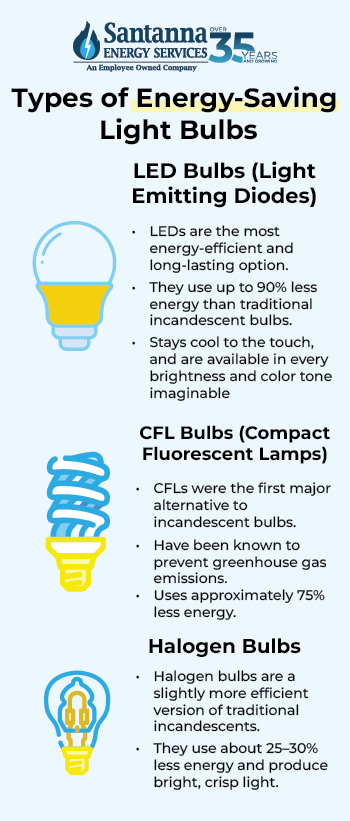
LED Bulbs (Light Emitting Diodes)
LEDs are the most energy-efficient and long-lasting option available today. According to ENERGY STAR, they use up to 90% less energy than traditional incandescent bulbs and can last 15 times longer. They turn on instantly, stay cool to the touch, and are available in every brightness and color tone imaginable.
LEDs also perform well in cold weather, making them ideal for Midwest garages, porches, and outdoor fixtures. While the upfront cost is higher compared to other lighting choices, they pay for themselves over time through lower energy bills and fewer replacements.
CFL Bulbs (Compact Fluorescent Lamps)
CFLs were the first major alternative to incandescent bulbs. These bulbs use less electricity at home and have been known to prevent greenhouse gas emissions that lead to global climate change, according to ENERGY STAR.
CFLs have disadvantages, too. They can take a few seconds to reach full brightness and don’t perform as well in cold spaces. CFL bulbs are best suited for indoor areas that stay warm and where lights are left on for extended periods. CFL bulbs also contain a small amount of mercury, which is toxic to the environment and can be released if the bulb breaks. Because of this, they require careful recycling rather than regular disposal.
Halogen Bulbs
Halogen bulbs are a slightly more efficient version of traditional incandescents. They use about 25–30% less energy and produce bright, crisp light that’s great for task lighting, such as in kitchens or bathrooms. However, their lifespan is significantly shorter, typically around 2,000 hours (approximately 1.5 years based on normal use of 3 hours a day), and they generate more heat than LEDs or CFLs.
Because of their shorter lifespan and higher heat output, halogens are typically used for accent or decorative lighting rather than everyday fixtures. Many households are now replacing them with LEDs for better performance and lower energy use.
Which Light Bulb Is the Most Energy Efficient?
LED bulbs are currently the most energy-efficient lighting option available for homes, outperforming both CFLs and halogen bulbs in nearly every way. According to GE Lighting, a light bulb that’s 100% efficient would convert every bit of electricity into visible light with no heat loss.
While no bulb can achieve that yet, LEDs come close, transforming the majority of their energy into light instead of wasted heat. Due to this efficiency, LEDs use up to 90% less energy than traditional incandescent bulbs. They also last much longer, often 25,000 to 50,000 hours or more if well taken care of.
For Midwest homes that see longer nights and shorter winter days, LEDs make even more sense because they stay bright in cold weather and reduce the need for frequent bulb changes. In short, LEDs don’t just save power but also save time, money, and frustration while keeping your home bright and your energy bills low all year round.
A Room-By-Room Guide To Choosing Energy-Saving Bulbs
Still need some help choosing which light bulb is right for your space? Let us help determine which energy-saving light bulb is best for your home.
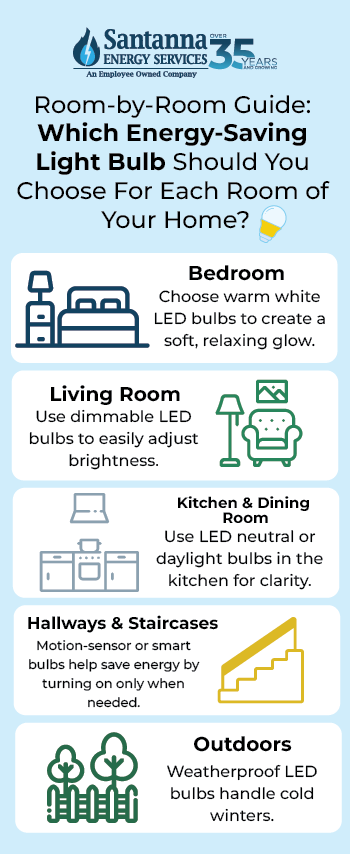
Because lighting isn’t one size fits all, here’s a simple room-by-room guide we’ve created to help you match each space with the best, most efficient lighting:
Bathroom: Bright, High-CRI Bulbs for Grooming and Mirrors
The bathroom is where lighting and clarity matter most. We recommend using LED bulbs with a high Color Rendering Index (CRI) to make colors and skin tones look natural. Choose bright, neutral white light near mirrors to eliminate shadows and make daily grooming easier and more accurate.
Bedroom: Warm White Light for a Calm, Relaxed Atmosphere
Your bedroom is where comfort is key. We suggest choosing warm white bulbs to create a soft, relaxing glow that helps your body wind down. For more control, use dimmable LEDs so you can brighten the room in the morning and lower the light for evening calm.
Living Room: Dimmable LEDs for a Layered Ambiance
In the living room, flexibility makes all the difference. Use dimmable LED bulbs to easily adjust brightness, from bright light for reading or cleaning to a soft glow for movie nights. Layer different fixtures, like table lamps and ceiling lights, to add warmth and depth to the space.
Kitchen & Dining Room: Neutral Daylight for Clarity and Food Prep
Kitchens need bright, focused lighting for cooking and cleaning, while dining areas benefit from warm, inviting light. We recommend using neutral or daylight bulbs in the kitchen for clarity and softer, warm tones above the table to make meals feel more welcoming.
Hallways & Staircases: Motion-Sensor or Smart Bulbs for Safety
These areas often don’t need constant lighting, so motion-sensor or smart bulbs help save energy by turning on only when needed. Bright but not harsh light improves visibility and safety, especially in the evenings.
Outdoors: Weatherproof LEDs for Cold Climates and Security
Outdoor lights face temperature changes, moisture, and long operating hours. Weatherproof LED bulbs handle cold Midwest winters and still deliver bright, reliable light. For security and convenience, use motion-sensor or dusk-to-dawn bulbs that automatically turn on when needed.
The right lighting setup transforms your home into a place that’s both comfortable and efficient. Each room plays a role in your daily routine, and by choosing energy-saving light bulbs, you’ll enjoy better visibility, lower energy use, and a home that feels warm and welcoming year-round.
Best Energy-Saving LED Light Bulbs
We’ve reviewed over 20 different models of LED light bulbs to find the best brands and models. Here are some of the best energy-saving LED light bulbs, chosen for their reliability, lifespan, and light quality:
Philips UltraEfficient LED
If your goal is to save as much energy as possible, the Philips UltraEfficient LED is a gold standard. This bulb uses about 40 percent less energy than standard Philips LEDs and can last up to 50,000 hours. That’s decades of reliable light before you’ll need to replace it.
It’s ideal for high ceilings, outdoor fixtures, or anywhere you prefer a long-term, low-maintenance solution. Once installed, you can simply enjoy consistent, high-quality light for years.
Each bulb costs around $7.50 and is best for homeowners who want to save the most energy and minimize how often they replace bulbs.
Philips Non-Dimmable LED Frosted
Philips Non-Dimmable LED Frosted is a reliable, everyday option. It uses roughly 87% less energy than a traditional 100-watt bulb and delivers about 800 lumens of clean, comfortable light at just 8–10 watts.
Each bulb lasts around 10 years with normal use. It’s mercury-free, eye-safe, and easy on your electric bill.
Each bulb costs about $8 and is ideal for general household lighting in spaces like living rooms, kitchens, and work areas that need steady brightness throughout the day.
Sylvania LED A19 Bulbs
For homeowners who want to switch to LEDs without spending much up front, the Sylvania LED A19 Bulb is a solid pick. It matches the brightness of a 60-watt incandescent while using only 8.5 watts, cutting energy use by roughly 85%. These bulbs turn on instantly, last up to 11,000 hours, and provide soft white light that feels inviting.
Each bulb costs around $1 and is best suited for budget-minded households updating multiple rooms, including home offices, hallways, or kids’ bedrooms.
Feit Electric LED
The Feit Electric LED stands out for its versatility because you can customize its lighting in one bulb. You can switch color temperatures from warm white to daylight, depending on the mood or task, with no extra bulbs required.
Each one replaces a 60-watt incandescent while using a fraction of the energy and lasts up to 15,000 hours. It’s fully dimmable too, so you can control brightness throughout the day.
Each bulb costs about $3.50 and is ideal for multi-use spaces like kitchens, offices, or living rooms where you want to adjust brightness and color throughout the day.
GE Relax LED Light Bulbs
The GE Relax LED Light Bulbs create a warm, soft white glow designed for cozy, comfortable spaces. These bulbs replace a standard 60-watt incandescent using only about 10 watts, helping you save more than 60% on lighting costs over the bulb’s lifespan. Each bulb lasts about 14 years based on 3 hours of daily average use.
Each bulb costs around $4 and is a perfect match for bedrooms, dining rooms, or family spaces where warm, relaxing light makes the room feel more welcoming.
Best Energy-Saving CFL Light Bulbs
If you prefer bulbs that balance affordability and efficiency, compact fluorescent lamps (CFLs) are a dependable option. Below are some of our picks for top-rated CFL bulbs that offer great performance, consistent brightness, and reliable value for everyday home use:
Philips Compact Fluorescent Bulb
The Philips Compact Fluorescent Bulb is designed for homeowners who want strong, balanced light while still saving energy. It produces bright, neutral white light and replaces a traditional 150-watt bulb while using only 33 watts, resulting in significant energy savings over time. With a lifespan of around 16,000 hours, it’s built for long-term performance.
This bulb is dimmable and offers excellent color accuracy, making it a great choice for spaces that require clear, dependable light.
Each bulb costs around $5 and works best in task-oriented areas such as bathrooms, kitchens, or laundry rooms where brightness and clarity are essential.
KOR Compact Fluorescent Light Bulb
The KOR Compact Fluorescent Light Bulb is a practical choice for homeowners looking for bright, clean light that works well in everyday spaces. It uses only 26 watts to replace a 100-watt incandescent bulb, saving plenty of energy while lasting far longer. The cool white tone gives excellent visibility, making it a great fit for rooms that need clarity and focus.
Each bulb costs about $5 and is best for kitchens, bathrooms, and home offices where task lighting is important.
UnitedLux E26 Spiral CFL Light Bulbs
The UnitedLux E26 Spiral CFL Light Bulb offers a warm, inviting glow while still keeping energy use low. Using only 13 watts to replace a 60-watt bulb, it cuts energy use by up to 90%. The soft white tone creates a cozy feel, and with a lifespan of about 15,000 hours, you won’t be changing bulbs often.
They’re also RoHS-compliant and flicker-free, which means safe, steady lighting from the moment you switch them on. Each bulb costs around $3 and is best suited for living rooms, bedrooms, and hallways where you want warm light that still saves energy.
Arsmrau E26 Base CFL Light Bulbs
Simple and efficient, the Arsmrau E26 CFL Light Bulb gives off a soft, warm white glow that’s easy on the eyes. It uses just 13 watts to replace a 60-watt bulb, saving approximately 80% on energy use. With a lifespan of around 10,000 hours, it’s an easy upgrade for fixtures you use every day, like bedside lamps, ceiling lights, or desk lamps.
Each bulb costs about $3.50 and is a great option for bedrooms, reading areas, and offices where you need gentle light that still cuts energy costs.
Xtricity Compact Fluorescent Light Bulbs
The Xtricity Compact Fluorescent L delivers dependable brightness and long life in a compact design. Using only 23 watts, it provides the same brightness as a 100-watt bulb and lasts about 10,000 hours. It turns on instantly without flicker and produces a soft white glow that’s perfect for busy, high-traffic areas.
Each bulb costs around $4 and is an excellent choice for kitchens, living rooms, and multipurpose spaces that need bright, consistent light throughout the day.
Best Energy-Saving Halogen Light Bulbs
Halogen bulbs may not be as efficient as LEDs or CFLs, but they still have a place in many homes. They offer bright, natural light that makes colors pop, and they’re fully dimmable for a more customizable atmosphere.
Here are some of the best energy-saving halogen light bulbs available today, offering a balance of performance, brightness, and reliability for everyday home use.
GE 43W Energy Efficient Halogen Light Bulb
GE’s Soft White Halogen Light Bulb is a dependable choice if you like the look and feel of traditional bulbs but want something more efficient. Using 43 watts to replace a standard 60-watt bulb, it provides nearly the same brightness while using less power. It’s fully dimmable, lasts longer than regular incandescents, and fits most fixtures around the home, from table lamps to ceiling lights.
A 12-pack costs about $25. This bulb is best for living rooms, bedrooms, or reading areas where you want a warm, dimmable glow.
G8 Halogen Light Bulbs
Compact and powerful, the G8 Halogen Light Bulb produces a warm white glow that feels natural and comfortable. Using only 20 watts, it creates bright, accurate light with a Color Rendering Index (CRI) of 100, which means colors appear true to life. Each bulb lasts around 2,000 hours and turns on instantly without flicker, making it perfect for spaces where you need clear, consistent light.
They’re commonly used for under-cabinet lights, kitchen range hoods, and desk lamps, offering excellent brightness in small fixtures. Each bulb costs about $1 and is a great fit for task lighting in kitchens and workspaces.
Westinghouse 100W T3 Utility Halogen Bulb
The Westinghouse 100W T3 Utility Halogen Bulb is built for brightness and durability. It delivers 1,650 lumens of clear white light while maintaining full dimmability. This bulb is ideal for utility lighting, lasts around 1,500 hours, and provides crisp illumination for work lamps, security lights, and torchiere floor lamps.
Handle it carefully, as halogens can get hot during operation. The cost for each bulb is about $4.50 and is ideal for garages, workshops, and outdoor fixtures that need strong, steady light.
Alide MR16 Halogen Bulb
The Alide MR16 Halogen Bulb packs a lot of brightness into a small design. It uses just 20 watts to produce 280 lumens of warm, vivid light with a CRI of 100. The built-in safety fuse helps prevent overheating, and the bulb’s long lifespan of about 3,000 hours means fewer replacements.
It’s dimmable and works beautifully for accent lighting or highlighting specific areas in your home. Each bulb costs around $2 and is well-suited for living rooms, hallways, or art displays where focused, high-quality light makes a noticeable difference.
Ledvance Halogen Classic Shape Lamp
The Ledvance Halogen Classic Shape Lamp brings a touch of traditional style with improved energy efficiency. Using 53 watts to produce 880 lumens, it gives off a warm, pleasant glow that feels natural and inviting. With a CRI of nearly 99 and a color temperature of around 2800K, it’s a great alternative for those who prefer the look of old-fashioned bulbs but want to save a bit more energy.
Each bulb lasts about 2,000 hours, offering dependable light for everyday use. This bulb costs around $5 and is best for table lamps, ceiling fixtures, and dining areas where you want soft, warm lighting that feels welcoming.
The Best Overall Energy-Saving Light Bulbs
When it comes to balancing performance, comfort, and efficiency, the Philips Ultra HD 60W LED stands out as the best overall energy-saving bulb for homeowners. It delivers the perfect mix of bright, natural light and long-term energy savings while still feeling familiar and easy on the eyes.
This bulb is designed with a Color Rendering Index (CRI) of 95, which means it shows colors accurately and beautifully. It’s beneficial in spaces like kitchens, living rooms, and dining areas, where you want light that feels bright but still natural.
Its EyeComfort design minimizes flicker and glare, reducing eye strain during everyday use. The bulb also dims to a warm glow, mimicking the cozy ambiance of traditional incandescent lighting. It’s built for sustainability and long-term value, with a lifespan of up to 15,000 hours and the ability to save up to 80% more energy than standard bulbs.
Each bulb costs around $3.50, which is an excellent value for its light quality and long-term efficiency. It’s best for homeowners who want premium, comfortable lighting throughout their home, from the kitchen to the family room and everywhere in between.
Costs listed are approximations as of November 2025 and may vary by retailer or location.
Do Energy-Saving Bulbs Really Work?
Energy-saving bulbs like LEDs and CFLs work effectively by using significantly less energy and lasting much longer than traditional incandescent bulbs. That means the same level of brightness with a fraction of the electricity and far fewer replacements over time.
What makes these bulbs so effective is how they convert energy. Traditional bulbs waste most of their electricity as heat, but LEDs and CFLs use that energy primarily to produce light, not warmth.
This efficiency directly translates into lower household energy use and significant cost savings each year. The U.S. Department of Energy estimates that if every American household replaced just one old incandescent bulb with an ENERGY STAR®-certified LED by July 2028, the nation could save about $1.6 billion per year in energy costs.
These bulbs also help the environment. Because they use less electricity, they also reduce demand on power plants, which in turn lowers greenhouse gas emissions. And with many models now designed to provide soft, flicker-free light in a range of color tones, you no longer have to trade comfort for efficiency.
How Much Can I Save Daily, Monthly and Yearly by Switching To LED Bulbs?
Switching to LED bulbs might seem like a small change, but it can lead to real, measurable savings over time. If you replace 20 incandescent bulbs with LEDs, you can save around $385 a year on your electricity bill, just by upgrading your lighting!
Here’s how we got this estimate:
If you use your lights for about 6 hours a day, here’s what your savings could look like when you replace a 60-watt incandescent bulb with a 10-watt LED, based on the national average electricity rate of 17.62 cents per kilowatt-hour (kWh):
Estimated Energy and Cost Savings When Switching From a 60W Incandescent to a 10W LED
| Usage | 60W Incandescent | 10W LED | Energy Saved | Money Saved |
| Per Day (6 hours) | 0.36 kWh | 0.06 kWh | 0.30 kWh | $0.05/day |
| Per Month | 10.8 kWh | 1.8 kWh | 9.0 kWh | $1.59/month |
| Per Year | 131.4 kWh | 21.9 kWh | 109.5 kWh | $19.29/year |
Note: These savings are estimates and can vary based on your local electricity rate, bulb brand, and actual usage hours.
Now imagine the difference across your whole home!
These savings are even more noticeable in the Midwest and other regions where lights stay on longer during darker winter months. Plus, LEDs can last up to 15,000 to 25,000 hours, meaning fewer replacements and less waste.
What Causes Energy-Saving Bulbs to Fail Early?
One of the biggest surprises for homeowners who switch to energy-saving bulbs, especially LEDs, is when they burn out sooner than expected. They're supposed to last for years, so it can be frustrating when one fails early.
After all, these bulbs are designed and marketed for long life, so why do some stop working too soon?
Heat is the number one reason for early failure.
Unlike traditional bulbs that release most of their energy as heat, LEDs and CFLs are designed to stay cool. However, when they're placed in enclosed or poorly ventilated fixtures like ceiling fans or sealed outdoor lamps, heat can build up and damage the internal components. This shortens their lifespan significantly.
Power fluctuations and dimmer incompatibility.
These are other common culprits. Using energy-efficient bulbs with incompatible dimmer switches or low-quality fixtures can cause flickering, humming, or uneven voltage, which stresses the electronics inside the bulb. Over time, that strain leads to early burnout.
Frequent switching on and off.
This can also shorten the lifespan of CFLs. These bulbs rely on gases and coatings that wear out faster with repeated starts. LEDs are more resilient but can still suffer if turned on and off constantly in high-use areas.
Poor-quality manufacturing.
This is another factor to look for. Not all energy-saving bulbs are created equally. Certified products that carry the ENERGY STAR® label have been tested for longevity, brightness, and safety, so choosing those helps avoid early failure.
FAQs
How long before LED bulbs pay for themselves?
Although LEDs may cost a bit more upfront than less efficient bulbs, they usually pay for themselves in under a year, thanks to the money saved on lower energy use.
Can I use LEDs in enclosed fixtures or outdoor sockets?
Not all LEDs are designed for enclosed or outdoor use. Enclosed fixtures can trap heat, which shortens a bulb's lifespan unless it's rated for that purpose. Look for packaging that says "enclosed fixture rated" or "suitable for damp or wet locations" for outdoor sockets. Using the right bulb ensures safe operation and long-lasting performance.
Are all energy-saving bulbs compatible with ceiling fans and dimmer switches?
No, because compatibility depends on the bulb's design. Standard LEDs and CFLs may flicker, buzz, or wear out early if used with incompatible dimmers or fan controls. Always check the package for terms like "dimmable" or "ceiling fan rated." Choosing bulbs made for these fixtures ensures smooth performance and prevents premature failure.
Are LEDs recyclable?
Yes, LEDs are recyclable, and they should not be thrown in the regular garbage because they can contain hazardous materials like lead and arsenic.
How do I know if a light bulb is energy efficient?
Look for the ENERGY STAR® label or the Lighting Facts label on the package, which indicates it meets U.S. government efficiency standards. Another method is to compare lumens to watts on the package; a higher lumen-to-watt ratio means the bulb is more efficient at producing light for the amount of energy it consumes. Finally, you can look for the newer A-G energy rating scale, where an 'A' rating signifies the most energy-efficient option.
Choosing the right energy-saving light bulbs is one of the simplest ways to make your home brighter, more comfortable, and more efficient. From LEDs that last for years to CFLs and halogens that offer reliable lighting on a budget, the right bulb can help you cut costs, reduce waste, and create the atmosphere you want in every room.
And while upgrading your bulbs helps lower energy use, protecting your energy bill goes beyond lighting. With Santanna's Unlimited Energy plan, you can enjoy a predictable energy supply charge no matter how much electricity you use*, even during months when the lights stay on longer. It's an easy way to keep your home comfortable and your focus on what really matters.
Explore Santanna's Unlimited Energy plan today and discover how simple it is to keep your home bright, efficient, and worry-free year-round.
* Restrictions apply. Enrollment based upon program eligibility. Customers using more than 125% of normal monthly usage as determined by Santanna may be required to switch plans.
Tyler is an experienced energy professional, having worked for Santanna Energy Services, for the past four years. He is passionate about renewable energy and believes that diversifying the energy grid is the key to a sustainable future. Tyler is dedicated to supplying consumers with the best possible energy solutions and works diligently to make sure that Santanna can deliver the highest quality service.