
How Long Does It Take to Charge an Electric Vehicle?

by Chris Tessler
Updated: August 31, 2026
21.1 min read
Key Points of This Article:
- Charging time for an electric vehicle varies widely. It takes anywhere from about 18 minutes to as long as 4 days, depending on the charger type and battery size.
- Level 1, Level 2, and DC fast charging each provide different charging speeds, with Level 2 being the most practical for daily home use and DC fast charging offering the quickest top‑ups during travel.
- Real‑life EV charging usually happens during natural downtime (like overnight or at work), which makes owning an EV more about routine integration than waiting at a charger.
- Charging speed is influenced by factors like battery size, charger output, vehicle charging limits, and especially temperature, with cold weather causing slower charging.
Thinking about an electric vehicle often brings up one big, practical question: how long does it take to charge an electric vehicle? And will it be practical for my lifestyle? Unlike filling up a gas tank, charging an EV can look different depending on where you plug in, how much you drive, and even the weather outside.
But don't worry, you've come to the right place for answers. With more than 35 years of experience helping Midwest residents understand their energy use, and establishing ourselves as staples in the electricity industry, we've seen how everyday energy choices affect daily life.
EV charging works the same way. It's not about one exact number, but about how charging fits into your normal routine.
In this guide, we'll explain what EV charging time looks like in real life, what affects charging speed, and how it shows up in your electric bill. Let's take a clear look at what that means in everyday driving.
Do Homebuyers Consider EV Charging Costs?
According to Midwest realtor and EV charging expert Luke Schmidt of Berkshire Hathaway HomeServices Professional Realty, many homebuyers compare the cost of charging at home versus using public charging stations before investing in an EV.
“Most buyers now realize there are many public charging options available, but charging at home is usually less expensive over time,” Schmidt explains. “Homeowners also consider the upfront cost of installing a charger, but in many cases they eventually recoup that cost through lower charging expenses and added convenience.”
How Long Does It Take to Charge an Electric Vehicle?
Electric vehicles are more common than ever before. In fact, in a recent internal survey, we’ve found that 7% of employee-owners own an electric vehicle. Nationwide, 35% of Americans say they’re considering purchasing an electric vehicle in the future according to Gallup.
And according to Midwest realtor and EV charging expert Luke Schmidt of Berkshire Hathaway HomeServices Professional Realty says, “Most people really have no idea how much it costs to charge an EV. The truth is, it’s almost always cheaper than gas, especially if you are charging at home.”
As EV’s become popular, one of the most common questions arise: how long does it take to charge an electric vehicle?
In a nutshell, charging an electric vehicle can take anywhere from about 18 minutes up to 4 days, depending on the charger used and the size of the battery.
The reason why charging time varies so much is simple: not all chargers are the same, and not all batteries are the same size.
That’s why two electric cars can have very different charging times, even if they’re parked next to each other. Some EVs are also built to accept electricity faster than others. This means charging speed depends not just on the charger, but on the car itself as well.
Not all electric vehicles charge at the same speed. In fact, Industry benchmarks from Kelley Blue Book show that charging performance can vary widely, not just by chargers but by make and model too.
For example, some of the fastest‑charging EVs currently on the market include the Lucid Gravity at about 18.2 miles of range added per minute, the Porsche Taycan at roughly 16.9 miles per minute, and the Hyundai Ioniq 6 at around 14.5 miles per minute.
Even the fastest charging models on the market can vary by charging speed, and EV charging can feel very different from one driver to the next. That’s why it’s so important to evaluate your vehicle options and determine what type of charging speed you’re looking for so you can make your EV work for you.
How Long EV Charging Takes at Different Charging Levels
All of this variation in charging speed ultimately comes down to how electricity is delivered to the vehicle.
EV chargers are grouped into three main charging levels, and each level supplies power at a different rate. That difference directly affects how long charging takes and how much driving range is added over time.
With that in mind, here’s a practical breakdown of how long it typically takes to charge an electric vehicle at each charging level:
Level 1 Charging (Standard Wall Outlet)
Level 1 charging (one of the most common charging levels for electric vehicles) uses a regular 120-volt wall outlet, the same kind used for everyday household items like lamps or televisions. This is the slowest way to charge an electric vehicle.
On average, it adds only about 2 to 5 miles of driving range per hour, which means reaching about 80% charge can take more than 40 to 50 hours. Level 1 charging works best for very short daily trips or as a backup option when faster charging isn’t available.
Most electric vehicles come with a basic Level 1 charging cable included, which means this option is usually available no matter which EV you choose.
While it is convenient because it does not require special equipment, and a Level 1 charger can be plugged into most garage outlets if you have one available, many drivers eventually upgrade to faster charging for everyday use once they understand how charging fits into their routine.
Level 2 Charging (Home and Public Chargers)
Level 2 charging uses a 240-volt power source, similar to what large household appliances like electric dryers require. This is the most common and practical charging option for everyday use.
Level 2 chargers typically add 10 to 30 miles of driving range per hour, which makes them roughly 4 to 10 times faster than Level 1 charging. A Level 2 charger can easily charge your vehicle in 8-12 hours.
In practical terms, that means a Level 2 charger can add 8 to 25 more miles of range per hour than a standard wall outlet with a Level 1 charger. Because of this significant speed increase and added flexibility, Level 2 charging is well-suited for daily driving and routine charging needs.
Level 3 Charging (DC Fast Charging)
Level 3 charging, also known as DC fast charging, and one of the most scarily available charging levels for electric vehicles, is available at high-power public stations, most often along highways and major travel routes. DC fast charging is the fastest charging option available today, charging your EV in as little as 30 minutes.
According to the U.S. Department of Transportation, DC fast chargers can charge an EV to about 80% in 20 minutes to 1 hour. These chargers are designed for longer trips, making them the perfect road trip option.
Technically, yes, a Level 3 charger can be installed in your home but are EXTREMELY costly. According to Capital One, Level 3 chargers generally cost about $12,000 to $45,000. Not to mention installing a Level 3 charger in your home will require a significant breaker box upgrade to handle all that power.
Upgrading your breaker box alone can cost you anywhere from $2,000-$4,000 depending on what kind of capacity you’re looking for.
Real‑Life EV Charging Scenarios: What Charging Looks Like Day to Day
So, what does EV charging actually look like once you leave the spec sheet behind? Most drivers are not charging from empty to full every time. Instead, charging tends to happen around everyday errands and natural downtime.
If you are wondering how long it takes to charge an electric vehicle and whether an EV can fit into quick trips like a grocery run or longer routines like overnight charging at home, the scenarios below help put charging time into real‑life context:
What EV Charging Times Look Like in Everyday Life*
| Scenario | Charger Type | Typical Charging Time | Approx. Battery Added |
| Overnight home charging | Level 2 | About 6–8 hours | 40–70% |
| Workday top-up | Level 2 | About 2–4 hours | 15–35% |
| Grocery store stop | DC Fast Charging | About 15–25 minutes | 10–25% |
| Road trip break | DC Fast Charging | About 30–45 minutes | 30–60% |
| Apartment wall outlet | Level 1 | All night or longer | 10–20% |
*Battery percentages are estimates and assume a mid-size EV charging from a partially depleted battery. Actual results vary by vehicle, charger, and conditions.
These examples show why EV charging often happens while the car is already parked. Most daily charging fits into normal routines, like sleeping, working, or running errands, rather than waiting beside the car.
EV charging is less about waiting for a full charge and more about adding range during natural downtime, so the car is ready when you need it.
To put these scenarios into context, here’s a real example from my life, as an EV owner.
The electric vehicle my family and I drive is an older Nissan LEAF, so it has shorter range than newer EVs, and we use it mainly as an in-town commuter car.
When it comes to my bill, I noticed my annual usage and electric bill went up. I saw a 15% increase in annual usage, which added around $350 to my overall bill.
At my home, I have a Level 1 and Level 2 charger. I primarily use the Level 2 charger to charge the EV overnight. It takes my electric vehicle around 6 to 10 hours to charge depending on how low the battery is.
EV Charging Times by Vehicle Model
Once you understand how charging levels and everyday scenarios affect charging time, the next question is often more specific: how long will my vehicle take to charge?
While daily routines shape most charging habits, the vehicle itself still plays a major role. Battery size, onboard charging limits, and fast‑charging capability can all cause meaningful differences from one model to another.
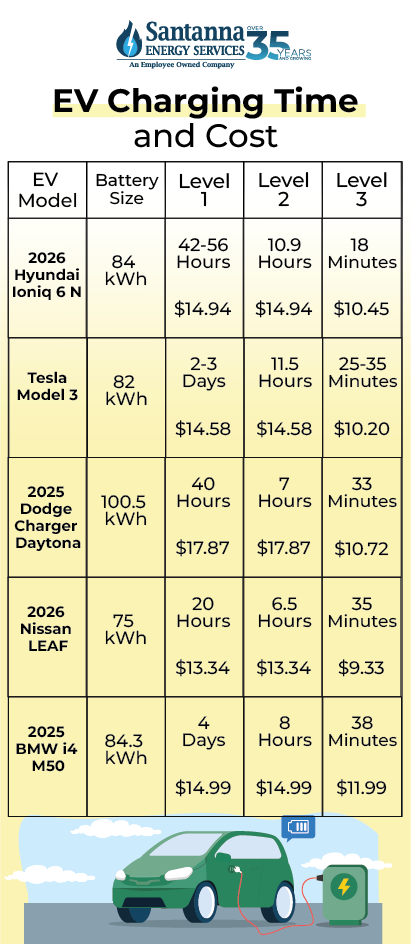
We’ve pulled some of the most popular and common EV models and crunched the numbers for you. Here’s what you can expect:
How Long Does It Take an Electric Vehicle to Charge by Model?
| EV Model | Battery Size | Level 1 (Wall Outlet) | Level 2 (Home Charger) | DC Fast Charging |
| 2026 Hyundai Ioniq 6 N | 84 kWh | 42–56 hours | About 10.9 hours | About 18 minutes (10%–80%) |
| Tesla Model 3 | 82 kWh | 2–3 days | About 11.5 hours | About 25–35 minutes (10%–80%) |
| 2025 Dodge Charger Daytona | 100.5 kWh | About 40 hours | About 7 hours | About 33 minutes (20% – 80%) |
| 2026 Nissan LEAF | 75 kWh | Over 20 hours to more than a day | About 6.5 hours | About 35 minutes (10%–80%) |
| 2025 BMW i4 M50 | 84.3 kWh | Up to 4 days | About 8 hours | About 38 minutes (10%–90%) |
Disclaimer: Charging times vary based on battery level, charger speed, vehicle limits, and temperature, so actual charging may be faster or slower than shown.
Taken together, these comparisons highlight why charging time can feel dramatically different depending on the vehicle.
For example, a Tesla Model 3 can reach 80% on a DC fast charger in as little as 25–35 minutes, while another EV with a similar battery size may need noticeably longer under the same conditions. Those differences add up over time, especially for drivers who rely on public fast charging or take frequent longer trips.
That's why it's important to look beyond just battery size and consider how a specific EV charges across different charger types. If charging speed is a priority for your lifestyle, doing a bit of model‑specific research can make a meaningful difference in day‑to‑day convenience.
Key Factors That Affect How Long It Takes to Charge an Electric Vehicle
EV charging time isn't random, and it isn't the same for every car. How long charging takes depends on how much energy the battery needs, how quickly energy can be delivered, and how the vehicle manages charging. The main factors include:
Battery Size (How Much Energy the Battery Holds)
Battery size determines how much electricity the vehicle needs to refill. Larger batteries store more energy, so they take longer to charge than smaller ones. This is similar to filling a larger fuel tank. The benefit of a larger battery comes down to a longer driving range, but the tradeoff is a longer charging time when the battery is low.
Battery State (How Full the Battery Is)
EVs do not charge at the same speed from empty to full, according to EVBox.
Charging is fastest when the battery is partially depleted and slows down as it fills up. That's why adding charge from around 20% to 80% happens relatively quickly, while the final portion takes longer to improve battery life.
As the battery gets closer to full, the vehicle automatically slows charging to protect battery health, which is why the final portion often takes longer.
Charger Output (How Fast Energy Can Be Delivered)
Different chargers supply electricity at different speeds, measured in kilowatts (kW).
Chargers with higher output can deliver energy faster, which shortens charging time. Slower chargers supply energy more gradually, which increases total charging time. The charger's power level sets the pace for how quickly the battery can be refilled, and this of course, can vary based on the charging levels for different electric vehicles.
Vehicle Charging Limits (What the EV Is Designed to Handle)
Every electric vehicle has built-in limits that control how much power it can safely accept. Even if a charger can deliver high power, the vehicle itself may restrict the charging speed. This is why two different EVs can charge at different rates on the same charger. Charging speed is partly determined by vehicle design.
Temperature and Weather Impacts (Especially Cold Conditions)
Cold temperatures can slow EV charging.
For example, in Michigan, where long winters and lake-effect snow are common, EV batteries often need extra time to warm up before charging efficiently.
No matter where you live, if cold climates are common, when electric vehicle batteries are cold, energy moves more slowly inside them, which can reduce driving range and slow down charging, according to PBS News.
Charging still works in winter, but it usually takes longer until the battery reaches a suitable temperature.
Why EV Charging Feels Different Than Filling a Gas Tank
By this point, one thing becomes clear: EV charging works differently than gas in more ways than just speed. So, what's the biggest difference between the two fueling options?
Gas cars fill up fast because all the fuel goes in at once, but electric cars work differently. They take in energy little by little, not all at the same speed, so they simply don't overload their battery.
When the battery starts getting full, the car slows down charging to keep the battery safe and healthy.
This gradual charging style is one reason EV charging feels different from fueling a gas car. They charge just enough to drive where they need to go and then unplug. This makes charging feel easier and fits better into everyday driving, even though it works differently than gas.
Does Cold Weather REALLY Affect How Long It Takes to Charge an Electric Vehicle?
The short answer is, absolutely! Cold weather can make EV charging take longer; take it from an energy supplier who's seen their fair share or Midwest winters and what it can do to electric vehicles.
In cold weather, drivers often notice charging takes longer, especially overnight. Charging still works, but it does not move as fast as it does in warmer weather.
In Midwest states like Illinois, Ohio, Pennsylvania, and Michigan, this is more noticeable during long winter months. Cold air, wind, and snow can all contribute to slower charging and slightly shorter driving range because EV batteries rely on chemical reactions that work best at warmer temperatures.
When it's cold, the battery has to use some of its energy to warm itself before it can charge efficiently, which naturally slows the process. This is normal and does not mean something is wrong with the car.
Where the car is parked also matters. A garage usually stays warmer than the outdoors, which can help the battery charge more smoothly. Cars parked outside are exposed to colder air, so charging may take a bit longer, especially on very cold nights.
Home Electric Vehicle Charging Implications (What EV Charging Changes for Your Home and Energy Use)
EV charging is not just a vehicle decision, but a home energy decision as well. Charging at home changes how, when, and where energy is used, which is why it's important to understand the practical implications before or shortly after making the switch. These are the main implications EV owners and future buyers should understand:
Everyday Convenience
Home charging means the vehicle refuels while it's parked, often overnight. Instead of making special trips to fuel up, charging becomes part of the car's downtime, similar to charging a phone while you sleep.
This can be extremely convenient if you work from home or have a short commute to the office each day.
You Can Make the Shift From Gas to Electricity
Fuel costs don't disappear when you switch to an electric vehicle, they simply move from the gas pump to your electric bill. Instead of paying for fuel all at once during fill‑ups, energy costs are spread out over time as the vehicle charges.
The amount of electricity used for charging closely follows how much the vehicle is driven. More miles driven require more electricity to recharge the battery, while fewer miles result in lower overall charging needs.
On a more positive note, switching from a gas-powered vehicle to an electric one, moves you and your family closer to energy independence. Not to mention it's better for the environment too!
There Will Be an Increase in Total Electricity Use
There's no secret that charging an EV increases your overall electricity use based on how much the vehicle is driven and how efficient it is. So, if you're thinking about purchasing an electric vehicle, it's important to know that a hike in your electric bill, especially if you're charging from home, will be coming.
But there is a way you can make your electric bill more predictable, even with the added cost of an electric vehicle.
When your electric vehicle charging is paired with a predictable energy plan, such as an Unlimited Energy plan that makes your supply charges more predictable,** many homeowners find it easier to budget because charging costs tend to follow a steady, repeatable pattern in supply charges rather than changing with fuel prices.
Timing Matters for Energy Demand
Many EVs are plugged in during the evening, when electricity demand is already higher. When charging happens at the same time across many vehicles, demand increases more sharply. Spreading charging over longer periods helps keep energy use steadier.
Electrical System Readiness
Some homes may need upgrades, such as a higher-capacity electrical panel, to support safe EV charging. These updates often require permits and inspections to meet electrical codes and ensure reliable operation. This is an added cost homeowners might not be ready for.
Environmental Impact
Home EV charging supports lower tailpipe emissions compared to gasoline vehicles. The overall environmental benefit depends on how electricity is generated, but EVs generally reduce direct emissions from driving.
What Is Top-Up Charging?
Top-up charging is the idea of adding small amounts of charge more often, instead of waiting until the battery is very low and charging it all the way to full. Many EV drivers plug in to add just enough energy for the next day or the next few trips.
Because EV batteries charge faster when they are not near empty or completely full, top-up charging often takes less time and fits more easily into everyday routines.
Top-up charging usually happens while the car is already parked, such as overnight at home or during short stops, which is why EV charging often feels flexible rather than something you have to wait around for.
In many cases, top-up charging is more energy efficient because batteries charge fastest when they are partially empty, it supports better battery longevity, allows more flexibility in daily driving, and helps reduce range anxiety by keeping the battery consistently topped up.
How EV Charging Affects Your Electric Bill
Charging an electric vehicle shows up on your electric bill as additional electricity use, not a separate charge. For most drivers, this increase follows a clear and predictable pattern tied directly to how often the vehicle is charged and how large the battery is.
On average, a full battery recharge costs about $13–$18 depending on the vehicle. Cars with larger batteries use more electricity per charge, while smaller batteries use less. Just like fuel, charging costs rise with more driving and stay lower when the vehicle is driven less.
The estimates below use the U.S. average electricity rate from the U.S. Energy Information Administration of $0.1798 per kilowatt-hour (kWh) as of October 2025. They show how battery size translates into real electric bill impact over time.
Estimated EV Charging Costs Based on One Full Charge
| EV Model | Battery Size | Estimated Cost per Full Charge |
| 2026 Hyundai Ioniq 6 N | 84 kWh | $15.10 |
| Tesla Model 3 | 82 kWh | $14.74 |
| 2025 Dodge Charger Daytona | 100.5 kWh | $18.07 |
| 2026 Nissan LEAF | 75 kWh | $13.49 |
| 2025 BMW i4 M50 | 84.3 kWh | $15.16 |
How EV Charging Habits Affect Time and Energy Use
Efficient EV charging is about creating simple, repeatable habits that fit into daily life. Small choices around when and how you charge can help charging feel smoother, more predictable, and easier to manage over time.
- Charge When the Car Is Already Parked: Charging works best when it happens during natural downtime, such as overnight. This allows the car to charge steadily without rushing or interrupting daily routines.
- Avoid Charging to 100% Every Time: Many EVs charge more smoothly when staying in the middle range of the battery. Charging to 100% every time can degrade the battery faster and reduce its lifespan. Charging only what you need helps keep charging times shorter and more consistent.
- Use Steady, Consistent Charging Habits: Charging a little more often instead of waiting until the battery is very low helps keep charging sessions predictable and easier to plan around.
- Be Mindful of Cold Weather: Cold temperatures can slow charging because batteries need time to warm up. This is normal and more noticeable during winter months.
- Spread Charging Over Longer Periods: Longer, slower charging sessions tend to align better with daily driving needs and help energy use feel more even over time.
- Pay Attention to How Driving Affects Charging: Driving more miles means the battery needs more energy. Over time, most EV owners notice a clear pattern between driving habits and charging needs.
How to Keep Your Electric Bill Predictable When Charging an EV
It's realistic to expect that your electric bill will increase when you start charging an EV at home. That added electricity use can catch people off guard if they are not expecting it, especially in the first few months of ownership.
One way drivers can manage that change is by pairing home charging with a predictable energy plan, such as Santanna's Unlimited Energy plan. Instead of electricity supply charges fluctuating from month to month, this type of plan can help create predictability by stabilizing your supply charges.** For many EV owners, that predictability makes it easier to budget and adjust to charging becoming part of everyday life.
EV charging doesn't have to feel like a surprise expense. With the right expectations and a plan designed for stability, it can become just another routine part of how energy is used at home.
FAQs
Can you overcharge an electric car?
No. Electric vehicles are designed to stop charging once the battery reaches its set limit to protect battery health.
Why does my EV charge faster at some public stations than others?
Charging speed depends on the station's power level and how much power the vehicle can accept. Even two fast chargers can deliver different speeds based on location and demand.
Do all electric cars use the same type of charger?
Not always. While many EVs use common charging standards, some vehicles are compatible with different plugs or charging networks. Adapters are often used to improve compatibility.
Is charging an EV similar to charging a phone?
In a simple way, yes. Charging an EV is similar to charging a phone, but it uses different chargers. Like a phone, an EV doesn't need to be charged to 100% every time to work well for daily use.
Charging an electric vehicle doesn't have to feel complicated. Once you understand how charging time, battery size, and electricity use work together, EV charging becomes predictable and easy to plan around. Most drivers charge during normal downtime, costs follow clear patterns tied to driving habits, and even seasonal changes start to make sense.
At Santanna, our role is to help you see the full energy picture with clarity, not confusion. Whether you're new to EVs or refining your charging routine, informed choices lead to fewer surprises and more confidence over time.
If making your electric bills more predictable matters to you, our Unlimited Energy plan is one option that can help create steadier monthly supply charges as EV charging becomes part of everyday life. Ready to explore what fits your needs? Check it out now.
** Restrictions apply. Enrollment based upon program eligibility. Customers using more than 125% of normal monthly usage as determined by Santanna may be required to switch plans.
Chris Tessler is a seasoned professional in the deregulated energy industry with over 15 years of experience. Throughout his career, he has honed his skills in commodity trading, risk management, and retail energy supplier operations. Chris has a passion for leveraging new technologies to address challenges at the intersection of the energy industry, carbon economy, and climate change, as well as finding innovative ways to promote healthy living and building strong communities in our modern urban environments.