

How Does Thermal Envelope Affect Heating and Cooling Efficiency?

by Tyler Castle
Updated: August 11, 2026
14.9 min read
Key Points of This Article:
- A strong thermal envelope improves heating and cooling efficiency by reducing heat loss and unwanted air exchange, which means your HVAC system doesn’t need to run as long or as often to maintain comfort.
- When the thermal envelope is weak, homeowners experience drafts, uneven temperatures, higher humidity, and increased energy bills due to constant heating or cooling cycles.
- Improving the thermal envelope through sealing air leaks, enhancing insulation, and addressing problem areas like basements, attics, windows, and doors can significantly lower energy use and create more consistent indoor comfort.
A home can have a perfectly good heating and cooling system and still feel uncomfortable.
Maybe one room is always colder in winter, your system runs constantly during heat waves, or your energy bills rise even though nothing about your habits has changed. When this issue happens, it comes down to how well your home can hold warm or cool air.
That's where the thermal envelope comes in. It's a part of your home that most people never think about, but it quietly decides whether your heating and cooling system gets a fair chance to do its job.
At Santanna Energy Services, we see this pattern every day across Midwest homes. When customers ask why their system runs constantly or why one room never feels right, the answer is often not the equipment itself, but how well the home can hold the air that system produces.
After years of helping homeowners understand their energy use, one thing is clear: efficiency starts with the home.
In this blog, we'll unpack how the thermal envelope works, where it breaks down, and why it matters so much for comfort and energy use.
What Is a Thermal Envelope?
A thermal envelope is what separates the inside of your home from the outside, and its quality can determine how well your house maintains heat and air conditioning.
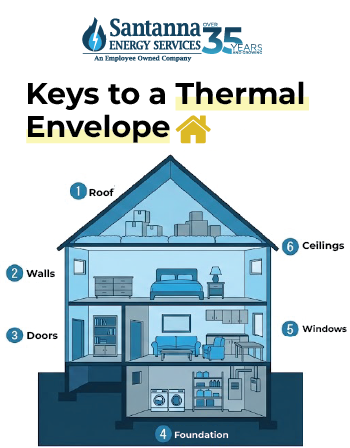
It is not one single part of the house. The thermal envelope is actually made up of your walls, attic, floors, windows, doors, and foundation. All of these parts work together like a shell around your home to keep heat and cool air inside.
When this shell is strong and connected, your home holds comfortable air better. When it has gaps or weak spots, heat and air move in and out more easily, making your home harder to keep comfortable, and can even lead to higher-than-expected electricity or gas bills.
You can think of a thermal envelope like closing all the windows and doors before turning on the heat or AC.
When everything is shut and sealed, the air stays where it belongs, and the room stays comfortable longer. Your home’s thermal envelope works the same way, helping control how much heat moves in or out throughout the house.
How Does Your Thermal Envelope Affect Heating and Cooling Efficiency?
The thermal envelope affects heating and cooling efficiency by controlling how well your home holds conditioned air. When the envelope works as a connected system, your heating and cooling equipment can maintain comfort with shorter, steadier run times.
When the envelope is weak or broken, the system has to run longer and more often just to keep up, often leading to your heating systems being less efficient and can rise your energy bills.
In every home, the thermal envelop come down to a few key layers working together. Here’s the specific layers of a home’s thermal envelope and how it can affect your home’s heating and cooling efficiency:
Insulation: One Layer of the Thermal Envelope
Insulation is one part of the thermal envelope. Its role is to slow how quickly temperatures inside the home change when outdoor conditions shift.
When insulation is even and continuous, the thermal envelope helps the home stay closer to the set temperature between heating or cooling cycles.
If insulation is missing, thin, or uneven, your thermal envelope becomes weaker in those areas and spaces like basements, attics, and walls could feel noticeably colder or hotter depending on the season.
Even if one section of your home has an inconsistent temperature, it’s hard for your HVAC system to maintain steady comfort throughout the rest of the house, because the system has to constantly compensate for that weak spot.
Air Sealing: This Keeps the Thermal Envelope Intact
Air sealing helps the thermal envelope stay connected. It limits how much indoor air escapes and how much outdoor air enters through gaps, cracks, and openings.
When air sealing is effective, or weatherstripping is applied to areas that are cracked, the thermal envelope holds conditioned air longer, allowing heating and cooling systems to maintain temperature instead of constantly replacing lost air.
When air leaks are present, the envelope breaks down and system run times increase because comfort cannot be maintained.
Windows and Doors: Openings Within the Thermal Envelope
Windows and doors are natural openings in the thermal envelope. Their condition affects how quickly indoor temperatures change near those areas.
When windows and doors perform well, they help the envelope stay continuous and reduce rapid temperature swings. When they perform poorly (like they window and doors consistently stay open, they aren’t closed all the way, or have worn-out seals), the envelope weakens around them, leading to more frequent heating and cooling cycles as the system reacts to those changes.
This makes for increasing energy bills as well.
Foundation: The Base of the Thermal Envelope
The foundation forms the lower boundary of the thermal envelope. In colder months, heat can move from your home into the ground if the foundation of the envelope is weak.
When the foundation is well protected, the thermal envelope helps lower levels like basements or crawl spaces stay closer to the desired temperature. When it is not, heating systems must run longer to replace lost warmth, leading to wear and tear.
What Happens to Your Home When Your Thermal Envelope Is Weak?
When the thermal envelope is weak, your home cannot hold heated or cooled air for very long. Warm air escapes during winter, and cooled air escapes during summer making your home uncomfortable.
Because of this, your heating and cooling system has to work harder just to keep temperatures steady, which reduces their efficiency. Your HVAC systems run longer and turn on more often, not because they are broken, but because the home keeps losing energy faster than the system can replace it.
Even high-efficiency equipment struggles when the home itself cannot support it.
In the same way, your home might feel stickier than usual in the summer, or even super humid. In the winter, your home will feel colder and draftier, leading to higher temperatures being set to maintain home comfort.
How a Thermal Envelope Affects Energy Bills
Most energy bill increases happen because heating and cooling systems run longer. Since heating and cooling make up the largest share of a home’s utility costs at 43%, longer run times due to a weak building thermal envelope have a big impact on monthly bills.
When a home cannot hold warm or cool air, naturally, you’ll want to adjust your thermostat to get to your desired comfort level. When you make these adjustments consistently over time, your electricity and heating bill is bound to increase. In the end, a weak thermal envelope can increase your energy bills.
A strong thermal envelope helps slow heat loss and heat gain, so indoor temperatures stay steadier. When temperatures change less, heating and cooling systems run less often, helping reduce extreme swings in energy use, which helps maintain the quality of your HVAC system too.
So, improving how well your home holds air is one of the most efficient ways to stabilize energy costs over time.
The Benefits of Having a Strong Building Thermal Envelope in Your Home
A strong building thermal envelope helps your home work smarter, not harder. By controlling how heat, air, and moisture move in and out, it supports comfort and efficiency without relying on your heating and cooling system to constantly fix problems.
Here are the benefits you’ll typically notice:
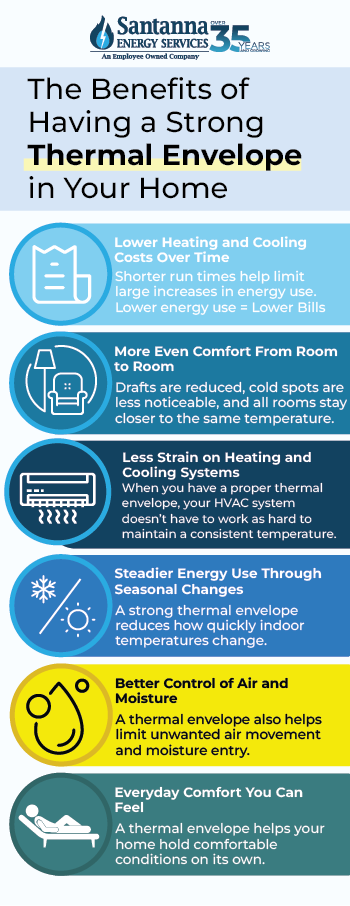
Lower Heating and Cooling Costs Over Time
Heating and cooling make up the largest share of energy use in most homes. When your home holds warm air in winter and resists outside heat in summer, those systems do not need to run as long or as often to stay comfortable.
Shorter run times help limit large increases in energy use during extreme weather. According to the U.S. Department of Energy, reducing heat loss and air leakage is one of the most effective ways to lower heating and cooling costs over time.
Improving your thermal envelope can lower your utility bills over time and with proper insulation.
More Even Comfort From Room to Room
Homes with strong thermal envelopes tend to feel more balanced. Drafts are reduced, cold spots are less noticeable, and all rooms stay closer to the same temperature. This makes your home more comfortable without constant thermostat adjustments or the need for extra energy-wasting equipment like space heaters or fans.
Less Strain on Heating and Cooling Systems
When the home does a better job holding conditioned air, heating and cooling systems do not have to run as often just to maintain temperature. This leads to steadier operation and fewer long run times, helping systems perform more efficiently day to day.
This reduces the need for frequent repairs caused by overworked systems and can help extend the lifespan of your heating and cooling equipment.
Steadier Energy Use Through Seasonal Changes
Because a strong thermal envelope reduces how quickly indoor temperatures change in your home, energy use tends to be less reactive to outdoor weather swings.
Instead of sharp increases during very hot or very cold periods, your energy usage stays more controlled, making household energy patterns easier to manage and even predict.
Better Control of Air and Moisture
A well-connected thermal envelope also helps limit unwanted air movement and moisture entry. This supports cleaner indoor air, reduces condensation and indoor humidity, and helps protect walls, floors, and other parts of the home over time, especially in climates with cold winters or humid summers.
Everyday Comfort You Can Feel
At its core, the thermal envelope helps your home hold comfortable conditions on its own. When heat stays where it belongs, rooms feel more stable, systems work more smoothly, and the home feels easier to live in year-round.
Simply put, a strong thermal envelope allows your home to share the workload with your heating and cooling system, instead of working against it.
What Parts of a House Make Up the Thermal Envelope
Now that you know how the thermal envelope works as a system, it helps to look at where it most often breaks down. These are the main places energy escapes in most homes, and each one plays a role in how well your home holds warm or cool air:
Your Attic and Roof
Heat rises, which makes the attic and roof in your home the most common place for heat loss. In many Midwest homes, this is also the largest surface area separating indoor air from extreme outdoor temperatures, so even small gaps in your thermal envelope can impact comfort and energy use.
Exterior Walls
Walls separate indoor air from outdoor temperatures, making them a major part of your home’s thermal envelope. Because they span every level of the house, even small insulation gaps can affect multiple rooms at once.
When insulation is missing, compressed, or uneven, heat moves through the walls more easily, causing rooms along exterior walls to feel colder in winter and warmer in summer. This often leads to thermostats being adjusted higher or lower than necessary.
Windows and Doors
Windows and doors are natural openings in the thermal envelope. Older or poorly sealed windows and doors allow heat to escape in winter and enter in summer. They are noticeable comfort-wise, but not always the largest source of energy loss.
Floors Over Unconditioned Spaces
Floors above garages, crawlspaces, or unfinished basements can lose heat to the space below because these areas are typically unheated and poorly insulated.
This creates a temperature gap between living spaces and the area underneath, which pulls warmth out of the floor during winter and allows heat to creep in during summer.
As a result, rooms above these spaces often feel colder, require more heating to stay comfortable, and can make your entire system work harder to maintain balance.
Basements, Crawlspaces, and Foundations
These areas connect the home to the ground, which stays cooler for much of the year. In Midwest homes, this can significantly increase heating demand if not well protected.
Common Signs Your Home’s Thermal Envelope Is Failing
When the thermal envelope is not doing its job, the signs of a weak envelope tend to show up in everyday living long before most homeowners realize there is an underlying efficiency issue.
If their not apparent to you, no worries! Here are some of the most common signs of a failing thermal envelope:
- Drafty Rooms: You may feel cold air near windows or doors in winter, or warm, sticky air entering in summer.
- Uneven Indoor Temperatures: Some rooms feel too warm while others feel too cool, even when the thermostat is set correctly.
- High Heating or Cooling Bills: Energy costs increase during very hot or very cold months, even if your usage habits have not changed.
- Heating or Cooling Systems Running Constantly: Your system seems to be on most of the time and rarely gets a break.
- Cold Floors or Hot Upper Levels: Floors feel cold underfoot, or upper floors are much warmer than lower levels.
Because thermal envelope issues involve insulation, air movement, and moisture control, it’s best to have a qualified professional evaluate your home rather than trying to diagnose or fix these issues on your own.
How To Improve Your Home’s Thermal Envelope
Improving your thermal envelope does not mean replacing everything at once. Small, targeted changes can make a noticeable difference in comfort and how hard your heating and cooling system has to work.
Here are some ways to improve your home’s thermal envelope:
Start With Air Leaks
Air leaks are often the easiest place to begin. Sealing gaps around doors, windows, attic openings, and basement penetrations helps keep conditioned air inside where it belongs. Many homeowners notice fewer drafts and steadier temperatures soon after air sealing is done.
Strengthen Insulation Where It Matters Most
Adding or improving insulation in the attic, walls, floors, or basement helps slow heat loss in winter and heat gain in summer. Attics are often a high-impact area because warm air naturally rises. Better insulation helps your home hold temperature longer between heating or cooling cycles.
Check Windows and Doors for Gaps
Windows and doors do not always need to be replaced to improve performance. Weatherstripping, caulking, and proper sealing can reduce air leaks and temperature swings near these openings.
Don’t Overlook Basements and Crawlspaces
In Midwest homes, cold ground temperatures can pull heat out of the house through the foundation. Sealing and insulating these areas can improve comfort on lower levels and reduce heating demand.
Consider a Professional Home Energy Audit
A home energy audit can help identify where your thermal envelope is weakest. Audits often use tools like blower doors or thermal imaging to show air leaks and insulation gaps that are hard to spot on your own. This helps homeowners focus on the improvements that matter most instead of guessing.
FAQs
Is the thermal envelope the same as insulation?
No, the thermal envelope and insulation are not the same. Insulation is a key component within the broader thermal envelope, which is the entire barrier (walls, roof, windows, foundation, air seals) separating your home’s conditioned indoor air from the outside environment, working together to control heat flow and energy efficiency.
Does an older home always have a weaker thermal envelope?
Older homes often have weaker thermal envelopes because building standards were lower and insulation or air sealing may be missing or deteriorated over time. Older walls, floors, and roofs may lack modern insulation or tight sealing, which leads to more heat loss and drafts compared to newer construction.
Can I improve my thermal envelope without replacing windows?
Yes. You can improve your thermal envelope without replacing windows by adding insulation in key areas and sealing air leaks around windows, doors, attics, and basements. Air sealing and adding insulation are among the most cost-effective ways to reduce heat loss and improve comfort, even if you keep your existing windows.
Is a home energy audit necessary before making changes?
A home energy audit is not required, but it is very helpful in identifying where your home is losing the most heat and where improvements will be most effective. An audit can pinpoint air leaks, insulation gaps, and other weaknesses in your home’s thermal envelope, so you can prioritize upgrades that provide the best comfort and energy savings.
Your heating and cooling system can only work as well as your home allows. When the thermal envelope holds heated and cooled air properly, comfort improves, systems run less, and energy use becomes steadier instead of reactive.
That steady energy use is what helps reduce surprises on your bill. A well-performing home creates more predictable demand, especially during extreme Midwest weather.
Santanna’s Unlimited Energy plan can also help keep things more predictable, with a steady supply charge on your bill, no matter the season.*
If stability and clarity matter to you, explore how this plan can fit your home.
* Restrictions apply. Enrollment based upon program eligibility. Customers using more than 125% of normal monthly usage as determined by Santanna may be required to switch plans.
Tyler is an experienced energy professional, having worked for Santanna Energy Services, for the past four years. He is passionate about renewable energy and believes that diversifying the energy grid is the key to a sustainable future. Tyler is dedicated to supplying consumers with the best possible energy solutions and works diligently to make sure that Santanna can deliver the highest quality service.