
Energy Efficient Home Designs: The Structural Choices That Lower Your Energy Bill

by Jenna Mendez
Updated: October 8, 2026
17.8 min read
Key Points of This Article:
- Energy-efficient home designs may reduce heating and cooling energy use by roughly 25% to 35%, which could translate to about $475–$670 in annual electricity savings in some homes.
- The most energy-efficient home designs often combine multiple strategies, including efficient building materials, thoughtful layouts, renewable energy systems, and high-performance home technologies.
- Features like better insulation, efficient windows, reflective roofing, and proper ventilation can help create a more comfortable home while reducing unnecessary energy use.
Many homeowners assume high energy bills are mostly caused by appliances, thermostats, or leaving too many lights on. While those things can affect energy use, the structure of your home often plays a much bigger role than people realize.
The way you design your home and add features like insulation, air sealing, window placement, roofing, and ventilation all affect how quickly heat enters or escapes your home. The more heat your home gains in summer or loses in winter, the more energy loss you risk.
Even homes that were not originally built for energy efficiency can still become more efficient over time. In fact, in a recent Santanna Energy Services survey, we found that 38% of employee-owners surveyed have made structural upgrades to improve the efficiency of their homes, showing that many homeowners are already taking steps to reduce energy waste through changes to the home itself.
As an energy supplier serving the Midwest for more than 35 years, we thrive when we can use our expertise in energy efficiency to help homeowners better understand how their homes work.
If you're looking for some ideas on energy-efficient home designs, keep reading. We'll take a closer look at the structural choices behind energy efficient home designs and how they can improve comfort, reduce energy waste, and help lower heating and cooling bills.
What Makes a Home Energy Efficient by Design?
An energy-efficient home is designed to help keep your home comfortable by minimizing heat gain and heat loss, reducing overall energy demand, and maintaining stable indoor temperatures with less reliance on heating and cooling systems.
When these features work together, a home can often maintain a consistent indoor environment while using less energy throughout the year. Let’s take a closer look at the design features that can contribute to a more energy-efficient home:
- Home Layout and Design: The layout of a home can affect airflow, temperature balance, and how heat moves between different rooms throughout the day.
- Home Orientation and Sunlight Exposure: The direction a home faces and how much sunlight it receives can affect indoor temperatures and overall heating and cooling demand.
- Insulation: Insulation helps slow down heat transfer and supports more stable indoor temperatures throughout the year.
- Air Sealing: Air sealing helps reduce conditioned air loss through hidden gaps, cracks, and leaks around the home.
- Moisture Control: Managing indoor moisture and humidity can help improve comfort while reducing unnecessary strain on cooling systems.
- Windows, Doors, and Skylights: These features can affect how much heat enters or escapes the home and how efficiently indoor temperatures are maintained.
- Roofing and Reflective Materials: Roofing materials can influence how much heat is absorbed into the home, especially during warmer months.
- Attic Ventilation and Airflow: Proper ventilation can help reduce trapped heat and moisture buildup inside attics and other parts of the home.
- Building Materials and Construction Methods: Some materials and construction techniques can help homes maintain more stable indoor temperatures while reducing energy waste.
- Efficient Heating and Cooling Systems: Heating and cooling systems play a major role in maintaining comfort while managing overall energy use.
- Lighting and Appliance Choices: Energy-efficient lighting and appliances can help reduce electricity usage throughout the home.
- Landscaping and Outdoor Shading Features: Trees, shading, and outdoor landscaping can help reduce direct heat exposure around the home.
Together, these smart design choices help homes better control heat, airflow, moisture, and indoor comfort while reducing unnecessary energy waste throughout the year.
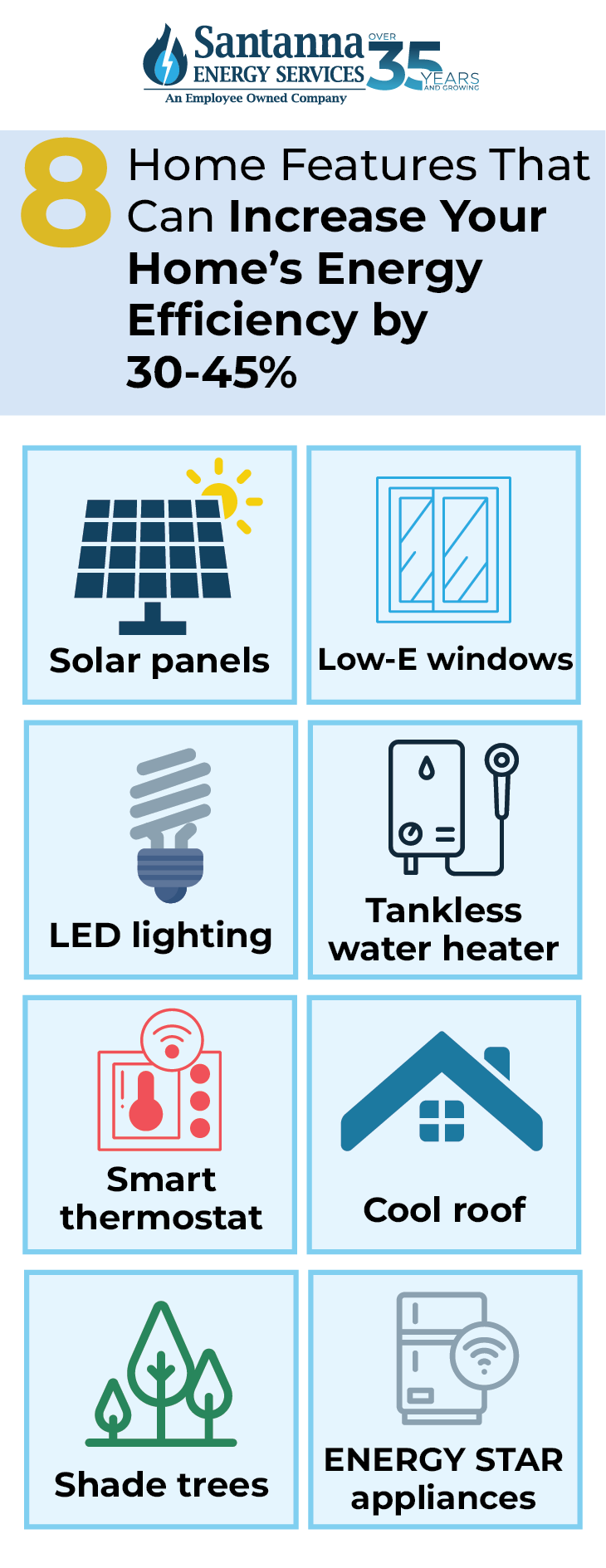
What Features Can Improve an Energy-Efficient Home?
Even homes that were not originally built for energy efficiency can still become more efficient over time. While energy efficient home designs typically begin with structural features like insulation, air sealing, and home orientation, there are also upgrades and technologies that can help reduce energy waste, improve comfort, and lower heating and cooling demand.
Here are some common features you may add to support a more energy-efficient home:
Solar Panels and Renewable Energy Systems
Solar panels can help improve home energy efficiency by generating electricity from sunlight and reducing how much power a home needs from the grid.
Many homeowners pair solar panels with improvements like insulation, air sealing, and efficient HVAC systems. In simple terms, the less energy a home wastes, the more value homeowners may get from the electricity their solar system produces.
Energy-Efficient Windows and Low-E Glass
Energy-efficient windows help reduce unwanted heat transfer between your home and the outdoors. This can help keep homes cooler during summer and warmer during winter.
Some windows include special low-emissivity (Low-E) coatings that help reduce heat transfer while still allowing natural light indoors. Over time, improved window performance may help reduce drafts, support more consistent indoor temperatures, and lower heating and cooling demand.
LED Lighting and Smart Lighting Controls
LED lighting uses less electricity and typically lasts much longer than traditional incandescent bulbs. Switching to LED lighting throughout the home may help reduce overall electricity use, especially in rooms where lights are used frequently.
Smart lighting controls, such as timers, dimmers, and motion sensors, can help reduce unnecessary energy use by automatically adjusting lighting when it is not needed.
Tankless and Energy-Efficient Water Heaters
Water heating is one of the larger energy expenses in many homes. Choosing a more efficient water heater may help reduce energy use while still providing reliable hot water.
Tankless water heaters heat water only when it is needed instead of continuously storing hot water throughout the day. This can help reduce unnecessary energy waste while maintaining household comfort.
Smart Thermostats and Home Energy Controls
Smart thermostats help improve efficiency by automatically adjusting heating and cooling settings based on your schedule and household routines. These systems can help reduce unnecessary HVAC runtime when you are asleep, away from home, or during less active hours.
Some smart thermostats also allow you to monitor temperature settings and energy usage more closely, which may help improve comfort while reducing unnecessary heating and cooling demand.
Cool Roofs and Reflective Roofing Materials
Cool roofs and reflective roofing materials are designed to reflect more sunlight and absorb less heat than traditional roofing materials.
This can help reduce heat buildup inside the home during warmer months, especially in attics and upstairs living spaces. In some homes, reducing roof heat gain may help lower cooling demand and improve indoor comfort.
Shade Trees and Outdoor Shading Features
Shade trees, awnings, covered patios, and other outdoor shading features can help reduce direct sunlight around the home.
By limiting heat exposure on windows, walls, and roofing surfaces, these features may help homes stay cooler naturally and reduce how often air conditioning systems need to run.
ENERGY STAR® Appliances and Efficient Electronics
ENERGY STAR® appliances and efficient electronics are designed to use less electricity compared to standard models. Appliances like refrigerators, dishwashers, washing machines, and electronics that run regularly throughout the day can all affect overall home energy usage.
While efficient appliances alone may not solve larger heating and cooling issues, they can still help support overall home efficiency when combined with strong insulation, air sealing, ventilation, and heat control throughout the home.
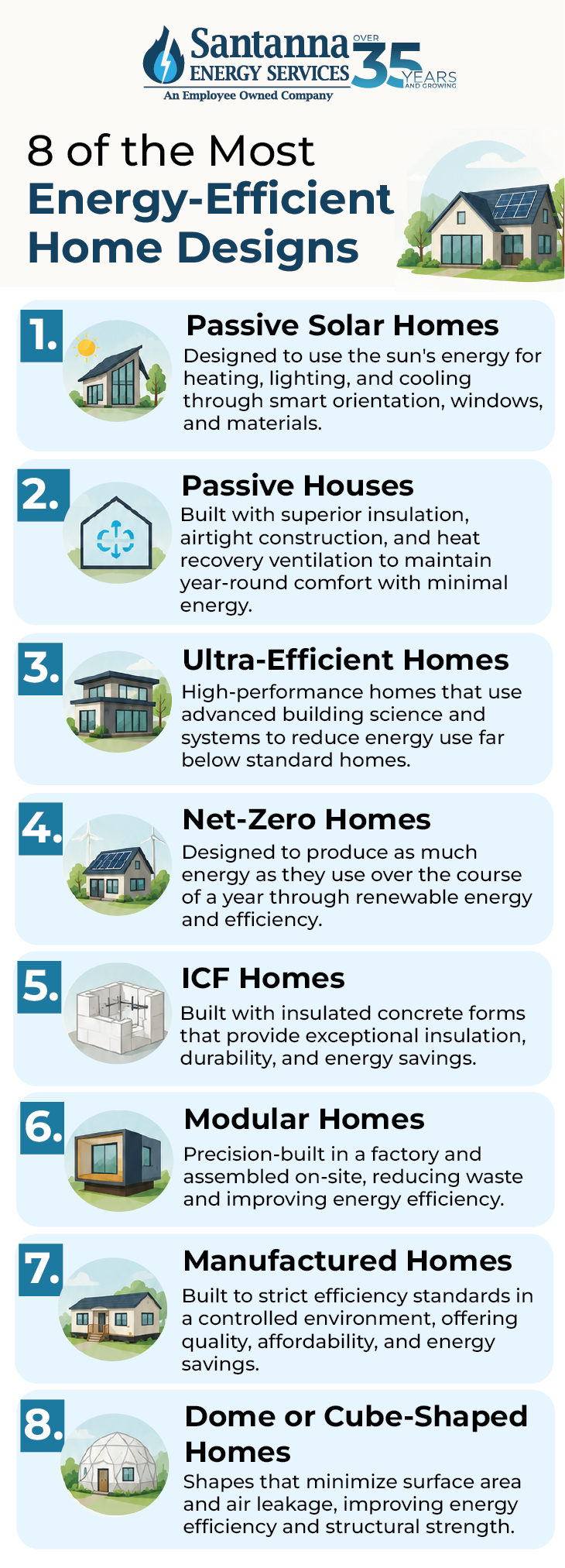
What Are the Most Energy-Efficient Home Designs?
The most energy-efficient home designs are built to reduce heat gain, heat loss, and unnecessary energy use while maintaining comfortable indoor temperatures throughout the year.
Many homeowners assume there is one “best” energy-efficient home design. In reality, the right design often depends on factors such as climate, budget, building materials, and long-term comfort goals.
Here are some of the most common energy-efficient home designs that are built to better control heat, reduce energy waste, improve indoor comfort, and lower heating and cooling demand throughout the year:
Passive Solar Homes
Passive solar homes are designed to use natural sunlight to help heat and cool the home more efficiently.
These homes often use strategic window placement, south-facing windows, roof overhangs, and shading techniques to capture warmth during winter while reducing excessive heat gain during summer. When designed properly, passive solar features can help reduce heating and cooling demand while improving natural indoor lighting throughout the home.
This type of design may work best for homeowners in climates with colder winters and consistent sunlight who want to reduce heating demand naturally.
Best For: Homeowners in sunny climates who want to use natural sunlight to help reduce heating and cooling demand while improving natural indoor lighting.
Passive Houses (Passivhaus)
Passive Houses, also known as Passivhaus homes, are designed to use very little energy for heating and cooling.
These homes are typically built with high levels of insulation, airtight construction, efficient windows, and controlled ventilation systems that help maintain stable indoor temperatures with minimal energy loss. Because these homes are designed to control heat very effectively, heating and cooling systems often do not need to work as hard to maintain comfort.
Passive House designs may work best for homeowners focused on long-term energy efficiency, stable indoor comfort, and lower heating and cooling demand throughout the year.
Best For: Homeowners focused on maximizing energy efficiency, maintaining stable indoor temperatures, and minimizing long-term heating and cooling costs.
Ultra-Efficient Homes
Ultra-efficient homes are designed to reduce overall energy consumption as much as possible through a combination of efficient construction features and modern home systems.
These homes may include advanced insulation, efficient HVAC systems, energy-efficient windows, smart home technology, and efficient lighting and appliances. The goal is to lower energy waste while improving comfort and reducing utility costs over time.
Ultra-efficient homes may work best for homeowners who want to combine multiple energy-saving features into one high-performance home design.
Best For: Homeowners who want to combine multiple energy-saving technologies and construction features into a single high-performance home.
Net-Zero Homes
Net-zero homes are designed to combine strong energy-efficient construction with renewable energy systems like solar panels to produce as much energy as they use over the course of a year.
The goal is to lower overall energy use first and then offset remaining energy usage through renewable energy production.
Net-zero homes may work best for homeowners interested in long-term energy savings and reducing dependence on outside energy sources.
Best For: Homeowners looking to generate as much energy as they use each year through a combination of efficient construction and renewable energy systems.
Insulated Concrete Form (ICF) Homes
Insulated Concrete Form (ICF) homes use concrete walls with built-in insulation to improve energy efficiency and indoor temperature stability, and they may use 30% to 50% less energy for heating and cooling compared to some traditional homes.
Because these walls are highly insulated and airtight, ICF homes may help reduce heat transfer and improve indoor comfort throughout the year. Some homeowners also choose ICF construction because of its durability and noise reduction benefits.
ICF homes may work best for homeowners living in areas with very hot summers, cold winters, or large seasonal temperature swings.
Best For: Homeowners in regions with hot summers, cold winters, or extreme temperature swings who want superior insulation and long-term durability.
Modular and Prefabricated Homes
Modular and prefabricated homes are built in sections within controlled factory environments before being assembled on-site.
Because these homes are often built with tighter construction methods and more consistent building practices, some may experience fewer air leaks and better insulation performance compared to older homes. Energy efficiency can vary depending on the builder and design, but many modern modular homes are designed with efficiency in mind.
These homes may work best for homeowners looking for modern construction methods that can support energy efficiency and shorter construction timelines.
Best For: Homeowners seeking a modern, energy-efficient home that can often be built more quickly than traditional site-built homes.
Energy-Efficient Manufactured Homes
Energy-efficient manufactured homes, formerly known as mobile homes, are built using energy-efficient construction practices designed to reduce heating and cooling demand.
Features may include improved insulation, better windows, tighter air sealing, and ENERGY STAR® certified appliances. While older manufactured homes may struggle with insulation and airflow issues, newer models often include more modern efficiency standards.
These homes may work best for homeowners looking for a more affordable housing option that still includes energy-efficient features.
Best For: Homeowners looking for a more affordable housing option that still includes many modern energy-efficient features.
Dome and Cube-Shaped Homes
Dome-shaped and cube-shaped homes are sometimes considered energy efficient because of how they improve heat transfer and airflow.
Compact home shapes with less exterior surface area may reduce the amount of heat entering or escaping the home. Dome homes may also allow air to circulate differently compared to traditional layouts. While these designs are less common, some homeowners explore them for their potential efficiency and durability benefits.
These homes may work best for homeowners interested in alternative home designs focused on reducing heat loss and improving airflow efficiency.
Best For: Homeowners interested in alternative home designs that may reduce heat loss and improve airflow through compact construction.
Straw Bale Homes
Straw bale homes use tightly packed straw bales as part of the wall system to provide insulation.
Because straw bales create thick, well-insulated walls, these homes may help reduce heat transfer and improve indoor temperature stability throughout the year. This type of construction is less common but is sometimes used in homes focused on natural building materials and energy efficiency.
Straw bale homes may work best for homeowners interested in natural construction methods and strong insulation performance.
The best energy-efficient home design is not always about one specific style or construction method. In many cases, it is about choosing features that work together to improve comfort, support efficient heating and cooling, and reduce unnecessary energy use over time.
Best For: Homeowners interested in natural building materials and exceptional insulation performance as part of a sustainable home design.
How Much Can an Energy-Efficient Home Design Lower Your Energy Bill?
In many cases, energy-efficient home designs may help lower heating and cooling energy use by roughly 25% to 35%, although actual savings will depend on your home, climate, energy habits, and utility rates.
To show how these savings can add up, let’s compare two similar homes with different design features.
Imagine two similar 2,000-square-foot homes in the Midwest. They have the same layout, climate, number of occupants, lighting, and appliances. The biggest difference is how each home is designed and built.
The standard home is built to basic code requirements and includes:
- Standard attic insulation
- Some air leaks around doors, windows, and attic penetrations
- Double‑pane windows without Low‑E coatings
- A darker roof that absorbs heat
- Incandescent lighting throughout the house
- A traditional HVAC system sized to compensate for heat loss and gain
During a typical summer month, this home uses about 900 kWh of electricity, much of it driven by air conditioning demand.
Now imagine the same home with several energy-efficiency upgrades. It has better attic insulation, improved air sealing, Low-E windows, LED lighting, a reflective roof, and improved ventilation to help manage heat and moisture.
While none of these improvements may seem dramatic on their own, they work together to reduce heat gain, limit conditioned air loss, and make the home easier to cool. As a result, the air conditioner may not need to run as often or for as long to maintain a comfortable indoor temperature.
In this example, the energy-efficient home uses approximately 585–675 kWh of electricity per month. Compared to the standard home, that represents a reduction of roughly 225–315 kWh each month.
Using an average electricity rate of about 17–18 cents per kWh, those energy savings could translate to approximately $40–$55 in monthly savings, or about $475–$670 per year.
This example illustrates how multiple efficiency improvements can work together to reduce overall heating and cooling demand. Similar benefits may also occur during winter when a home is better able to retain heated air and reduce heat loss.
Keep in mind that actual savings will vary based on your home’s design, local weather, energy prices, and how much heating and cooling your household uses throughout the year.
What Are the Most Cost-Effective Ways to Improve Energy Efficient Home Construction?
Improving home energy efficiency does not always require major renovations or expensive technology. In many homes, some of the most effective upgrades focus on reducing heat loss, controlling airflow, and helping heating and cooling systems work more efficiently.
Below are some of the most practical and cost-effective ways you can improve energy efficiency, reduce energy waste, and help lower heating and cooling costs over time:
Start With Attic Insulation and Air Sealing
According to iFOAM, attics are the number one source of heat gain and heat loss in many homes because warm air naturally rises and outdoor heat can easily build up through the roof and attic space. Improving attic insulation and sealing hidden air leaks around attic openings, ductwork, and recessed lighting can help homes hold conditioned air longer and reduce HVAC runtime.
Seal Drafts Around Windows and Doors
Small air leaks around windows and doors can continuously allow conditioned air to escape. Weatherstripping, caulking, and sealing gaps may help improve comfort while reducing heating and cooling loss throughout the year.
Improve Window Efficiency
Older or poorly sealed windows can allow heat to enter more easily during summer and let warm indoor air escape during winter.
This theme also came through in our employee-owner survey data. In the same questionnaire when asked about their go-to way to make their home’s design more energy efficient, about 58% of employee-owners mentioned windows, natural light, or window coverings as part of improving home energy efficiency.
Many suggested using natural light, adding window shades, sealing gaps around windows, and improving window performance to help manage heat gain and indoor comfort.
Improving window efficiency and sealing gaps around windows may help reduce temperature swings, improve indoor comfort, and reduce heating and cooling demand over time.
Upgrade Ventilation and Airflow
Proper ventilation helps reduce trapped heat, excess moisture, and stale air inside the home. Improving airflow through areas like the attic and other parts of the home may help heating and cooling systems work more efficiently while improving indoor comfort year-round.
Reduce Heat Buildup Around the Home
Outdoor heat can increase indoor cooling demand. Features like shade trees, reflective roofing, radiant barriers, and outdoor shading may help reduce how much heat enters the home during warmer months.
Use ENERGY STAR® Certified Appliances and Lighting
ENERGY STAR® certified appliances, water heaters, lighting, and electronics are designed to use less energy compared to standard models. While these upgrades do not replace strong home design, they can help support overall energy efficiency.
Upgrade Older Heating and Cooling Systems Gradually
Older HVAC systems may use more energy than newer high-efficiency systems because they are often less effective at controlling temperatures and may need to run longer to keep the home comfortable.. Heat pumps, properly sized HVAC systems, and zoning systems may help improve efficiency over time, especially when combined with insulation and air sealing improvements.
Focus on the Areas Where Your Home Loses the Most Energy First
For many homeowners, the best place to start is identifying where the home loses the most heat or gains the most unwanted heat. Common problem areas include:
- attics
- windows
- ductwork
- crawl spaces
- poorly sealed doors and openings
Addressing these areas first may often provide more noticeable comfort and efficiency improvements than upgrading appliances alone.
FAQs
Can older homes become energy efficient?
Yes, older homes can become more energy efficient through upgrades like insulation, air sealing, ventilation improvements, and efficient heating and cooling systems.
Will an energy-efficient home feel more comfortable?
Yes, energy-efficient homes often feel more comfortable because they help maintain more stable indoor temperatures, reduce drafts, and improve humidity control.
Do energy-efficient homes increase home value?
Yes, energy-efficient homes may increase home value compared to similar less-efficient homes because many buyers are looking for homes with lower utility costs, better comfort, and modern energy-saving features.
What is the difference between ENERGY STAR® and LEED?
ENERGY STAR® mainly focuses on energy efficiency and performance, while LEED evaluates broader sustainability features like materials, water use, and environmental impact.
Energy efficiency starts with how a home manages heat, airflow, insulation, and moisture, not just the appliances inside it. When all parts of a home work together effectively, heating and cooling systems often do not need to run as often, which can help reduce energy waste while supporting a more comfortable indoor environment.
For many Midwest homeowners dealing with hot summers, cold winters, and changing seasonal demands, even small improvements like better insulation, air sealing, or ventilation can make a noticeable difference in both comfort and monthly utility costs over time.
And while a well-designed home helps use energy more efficiently, pairing that efficiency with the right energy plan can help homeowners make the most of it. Santanna’s Unlimited Energy plan is designed to bring more predictability to your supply charge*, so you can focus less on seasonal energy surprises and more on keeping your home comfortable year-round.
The goal is simple. A more comfortable home, better energy performance, and savings that can add up over time.
Jenna Mendez is an experienced energy content professional who has spent four years researching, writing, and managing authoritative educational content for Midwest energy consumers at Santanna Energy Services. As a lifelong Illinois resident, Jenna brings firsthand knowledge of the region’s climate, communities, and household energy needs to her work.
She specializes in translating complex energy topics into clear, practical guidance about electricity and natural gas costs, appliance energy use, energy efficiency, and everyday home living. Drawing on industry research, Santanna customer data, and insights from experienced energy professionals, Jenna incorporates this knowledge into her content to help homeowners better understand their energy choices and make informed decisions for their households.