
Do Dehumidifiers Use a Lot of Electricity? Cost and Efficiency Explained

by Jenna Mendez
17 min read
Have you ever walked into your house on a humid summer day and felt that sticky, heavy air? Midwest homes are no strangers to moisture, and while a dehumidifier can make the air feel fresh again, many homeowners pause before turning it on, wondering if it will spike their electricity bill. It’s a fair question because comfort shouldn’t come with surprise costs.
When you know how much energy your dehumidifier really uses, it can help you balance comfort, savings, and efficiency. Knowing when and how to run it not only keeps your home dry and healthy but can also make a noticeable difference on your monthly electricity bill.
In this guide, we’ll break down how dehumidifiers use electricity, what affects their energy consumption, and smart ways to keep your costs low while staying comfortable all year long. Let’s dive in.
Key Points of This Article:
- ENERGY STAR certified dehumidifiers use up to 20% less energy than standard models.
- Most home dehumidifiers run between 300 and 700 watts depending on the type and size.
- A dehumidifier doesn’t cool a room like an AC, but it can make the space feel more comfortable by lowering humidity.
- A dehumidifier cannot double your electricity bill, even with daily use.
- Midwest homes often need dehumidifiers the most because summer humidity can reach 54-88% after storms, leading to moisture buildup in basements, crawl spaces, and walls.
Types of Dehumidifiers
Not all dehumidifiers work the same way, and knowing the difference helps you choose one that actually fits your home, saves energy, and keeps humidity in check year-round. We recommend selecting the right type based on your room size, climate, and how often you need to run it.
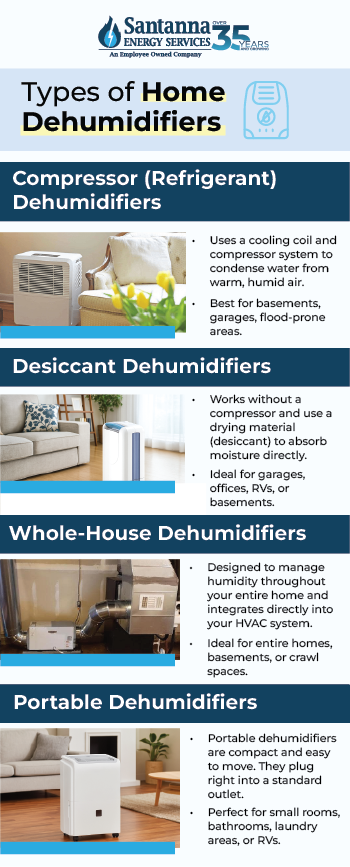
Here's what you need to know about each type of dehumidifiers and where they work best:
Compressor (Refrigerant) Dehumidifiers
Compressor or refrigerant dehumidifiers are the workhorses of moisture removal. It uses a cooling coil and compressor system to condense water from warm, humid air, much like an air conditioner. These are best for basements, garages, flood-prone areas, and other warm, humid environments where excess moisture builds up quickly.
A model that perfectly represents this type is the Global Industrial™ Low Grain Refrigerant Dehumidifier with Pump. Designed for industrial and commercial use, it performs exceptionally well in high-humidity environments and during flood recovery or remediation. Its low-grain R410A refrigerant improves overall efficiency and dehumidifying power, allowing it to perform reliably even in higher temperatures.
A compressor or refrigerant dehumidifier is a great fit if you're dealing with heavy moisture problems, large damp spaces, or areas that need strong, continuous humidity control.
Desiccant Dehumidifiers
Desiccant dehumidifiers work without a compressor and use a drying material (desiccant) to absorb moisture directly from the air. This type of dehumidifier is quiet, reliable, and ideal for cooler spaces where refrigerant-based models may struggle, such Ideal as garages, offices, RVs, or basements that stay under 65°F.
A great example of this category is the EDV-4000 Rotary Desiccant Dehumidifier. It uses innovative rotary desiccant technology to provide high-volume dehumidification with low energy use. Designed for home and office environments, it features a large water basin that only needs occasional emptying and includes a built-in ionizer for fresher air.
A desiccant dehumidifier is an energy-efficient, low-maintenance option that performs well year-round, making it especially helpful if you have cool or unheated spaces that stay damp most of the year.
Whole-House Dehumidifiers
Whole-house dehumidifiers are designed to manage humidity throughout your entire home. It integrates directly into your HVAC system, drawing in moist air, drying it, and redistributing clean air across multiple rooms. These systems are ideal for entire homes, basements, or crawl spaces, providing balanced comfort and preventing mold or structural damage.
The Santa Fe Ultra70 Whole House Dehumidifier is a strong example of this type. It removes up to 70 pints of moisture per day for spaces up to 1,800 sq. ft. and works efficiently while drawing only 4.1 amps. This unit uses a MERV-13 filter to capture fine particles and R454B refrigerant for an eco-friendly performance.
A whole-house dehumidifier is a great fit if you want powerful humidity control with low energy consumption.
Portable Dehumidifiers
Portable dehumidifiers are compact and easy to move, making them perfect for small rooms, bathrooms, laundry areas, or RVs. You can just plug it into a standard outlet and it is designed for quick, efficient moisture removal wherever you need it.
A good example of this type is the Ukoke 1750 Sq. Ft Portable Dehumidifier. It removes up to 9 pints of moisture per day under normal conditions and up to 32 pints per day in extreme humidity (95°F and 90% RH). This unit strikes an excellent balance between performance and energy efficiency, keeping your space comfortably dry without doubling your electric bill.
A portable dehumidifier is a great choice if you need targeted moisture control in bedrooms, apartments, or any small to mid-sized room that gets damp quickly.
Do Dehumidifiers Use a Lot of Electricity?
Most dehumidifiers use less electricity than people think. A typical home dehumidifier that uses 580 watts and runs for 8 hours a day consumes about 4.64 kWh of electricity daily.
At the average U.S. electricity rate of $0.1762 per kWh (as of August 2025), running a dehumidifier in your home can cost you around 82¢ a day, or roughly $25 per month if used daily.
They draw far less power than big cooling appliances like air conditioners or space heaters, and your actual energy use depends on the unit's size, efficiency, and daily runtime. Many new dehumidifiers are more energy efficient, so upgrading to a newer model can immediately help lower your usage.
And if you choose one with the ENERGY STAR rating, you'll save even more since these units use up to 20% less energy than standard models.
For comparison, a central air conditioner running at 3,000 watts for 8 hours would use about 24 kWh per day, costing around $4.23 per day or about $127 per month. That's five times the energy cost of using a dehumidifier!
Comparing Dehumidifiers' Energy Use to Other Home Appliances
You might be wondering, how do dehumidifiers stack up against your other appliances in your home? Well, you've come to the right energy experts!
Let's take a look at the chart below to see how much energy a dehumidifier uses compared to other common household appliances, so you can easily understand where it fits into your daily electricity use:
Energy Use of Common Home Appliances
| Appliance | Power (Watts) | Usage Time | Energy Used (Watt-Hours) |
| Whole-House Dehumidifier | 580 W | 8 hours | 4,640 Wh |
| Ceiling Fan | 60 W | 8 hours | 480 Wh |
| Television | 100 W | 6 hours | 600 Wh |
| Microwave Oven | 1,000 W | 0.5 hours | 500 Wh |
| Air Conditioner | 3,000 W | 8 hours | 24,000 Wh |
| Space Heater | 1,500 W | 8 hours | 12,000 Wh |
| Refrigerator | 500 W | 24 hours | 12,000 Wh |
| Hair Dryer | 1,000 W | 0.5 hours | 500 Wh |
| Laptop | 100 W | 10 hours | 1,000 Wh |
| Dishwasher | 1,800 W | 2 hours | 3,600 Wh |
Note: Wattage figures for these appliances are sourced here.
Factors That Affect a Dehumidifier's Electricity Use
A dehumidifier's energy use can vary from home to home. Even the same model can use more or less power depending on your room size, climate, and how often it needs to run.
Here are the key things that influence how much electricity your unit uses:
- Room Size: Larger rooms or open spaces take longer to dry out because there's more air volume to process. A dehumidifier in a small bedroom might run a few hours, while the same unit in a large basement could run all day. Always match the unit's capacity (measured by how many pints of moisture it can remove in a day) to your room size for efficiency.
- Climate: If you live in the Midwest, humidity can rise sharply during the summer. When the air holds more moisture, the dehumidifier works harder and stays on longer, using more electricity.
- Humidity Level: The wetter the air, the longer the dehumidifier must run to reach a comfortable level. Once your home reaches the right humidity range, using an auto mode can help maintain its efficiency.
- Temperature: Dehumidifiers work more efficiently in warm air. In cooler areas like unheated basements, the coils may struggle to condense moisture, which makes the unit work harder and use more power.
- ENERGY STAR Rating: Models with this certification use up to 20% less energy than standard ones without reducing performance. Over time, that can mean real savings on your electricity bill.
- Features: Units with auto shutoff, timers, and built-in humidity sensors run more efficiently because they avoid unnecessary use. They turn off once your preferred humidity level is reached.
- Age & Maintenance: Older units or ones with clogged filters use more electricity because the machine has to work harder. Cleaning the air filter every few weeks improves airflow and keeps energy use lower.
- Settings & Runtime: Running your dehumidifier on continuous mode dries the air faster but uses more power. Auto mode or a timer helps maintain the right humidity level without running the unit all day.
How Many Watts Does a Dehumidifier Use?
Most home dehumidifiers use between 300 and 700 watts, depending on their size and model. A whole-house dehumidifier, which is common in Midwest homes, typically runs at about 580 watts. When used for 8 hours a day, that equals roughly 4,640 watt-hours (Wh) of electricity.
To compare, a refrigerator uses around 500 watts, but it runs continuously for 24 hours, totaling about 12,000 Wh per day. Meanwhile, a space heater draws roughly 1,500 watts when running for 8 hours, consuming about 12,000 Wh in the same period.
So, while a dehumidifier does use power, its energy consumption is less than half that of a space heater and much lower than a refrigerator's full-day use. This makes it a relatively efficient appliance for keeping your home comfortable, especially in humid Midwest climates.
How Many Watts Does Each Type of Dehumidifier Use?
How many watts does a dehumidifier use depends on its type and size. Bigger units built for whole homes or damp basements use more power, while small portable models use much less.
Here's a clear breakdown of how many watts each type uses and what they're best for:
Dehumidifier Wattage Comparison by Type
| Type of Dehumidifier | Average Wattage (W) | Best For |
| Compressor (Refrigerant) Dehumidifiers | 1,040 W | Basements, garages, crawl spaces, large living rooms, and flood recovery areas |
| Desiccant Dehumidifiers | 615 W | Garages, RVs, offices, basements, and other cooler or unheated spaces. |
| Whole-House Dehumidifiers | 580 W | Entire homes, basements, or large multi-room areas connected through HVAC systems. |
| Portable Dehumidifiers | 195 W | Bedrooms, bathrooms, laundry rooms, closets, or small apartments. |
How Many Amps Does Each Type of Dehumidifier Use?
Every outlet and circuit in your home can only handle a certain amount of electrical load, so knowing the amp draw helps you figure out whether your dehumidifier and other appliances can safely run on the same line.
The chart below shows a breakdown of how many amps each type of dehumidifier pulls while running:
Average Amperage of Different Types of Dehumidifiers
| Type of Dehumidifier | Watts (W) | Amps (A) |
| Compressor (Refrigerant) | 1,040 W | 8.67 A |
| Desiccant | 615 W | 5.13 A |
| Whole-House | 580 W | 4.83 A |
| Portable | 195 W | 1.63 A |
How to Convert Watts to Amps
Here's a very simple way to calculate amps (A) from watts (W):
Step 1: Identify your dehumidifier's wattage: Look at the label or manual to find the wattage. For example, let's use 580 watts.
Step 2: Check the voltage in your home: Most homes in the United States run on 120 volts, which is the number you'll use for this calculation.
Step 3: Use the formula to convert watts to amps: Divide the watts by the volts. The formula looks like this: Amps = Watts ÷ Volts
Step 4: Put the numbers together: Using the example above: 580 watts ÷ 120 volts = 4.83 amps.
That's it. This simple formula lets you see how much electrical current your dehumidifier pulls while running, which helps you understand whether it can safely share a circuit with other appliances.
How Much is the Energy Consumption Does Each Type of Dehumidifier Use Daily, Weekly, Monthly, and Yearly?
A dehumidifier's energy use depends on its wattage, its size, and how long it runs each day. It will use more power during the initial ramp-up period when it is working to reach your target humidity level. After that, most units use less energy because auto mode allows them to cycle on and off as needed.
The chart below shows the average energy consumption for each type of dehumidifier based on 8 hours of daily use. These numbers reflect typical operation in auto mode under normal household conditions:
Average Energy Consumption by Dehumidifier Type
| Type of Dehumidifier | Average Wattage (W) | Daily Use (kWh) | Weekly Use (kWh) | Monthly Use (kWh) | Yearly Use (kWh) |
| Compressor (Refrigerant) | 1,040 W | 8.32 kWh | 58.24 kWh | 249.6 kWh | 3,036.8 kWh |
| Desiccant | 615 W | 4.92 kWh | 34.44 kWh | 147.6 kWh | 1,795.8 kWh |
| Whole-House | 580 W | 4.64 kWh | 32.48 kWh | 139.2 kWh | 1,693.6 kWh |
| Portable | 195 W | 1.56 kWh | 10.92 kWh | 46.8 kWh | 569.4 kWh |
How Much Does It Cost to Run a Dehumidifier in the Midwest?
The cost of running a dehumidifier depends on two main factors: how much electricity your unit uses and your state's electricity rate. Since rates vary slightly across the Midwest, (as of September 2025 according to the Energy Information Administrations) your total energy cost can differ from one state to another.
The charts below show the estimated daily, weekly, monthly, and yearly costs for different types of dehumidifiers, assuming 8 hours of daily use:
Cost to Run a Dehumidifier in Ohio (17.61¢/kWh)
| Type of Dehumidifier | Daily Cost | Weekly Cost | Monthly Cost | Yearly Cost |
| Compressor (1,040 W) | $1.47 | $10.26 | $43.95 | $534.78 |
| Desiccant (615 W) | $0.87 | $6.06 | $25.99 | $316.24 |
| Whole-House (580 W) | $0.82 | $5.72 | $24.51 | $298.24 |
| Portable (195 W) | $0.27 | $1.92 | $8.24 | $100.27 |
Cost to Run a Dehumidifier in Pennsylvania (19.94¢/kWh)
| Type of Dehumidifier | Daily Cost | Weekly Cost | Monthly Cost | Yearly Cost |
| Compressor (1,040 W) | $1.66 | $11.61 | $49.77 | $605.54 |
| Desiccant (615 W) | $0.98 | $6.87 | $29.43 | $358.08 |
| Whole-House (580 W) | $0.93 | $6.48 | $27.76 | $337.70 |
| Portable (195 W) | $0.31 | $2.18 | $9.33 | $113.54 |
Cost to Run a Dehumidifier in Illinois (18.09¢/kWh)
| Type of Dehumidifier | Daily Cost | Weekly Cost | Monthly Cost | Yearly Cost |
| Compressor (1,040 W) | $1.51 | $10.54 | $45.15 | $549.36 |
| Desiccant (615 W) | $0.89 | $6.23 | $26.70 | $324.86 |
| Whole-House (580 W) | $0.84 | $5.88 | $25.18 | $306.37 |
| Portable (195 W) | $0.28 | $1.98 | $8.47 | $103.00 |
Can a Dehumidifier Double My Bill?
No, a dehumidifier can't double your electricity bill. It does use power, but the amount is small compared to high-energy appliances like air conditioners or space heaters.
For example, a whole-house dehumidifier that runs at 580 watts for 8 hours a day uses about 4.6 kilowatt-hours (kWh) of electricity. At the Midwest's average electricity rate of about $0.18 per kWh, that comes to roughly 83 cents per day, or about $25 per month if you use it daily.
Even if you run your dehumidifier more often during humid months, it still makes up only a small part of your overall electricity use. It can even help lower your cooling costs because dry air feels cooler and allows your air conditioner to work less.
So, while a dehumidifier adds a little to your energy bill, it won't cause a major jump and may help your home stay comfortable without overworking your HVAC system.
How to Calculate Dehumidifier Energy Consumption
Want to know how much your dehumidifier adds to your electric bill? It's actually very easy to figure out. You just need the wattage on the label and how many hours you use it each day:
1. Find the wattage.
Look for the wattage on your dehumidifier. This is usually listed as "W" or "Watts." For this example, we'll use 580 watts.
2. Estimate your daily use.
Multiply the wattage by how many hours you use it per day. If you run it for 8 hours:
580 watts × 8 hours = 4,640 watt-hours per day
3. Convert to kilowatt-hours (kWh).
Your electric bill uses kWh, so divide 4,640 by 1,000:
4,640 ÷ 1,000 = 4.64 kWh per day
4. Calculate the cost.
Multiply your daily kWh by your electricity rate (found on your utility bill). We're using the average U.S. rate of $0.1762 per kWh as of August 2025:
4.64 kWh × $0.1762 = $0.82 per day
If you run your dehumidifier for 8 hours every day, that daily amount adds up to about $24.53 per month.
Does a Dehumidifier Cool a Room?
A dehumidifier doesn't cool the air the way an air conditioner does, but it can still make a room feel noticeably more comfortable. By pulling excess moisture out of the air, it lowers the humidity level. When the air is less humid, sweat can evaporate from your skin more easily, which helps your body cool itself naturally.
This is why a room can feel a few degrees cooler even if the actual temperature stays the same. A dehumidifier does release a bit of heat while it runs, so in smaller rooms you might notice a slight rise in temperature. Even with that small amount of warmth, most people find the space feels better because dry air is easier to breathe and feels lighter and cooler overall.
Why Do Midwest Homes Need Dehumidifiers the Most?
Midwest homes deal with some of the biggest humidity swings in the country. Summers get muggy, spring brings heavy rain, and many homes have basements that stay damp almost all year. Humidity levels in the Midwest can reach as high as 54-88% during summer, especially after storms, and that moisture often settles into basements, crawl spaces, and walls.
This creates ideal conditions for mold, mildew, musty odors, and moisture damage. Over time, high humidity can warp wood floors, harm furniture, and even affect your home's foundation.
A reliable dehumidifier helps pull that extra moisture out of the air and keeps humidity at a healthy level. This protects your home, improves indoor air quality, and even helps your air conditioner work more efficiently since dry air naturally feels cooler.
For many Midwest homeowners, a dehumidifier isn't just a comfort upgrade. It's a simple way to prevent long-term damage and keep indoor air healthier throughout the year.
How To Make Your Dehumidifier More Energy-Efficient
You don't need anything complicated to help your dehumidifier run more efficiently. A few simple habits can make a big difference in how much energy it uses and how long it lasts:
- Set a Comfortable Humidity Level: Aim for moderate humidity instead of running your unit nonstop to reach your target level faster without wasting power.
- Keep It Clean: Wipe down the exterior and clean the air filter regularly so air can flow freely.
- Choose the Right Spot: Place your dehumidifier in an open area where air can circulate freely, rather than against a wall or behind furniture, so it doesn't have to work harder than necessary.
- Use Built-in Settings: Take advantage of timer or auto-shutoff features to avoid overuse.
- Close Windows and Doors: This keeps outside air from adding more moisture while the unit is running.
- Empty the Tank Often: A full tank can slow performance and make the unit work harder.
- Store it Properly: When not in use, unplug it, clean it, and store it in a dry place to prevent damage and keep it ready for the next season.
These small steps can help your dehumidifier use less energy, last longer, and keep your home feeling fresh and comfortable.
FAQs
Are new dehumidifiers more energy-efficient?
Yes, newer dehumidifiers, especially the ENERGY-STAR rated models are more energy-efficient than older models that use 20% less energy, according to ENERGY STAR. Modern units also come with ENERGY STAR® certification, which guarantees they meet strict efficiency standards. It's important to know this because upgrading to a new, energy-efficient dehumidifier not only lowers your electricity costs but also helps your system last longer.
How long do dehumidifiers last?
The typical lifespan of a dehumidifier is about 5 to 10 years, depending on the brand, usage, and upkeep.
Should I unplug my dehumidifier when not in use?
Yes. It's best to unplug your dehumidifier when you're not using it for an extended period. This saves standby power, prevents unnecessary wear, and reduces the risk of electrical issues. Before storing, empty the tank and clean the unit.
Dehumidifiers may seem like small appliances, but they play a big role in keeping your home healthy, comfortable, and energy-efficient, especially in humid Midwest climates. By understanding how much electricity they use, how to maintain them properly, and which type fits your space best, you can reduce humidity without driving up your energy costs.
And if you're looking to keep your overall home energy supply costs predictable, Santanna's Unlimited Energy plan can help. With one simple monthly supply charge, you can run your dehumidifier and the rest of your home's essentials without worrying about your usage.*
Stay comfortable, stay efficient, and keep your supply charge under control. Explore Santanna's Unlimited Energy plan today.
* Restrictions apply. Enrollment based upon program eligibility. Customers using more than 125% of normal monthly usage as determined by Santanna may be required to switch plans.
Jenna Mendez is a Midwest native with lifelong roots in Illinois and time spent in Ohio during college, giving her a deep understanding of the Midwest region’s people, climate, and energy needs. She brings firsthand experience and local insight to topics that matter to Midwest homeowners, especially energy efficiency, sustainability, and home living. Jenna specializes in writing about eco-friendly living, all things Midwest, renewable energy, and practical ways to reduce energy costs. Jenna brings a trusted, and local hometown voice to every article she writes, helping readers live well, and sustainably, right where they are.