
Electric vs. Gas Outdoor Heaters: Cost and Efficiency for Patio Season

by Tyler Castle
24.1 min read
The warmer seasons can feel a little bittersweet for homeowners. The days are warmer, the sun stays out longer, and it finally feels like patio season again. Then evening hits, the temperature drops, and sitting outside suddenly feels uncomfortable.
That is usually when the question comes up: should I get an outdoor heater, and if so, should it be electric or gas?
Once you start looking, the answers can feel overwhelming. Some people say electric heaters are cheaper and more efficient. Others insist gas heaters are the only way to stay warm outside.
Then you start thinking about your energy bill, the size of your patio, how windy your yard gets, and whether one option is safer than the other. It's easy to feel unsure about what makes sense for your home.
At Santanna Energy Services, we help Midwest residents understand how electricity and natural gas work in everyday situations. We focus on clear explanations, realistic costs, and practical guidance so homeowners can make decisions with confidence, not guesswork.
In this guide, we break down electric vs gas outdoor heaters. You will learn how each type works, what it typically costs to run, how your patio layout affects comfort, and how to use outdoor heaters more efficiently. By the end, you will have a clearer idea of which option fits your space, your habits, and your comfort, so patio season feels enjoyable again.
Key Points of This Article:
- Electric patio heaters usually offer more predictable nightly costs, while gas heaters provide stronger heat for larger, open patios but can vary more in fuel use.
- For typical 3-hour patio use, both electric and gas heaters often cost less than one dollar per evening, but frequent nightly use is what really increases your monthly bill.
- Electric heaters work best for smaller, sheltered spaces with focused seating, while gas heaters are better suited for windy or exposed patios that need wider heat coverage.
- Small setup changes like blocking wind, tightening seating areas, and warming up briefly before lowering the heat can reduce outdoor heating costs without sacrificing comfort.
What Is an Electric Outdoor Heater and How Does It Work?
An electric porch heater is usually an infrared outdoor heater that converts electricity into radiant heat, with up to about 98% of the energy going directly toward warmth instead of being lost to the surrounding outdoor air.
If you have ever stepped onto your porch in early spring and felt comfortable for a few minutes before the chill set in, you already understand why these heaters are popular. The air cools quickly after sunset, but you still want to enjoy sitting outside without dragging blankets out every night.
Electric porch heaters work by sending electricity through a heating element inside the unit. That element heats up and releases radiant warmth, similar to how sunlight can warm your skin on a cool day. Because the heat is directed, it feels strongest when you are sitting or standing within the heater's line of sight.
This is why placement makes such a difference. When the heater is aimed at your seating area, it can feel very effective. When it is pointed into open space, especially on a windy Midwest evening, the warmth can fade quickly.
What Is an Outdoor Gas Heater and How Does It Work?
An outdoor natural gas heater burns natural gas to produce steady heat, often making it more comfortable in large or open patio spaces. Unlike electric heaters, these heaters need enough open space for safe airflow, which usually means at least about 25% of the area should remain open rather than fully enclosed.
If your deck is uncovered or your patio gets a lot of wind, you may have noticed that warmth disappears fast. One of the main reasons homeowners consider natural gas heaters for patio season is that they are designed to produce stronger, more widespread heat that can better hold up in open air.
Gas outdoor heaters work by feeding natural gas through a fixed line into the unit. The gas ignites inside the heater and produces heat through combustion. Depending on the design, that heat can warm the surrounding air and also radiate outward toward where people are sitting, helping larger seating areas feel more comfortable.
One important thing to know is that gas heaters usually require more setup. Natural gas models often need professional installation and a dedicated gas line. They are less flexible than electric heaters, but many homeowners appreciate the steady heat once everything is in place.
Pros and Cons of an Electric Outdoor Heater
Electric outdoor heaters are a good fit for patio season when you want quick, targeted warmth for sitting outside on cool spring evenings.
If you enjoy using your patio for a short dinner, a cup of coffee, or winding down after sunset, electric heatersare ideal. Here are the pros and cons of using an electric outdoor heater:
Pros
Fast warmth for seated patio use.
Electric heaters provide radiant heat that warms people sitting nearby, which works especially well for patio furniture setups where everyone is gathered around one table or seating area.
Efficient for short patio sessions.
According to the U.S. Department of Energy, electric resistance heaters convert 100% of the electricity they use into heat at the heater. Because they produce heat immediately and direct it where it's needed, they work well for short, targeted patio use.
Easy to turn on and off.
Plug-in operation makes it simple to heat the patio only when you are outside. You are not running fuel continuously.
Minimal upkeep during the season.
There are no fuel tanks to refill and no combustion parts to monitor between uses. For many homeowners, that simplicity matters.
No flame on the patio.
Many homeowners feel more comfortable using electric heaters near seating areas, cushions, and walkways because there is no open flame.
Works well in partially protected patios.
Covered or semi-sheltered patios often feel noticeably warmer with an electric heater, especially when the wind is blocked.
Cons
Best for focused seating areas.
Electric heaters work best when aimed directly at where people sit. If your patio layout is spread out, not everyone may feel the same warmth.
Wind can reduce comfort.
Wind can reduce comfort with electric outdoor heaters. Because electric models rely on radiant heat rather than warming the air, breezy Midwest evenings can still feel chilly in an open patio, as wind quickly carries away the warmth from your skin even when the heater is running.
Electrical capacity matters.
Some outdoor outlets may not support higher-watt heaters without a dedicated circuit. It is important to check before purchasing.
Pros and Cons of an Outdoor Gas Heater
Outdoor gas heaters are often chosen for patio season when the space is large, open, or exposed to wind.
If your patio is uncovered or you like hosting longer gatherings outdoors in cooler weather, gas heaters can provide stronger, more consistent warmth. Here are the pros and cons of using a gas outdoor heater for patio season:
Pros
Stronger heat for open patios.
Gas heaters produce higher heat output, which helps maintain comfort in open or breezy spaces where electric heat might feel weaker.
Better coverage for larger patios.
One properly sized unit can warm a wider seating area, making it helpful for gatherings.
Steady warmth for longer evenings.
Gas heaters tend to feel more consistent during extended outdoor use, especially when temperatures continue dropping after sunset.
Convenient for homes with natural gas lines.
Once professionally installed and connected to a dedicated gas line, there is no need to manage propane tanks or plug capacity.
Less demand on outdoor electrical outlets.
This can be helpful for patios with limited electrical access or multiple outdoor appliances.
Cons
Requires installation planning.
Natural gas outdoor heaters usually require professional installation and a dedicated gas line, which adds upfront cost.
Fixed placement.
Once installed, the heater cannot be easily moved if your patio layout changes.
Open flame requires clearance.
Furniture, décor, and overhead structures must be kept at a safe distance for proper airflow and safety.
Needs open airflow.
Gas heaters for outdoor use should only be used in open outdoor patio spaces and never in enclosed or partially enclosed areas without proper ventilation.
On-site emissions are part of the tradeoff.
Because gas heaters burn natural gas, they produce carbon dioxide at the patio. For homeowners comparing environmental impact, this is something to consider alongside comfort and heat output.
Types of Outdoor Heaters for Patio Season
Now that you understand how electric and gas heaters work and the tradeoffs involved, it helps to look at the different styles available. There are a few common types of outdoor heaters homeowners use during patio season, and each one fits a different kind of space and lifestyle.
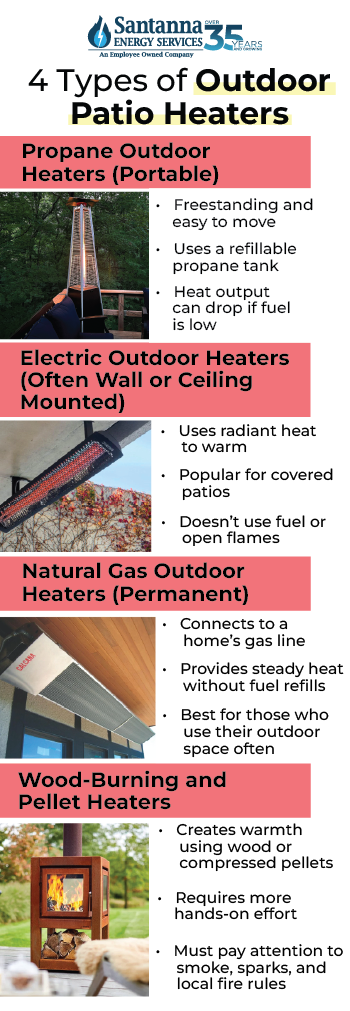
Propane Outdoor Heaters (Portable)
Propane heaters are freestanding and easy to move around the patio. They use refillable propane tanks and are often chosen for flexibility.
These work well if you like rearranging your patio furniture or want the option to move the heater out of the way when the weather warms up. The tradeoff is that tanks need refilling, and heat output can drop as fuel runs low.
Electric Outdoor Heaters (Often Wall or Ceiling Mounted)
Electric heaters are commonly mounted on walls or ceilings and use radiant heat to warm people sitting nearby.
They are popular for covered patios and porches where you want quick, focused warmth for short periods. Because they do not use fuel or open flames, many homeowners find them simple and easy to manage during patio season.
Natural Gas Outdoor Heaters (Permanent)
Natural gas outdoor heaters are permanently connected to a home's gas line. Once installed, they provide steady heat without the worry of refueling.
These are a good fit for larger patios or homeowners who use their outdoor space often during cooler months. Installation usually requires a professional, and the heater stays in one place, limiting flexibility.
Wood-Burning and Pellet Heaters
Wood-burning fire pits and pellet heaters create warmth using wood or compressed pellets.
These can add ambiance and a cozy feel, but they require more hands-on effort. You need fuel storage, regular tending, and attention to smoke, sparks, and local fire rules. For many homeowners, these are more about atmosphere than consistent heat.
Each type has its place. The best choice usually depends on how often you use your patio, how much space you want to heat, and how much setup or maintenance you are comfortable with during patio season.
How Much Electricity Does an Outdoor Electric Patio Heater Use?
A 1,500-watt electric outdoor heater uses about 4.5 kilowatt-hours (kWh) of electricity per day if it runs for 3 hours.
Here is how that breaks down: A 1,500-watt heater is equivalent to 1.5 kilowatts. When you run it for 3 hours, you multiply 1.5 by 3. That equals 4.5 kilowatt-hours of electricity for the day.
This kind of usage is very common during patio season. Many homeowners in the Midwest turn the heater on after dinner, enjoy the patio for a few hours, then shut it off for the night.
To put this into a familiar frame, using a patio heater for a few evening hours is similar to running several household appliances at once for a short period. It usually does not feel extreme on its own, but it can add up if it becomes a nightly habit.
How Much Gas Does an Outdoor Gas Patio Heater Use?
A typical outdoor gas patio heater uses between 1.5 kg and 3 kg of Liquefied Petroleum Gas (LPG) per day if it runs for about 3 hours.
Here is how that breaks down: Most outdoor gas heaters use about 0.5 to 1 kilogram of LPG per hour, depending on the heat setting and heater design. If you run the heater for 3 hours in the evening, you multiply that hourly use by 3.
That means on a lower heat setting, 0.5 kg multiplied by 3 hours equals about 1.5 kg of LPG. On a higher heat setting, 1 kg multiplied by 3 hours equals about 3 kg of LPG.
Unlike electric heaters, gas usage varies more depending on how high the flame is set and how exposed your patio is. If the heater runs at a higher setting to fight wind or warm a larger space, fuel consumption increases.
The key difference comes down to predictability. Electric use tends to stay steady per hour, while gas use changes based on heat level and outdoor conditions. In both cases, how long you run the heater each evening has a bigger impact on your total energy use than the heater type alone.
For example, a short period of patio heater use once or twice a week will look very different on your monthly bill compared to running the heater every night for several hours throughout the entire patio season.
Occasional use usually stays modest and manageable, but steady nightly use, especially during cooler Midwest months, can gradually increase your overall energy costs without you immediately noticing the pattern.
Now that you have a clearer picture of how much electricity and gas these heaters typically use, it helps to look at what that energy consumption costs, so you can compare the options side by side and see what it would mean for your monthly budget.
Electric vs. Gas Patio Heaters: Cost to Run Comparison
For a typical patio-season evening, assuming about 3 hours of use per day, electric and gas patio heaters often cost a similar amount to run. The difference comes from how each heater uses energy and how steady that use is over time.
This comparison is based on common patio-season behavior: turning the heater on after dinner, enjoying the patio for a few hours, then shutting it off for the night.
Electric vs. Gas Patio Heater Cost To Run Comparison (3 Hours Per Day)
| Category | Electric Patio Heater | Gas Patio Heater |
| Typical patio use | 3 hours per day | 3 hours per day |
| Energy used per day | 4.5 kWh | 1.5 to 3 kg of LPG |
| Fuel type | Electricity | Propane or natural gas |
| Rate used | $0.1778 per kWh | $0.558 per gallon |
| Estimated cost per day | About $0.80 | About $0.44 to $0.88 |
| Cost behavior | Very predictable | Varies by heat setting |
| Best fit | Short, focused patio use | Larger or open patios |
With 3 hours of daily use, electric patio heaters tend to have steady, easy-to-predict costs, especially for smaller or sheltered patios. Gas heaters can cost less or more per evening, depending on how high the heat is set and how open the space is.
How long you run the heater each day and how often you use it during patio season matter more than the heater type alone.
Which Outdoor Heater Is Cheaper To Run?
Neither electric nor gas patio heaters are automatically cheaper to run. With about 3 hours of use per evening during patio season, the total cost usually depends more on how you use the heater, including heat settings and wind exposure, than the fuel source itself.
In our example, the electric outdoor heater costs about $0.80 per evening. That cost stays fairly steady because the heater uses the same amount of electricity each hour.
The gas outdoor heater shows a wider range. At lower heat settings, it can cost around $0.44 per evening. At higher heat settings, it can cost closer to $0.88 per evening. This happens because gas heaters burn more fuel as the heat level increases.
This is a very common experience for homeowners. Electric heaters feel more predictable from night to night, while gas heaters can feel cheaper one evening and more expensive the next, depending on how high the heat is turned up and how open the patio is.
Electric outdoor heaters are often cheaper for short, controlled patio use, while gas heaters can be cheaper or more expensive depending on how much heat you need. In the end, the most affordable option is usually the one that fits your patio layout and how you realistically use it, not just what looks cheaper on paper.
Is It Cheaper To Run a Heater Longer at Low Output or Shorter at High Heat?
Most of the time, it is cheaper to run a patio heater on a higher setting for a shorter time, then turn it down or off once everyone feels comfortable.
A heater uses the most energy when it is running at its highest output. If you leave it on for a long time, even at a lower setting, you are still paying for more total hours of heat. For many patios, you get better results by warming up the seating area quickly, then using a lower setting to maintain comfort.
This is especially true for patios that are partly sheltered. Once the chairs, table, and people warm up, you often do not need the heater blasting the whole time.
The one exception is an open, windy deck. In that case, high heat for a short burst may not "stick" because the warmth gets carried away. When wind is working against you, it can be cheaper and more comfortable to lower the heat and focus it on where you sit, using wind-blocking and tighter seating zones.
For most patio-season nights, a short warm-up on a higher setting followed by a lower setting is the best balance of comfort and cost.
How Does Running an Outdoor Heater During Patio Season Affect My Electricity Bill?
Running an outdoor electric patio heater during patio season usually increases your electricity bill a little, and the impact depends on how long you use it and your electricity rate.
Using a common 1,500-watt electric patio heater for about three hours in the evening, at an electricity rate of 17.78 cents per kilowatt-hour, adds roughly $0.80 for that day. For many, that looks small on its own, especially when the heater is only used occasionally.
But if that becomes a nightly habit, the cost can add up. Using the heater for 3 hours every evening for a full month at the same rate can increase your bill by around $20-$25. That is noticeable, but still within a range many homeowners expect during patio season.
Now, picture a longer get-together. You invite friends or relatives over, dinner stretches out, and everyone stays on the patio for about six hours. At the same electric rate of 17.78 cents per kilowatt-hour, that one evening would add about $1.60 to your electricity use.
Occasional longer patio nights are normal and expected, especially during gatherings. Electricity bills usually only shift noticeably when longer patio use becomes a regular pattern, not when it happens once in a while.
Which Option Is More Eco-Friendly: Electric or Gas Outdoor Heaters?
The more eco-friendly option depends on where the energy comes from and how often you use the heater.
Electric outdoor heaters do not make smoke or fumes where you sit. There is no flame. The impact on the environment comes from how the electricity is made. Some electricity comes from cleaner sources like wind or solar, and some comes from fuel. When more clean energy is used, electric heaters are better for the environment.
Gas outdoor heaters make heat by burning fuel. When fuel burns, it creates carbon emissions. This is normal and expected, but it does mean gas heaters have a direct impact on the air.
Here is the part many homeowners overlook. How long and how often you use the heater matters more than the type. Using a heater once in a while for a cool evening has a small impact. Running it many nights in a row for long hours has a bigger impact.
If reducing environmental impact is your main goal, electric heaters used for shorter, controlled patio time are often the lower-impact choice. Gas heaters can still make sense for larger or open patios, especially when they are used thoughtfully and turned off when not needed.
Which Is More Energy Efficient?
Electric deck heaters are more energy efficient for small, sheltered decks and short use, while gas deck heaters are more effective for large, open decks and longer evenings.
That difference comes down to how heat behaves outdoors. Electric heaters send focused, radiant heat directly toward people sitting nearby, so very little energy is wasted when the space is protected and the heater is aimed well.
Gas heaters produce much more heat overall. That extra output helps replace heat that escapes in open or windy areas, which is why gas heaters feel more comfortable on large or exposed decks, even though they use more energy to do it.
Best Outdoor Electric Heater for Patio Season
If you focus on lower upfront cost and efficient short-term use, electric patio heaters are often the more budget-friendly option.
A typical example is an EAST OAK electric patio heater, priced around $74.99. At 1,500 watts, this type of heater converts electricity directly into heat at the unit, which makes it efficient for focused patio seating during short evening use.
With an estimated operating cost of about $0.80 for three hours of use at an average electricity rate, electric heaters are easier to predict from a budgeting standpoint. They tend to make the most sense for smaller patios, covered areas, or homeowners who only use their heater occasionally during patio season.
Best Outdoor Gas Heater for Patio Season
If you are willing to spend more upfront in exchange for greater heat coverage, gas patio heaters are often the better fit.
A common example is the Hampton Bay gas patio heater, priced around $159.00 with a heat output of 48,000 BTUs. This level of output is designed to warm larger or more open patio spaces where heat escapes quickly.
Operating costs for gas heaters vary more than electric. Based on typical use, running a gas heater for about three hours can cost roughly $0.44 to $0.88 per evening, depending on the heat setting. That range makes gas heaters harder to predict, but potentially cost-effective for larger patios that need stronger heat.
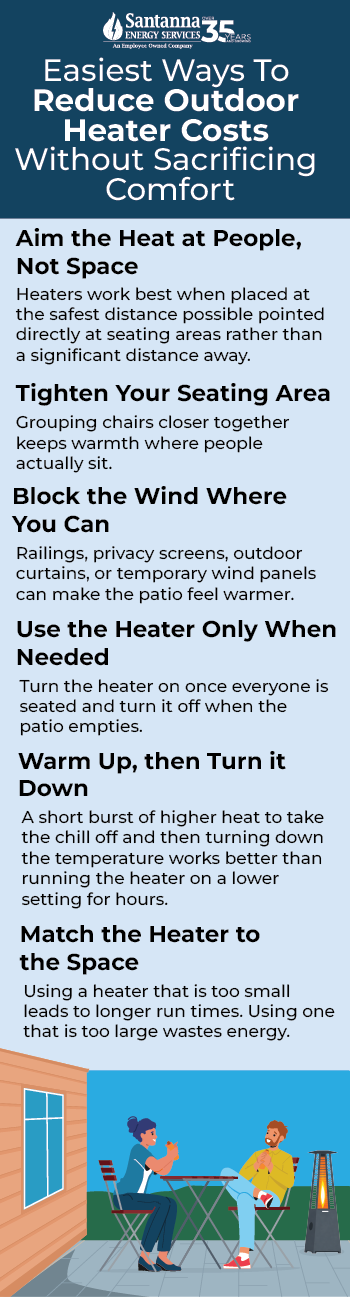
What Are the Easiest Ways To Reduce Outdoor Heater Costs Without Sacrificing Comfort?
You can lower outdoor heating costs without feeling cold by using the heater more intentionally, rather than turning it off completely.
If you have ever cranked the heater up and still felt chilly, that is usually a setup issue, not a heater problem. Small changes in how and where you use the heater often make the biggest difference. Here are the easiest ways to reduce outdoor heater costs without sacrificing comfort:
Aim the Heat at People, Not Open Space
Radiant heaters work best when they are pointed directly at seating areas. Heating an empty patio space costs more and feels less comfortable.
Tighten the Seating Area
Grouping chairs closer together keeps warmth where people actually sit, which helps the heater work more efficiently.
Block the Wind Where You Can
Even light wind can pull heat away. Railings, privacy screens, outdoor curtains, or temporary wind panels can make the patio feel warmer without increasing heater output.
Use the Heater Only When Needed
Turn the heater on once everyone is seated and turn it off when the patio empties. Heating an empty patio is one of the easiest ways to waste energy.
Warm Up, then Turn it Down
A short burst of higher heat to take the chill off often works better than running the heater on a lower setting for hours.
Match the Heater to the Space
Using a heater that is too small leads to longer run times. Using one that is too large wastes energy. Right sizing helps balance comfort and cost.
What Are the Main Safety Considerations With Outdoor Heaters for Patio Season?
Outdoor heaters are generally safe to use as long as they have enough space around them, are placed securely on a stable surface, and are turned off when no one is outside.
Sometimes, it's usually not the heater itself that causes problems. Most safety issues come from small, common mistakes, like placing a heater too close to furniture or leaving it on after everyone goes inside. Here are the main safety considerations for both electric and gas outdoor heaters:
Safety Considerations for Using Electric Outdoor Heaters
- Keep the heater away from cushions, curtains, umbrellas, and décor.
- Plug the heater directly into an outdoor-rated outlet.
- Avoid power strips and indoor extension cords.
- Use only outdoor-rated, heavy-duty extension cords if needed.
- Check cords and plugs for cracks or wear, especially after winter.
- Place the heater where kids and pets cannot easily touch it.
- Turn the heater off when the patio is not in use.
Safety Considerations for Using Gas Outdoor Heaters
- Use gas heaters only in open outdoor spaces, not enclosed or screened areas.
- Keep plenty of open airflow, usually at least part of the patio open.
- Maintain clear space around the heater, especially above it.
- Keep the heater away from furniture, railings, and overhangs.
- Store propane tanks safely and check connections for leaks.
- If you smell gas, turn the heater off and stop using it until it is checked.
- Never leave a gas heater running unattended.
Electric heater safety mostly involves safe wiring and clearance. Gas heater safety primarily concerns airflow, clearance, and fuel safety. In both cases, supervision and proper placement matter more than run time during patio season.
Electric or Gas Outdoor Heaters: Which One Is Right for You?
The right choice depends on your patio setup, how often you use it during patio season, and whether you care more about predictable costs or stronger heat coverage.
If you are standing in your backyard thinking, "I just want to be warm out here without overthinking it", this decision guide is for you.
Choose an Electric Outdoor Heater for Your Patio If…
- You have a small to medium patio, balcony, or covered porch.
- You mainly want warmth for short evening use, like 1 to 3 hours at a time.
- You want a predictable operating cost, since electric use stays steady when the heater is on.
- You prefer a setup that is simple to plug in and turn off, with less maintenance.
- You usually sit in one spot and can aim the heater at your main seating area.
- You are working with a lower upfront budget, since electric heaters often cost less to buy.
Choose an Outdoor Gas Heater for Your Patio If…
- You have a large, open patio or deck, especially if it gets windy.
- You often host and want warmth that can cover a wider area.
- You plan to use your patio heater for longer gatherings, like 4 to 6 hours at a time.
- You do not mind a higher upfront cost if it means more heat output.
- You want stronger heat that feels comfortable even when the patio is more exposed.
- You are okay with more setup and safety attention, especially if the heater uses fuel.
In the end, electric heaters are usually better for smaller, sheltered patio spaces with more predictable costs, while gas heaters often make more sense for larger, open patios where stronger warmth is needed.
FAQs
Do Deck Heaters Actually Work in the Wind?
Yes, deck heaters work in the wind, but wind reduces their effectiveness regardless of the type. Electric heaters perform best in light wind because they use radiant heat that warms people directly. Gas heaters usually handle wind better since they produce stronger heat, but even they lose efficiency in fully open, breezy spaces.
How Long Is It Safe To Run an Outdoor Heater?
Most outdoor heaters are safe to run for about 3 to 6 hours at a time, as long as they are used properly and someone is present. For longer gatherings, up to 6 to 8 hours can be reasonable, but heaters should never be left unattended. Turn them off when the patio is no longer in use.
Can You Leave Patio Heaters Outside All Year?
Yes, most outdoor-rated patio heaters can stay outside year-round if they are properly protected. Electric models should be covered and cords checked before each season. Gas heaters can also stay outside, but portable propane tanks should be disconnected or protected during the winter months.
Outdoor heaters can help you enjoy your patio longer, even on cool evenings. Electric heaters work well for small patios and short-term use. Gas heaters work better for bigger patios and longer gatherings. In both cases, how you use the heater matters just as much as which one you choose.
When you understand how your heater works and what it costs to run, there are fewer surprises. You know when to turn it on, when to turn it off, and how to stay warm without wasting energy. That makes patio time more relaxing and more fun.
Thinking about energy in simple terms helps both inside and outside your home. With Santanna's Unlimited Energy plan, you enjoy predictable supply charges each month,* even when energy use changes during patio season. That kind of predictability can help you enjoy your home with less worry and more comfort.
* Restrictions apply. Enrollment based upon program eligibility. Customers using more than 125% of normal monthly usage as determined by Santanna may be required to switch plans.
Tyler is an experienced energy professional, having worked for Santanna Energy Services, for the past four years. He is passionate about renewable energy and believes that diversifying the energy grid is the key to a sustainable future. Tyler is dedicated to supplying consumers with the best possible energy solutions and works diligently to make sure that Santanna can deliver the highest quality service.