
How Many Watts Does a Freezer Use?

by Tyler Castle
18.1 min read
Ever find yourself wondering how much electricity your freezer actually uses? Maybe you’ve noticed your electric bill creeping up, or you’re just curious if that second freezer in the garage is worth keeping plugged in. It’s a common question that many homeowners ask once they realize not every appliance runs the same way or costs the same to operate.
If you’ve always wondered this, you’ve come to the right energy experts to help you figure this out. With 35 years of experience as an electricity supplier, we know our way around kitchen appliances.
In this guide, we’ll break down how many watts a freezer uses, what affects its energy consumption, and simple ways to keep it running efficiently. With a little insight, you’ll be able to keep your food and your energy budget perfectly chilled. Let’s get started.
Key Points of This Article:
- A typical household freezer uses between 80 and 310 watts during active cooling cycles, depending on its type, size, and efficiency.
- Chest freezers are the most energy-efficient, averaging 80–200 watts, while upright and drawer freezers generally consume more power.
- Freezers cycle on and off throughout the day, so their actual daily electricity use ranges from 0.6 to 1.5 kWh, making them surprisingly efficient compared to other large appliances.
- Factors like placement, maintenance, and usage habits significantly affect energy consumption, and simple steps such as keeping the door sealed and cleaning coils can help reduce power use.
How Many Watts Does a Freezer Use?
A typical household freezer uses between 80 and 310 watts during active cooling cycles.
Every freezer uses a certain amount of power, or watts, to keep food safely frozen, but the exact wattage your individual freezer will use depends on its type, size, efficiency rating, and usage habits.
If you’re looking for an average wattage by freezer type, here’s what you can expect:
Average Freezer Wattage by Freezer Type
| Freezer Type | Typical Running Wattage | Average Daily Use (Wh) | Average Weekly Use (Wh) | Average Monthly Use (Wh) |
| Chest Freezer | 80–200 watts | 600–1,200 Wh per day | 4,000–8,000 Wh per week | 18,000–36,000 Wh per month |
| Upright Freezer | 100–250 watts | 800–1,500 Wh per day | 6,000–10,000 Wh per week | 24,000–45,000 Wh per month |
| Drawer Freezer | 100–220 watts | 700–1,300 Wh per day | 5,000–9,000 Wh per week | 21,000–39,000 Wh per month |
Tip: Even though upright and drawer models may consume a bit more power, regular maintenance and mindful usage such as keeping the door sealed properly and avoiding overpacking can help any freezer operate more efficiently and last longer.
How Many Watts Does a Chest Freezer Use?
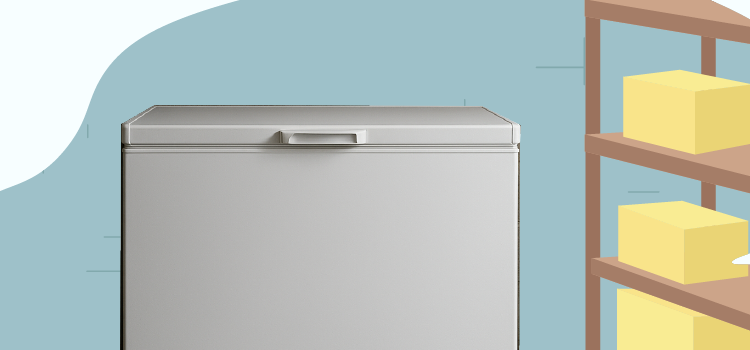
A chest freezer is one of the most energy-efficient freezer styles you can own. An ENERGY STAR® certified chest freezer uses about 25 watts on average daily (or around 215 kWh/year), depending on its size, insulation quality, and how often it’s opened. This around 55 less watts than a standard kitchen f
Because cold air naturally sinks, the top-opening design helps trap cool air inside every time you open the lid. This reduces the amount of work the compressor has to do, making chest freezers more efficient than upright models.
Depending on your model, a chest freezer’s running wattage can reach between 80 and 200 watts during active cooling, it doesn’t run continuously. Like a regular kitchen freezer, it instead cycles on and off throughout the day to maintain a steady temperature, which keeps overall energy use low.
For homeowners, this means a chest freezer can be a practical and cost-effective way to store bulk groceries, frozen meals, or seasonal produce without significantly raising your energy bill.
Placing your chest freezer in a cool, dry, and well-ventilated area, like a basement or utility room, can help it run even more efficiently. Regular maintenance, such as keeping the coils clean, defrosting when frost builds up, and ensuring a tight door seal—can also extend its lifespan and maintain optimal performance.
In short, chest freezers are built for long-term efficiency. They use less energy than most upright models, stay cold longer during power outages, and give homeowners reliable cold storage while keeping electricity costs low.
How Many Watts Does a Deep Freezer Use?
An ENERGY STAR® certified deep freezer uses about 50.86 watts on daily average (approximately 395 kWh/year), depending on its capacity, efficiency rating, and usage conditions. A deep freezer uses more electricity than a chest freezer but less than a kitchen freezer.
During active cooling, its running wattage can range between 100 and 250 watts, but like other freezers, it doesn’t draw that much power all the time. The compressor cycles on and off to maintain consistent temperatures, helping balance performance and energy use.
A deep freezer is designed for long-term food storage, often used to hold large quantities of frozen meat, produce, or bulk groceries. While many people use the term “deep freezer” to describe a chest freezer, it can also refer to large upright models made to maintain lower temperatures for extended periods.
Its thick insulation and powerful compressor help preserve food for months, but they also influence how much energy it uses.
For homeowners, this means a deep freezer offers reliable, high-capacity storage with moderate power needs. To keep it running efficiently, place it in a cool, dry, and well-ventilated location, avoid frequent door openings, and clean the coils regularly. Checking the door seal and defrosting when needed can also help reduce strain on the compressor and prevent wasted energy.
In short, deep freezers are built for dependable long-term storage. They provide the space and freezing power you need while maintaining manageable energy consumption when used and maintained properly.
How Much Electricity Does a Freezer Use?
Running a freezer might sound like it uses a lot of power, but in reality, it’s surprisingly efficient. A kitchen or drawer freezer uses 0.7kWh – 1.3 kWh a day and a chest freezer uses 0.6 kWh – 1.2 kWh daily. Even a deep freezer that operates all day uses about the same amount of electricity as running a few household lights for several hours.
Keep in mind that a freezer doesn’t run constantly like a fridge does. It cycles on and off throughout the day as it maintains the set temperature, so the total amount of electricity you use today might not be the same tomorrow.
Below is an average daily, weekly, monthly, and yearly electricity use for three of the most common freezer types. These estimates are based on average freezer wattage that is plugged in 24 hours a day, with natural on-and-off compressor cycling already factored in:
Average Electricity a Freezer Uses Daily, Weekly, Monthly, and Yearly
| Freezer Type | Typical Running Wattage | Daily (kWh) | Weekly (kWh) | Monthly (kWh) | Yearly (kWh) |
| Chest Freezer | 80–200 W | 0.6–1.2 | 4–8 | 18–36 | 220-440 |
| Upright Freezer | 100–250 W | 0.8–1.5 | 6–10 | 24–45 | 290-550 |
| Drawer Freezer | 100–220 W | 0.7–1.3 | 5–9 | 21–39 | 260-470 |
A typical upright kitchen freezer (typically in a side-by-side freezer) uses roughly 1 kWh per day, about the same energy it takes to run a modern refrigerator for half a day. A chest freezer, which holds cold air better, uses even less.
When estimating how much electricity a freezer uses, you'll also need to factor in external factors when figuring out what the total energy use of your freezer will be. The total energy used also depends on how often the door is opened, how full the freezer is, and the surrounding temperature. These components all affect the electricity consumption of your freezer.
So, while your freezer runs almost 24/7, it's still one of the most energy-efficient large appliances in your home.
How Much Does It Cost to Run a Freezer?
Running a freezer is more affordable than most homeowners think. While it operates 24 hours a day, it doesn't draw full power all the time. The compressor cycles on and off to maintain a steady temperature.
The overall cost depends on factors like the freezer's size, age, and efficiency rating, as well as how often it's opened and where it's placed in your home. Here's how much it would cost to run your freezer:
Average Cost to Run a Freezer Daily, Weekly, Monthly, and Yearly at the Average Electricity Rate of 17.62¢/kWh
| Freezer Type | Average Daily Cost | Average Weekly Cost | Average Monthly Cost | Average Yearly Cost |
| Chest Freezer | $0.16 | $1.11 | $4.76 | $57.88 |
| Upright Freezer | $0.20 | $1.42 | $6.08 | $73.96 |
| Deep Freezer | $0.18 | $1.23 | $5.29 | $64.31 |
Our data shows a significant cost difference, with a chest freezer being the cheapest to run at only $57.88 per year. In contrast, an upright freezer will cost you about $73.96 annually, making a chest model the clear winner for long-term savings.
Factors That Affect Your Freezer’s Electricity Consumption
Your freezer’s energy usage isn’t fixed, it changes based on how, where, and how often you use it. Every home is different, which means the same appliance can perform efficiently in one space but work much harder in another. Knowing what influences your freezer’s electricity consumption helps you understand why bills fluctuate and how to keep your appliance running smoothly for years. Here are the most common factors affecting how much electricity your freezer uses:
1. Size and Type of Freezer
The larger the freezer, the more space there is to keep cold, which naturally requires more energy. The design also matters. Some freezers hold cold air better when opened, while others lose more of it, causing the motor to work harder to restore the temperature.
2. Age and Efficiency Level
Over time, the parts that make your freezer efficient (like seals, compressors, and insulation) start to wear down. Older models also tend to have less efficient technology, which means they use more energy to do the same job as a newer unit.
3. Temperature and Placement
Freezers work best in stable, moderate temperatures. When placed in areas that get too warm, such as garages or near heat sources, they must work overtime to stay cold. On the other hand, very cold spaces can also affect performance if the temperature drops below what the freezer is designed to handle.
4. Usage Habits
How often you open the door or how long you leave it open directly affects energy use. Each time warm air enters, the freezer needs extra power to cool back down. Even small habits, like checking what’s inside too often, can add up over time.
5. Maintenance and Condition
A well-maintained freezer runs more efficiently. When frost builds up, coils gather dust, or door seals become loose, the freezer has to run longer to keep things cold. Regular cleaning and upkeep help reduce strain and improve overall performance.
6. Temperature Settings
Colder isn’t always better. Setting your freezer too low doesn’t make food last longer but does make the appliance use more energy than necessary. Keeping it at the proper temperature ensures the right balance between food safety and efficiency.
How To Calculate Freezer Wattage
Knowing how to calculate your freezer’s wattage can help you understand how much energy it uses and what it costs to run. The good news is, it’s simple, and you don’t need any special equipment, just a few basic numbers that are already on your appliance label.
Step 1: Find the Appliance Label
The first step is to determine the maximum running wattage of your freezer. Watts measure the rate at which electricity is consumed, and the calculation is straightforward.
- Look inside the freezer door, on the back, or near the power cord to find the official label. You are looking for two specific numbers: Volts (V) & Amps (A).
- Next, multiply the voltage by the current (amps) to find the maximum watts.
This will give you the maximum potential running wattage of the freezer when the compressor is fully engaged.
Step 2: Calculate the Running Wattage
Once you have the wattage, you can take your calculation a step further to estimate the energy used over time and its associated cost.
Electricity companies charge you for kilowatt-hours (kWh), which is a unit of energy representing how much power (kilowatts) you use over a period of time (hours).
- Multiply the wattage you calculated by the average number of hours your freezer runs per day.
- Divide the result by 1,000 to convert the wattage into kilowatts (kW).
Now that you have your estimated daily or monthly kWh, you can figure out the dollar cost.
- Locate your local electricity rate, which is typically listed on your monthly utility bill (e.g., $0.12 per kWh).
- Multiply the total estimated kilowatt-hours by your local rate.
Step 3: Account for Real Usage vs. Maximum Label
It’s important to remember that the calculation above provides a maximum estimate. Your freezer’s compressor cycles on and off throughout the day. It doesn’t run continuously for 24 hours. The actual energy used is therefore lower than the maximum wattage shown on the label.
To get the most accurate reading of what your freezer actually costs to run, you can use a plug-in watt meter (often called a Kill-A-Watt meter) or a smart plug with energy monitoring. These devices measure the real-time consumption over several days to give you a true average of your appliance’s energy use.
Does Your Freezer Location Affect Energy Consumption?
Where you keep your freezer can make a big difference in how much energy it uses, especially if it’s in your garage or basement. In fact, in a recent Santanna survey, 25% of employee-owners own a second freezer. It’s likely that these extra units place themselves in basements and garages, too.
Freezers are designed to maintain a consistent internal temperature, but they rely on the surrounding environment to do it efficiently. If your freezer is kept in a warm garage, the compressor has to work harder to remove heat from the inside. That constant extra effort increases both energy use and wear on the appliance.
In contrast, a cool basement can be one of the most energy-efficient locations. The naturally lower temperature helps the compressor cycle less often, saving energy while keeping your food safely frozen.
It also matters what type of freezer you have.
- Chest freezers handle temperature swings better because cold air stays trapped when you open the lid.
- Upright freezers lose more cold air when the door opens and can struggle in uninsulated or hot garages.
- Garage-ready freezers are designed for wider temperature ranges and are ideal if your only storage option is outdoors or in an unheated area.
How Does the Energy Consumption of a Freezer Compare to a Fridge?
If a freezer had a best friend, it would be the fridge. They work side by side in most homes; one keeping your food fresh and ready to eat, the other preserving it for the long haul. But when it comes to energy use, these two kitchen essentials play very different roles.
A fridge keeps food cool, not frozen, which means it doesn’t need to reach extreme temperatures. However, because it’s opened more often and runs more frequently throughout the day, it ends up using more electricity overall. Depending on its size and wattage, a refrigerator can use anywhere from 7 to 19 kWh per day, adding up to several thousand kilowatt-hours per year.
A freezer, by comparison, works harder in short bursts but cycles on and off less frequently. Most chest and upright freezers average between 0.6 and 1.5 kWh per day, which is a fraction of what a fridge uses. Once they reach their set temperature, they rely on insulation to maintain it, making them surprisingly efficient.
If you use a combined fridge-freezer unit, you’re getting the best of both worlds. Sharing one compressor and insulation makes these combo appliances more efficient than running two separate units. But for households that buy in bulk or preserve food for longer periods, a dedicated chest freezer still makes sense — it’s built to hold cold air better and maintain stable temperatures even during frequent door openings.
Curious about how your fridge stacks up? Check out our guide here to see how much energy your fridge consumes and how to keep it running efficiently.
How Full Should a Freezer Be for Best Efficiency?
There’s a long-running debate about whether a freezer should be packed full or kept partially empty. The answer lies somewhere in the middle: a freezer that’s about two-thirds full tends to be the most efficient.
When your freezer is too empty, every time you open the door, warm air fills the space, and the compressor has to work harder to cool it again.
When it’s overloaded, cold air can’t circulate properly, which also makes the unit work harder and can cause uneven freezing.
Keeping it moderately full creates a “thermal mass,” the frozen items help maintain a stable temperature so the freezer doesn’t have to cycle as often.
If your freezer isn’t full, you can use simple hacks like storing containers of water or ice packs to take up space. They’ll help regulate temperature and improve efficiency without adding much cost.
Tips To Reduce Freezer Power Consumption
Your freezer works around the clock, but it doesn’t need to be an energy drain. With a few simple habits and a little care, you can help it run more efficiently, reduce wear and tear, and keep your food safely frozen without wasting electricity.
Here are some easy, practical ways to lower your freezer’s energy use:
- Choose the right location. Keep your freezer in a cool, dry, and well-ventilated spot. Avoid placing it near heat sources like ovens or direct sunlight. Freezers in hot or humid areas have to work harder to stay cold.
- Maintain good airflow. Make sure there’s enough space around your freezer so air can circulate. Proper airflow helps release heat from the coils and keeps the motor from overworking.
- Organize and don’t overload. Avoid stuffing your freezer too full or leaving it mostly empty. A balanced load helps maintain steady cold temperatures and prevents the compressor from running too often.
- Keep the door sealed tight. Check the rubber seal around the door for cracks or wear. A tight seal prevents cold air from escaping and keeps your freezer running efficiently.
- Defrost when needed. Frost buildup can act like insulation, making your freezer work harder to stay cold. Regular defrosting helps maintain smooth airflow and efficient cooling.
- Set an appropriate temperature. You don’t need to turn your freezer to its coldest setting. Keeping it at a consistent, moderate temperature is enough to preserve food safely and save energy.
- Clean the coils and vents. Over time, dust and dirt can collect on the back or bottom coils. Cleaning them occasionally helps your freezer cool more effectively and reduces strain on the compressor.
- Open the door less often. Plan what you need before opening the freezer. Every time the door opens, warm air enters and forces the freezer to use more energy to cool back down.
- Keep it maintained. Regularly inspect your freezer for signs of wear or unusual noise. Simple maintenance keeps it performing efficiently for years to come.
By following these everyday habits, you can help your freezer stay efficient, last longer, and use less power — all while keeping your food safely frozen and your energy bills steady.
FAQs
Does a freezer in the garage use more electricity?
Yes. According to the U.S. Department of Energy (DOE), freezers placed in hot or uninsulated areas like garages use more electricity because the compressor runs longer to keep the interior cold. Extreme temperatures — both hot and cold — make the unit work harder to maintain stable performance.
Can I put my deep freezer in an unheated garage?
It depends on the model. Many standard freezers aren’t designed to operate in very cold environments. If the surrounding temperature drops too low, the compressor may not run properly. Always check your manufacturer’s guidelines — some models are labeled “garage-ready” and can handle wider temperature ranges.
Should I replace my old deep freezer to save electricity?
If your freezer is more than 10-15 years old, replacing it can save energy and money. ENERGY STAR reports that newer certified models use significantly less electricity due to improved insulation, compressor design, and temperature controls.
Does freezer wattage stay constant?
No. Freezers cycle between active cooling and idle phases. Wattage rises when the compressor runs and drops when it turns off. Over a full day, the average wattage is lower than the rated wattage on the label.
Does opening the freezer door too often increase electricity use?
Yes. Every time the door opens, warm air enters and the freezer must use more energy to bring the temperature back down. Keeping the door closed as much as possible helps save energy and maintain consistent temperatures.
How often should I defrost my freezer to save energy?
Defrost whenever frost buildup is thicker than a quarter-inch. Excess frost restricts airflow and forces the compressor to work harder. Regular defrosting improves efficiency and helps your freezer last longer.
What size generator do I need to run a freezer?
A small household freezer typically requires a generator that can handle at least 600 to 800 running watts to cover startup surges. Always check your freezer’s specifications to ensure your generator provides enough power without overloading.
Understanding how many watts a freezer uses helps you see how this everyday appliance affects your home’s overall energy use. While each model varies, simple habits like good placement, proper maintenance, and mindful use can make a noticeable difference in efficiency.
If you want to keep your energy supply charge steady no matter how much power your home uses*, Santanna’s Unlimited Energy plan can help. It offers predictable supply costs so you can focus on what matters most — keeping your home comfortable and your food perfectly frozen. Explore Santanna’s Unlimited Energy plan today and enjoy worry-free energy for your home.
* Restrictions apply. Enrollment based upon program eligibility. Customers using more than 125% of normal monthly usage as determined by Santanna may be required to switch plans.
Tyler is an experienced energy professional, having worked for Santanna Energy Services, for the past four years. He is passionate about renewable energy and believes that diversifying the energy grid is the key to a sustainable future. Tyler is dedicated to supplying consumers with the best possible energy solutions and works diligently to make sure that Santanna can deliver the highest quality service.