
How Many Watts is a Slow Cooker Use? Electricity Costs & More

by Jenna Mendez
Updated: October 29, 2026
13.4 min read
Key Points of This Article:
- Slow cookers typically use about 70 to 300 watts, although the exact power draw depends on the model, size, and heat setting.
- Total electricity use depends on both wattage and cooking time, with electricity use ranging from about 0.4 to 2.7 kWh per cooking session.
- At an average residential electricity price of 18.44 cents per kWh, an eight-hour session in the examples costs about $0.15 to $0.40.
- Checking your model's rated wattage, keeping the lid closed, following recommended cooking times, and choosing the right appliance for the meal can help avoid unnecessary electricity use.
You might think a slow cooker that cooks for eight hours uses a lot of electricity, but cooking time only tells part of the story. Because slow cookers use relatively low wattage, an all-day meal may use less electricity than you expect.
But how much less? And does cooking on Low or High make a difference? The answer depends on your Crockpot's wattage, cooking time, and how it heats.
We'll show you how many watts a Crockpot uses, what that means for your electric bill, and how its energy use compares with an oven and other cooking appliances. Let's get started.
How Many Watts is a Slow Cooker?
A slow cooker typically uses about 70 to 300 watts of electricity while cooking, but the exact wattage depends on the model and heat setting. For example, slow cooker brand Crock-Pot lists a 2-quart model at about 100 watts, while several 6- and 7-quart models are rated between 240 and 280 watts.
That is much less power than many larger cooking appliances, but there isn't one wattage that applies to every Crockpot slow cooker. The best number to use when estimating your electricity consumption is the wattage listed for your specific model.
Typical Slowe Cooker Wattage by Size
| Slow Cooker Size | Example Rated/Maximum Wattage | Common Use | What Homeowners Should Know |
| 2 quart | About 100 W | Dips, sides, sauces, smaller meals | Smaller Crockpots generally have lower power requirements |
| 4.5 quart | About 210 W | Small family meals, soups, stews | Mid-size models can use around 200 W, but wattage varies by model |
| 6 quart | About 240 W | Family meals, roasts, larger recipes | A common family-size Crockpot may require around 240 W at maximum power |
| 7 quart | About 270 W | Larger meals, roasts, batch cooking | Larger models can approach 300 W, although size alone does not determine wattage |
Note: Check the label, owner's manual, or manufacturer specifications for your model's actual wattage.
Your model's wattage and how long you use it determine its estimated electricity consumption, so use the wattage listed on your appliance when calculating energy use and cost.
How Many Watts Does a Crockpot Use on Low?
A Crockpot typically uses about 45 to 150 watts on Low, although the exact power draw varies by model. Low heats food more gradually than High, which is why recipes typically require a longer cooking time on this setting.
On Crockpot models, Low takes longer to reach the simmer point, while High gets there faster. Because the Crockpot also adjusts how it heats to maintain temperature, it may not draw the same wattage continuously throughout an eight-hour recipe.
How Many Watts Does a Crockpot Use on High?
A Crockpot typically uses about 150 to 210 watts on High, although the exact amount varies by model. Although the exact amount varies by model. High brings food to the simmer point faster than Low, typically taking about 3 to 4 hours compared with 7 to 8 hours on Low, which is why recipes generally require less cooking time on High.
While High may draw more power while heating, higher wattage does not automatically mean a higher electricity cost for the entire meal. A recipe might cook for four hours on High instead of eight hours on Low, for example. Your total electricity use depends on both the Crockpot's power draw and how long it runs.
What Affects a Slow Cooker's Electricity Use?
A slow cooker's electricity use depends on more than just its wattage. Its size, heat setting, cooking time, and how it maintains heat all affects how much electricity it actually uses.
Here's what can influence your slow cooker electricity usage the most:
- Slow cooker size. Larger slow cookers often have higher wattage ratings than smaller models. A 2-quart Crockpot, for example, may require less power than a 7-quart model, but always check your specific model's wattage.
- Heat setting. Low, High, and Warm use heat differently. High heats food faster, Low takes longer to reach cooking temperature, and Warm maintains the temperature of already-cooked food.
- Cooking time. The longer your slow cooker runs, the more electricity it can use. However, eight hours of cooking does not necessarily mean it draws its full rated wattage for all eight hours.
- Heating cycles. A slow cooker may adjust or cycle its heating element as it maintains temperature instead of drawing maximum power continuously. This is why actual electricity use can be lower than a simple maximum-wattage estimate.
- Design and heat retention. The lid, cooking pot, heating system, and overall design affect how well a Crockpot holds heat and how much additional heating it needs during cooking.
How to Find Your Slow Cookers Exact Wattage
The most accurate way to find your slow cookers wattage is to check the appliance's rating label or the manufacturer's information for your exact model, rather than relying on an average wattage you find online. Slow cookers vary in size, design, and power, so your own appliance's information will give you the best number for estimating electricity use.
Start by checking these places:
- Look at the appliance label. Check the bottom or back of your Crockpot for a label showing its electrical information. You may see the wattage listed directly as watts or W.
- Check the owner's manual. The manual may list the appliance's wattage or other electrical specifications.
- Search the manufacturer's website. If you know the model number, look up that specific model rather than relying on specifications for a similar-looking slow cooker.
- Use a plug-in electricity monitor. If you want to know how much power your slow cooker actually draws while cooking, a plug-in energy monitor can measure its real-world electricity use.
If your slow cooker lists volts and amps but not watts, you can estimate its wattage with a simple calculation:
Volts × Amps = Watts
For example, if the label says 120 volts and 2 amps:
120 V × 2 A = 240 watts
That gives you an estimated power rating of 240 watts.
Keep in mind that the wattage printed on the label does not necessarily mean your Crockpot draws that amount of power every minute it is plugged in. Its heating element may cycle as it reaches and maintains the needed temperature.
Knowing your Crockpot's actual wattage gives you a much better starting point for figuring out how many kilowatt-hours it may use and how much a typical cooking session could cost, rather than relying on a general estimate that may not match your appliance.
What is My Slow Cooker's Electricity Usage on Average?
A slow cooker can use roughly 0.4 to 2.7 kWh of electricity over a 4- to 10-hour cooking session, depending on its wattage and how long it runs. A smaller 100-watt slow cooker could use up to about 0.8 kWh of electricity over eight hours, while a larger 270-watt model could use up to about 2.16 kWh of electricity over the same period.
The easiest way to estimate your slow cookers' electricity usage is to connect wattage with cooking time. Watts tell you how much power the appliance can draw, while kilowatt-hours (kWh) tell you how much electricity it uses over time.
To estimate the electricity usage of your slow cooker, use this simple formula:
Watts ÷ 1,000 × Hours Used = kWh
For example, using a 210-watt slow cooker for example for eight hours:
210 W ÷ 1,000 × 8 hours = 1.68 kWh
So, a 210-watt Crockpot running continuously at that wattage for eight hours would use about 1.68 kWh. Actual use may be lower because the appliance may not draw its maximum rated power continuously.
Slow Cooker Electricity Usage by Size and Cooking Time
| Crockpot Size | Wattage | 4 Hours | 6 Hours | 8 Hours | 10 Hours |
| 2 quart | 100 W | 0.40 kWh | 0.60 kWh | 0.80 kWh | 1.00 kWh |
| 4.5 quart | 210 W | 0.84 kWh | 1.26 kWh | 1.68 kWh | 2.10 kWh |
| 6 quart | 240 W | 0.96 kWh | 1.44 kWh | 1.92 kWh | 2.40 kWh |
| 7 quart | 270 W | 1.08 kWh | 1.62 kWh | 2.16 kWh | 2.70 kWh |
Does a Crockpot Use a Lot of Electricity?
No, a Crockpot generally does not use a lot of electricity, even though it may cook for several hours; typically, a 210-watt Crockpot running for eight hours would use up to about 1.68 kWh, while a 270-watt model would use up to about 2.16 kWh.
To put that electricity use into perspective, that's roughly the same amount of electricity a 100-watt TV would use if it ran continuously for about 17 to 22 hours.
Its relatively low wattage helps keep electricity use modest compared with many larger cooking appliances.
How Much Does It Cost to Run a Slow Cooker?
Running a slow cooker for eight hours costs about 15 to 40 cents per cooking session in our examples, based on the U.S. average residential electricity price of 18.44 cents per kWh as of May 2026, according to the U.S. Energy Information Administration (EIA). Even though a slow cooker can cook for most of the day, its relatively low wattage can keep the electricity cost for one meal under 50 cents.
The cost depends on three things: your Crockpot's wattage, how long you use it, and your electricity rate. Using the same Crockpot sizes and wattages from our electricity-use examples above, here's what an eight-hour cooking session could cost.
Estimated Slow Cooker Operating Cost
| Crockpot Size | Wattage | 8-Hour Electricity Use | Cost per 8-Hour Use | Weekly Cost | Monthly Cost | Yearly Cost |
| 2 quart | 100 W | 0.80 kWh | $0.15 | $1.03 | $4.43 | $53.84 |
| 4.5 quart | 210 W | 1.68 kWh | $0.31 | $2.17 | $9.29 | $113.07 |
| 6 quart | 240 W | 1.92 kWh | $0.35 | $2.48 | $10.62 | $129.23 |
| 7 quart | 270 W | 2.16 kWh | $0.40 | $2.79 | $11.95 | $145.38 |
Note: Estimates use the U.S. average residential electricity price of 18.44 cents per kWh as of May 2026. Weekly, monthly, and yearly costs assume one eight-hour cooking session every day, using 7 days per week, 30 days per month, and 365 days per year.
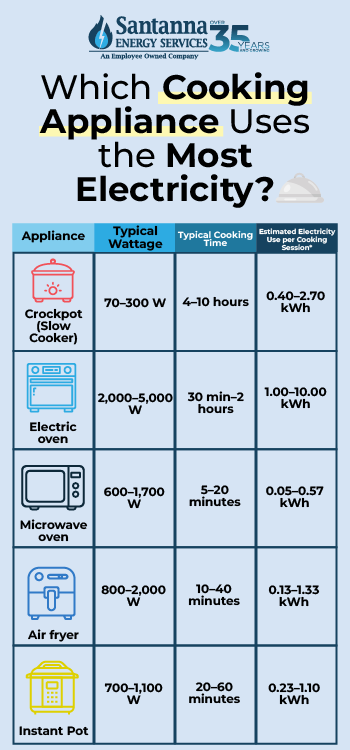
Crockpot vs. Other Cooking Appliances: Which Uses More Electricity?
A Crockpot typically uses about 70 to 300 watts, which is much lower than many other cooking appliances. However, lower wattage does not always mean lower electricity use for the entire meal.
Crockpots are designed to cook food slowly over several hours, while other cooking appliances may use more power but run for much less time. This means both wattage and cooking time affect how much electricity an appliance actually uses.
Electricity Use of a Crockpot vs. Other Cooking Appliances
| Appliance | Typical Wattage | Typical Cooking Time | Estimated Electricity Use per Cooking Session* | What to Know |
| Crockpot (Slow Cooker) | 70–300 W | 4–10 hours | 0.40–2.70 kWh | Low wattage, but long cooking times can add up |
| Electric oven | 2,000–5,000 W | 30 min–2 hours | 1.00–10.00 kWh | Much higher wattage, although cooking time may be shorter |
| Microwave oven | 600–1,700 W | 5–20 minutes | 0.05–0.57 kWh | Higher wattage, but very short cooking times can keep total electricity use low |
| Air fryer | 800–2,000 W | 10–40 minutes | 0.13–1.33 kWh | Higher wattage, but typically cooks food much faster |
| Instant Pot | 700–1,100 W | 20–60 minutes | 0.23–1.10 kWh | Higher wattage than a Crockpot, but usually runs for much less time |
Note: Estimated electricity use is calculated from the lowest wattage with the shortest cooking time and the highest wattage with the longest cooking time shown. These estimates assume continuous operation at the listed wattage. Actual electricity use varies by appliance, model, cooking time, temperature or setting, preheating, and how the appliance cycles while heating.
As you can see, higher wattage does not always mean more electricity use for the entire meal. Cooking time matters too. For the best comparison, look at the total kWh used per cooking session, not watts alone.
How to Use a Slow Cooker Without Wasting Electricity
Using a slow cooker efficiently is mostly about avoiding unnecessary cooking time and heat loss. You don't need to change the way you cook. A few simple habits can help you get the convenience of slow cooking without using more electricity than necessary.
- Match the slow cooker size to your meal. If you usually cook smaller portions, you may not need a large slow cooker. Choose a size that fits the amount of food you regularly prepare.
- Keep the lid closed. Opening the lid lets heat escape, and your slow cooker has to heat back up. Check your food only when necessary.
- Choose Low or High based on the recipe. High may use more power but cook food faster, while Low cooks more slowly. Neither setting is automatically more energy-efficient, so use the setting recommended for your meal.
- Don't leave Warm on longer than needed. Warm still uses electricity. Once you're finished serving the meal, follow food-safety guidance and your manufacturer's instructions for storing leftovers.
- Use the right appliance for the meal. A slow cooker makes sense for meals that benefit from hours of slow cooking. For quickly heating a small portion or cooking something in a few minutes, another appliance may use less electricity overall.
- Skip unnecessary preheating. Many slow cooker recipes don't require preheating. Unless your recipe or manufacturer recommends it, there's usually no reason to run the Crockpot empty beforehand.
- Measure your actual electricity use. If you're curious about exactly how much electricity your slow cooker uses, a plug-in electricity monitor can measure its kWh during a real cooking session.
The goal is simple: use the electricity you need to cook the meal, without using more than necessary. Keeping the lid closed, following the right cooking time, and choosing the right appliance for the job can all help.
FAQs
Does a Slow Cooker Use Less Electricity Than an Oven?
Yes, a slow cooker generally uses less electricity than a full-size electric oven, using about 0.40 to 2.70 kWh per cooking session, compared with 1.00 to 10.00 kWh for an electric oven. Based on our estimates, that's about 0.60 to 7.30 kWh less electricity per cooking session.
How Many Amps Does a Crockpot Use?
A Crockpot using 70 to 300 watts would draw about 0.6 to 2.5 amps on a 120-volt household circuit. You can estimate your Crockpot's amperage by dividing its wattage by voltage. Your actual amperage will depend on your specific model and how much power it draws while operating.
Does a Crockpot Use Electricity When Plugged In but Turned Off?
A manual Crockpot generally does not use meaningful electricity when switched to Off, while some digital models may use a small amount of standby power for electronic controls or displays. Standby use varies by model, so a plug-in electricity monitor is the best way to measure it.
How Much Does It Cost to Run a Crockpot for 8 Hours?
Running a Crockpot for eight hours can cost about $0.15 to $0.40 based on our 100- to 270-watt examples and the U.S. average residential electricity price of 18.44 cents per kWh as of May 2026. Your actual cost depends on your Crockpot's wattage, how it operates while heating, and your electricity rate.
Is It Safe to Leave a Crockpot on Low Overnight?
Yes, it can be safe to leave a Crockpot cooking on Low overnight when you follow the manufacturer's instructions and the recommended cooking time for your recipe. Keep the Crockpot turned on, covered, and placed on a stable, heat-resistant surface, and follow proper food-safety guidance.
A slow cooker may cook for hours, but long cooking time does not automatically mean high electricity use. What matters is your slow cookers' wattage, how long it runs, and your electricity rate. Knowing these numbers can help you understand what each meal may add to your electric bill.
And while knowing how much electricity your slow cooker and other appliances use can help you better understand your energy costs, you may also want more predictability in the supply portion of your electric bill. With Santanna's Unlimited Energy plan, you can enjoy a predictable monthly electricity supply charge within your plan's terms, so normal changes in electricity use from cooking, cooling, and everyday life don't automatically change that supply charge.* Explore Unlimited Energy and see if it's the right fit for your home.
Cook the meals you love, understand the energy you use, and make your household energy costs a little easier to plan for.
* Restrictions apply. Enrollment based upon program eligibility. Customers using more than 125% of normal monthly usage as determined by Santanna may be required to switch plans.
Jenna Mendez is an experienced energy content professional who has spent four years researching, writing, and managing authoritative educational content for Midwest energy consumers at Santanna Energy Services. As a lifelong Illinois resident, Jenna brings firsthand knowledge of the region’s climate, communities, and household energy needs to her work.
She specializes in translating complex energy topics into clear, practical guidance about electricity and natural gas costs, appliance energy use, energy efficiency, and everyday home living. Drawing on industry research, Santanna customer data, and insights from experienced energy professionals, Jenna incorporates this knowledge into her content to help homeowners better understand their energy choices and make informed decisions for their households.