

How Much Does a Whole Home Battery Backup Cost? Price, Tax Credits and Savings Explained

by Brennan Lambrecht
Updated: October 15, 2026
12 min read

Key Points of This Article:
- A whole home battery backup system can cost between $12,000 and $22,000.
- Potential savings vary by household and may be highest for homeowners with time-of-use electricity rates, rooftop solar, high energy costs, or access to Virtual Power Plant programs.
- Federal, state, and utility incentives may help reduce costs, but eligibility depends on installation timing, location, and current program rules.
- For many homeowners, the biggest value of a whole home battery is reliable backup power during outages rather than immediate monthly bill savings.
Many homeowners assume a whole home battery backup has one fixed price or that buying one will automatically save them money. In reality, the total cost can vary by thousands of dollars depending on the battery size, installation, available tax credits, and how you plan to use it.
If you're thinking about adding a battery to your home, it's normal to wonder whether it's worth the investment. Between different price estimates, federal incentives, and claims about lowering electric bills, it can be difficult to know what you'll actually pay and whether a battery makes financial sense for your household.
At Santanna, we're here to help you understand what goes into the cost of a whole home battery backup, what incentives may be available, and when a battery can actually help lower your energy costs.
By the end of this guide, you'll know what affects the price, how tax credits and potential savings fit into the equation, and the key factors to consider before deciding if a whole home battery is the right investment for your home.
How Much Does a Whole Home Battery Backup Cost?
A whole home battery backup system can cost between $12,000 and $22,000 for a typical setup depending on brand.
The final cost depends on several important factors:
- How much of your home you want to power. Systems that only support essential needs like lights and refrigerator cost less than systems designed to power most or all of the home. The more you want to power your home, the more costly your system will be.
- Battery size and storage capacity. Larger batteries that store more electricity cost more but can power your home for longer during outages.
- Installation requirements in your home. Some homes may need electrical upgrades, such as panel changes or wiring adjustments, before installation is possible.
- Labor and installation work. The complexity of installation can affect the total price depending on how your home is set up.
- Permits and local requirements. Some areas require permits or inspections, which can add to the overall cost and timeline.
In simple terms, the more power you want and the more work your home needs to support the system, the higher the total cost will be.
Every home is different, so the combination of these factors determines the final installation cost. Knowing what affects the price can help you compare quotes and ask informed questions before work begins.
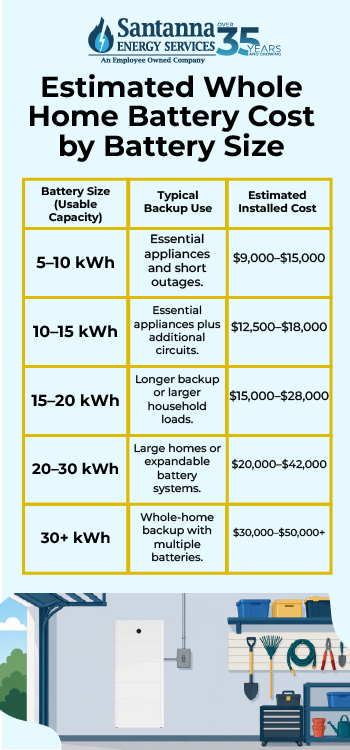
Estimated Whole Home Battery Cost by Battery Size
| Battery Size (Usable Capacity) | Typical Backup Use | Estimated Installed Cost |
| 5–10 kWh | Essential appliances and short outages | $9,000–$15,000 |
| 10–15 kWh | Essential appliances plus additional circuits | $12,500–$18,000 |
| 15–20 kWh | Longer backup or larger household loads | $15,000–$28,000 |
| 20–30 kWh | Large homes or expandable battery systems | $20,000–$42,000 |
| 30+ kWh | Whole-home backup with multiple batteries | $30,000–$50,000+ |
Note: Estimated installed costs are based on current market pricing and vary by battery brand, installation complexity, electrical upgrades, permits, and location. Costs are shown before applicable tax credits or incentives unless otherwise noted.
Popular Whole Home Battery Brands Compared by Installation Cost
| Battery Brand | Typical Battery Size Options | Estimated Installed Cost* |
| Tesla Powerwall 3 | 13.5 kWh | $16,200-$34,000 |
| FranklinWH | 15 kWh | $8,000 and $15,000 |
| Lunar Home Battery | 5-20 kWh | $20,000 to $42,000 |
| Enphase IQ 5P (includes two Enphase IQ 5P batteries) | 5 kWh | $15,000 |
| LG Energy Solution RESU | 9.8-16 kWh | $9,000 to $16,000 |
| Generac PWRcell | 9-18 kWh | $12,500-$18,000 |
*Prices are approximate and may represent different system configurations. Some manufacturers publish pricing before federal tax credits or incentives, while others may include different installation assumptions. Actual costs vary by installer, location, and system design.
How Much Money Can You Actually Save With a Whole Home Battery Backup?
A whole home battery can help lower your electricity costs, but the amount you can save depends heavily on how your utility prices electricity and how you use your battery. Home battery storage can reduce electricity costs under certain conditions, but actual savings will vary by household and energy market.
The potential savings are typically greatest for homeowners with time-of-use electricity rates, rooftop solar panels, or access to programs that compensate customers for participating in a Virtual Power Plant (VPP).
How Can a Battery Save Money With Time-of-Use Electricity Rates?
Time-of-use electricity rates charge different prices depending on when electricity is consumed. Electricity may cost less during off-peak hours and more during periods of high demand.
For example, imagine your electricity costs 10 cents per kWh during off-peak hours and 25 cents per kWh during peak hours.
If you charge your battery with 10 kWh of electricity during the lower-cost period and use that stored electricity instead of purchasing 10 kWh during the peak period, the difference in electricity prices would be:
10 kWh × ($0.25 − $0.10) = $1.50
If a household could shift 10 kWh of electricity use each day from peak to off-peak pricing, that creates a gross price difference of $1.50 per day or upwards of about $548 per year with the proper whole-home battery.
How Can Solar Panels Change the Savings?
Pairing a battery with rooftop solar changes the equation because the battery can store electricity your solar panels produce instead of immediately sending excess electricity to the grid.
Whether this saves you money depends heavily on your utility's net metering or solar compensation rules. If your utility provides full retail credit for excess solar generation, storing that electricity may provide less additional financial benefit than selling that energy back to the grid.
Which Homeowners Have the Greatest Opportunity to Save?
A battery generally has a stronger financial case when it can provide value in more than one way.
For example, a homeowner who has rooftop solar, pays time-of-use electricity rates and qualifies for a VPP program may have several opportunities to receive financial value from the same battery.
A homeowner with a flat electricity rate, no solar and no available VPP may receive little direct monthly bill savings and instead be purchasing the system primarily for backup power.
What Does a Whole Home Battery Really Cost Over Its Lifetime?
One of the biggest challenges to purchasing a whole-home battery is accounting for the large upfront cost. But over time, can the payback period of a whole-home battery be worth the upfront cost? While a battery may help lower electricity costs over time, how long it takes to financially offset that initial investment depends heavily on how the battery is used.
For a homeowner without solar who relies solely on time-of-use (TOU) arbitrage, the payback period can be lengthy. One 2026 analysis estimates that an $11,000 whole-home battery used for TOU arbitrage could take about 21 years to pay back.
That's because the annual savings from shifting electricity use may be relatively small compared with the upfront cost of the battery.
Financing Options for a Whole Home Battery Backup
Because whole home battery systems can cost tens of thousands of dollars, many homeowners choose to finance part or all of the installation.
Common financing options include:
- Paying Cash: Paying upfront avoids interest charges and allows you to immediately benefit from any available tax credits or incentives.
- Home Improvement Loans: Many banks and credit unions offer unsecured or secured loans specifically designed for energy-efficient home improvements. For example, organizations like Clean Energy Credit Union offers loans of $1,000 to $50,000 for a battery storage system.
- Installer Financing: Many battery manufacturers and installers partner with financing companies that offer fixed monthly payments or promotional interest rates.
- Home Equity Line of Credit (HELOC): Homeowners with sufficient equity may use a HELOC to finance the project, often at lower interest rates than personal loans.
- Solar Loans: If you're installing a battery alongside a new solar system, many installers offer bundled financing that covers both systems together.
Before choosing financing, compare interest rates, loan terms, monthly payments, and any fees to understand the total long-term cost.
Are There Incentives or Tax Credits for Whole Home Batteries?
Some homeowners may be able to qualify for financial incentives when installing a whole home battery backup system, but availability depends on federal rules, state programs, and local utility support.
As of 2026, the federal Residential Clean Energy Credit is no longer available for new battery storage installations. The federal credit previously allowed eligible homeowners to claim 30% of qualifying costs for battery storage systems, but legislation enacted in 2025 ended the credit.
Homeowners who installed an eligible battery system between December 31, 2021, and January 1, 2026 may still be able to claim the credit for the applicable tax year, subject to IRS requirements
While the federal tax credit has ended for new installations, some states offer programs or incentives that can help reduce costs for homeowners who install battery storage systems. These programs vary and may not be available in every location.
Because these incentives depend on where you live and your specific installation details, homeowners should always confirm eligibility through official state or utility sources before making any decisions.
In simple terms, there may be financial support available to help reduce the cost of a battery system, but it is not guaranteed and depends on your location and eligibility.
For homeowners in Illinois, the 30% federal tax credit may be available for eligible battery installations. Depending on your utility and where you live, additional battery storage or distributed energy incentives may also be available through programs offered by utilities such as ComEd or Ameren Illinois.
Additionally, customers in Illinois can qualify for a rebates for using batteries and other smart energy devices that help reduce strain on the grid and lower overall electricity costs. More details can be found here!
For homeowners in Ohio, eligible battery installations may also qualify for the 30% federal tax credit. While Ohio does not currently have a statewide residential battery rebate program, local utility or community incentive programs may occasionally be available.
For homeowners in Pennsylvania, eligible battery storage systems may qualify for the 30% federal tax credit. Although statewide residential battery rebates are limited, homeowners should check for local utility programs or other incentives that may help reduce installation costs.
Because incentive programs and eligibility requirements can change over time, it's always a good idea to verify the latest information through official federal, state, or utility resources before making a purchase decision.
Is a Whole Home Battery Worth the Cost?
For some homeowners, a whole home battery is worth the cost. For others, it may not be the right choice. The answer depends on how often you experience power outages, how much backup power you need, your budget, available tax credits, and the value you place on keeping your home powered during an outage.
A whole home battery is designed to provide reliable backup power, not immediate cost savings. Because of the upfront cost, it can take several years to more than a decade before the value of lower electricity costs and available incentives offsets the initial purchase price.
Depending on electricity rates, battery usage, and available incentives, a $10,000 system might take around 8 to 12 years to offset its cost, while larger systems may take 12 years or longer. The actual time depends on factors such as your electricity usage, battery size, local electricity rates, available incentives, and how often you use the battery.
For many homeowners, however, the biggest benefit isn't how long it takes to offset the cost. It's having backup power to keep essential appliances running during an outage, protecting refrigerated food and medications, staying connected, and reducing the disruption that comes with losing electricity.
Ultimately, whether a whole home battery is worth the cost comes down to your household's backup power needs, budget, and long-term energy goals. Looking beyond the purchase price can help you decide whether the added reliability and convenience are the right fit for your home.
Who Benefits Most Financially From a Whole Home Battery Backup?
A whole home battery may provide the greatest financial value for homeowners who:
- Experience frequent or prolonged power outages
- Live in areas with high electricity prices
- Are enrolled in time-of-use electricity plans
- Already own rooftop solar panels
- Work remotely and depend on reliable electricity
- Need uninterrupted power for medical equipment or other essential devices
- Can participate in a Virtual Power Plant (VPP) program
A whole home battery may provide less financial value if you:
- Rarely experience power outages
- Pay the same electricity rate throughout the day (no time-of-use pricing)
- Have relatively low monthly electricity usage
- Do not qualify for available incentives
- Only want backup power for occasional short outages and a portable or standby generator would meet your needs at a lower upfront cost
FAQs
Can one battery power an entire house?
Yes, one whole home battery can power an entire house if it has enough storage capacity and output for your home's electricity needs, although many homes require multiple batteries for full-home backup.
Is a whole home battery cheaper than a generator?
Not usually, as whole home batteries generally cost more upfront than generators, but they can have lower operating and maintenance costs because they don't require fuel.
A whole home battery can be a valuable addition to some homes, but it isn't the right choice for everyone. The best option depends on your household's backup power needs, how often you experience outages, your budget, and the value you place on keeping your home powered when the grid goes down.
Understanding what affects battery costs, available tax credits, battery lifespan, and the amount of backup power you actually need can help you choose a system that fits your home instead of simply choosing the biggest or most expensive one.
Preparing your home doesn't stop with backup power. Everyday energy choices matter, too.
Santanna's Unlimited Energy Plan offers more predictable electricity supply charges and fewer surprises on the supply portion of your bill, helping make your monthly energy costs easier to plan for throughout the year.** Explore Unlimited Energy plan to see how it can complement your overall approach to managing your home's energy needs with greater confidence.
** Restrictions apply. Enrollment based upon program eligibility. Customers using more than 125% of normal monthly usage as determined by Santanna may be required to switch plans.
Brennan Lambrecht is a marketing professional with six years of experience in creating helpful content for customers. At Santanna, Brennan focuses on researching emerging energy technologies, including virtual power plants, distributed energy resources, home battery storage, and energy-grid innovation. His research is informed by direct conversations with companies operating in the virtual power plant and battery storage space, giving him valuable industry insight into how these technologies work and what they could mean for energy consumers.