
How To Avoid Utility Scams: What Homeowners Should Know

by Chris Tessler
37 min read

Utility scams are increasing, and many of them look surprisingly legitimate. They can arrive as phone calls, emails, text messages, or even someone knocking at your door. Because every household relies on electricity and natural gas, scammers know energy-related messages get immediate attention.
In fact, in a recent internal survey, 25% of our employee‑owners reported being contacted by someone impersonating a utility or energy supplier. This firsthand data highlights how common and convincing these scams can be.
For homeowners, especially during high-bill seasons or extreme Midwest weather, energy communication already feels serious. Scammers take advantage of that. Scammers rely on urgency and confusion to push people into quick decisions before there is time to verify what is real. But luckily, you don't have to deal with scams alone.
At Santanna Energy Services, we have been trusted as a reliable energy supplier serving the Midwest for more than 35 years, that have helped customers understand how legitimate utility and supplier communication works. And we can help you too.
When you know what real companies will and will not do, it becomes much easier to recognize when something feels off.
In this guide, we'll cover how utility scams typically work, the most common tactics to watch for, and the practical steps every homeowner should take to avoid becoming a target. Let's get started on how you can protect yourself.
Key Points of This Article:
- Utility scams are widespread and increasingly sophisticated, with scammers impersonating real utility companies to pressure homeowners into urgent payments or sharing personal information.
- Common scam tactics include shutoff threats, fake emails or texts, caller ID spoofing, door‑to‑door visits, and unauthorized supplier switching (“slamming”), all designed to create fear, confusion, or false trust.
- Legitimate utility companies never demand immediate payment, request gift cards or cryptocurrency, refuse call‑backs, or ask for sensitive information through unsolicited contact, making these actions clear red flags.
- Homeowners can protect themselves by slowing down, independently verifying contacts using official utility channels, avoiding suspicious links or payments, and reporting scam attempts to utilities and federal authorities.
What Is a Utility Scam and How Does It Work?
A utility scam describes when someone pretends to be connected to your electricity or gas utility to get your money or personal information.
They might claim to represent your local utility company, an energy supplier, a billing department, or even an energy assistance program that contacts you about a problem with billing or claiming your utility services will be shut off.
When it comes to utility scams, this contact can come through a phone call, text, email, or an unexpected visit to your door.
The Federal Trade Commission explains that many utility scams follow a predictable pattern:
The caller claims to be from your gas, water, or electric company and threatens immediate utility shutoff unless you pay. They often demand hard-to-trace payments like wire transfers, gift cards, reloadable cards, or cryptocurrency. Once money is sent through these methods, it is usually very difficult to recover.
Commonly, the scammer begins with an automated robocall or pre-recorded message telling you to "press 1" to speak with a representative. In other cases, it may be a live person using a prepared script. With newer technology, some scammers even use AI-generated voices that sound calm and realistic.
What makes utility scams convincing is not complexity, but urgency and familiarity. The real goal is to get you to act fast, before you have time to verify.
If someone is pressuring you to pay right now, click a link, or share sensitive information without allowing you to confirm it through official channels, treat it as suspicious and verify directly using the phone number on your bill or the company's verified website.
Why Do Utility Scams Target Homeowners?
Utility scams target homeowners because energy is essential for everyday home comfort, and scammers know most people will pay attention the moment their comfort is threatened.
Everyone relies on natural gas and electricity to power their homes and to keep their home life in balance and their daily routines going.
Another reason is trust. Utility companies are established institutions. They send real bills, real notices, and real service updates. Because homeowners are used to receiving legitimate communication from utilities, a scam message can blend in more easily than a message pretending to be from an unfamiliar company.
There is also the issue of complexity. Energy bills include supply charges, delivery charges, usage totals, taxes, and rate structures. In deregulated states like Illinois, Ohio, and Pennsylvania, there may also be a separate energy supplier listed, adding more detail to an electricity bill. When billing language feels technical, scammers can misuse those terms to sound convincing.
In the same way, public information makes targeting easier as well. Names, addresses, and phone numbers are often available through data brokers or in previous data breaches.
If your utility company doesn’t have proper IT safety in place, your account information could be at risk. When a scammer already knows your address, their messages feel more personal, even though that information may not be private.
With this in mind, you can recognize these tactics and learn how to respond calmly instead of reacting quickly.
Are Utility Scams Common in the U.S.?
Utility scams are extremely common in the U.S., and they tend to spike when the weather (during the summer and winter) and when high bills make people feel alarmed at their high bills during peak energy seasons.
A 2025 report covered by Yahoo Finance found that nearly 1 in 5 (18%) Americans reported being targeted by a utility scam. Making utility scams more common than you think.
Many respondents from this study also said scam attempts increased during natural disasters or extreme weather events. The Federal Trade Commission has warned that scammers often follow storms and outages, sending messages that appear to come from utility companies and demanding payment for restoration or account verification.
This seasonal pattern is important to understand because weather creates urgency and urgency lowers caution. The safest mindset is simple and steady. If a message about your energy service feels rushed or pressuring, treat it as suspicious until you verify it through official channels.
The Most Common Types of Utility Scams and Their Tactics
Now that you know how common utility scams can be, here’s what they may look like and how to spot them. Utility scams follow familiar patterns. They look official, sound confident, and try to create just enough urgency to push you into acting before you verify.
Below are the most common types of utility scams and the tactics Midwest homeowners may encounter:
Technique 1: Shutoff Threat Phone Calls (Utility Bill Scam Calls)
Utility bill scam calls often threaten to shut off your utility services and usually come as an unexpected phone call that sounds urgent and serious. The caller may sound official and reference your account and claim they’re a representative from your utility company.
What they are trying to steal is immediate payment, sensitive financial details, or your utility account number (UAN), before you have time to verify the claim.
Utility scammers on the phone may say or do:
- “Your electricity will be shut off within the hour.”
- “This is your final notice.”
- “We sent previous notices that you ignored.”
- “Stay on the line while you make payment.”
- “You must pay right now to stop service interruption.”
- Refuse to let you hang up and call back.
- Use aggressive or intimidating language.
- Demand payment through gift cards or payment apps.
- Spoof the real utility’s phone number on your caller ID.
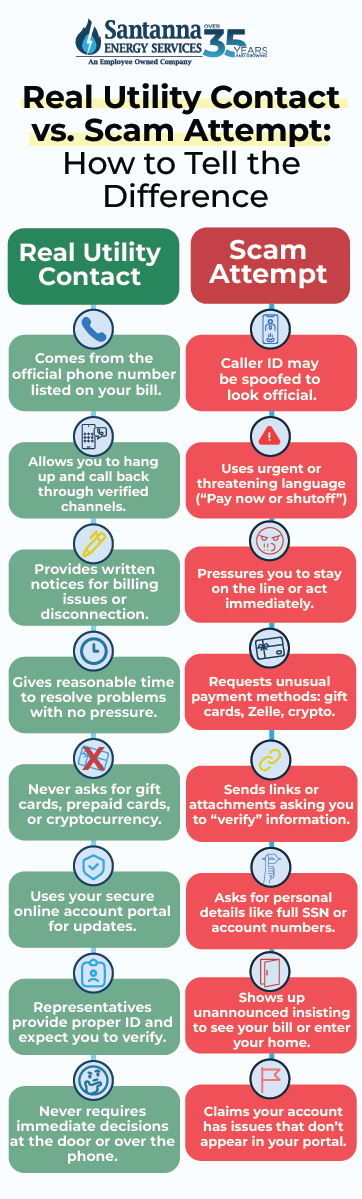
Utility bill scam calls work by creating panic. When someone feels rushed, they are less likely to verify. A legitimate utility will never demand immediate payment over the phone or prevent you from calling back to confirm.
If their words seem urgent or said to scare you, you’re likely dealing with a utility scam.
Technique 2: Slamming (Unauthorized Energy Supplier Switching)
Slamming often looks like a routine rate check or contract update, but it’s not.
According to Santanna Energy Services General Counsel Thomas Tynes, unauthorized supplier switching is already prohibited under consumer protection regulations.
Thomas says, “Unauthorized supplier switching occurs when a customer’s gas or electric provider is changed without the customer’s knowledge or consent. This practice, often called ‘slamming,’ is prohibited in most states. Regulations typically require proof that a customer knowingly agreed to enroll in a new energy product before a supplier change can occur.”
In this situation, the scammer is trying to gain your verbal or written authorization to switch your supplier without your full understanding, either on the phone or at the door.
Scammers attempting “slamming” may say or do:
- “We just need to verify your current rate.”
- “Your contract expires today.”
- “We are updating accounts in your neighborhood.”
- “This switch will lower your bill immediately.”
- Ask to see your utility bill to confirm your account number.
- Present paperwork that looks like a simple rate comparison.
- Record a call in a way that sounds like authorization.
- Use vague language to get you to say “yes.”
This tactic relies on confusion and rushed agreement, and it’s important to know that you are never required to switch suppliers immediately or even at all if there’s no issues with your service.
Legitimate supplier changes require clear authorization, enrollment online through your new supplier’s website, or by calling your supplier directly through their verified number for assistance. Suppliers should never call you directly, urging or pressing you to switch your energy supplier.
If you believe your supplier was switched without your permission, you can file a complaint with the Federal Communications Commission. Contact the FCC Consumer Center at 1-888-CALLFCC (voice) or 1-888-TELLFCC (TTY) for guidance on reporting slamming and understanding your rights.
Technique 3: Caller ID Spoofing Energy Scams
Modern technology is super sophisticated. Caller ID spoofing makes utility bill scam calls appear as though it is coming from your real utility. The number or name on your screen may match the official company number or name.
The goal is to steal personal or payment information by building instant trust. When you see the legitimate number and name of your utility company, you’ll be more inclined to pick up the phone and engage, since a customer might think there’s something wrong with their account.
Scammers may:
- Claim they are from the billing department.
- Provide a fake employee ID number.
- Reference your address.
- Say they are calling about your recent electric bill.
- Sound calm and professional.
- Insist you cannot call back because the line is direct.
When a familiar number appears, it is easy to lower your guard. Real representatives from your utility and supplier will always allow you to hang up and call the official number listed on your bill.
Technique 4: Fake Utility Bill Emails (Phishing Attempts)
Electric bill scams usually arrive as an email that looks like a real bill or urgent account notice. The message may appear polished and official, complete with an official logo and seemingly legitimate email address.
The scammer’s goal is to get you to click a link or download an attachment that collects your login or financial details.
Scammers may:
- Send a utility bill fake PDF attachment.
- Use subject lines like “Immediate Payment Required.”
- Include company logos.
- Claim your account is suspended.
- Ask you to confirm account information.
- Provide links that resemble the real website.
- Urge you to click before a deadline.
Electric bill scams rely on quick clicks and customers who are off their guard. Legitimate energy utilities and suppliers do not require you to confirm sensitive information through unsolicited email links and require you to download anything to see your bill.
Technique 5: Smishing Text Message Scams
Smishing scams, or SMS phishing scams, come through text messages. KeepNet reports that smishing click-through rates range from 19-36% making these quick text‑based attacks surprisingly effective.
They are usually designed to be brief, urgent, and to feel immediate. The goal is to get you to tap a link in the text message that leads to a fake payment or login page.
Smishing scams may say or do:
- “Your electric bill is overdue.”
- “Service suspended. Click here.”
- “Refund pending. Confirm now.”
- Include shortened links.
- Set short response deadlines.
- Claim immediate action is required.
Because texts often look like routine alerts, many people click without thinking. However, legitimate utility companies do not request payment, personal information, or account verification through random text links.
If a message urges quick action, includes a shortened URL, or feels even slightly out of place, it’s best to treat it as suspicious.
Technique 6: Door-to-Door Utility Scams
Door-to-door utility scams involve someone appearing at your home claiming to represent a utility or supplier. It may look official at first glance, but they have the ultimate goal of trying to collect your account information or signature so they can enroll you in services you never agreed to or misuse your personal details.
Door-to-door utility scammers may:
- Ask to see your utility bill.
- Claim they need to verify your meter number.
- Say they are working with your utility.
- Imply rates are changing immediately.
- Flash a badge briefly.
- Ask to enter your home.
The pressure of a face-to-face interaction can make it harder to say no. Real utilities and energy suppliers never require you to show your bill or allow entry into your home without verification.
Legitimate representatives expect you to take your time, confirm their identity, and contact your utility directly if something feels off. They will not rush you, pressure you to make on‑the‑spot decisions or insist on seeing documents that reveal personal account details.
If someone pushes for immediate access or tries to create a sense of urgency at your door, it’s a strong sign that the interaction is not legitimate.
Technique 7: Overpayment Claims and Refund Energy Scams
These types of attacks can come from anywhere, whether it’s through the phone, email or even at your front door.
Refund energy scams sound helpful rather than threatening, claiming that you overpaid and are owed money back, but the real objective is to collect your bank account details or trick you into sending money back.
Scammers often create a sense of relief or excitement, making the offer feel like a bonus or a reward you didn’t expect. They may send what looks like a legitimate check in the mail, where the check bounces, leaving you liable for the lost money.
They also might ask you to “verify” your banking information, or claim a refund must be processed immediately. Once you engage, they use urgency and confusion to get you to act quickly.
Refund energy scammers may say or do:
- “You overpaid your electric bill.”
- “You qualify for a refund.”
- Ask for banking details.
- Send a fake check.
- Request partial repayment.
- Create urgency to claim the refund.
Refund language can lower suspicion and get you excited about the possibility of more money, but legitimate utilities do not request sensitive financial information through unsolicited contact to process credits.
Technique 8: Meter or Equipment Inspection Scams
Meter inspection scams typically begin with someone claiming there is an urgent technical problem with your meter or other energy equipment.
In most cases, these scammers are attempting to gain access to your home under the pretense of performing a required inspection or repair. Once inside, they may insist on immediate payment for supposed emergency services, pressure you to sign documents, or gather account details they can use for fraudulent activity.
Meter scammers may say or do:
- “Your meter is malfunctioning.”
- “Your high bill is due to faulty equipment.”
- “We need to test your wiring.”
- Ask to enter your home immediately.
- Request payment for emergency repairs.
- Ask for your account number.
- Wear generic safety vests.
Legitimate utilities, however, provide advance notice for scheduled inspections, clearly identify themselves, and never demand payments for malfunctioning equipment.
Technique 9: Emergency-Related Utility Scams
According to the Federal Trade Commission, utility scams occur most often in winter or after severe weather. So, when the weather is severe, people expect updates from their utility companies, making them more likely to trust unexpected calls, messages, or emails that appear urgent about their services.
This gives scammers the perfect opportunity to use real events to make their message feel urgent and legit. Their goal is to exploit stress and distraction, and when you’re worried about losing heat during a cold snap or restoring power during an outage, you’re far more likely to give in to high‑pressure tactics.
Scammers may say or do:
- “Emergency disconnection policies are in effect.”
- “Pay now to restore priority service.”
- “Your service is at risk due to weather.”
- Impersonate emergency crews.
- Reference real storm events.
- Send urgent outage texts.
- Claim new emergency rates require confirmation.
Stressful situations can cloud judgment. During real emergencies, utilities won’t demand immediate payment for restoration or priority treatment. Utilities will often text you with updates regarding your service and work at their own pace, restoring power over time while not prioritizing one house over another.
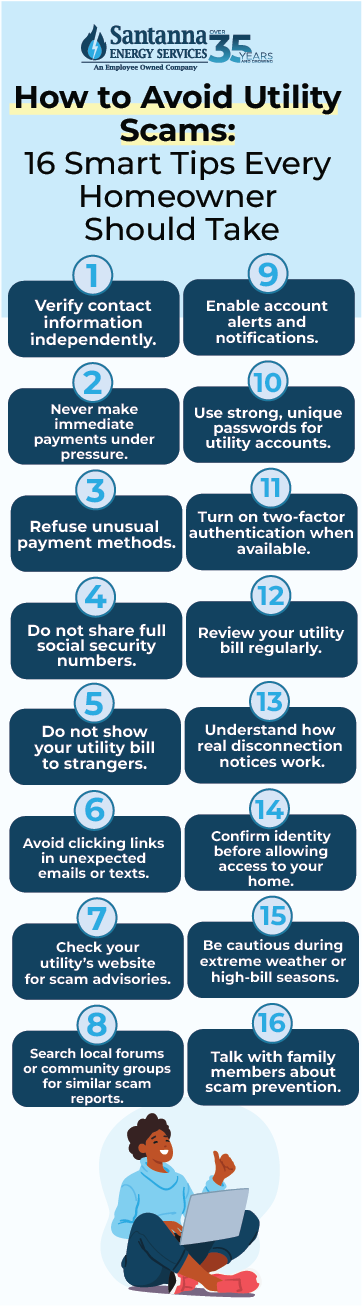
How to Avoid Utility Scams: 16 Smart Tips Every Homeowner Should Take
Now that you know how utility scams work and what the most common techniques are, avoiding them can be easy with a few steady habits. Here are practical steps every homeowner can take to avoid utility scams:
1. Verify Contact Information Independently
When calling your utility company, always use the official phone number printed on your utility bill or listed on the company’s verified website. Do not rely on phone numbers provided in calls, texts, or emails, since scammers often use fake callback numbers.
A helpful habit to avoid utility scams over the phone is to save your utility’s official customer service number in your phone. That way, if something feels suspicious, you can call the trusted number you saved instead of reacting to the one that contacted you.
2. Never Make Immediate Payments Under Pressure
If someone says you must pay within minutes to avoid a problem, pause. Electric bill scams often use pressuring language to get you to agree to something quickly. Legitimate utilities provide written notices and a reasonable time to resolve billing issues. Pressure is a scammer’s strongest tool.
Slowing down protects you from making a rushed decision that you cannot undo. Take a minute to process what you’re being asked and take the time you need to verify your options and fact check.
3. Refuse Unusual Payment Methods
Utility companies never request payment through gift cards, cryptocurrency, prepaid debit cards, or peer-to-peer apps like Zelle or Venmo. These payment methods are difficult to trace and almost impossible to recover. Saying no to these options immediately removes most scam risk and it’s the easiest way you can learn how to avoid utility scams
4. Do Not Share Full Social Security Numbers
Most utilities will not ask for your full Social Security number during an unexpected call. Once shared, that information can be used far beyond a single scam. Protecting it protects more than just your energy account.
At the very most, your utility may ask for your utility account number to verify your account information, but even that information should be protected too and shouldn’t be given to anyone other than your utility provider or energy supplier.
5. Do Not Show Your Utility Bill to Strangers
Your energy bill contains your account number and personal details. If someone comes to your door asking to “verify” your rate, do not hand it over and believe them immediately. That document gives scammers the exact information they need to impersonate you or switch your supplier without permission.
Always ask for verification first to ensure they are who they say they are.
6. Avoid Clicking Links in Unexpected Emails or Texts
Instead of clicking links in messages, type the company’s website directly into your browser and log in to your account from there. Fake links often lead to imitation websites designed to collect passwords and payment details. Logging in manually keeps you in control. Here are a few simple ways to spot a fake link before you accidentally click it:
- Hover over the link (without clicking) to preview the real URL. If it doesn’t match the company’s official website, or looks slightly “off”, it’s likely fraudulent.
- Look for misspellings or extra characters, such as “santana‑energy.com” instead of “santannaenergyservices.com,” or unusual extensions like “.info,” “.xyz,” or “.support” when you expect “.com.”
- Beware of shortened links, like bit.ly or tinyurl, especially if the sender is unfamiliar or the message feels urgent. Scammers often use these to hide malicious destinations.
- Check for subtle impersonation tricks, such as swapped letters (e.g., “rn” instead of “m”), added numbers, or hyphens to mimic real brands.
- Be cautious of links that take you to a login page immediately. Legitimate utilities rarely send login-required alerts without directing you through their main homepage.
- If the message pressures you to click quickly, treat the link as suspicious. Real companies do not use urgency to force immediate action.
7. Check Your Utility’s Website for Scam Advisories
Many utilities post scam alerts on their official websites. If something feels off, check the company’s site to verify. You may find that others have reported the same tactic. That confirmation can save you from engaging further.
If there’s nothing on the website that flags this, make a quick call to your utility or supplier’s official call center to check with a real person. A quick call now could save you a lot of frustration later.
8. Search Local Forums or Community Groups for Similar Scam Reports
Before responding to suspicious contact, look at trusted neighborhood forums or community groups. Scams often hit multiple households in the same area, and seeing similar reports can quickly confirm your suspicion.
For an extra layer of protection, as we’ve said before, give your utility a quick call to voice your suspicions to their call center team so they can verify directly whether any real issue exists on your account.
9. Enable Account Alerts and Notifications
Most utilities allow you to set up billing and account alerts by email or text. These notifications help you know what real account activity looks like and where official alerts come from. When you receive a message outside those alerts, you will recognize it faster.
10. Use Strong, Unique Passwords for Utility Accounts
Avoid reusing passwords across different accounts. If one account is compromised elsewhere, reused passwords make it easier for scammers to access your utility account too.
As a rule of thumb, your password should be a minimum of 14 to 16 characters long and should have a mix of capital letters and special characters.
11. Turn On Two-Factor Authentication When Available
Two-factor authentication adds an extra step when logging in, usually through a code sent to your phone. Even if someone gets your password, they still cannot access your account without that second code.
12. Review Your Utility Bill Regularly
Take a few minutes each month to review your bill carefully. Look for unfamiliar supplier names, unexpected rate changes, or new charges. Catching changes early prevents bigger problems later.
A fake utilities bill may also include subtle inconsistencies such as slightly altered or pixilated logos, unusual account numbers, misspelled company names, incorrect billing periods, or payment instructions that don’t match your normal process.
Scammers often use urgent language or highlight “immediate payment required” in bold or red text to pressure you into reacting quickly. If anything on your bill looks different from what you typically see, it’s worth verifying through your official online account or by calling your utility directly. This is one of the easiest ways you can learn how to avoid utility scams
13. Understand How Real Disconnection Notices Work
Utilities typically send written notices and provide time to resolve unpaid balances before utility disconnection.
Utilities cannot typically disconnect service without a documented process, Santanna Energy Services General Counsel Thomas Tynes says.
“Disconnection usually occurs only after prolonged non-payment and after the utility provides warning notices,” he explains. “In many states, disconnections may also be restricted during extreme weather seasons because of health and safety concerns.”
Knowing this removes the fear that scammers rely on. If someone threatens immediate shutoff without notice, that is a strong red flag.
14. Be Cautious During Extreme Weather or High-Bill Seasons
Scam activity often increases during winter heating and summer cooling months in the Midwest because energy is essential for comfort during large swings in the season. When bills are higher and stress is already present, scam messages can feel more believable. Staying aware during these seasons makes you less vulnerable.
15. Confirm Identity Before Allowing Access to Your Home
If someone claims to represent your utility, ask for identification and verify through official contact channels before allowing entry. Legitimate inspections are typically scheduled or communicated in advance. You never have to allow immediate access without verification.
16. Talk With Family Members About Scam Prevention
Make sure seniors, renters, and young adults in your household understand common scam tactics. A simple rule like “call and verify before paying” can prevent emotional decisions. When everyone in the home knows the plan, scammers lose their advantage.
These steps are simple, but they are powerful. Utility scams depend on urgency and confusion. When you slow down, verify independently, and know what real utilities will and will not do, you protect both your home and your peace of mind.
What Our Internal Survey Revealed About How People Handle Utility Scam Attempts
In our internal survey, employee‑owners not only reported how often they were contacted by scammers, but also how they responded in the moment. A clear theme emerged: people pause, verify, and avoid engaging directly with suspicious messages.
- “I Googled it.” Many employees quickly search the phone number, subject line, or message text to see if others have reported it as a scam.
- “I normally log into my online account to verify.” Instead of clicking links or calling back unknown numbers, they go straight to the official customer portal to confirm whether any alert is real.
- “I check the email address.” Several noted they receive suspicious emails and examine the sender’s domain and header details before taking action.
- “Ignored it.” Some choose not to engage at all, often the safest immediate response when a message feels even slightly off. But we recommend taking action by checking your account and calling your utility to verify.
What Real Utility Companies and Energy Suppliers Never Do
Real utility companies and energy suppliers follow clear policies and documented processes. They do not rely on fear, surprise, or secrecy.
Here are a few things legitimate companies will never do:
- Show up unannounced demanding payment at your door without proper identification. Field representatives are not sent to collect cash or payment on the spot.
Consumer protection laws require utilities and energy suppliers to clearly identify themselves and explain who they represent when interacting with customers.
“Consumer protection regulations require various verbal or written disclosures when a utility or supplier first interacts with a customer,” explains Santanna Energy Services General Counsel Thomas Tynes. “Agents must clearly identify themselves and the company they work for, and suppliers typically send written follow-up communication confirming enrollment and explaining the customer’s rights and responsibilities.”
- Change your supplier without documented authorization. Supplier switches require proper consent and confirmation under state and federal rules.
- Ask you to keep a billing issue secret or avoid contacting customer service. You should always feel free to verify through official channels.
- Refuse to provide written documentation. Legitimate billing issues, rate changes, or disconnection notices are documented in writing.
- Pressure you to bypass your normal account portal. Real companies encourage customers to log into their official accounts to confirm details.
- Threaten legal action within minutes. Real collections and disconnection processes follow regulated timelines, not instant ultimatums.
If a contact does not follow standard utility procedures, it is safest to pause and verify through the official phone number printed on your bill or the company’s verified website.
How To Verify a Utility Company Contact Safely
You can verify a utility company contact safely by pausing the conversation and checking your account through official channels like their official customer portal or website. Or by calling your utility’s call center directly to double-check their contact information.
Most homeowners have had that moment where a message sounds urgent and you wonder if you should respond right away. The safest move is to slow it down. Real utilities and energy suppliers understand verification, and scammers usually try to prevent it.
Here is a simple process you can follow every time to protect yourself from utility scams:
- Do not respond directly. Do not reply to the text, click the link, or call back the number that contacted you. That is often how scams pull you in.
- Find the official number on your bill or the company’s official website. Use the phone number printed on a recent statement or listed in the official contact section online.
- Call and verify. Ask one clear question: “Is there any issue or notice on my account right now?” If it is real, they will confirm it.
- Log into your official account portal. Instead of trusting what the message says, check your account directly for notices, balance details, or alerts.
If you follow this routine, you do not have to guess whether a message is legitimate. You will know, and you will stay in control.
How AI and Technology Are Making Utility Scams Harder to Spot
AI and modern tech are making utility scams harder to spot because scams can look and sound more real and legitimate than ever before.
You have probably noticed it yourself. Some scam emails do not have obvious typos anymore, and some calls sound calm and professional with “real voices”. Even the phone number on your screen can look like it belongs to a real company. That is not your imagination. Scammers are using better tools.
The FBI has warned that cyber-enabled fraud is being accelerated by artificial intelligence. In the first seven months of 2025, AI-related activity drove more than 9,000 complaints to the FBI’s Internet Crime Complaint Center, and those complaints covered many kinds of scams.
AI-generated scams included:
- More convincing scripts: Scammers can sound polished and prepared, with the right phrases and a confident tone.
- Spoofed numbers: Caller ID can be faked, so the call may appear to come from a real utility or supplier.
- Realistic-looking messages: Emails, texts, and attachments can look official, with logos and formatting that feel familiar.
- Fake identities: The FBI notes fraudsters can use tech to create fake profiles, voice clones, identification documents, and even videos that look believable.
And you should bet that these practices are used in sophisticated utility scams too.
If you do get targeted, report suspicious activity to the IC3 at ic3.gov. When you report, it helps to include who contacted you, how they contacted you (phone, email, website), any payment details, and a short description of what happened.
How Can You Protect Yourself From AI-Powered Utility Scams?
AI makes scams more polished, but it does not change how real utility companies operate. The key difference with AI-related scams is not new payment methods. It is realism. Messages may sound clearer, emails may look professional, and even voices may seem natural.
Instead of focusing on how convincing something sounds, focus on whether it follows real utility procedures. Here’s what you can do to avoid AI-generated utility scams:
Expect Written Documentation for Serious Account Issues
AI may create urgency through calls or texts, but legitimate shutoff notices, supplier changes, and billing disputes are documented in writing and follow clear timelines. If there is no written record in your official account portal, treat the message as suspicious.
To verify if these written documents are official, call your utility’s call center to confirm.
Understand That Familiar Details Do Not Prove Legitimacy
AI tools and data leaks allow scammers to reference your name, address, or recent storm events. That information may feel personal, but it does not confirm authenticity. Only official account access and verified customer service channels can confirm legitimacy.
Assume That Realism Is Now Easy to Fake
In the past, poor grammar or robotic voices were warning signs. That is no longer reliable. AI-generated emails, scripts, and voice messages can sound professional. That means the old rule of “it sounds fake” is no longer enough. The new rule is simple: verify through official channels every time.
Focus on Process, Not Emotion
AI scams are designed to trigger urgency. Real utilities follow process. They provide notice, allow time, and document account changes. If a message pushes emotion instead of procedure, pause.
How Your Energy Bill Can Help You Spot a Scam
Your energy bill is one of the easiest ways to verify whether a message is real or a scam.
Most homeowners have had that moment where a call or text mentions an “unpaid balance” or a “rate change” and you wonder if it could be true. Instead of guessing, use your most recent bill and your official account portal as your source of truth.
A legitimate billing issue will show up in writing on your bill or inside your official online account. You should be able to see your current balance, your billing dates, your usage, and any important notices without relying on a stranger’s message.
If your suspicious bill doesn’t match up with what your official customer portal is saying, it’s likely a fake utility bill.
Your bill also helps you check the details scammers often misuse. Real utilities use consistent official phone numbers and account formats.
In the same way, if you are in a deregulated market, your bill will show who supplies your energy. If someone claims your supplier changed, your bill should reflect it.
Lastly, real past-due balances and notices follow a documented timeline. They are not handled through surprise calls demanding instant payment.
If a message does not match what you see on your actual bill or official account portal, treat it as suspicious. The safest move is always the same: pause, verify using official contact details, and never pay based on a message you cannot confirm.
What Should You Do If You Suspect a Utility Scam?
If you think you were targeted by a utility scam, the most important thing is to slow down and follow clear steps. Acting calmly can protect your finances and your personal information.
1. Stop the Interaction Immediately
End the conversation right away. Hang up the phone, stop replying to texts or emails, or close the door if someone is standing there. Do not click links, send money, or provide additional details.
Scammers rely on keeping you engaged. Once you pause the interaction, you regain control.
2. Save Important Details Before Deleting Anything
Before you erase a message or block a number, take a moment to document what happened.
Write down or screenshot the phone number, email address, or website used, the date and time of contact, what the person claimed, and any payment instructions they gave.
If money was requested, note the amount and payment method. This information helps authorities track patterns and warn other homeowners.
3. Verify Your Account Details Using Official Channels
Do not use the contact information the caller or message provided. Instead, find the official phone number printed on your utility bill or listed on the company’s verified website.
Call your utility and ask one simple question: “Is there any issue with my account right now?” And if the answer is no, you’re likely dealing with an energy scam.
You can also log directly into your official online account portal to check for notices or alerts. If nothing appears there, the contact was likely a scam as well.
4. Report the Scam to Federal Authorities
File a report with the Federal Trade Commission here. Reporting helps authorities identify trends, shut down active scam operations, and alert other consumers. Even if you did not lose money, reporting still matters.
5. Notify Your Utility or Energy Supplier
Contact your actual utility company or energy supplier and let them know what happened. Many companies track scam activity and post public warnings to protect other customers.
Your report may help prevent someone else from becoming a victim.
6. Contact Local Law Enforcement If Needed
If you feel threatened, harassed, or pressured in person, contact your local police department. In-person scams and aggressive behavior should always be documented.
7. Take Immediate Action If You Paid or Shared Information
If you sent money or shared sensitive details, act quickly but calmly.
Be sure to call your bank or credit card provider immediately, ask them about stopping or disputing the transaction, change the passwords for your utility account and any accounts using the same password, and monitor your bank and credit statements closely.
If this issue continues with your account, consider placing a fraud alert on your credit file. These steps can reduce financial damage and prevent further misuse of your information.
How To Report a Utility Scam in Your State
If you live in the Midwest, you have both federal and state-level options for reporting utility scams. Filing a report does more than document what happened. It helps agencies track scam patterns, issue public warnings, and protect other homeowners in your community.
If you suspect a utility scam, consider reporting it at the local, state, and federal levels. Below are the primary resources available to homeowners in the Midwest:
How to Report a Utility Scam in Ohio
If you believe you were targeted, you can also file a complaint with the Ohio Attorney General’s Office by calling 1-800-282-0515 or submitting a report here.
How to Report a Utility Scam in Pennsylvania
Pennsylvania residents can also contact the Pennsylvania Bureau of Consumer Protection at 1-800-441-2555 and file a complaint with the Pennsylvania Office of Attorney General.
How to Report a Utility Scam in Illinois
Illinois homeowners can file a complaint with the Illinois Attorney General’s Consumer Fraud Division through the Attorney General’s website or by calling the state’s consumer fraud hotline here.
How to Report a Utility Scam in Michigan
Michigan residents can also file a complaint with the Michigan Attorney General’s Consumer Protection Division here and report fraud to the Federal Trade Commission at 877-382-4357.
Why Education About Utility Scams Matters More Than Fear
Education matters more than fear because fear makes people rush, and rushed decisions are exactly what scammers want.
You have probably felt it before. A message comes in about your energy account and your brain jumps to the worst-case scenario. That reaction is normal. Scammers count on it.
When someone feels nervous or embarrassed, they are less likely to slow down and think clearly. Panic can lead to quick payments, quick clicks, or sharing information you would normally protect. That is why scam messages often feel urgent and intense.
Education gives you a simple way out. You do not have to guess. You can verify. When you know to use the official number on your bill, log into your real account portal, and refuse unusual payment requests, you take control of the situation.
Many utility scams work because homeowners are not always sure who does what. Delivery utilities, suppliers, billing notices, rate changes, account updates. It can be confusing, especially in deregulated markets. When you understand how real billing communication works, scam messages lose their power.
The goal is not to be afraid of every call or email. The goal is to feel steady and confident. When you know what to look for and how to verify, you protect your home, your money, and your peace of mind.
How Santanna Energy Services Protects Your Account and Reduces Scam Risk
Protecting your energy account is not just about avoiding scams. It is also about knowing how your actual supplier communicates with you.
At Santanna Energy Services, we have been a verified energy supplier serving the Midwest for more than 35 years, serving over 500,000 customers, and where clear communication and secure account access is part of how we operate every day.
Here’s how we go to lengths to protect you and your information from energy scams:
We Communicate Clearly During Renewal Windows
If you are approaching your contract renewal window, we do not surprise you with last-minute calls demanding action.
We send advance communication by email and physical mail, so you have time to review your options. Renewal notices include clear information about timing, your plan details, and how to contact us directly using verified channels.
We will never pressure you to act within minutes.
We Provide a Secure Customer Portal
Your account information is available through a secure online customer portal. Inside your portal, you can review your plan details, renewal timing, and account notices.
If a message ever claims something about your account, you can log in directly and confirm it yourself. That visibility reduces uncertainty and makes scam attempts easier to spot.
We Have Dedicated Team of Knowledgeable Call Center Associates
If you receive a suspicious call, email, or door visit, you can contact our customer care team directly using the official phone number listed on your bill or through our verified website.
Our trained call center associates can confirm whether communication is legitimate and help you understand what is real and what is not, and can help you take the right next steps to protect your account.
We Operate as a Verified Energy Supplier
We at Santanna Energy Services are a licensed and verified energy supplier serving Midwest homeowners in Ohio, Pennsylvania, Illinois, Michigan, and Indiana.
As a regulated supplier, every part of our process, from billing to renewals to account updates, follows strict state and industry requirements.
Supplier changes always require proper authorization and documented consent. We never pressure customers into switching, and we never use aggressive tactics like demanding immediate payment over the phone, asking for gift cards, or insisting that you stay on the line.
Our communication is transparent, regulated, and designed to protect your account, not compromise it.
FAQs
Can a utility company disconnect service without notice?
No, in most states, utilities are required to provide advance written notice before disconnecting residential service for nonpayment. They must also follow specific procedures and timelines.
Do utility companies ever ask for gift card payments?
No, legitimate utility companies do not request payment through gift cards, cryptocurrency, wire transfers, or peer-to-peer payment apps. That is a major red flag.
Can scammers switch my supplier without permission?
Yes, this practice is known as “slamming.” It involves switching your energy supplier without proper authorization. Federal and state rules require clear consent before a supplier change can occur.
Utility scams work best when people feel rushed, confused, or unsure of what is real. Most scams fall apart when you slow down, verify independently, and understand how legitimate utility communication works. A few extra minutes of checking can prevent financial loss and protect your personal information.
If there is one habit to keep, it is this: pause before you pay, click, or share. Use the official phone number on your bill. Log in directly through your verified account portal. Do not let urgency override clear thinking.
As an energy supplier serving the Midwest for more than 35 years, we believe education is one of the strongest forms of protection. When you understand what real utilities and energy suppliers will and will not do, stressful messages lose their power.
Confidence also comes from clarity in your energy plan. When your pricing structure is predictable and communication is straightforward, it becomes much easier to recognize when something does not belong. That is one reason many homeowners choose plans like Santanna’s Unlimited Energy plan.
If you want fewer surprises on the supply charges* of your bill, explore our Unlimited Energy plan and see if it is a good fit for your home. The more predictable your real energy costs are, the easier it is to spot what is not real.
With awareness, steady verification habits, and a clear understanding of your plan, you stay in control.
* Restrictions apply. Enrollment based upon program eligibility. Customers using more than 125% of normal monthly usage as determined by Santanna may be required to switch plans.
Chris Tessler is a seasoned professional in the deregulated energy industry with over 15 years of experience. Throughout his career, he has honed his skills in commodity trading, risk management, and retail energy supplier operations. Chris has a passion for leveraging new technologies to address challenges at the intersection of the energy industry, carbon economy, and climate change, as well as finding innovative ways to promote healthy living and building strong communities in our modern urban environments.