

The Three Main Charges on Your Electricity Bill Explained: Supply, Delivery & Fees

by Chris Tessler
Updated: August 3, 2026
9.4 min read
Key Points of This Article:
- Most electricity bills are made up of three main parts: supply charges, delivery charges, and taxes and fees.
- Supply charges cover the actual electricity a home uses and are often the portion homeowners can influence most through usage habits or plan choices.
- Delivery charges are set by the local utility and pay for the infrastructure and services needed to bring electricity safely to the home.
- Taxes and fees are usually required by government agencies or utility programs
Many homeowners do not realize their electricity bill contains three main parts: supply charges, delivery charges, and taxes and fees. The problem is that bills often show multiple line items, changing numbers, and unfamiliar terms that make it hard to understand what you are paying for each month.
That confusion becomes even more frustrating when your electric bill suddenly increases, and you are left wondering whether the problem is your energy usage, your electricity rate, utility charges, or something else entirely.
As an energy supplier serving the Midwest for more than 35 years, we understand electricity bills can feel confusing. That is why we created this guide and tapped into our industry knowledge to clearly explain how supply charges, delivery charges, and taxes and fees work together, what parts of your bill you may have control over, and how understanding your bill can help you make smarter energy decisions.
What Are the Three Main Charges on an Electricity Bill?
The three main charges on an electricity bill are supply charges, electricity delivery charges, and taxes and fees. Everything else on the bill is usually connected to one of these core parts. Understanding these sections can make electricity bills much easier to read and help explain why monthly costs change over time.
- Electric Bill Supply Charges: Electric bill supply charges are the cost of the actual electricity your home uses throughout the month.
- Electricity Delivery Charges: Electricity delivery charges are the costs associated with bringing electricity from the power grid to your home.
- Taxes and Fees: Taxes and fees are additional charges required by local, state, or federal governments and utility programs.
Who Controls What on My Electricity Bill?
| Charge | Who Sets It? | Can You Change It? |
| Supply | Supplier | Usually Yes |
| Delivery | Utility | Usually No |
| Taxes | Government | No |
What Is the Simple Formula Behind Calculating Your Electricity Bill?
Most electricity bills follow a simple formula: the amount of electricity your home uses, multiplied by your electricity rate, plus delivery charges and other taxes or fees.
Here is the basic way most electricity bills are calculated:
Total Bill = (kWh Used × Electricity Rate) + Delivery Charges + Taxes/Fees
While actual electricity bills may look complicated because of all the line items and numbers, this formula is usually what everything comes back to.
What Are Electric Bill Supply Charges and How Do They Affect My Bill?
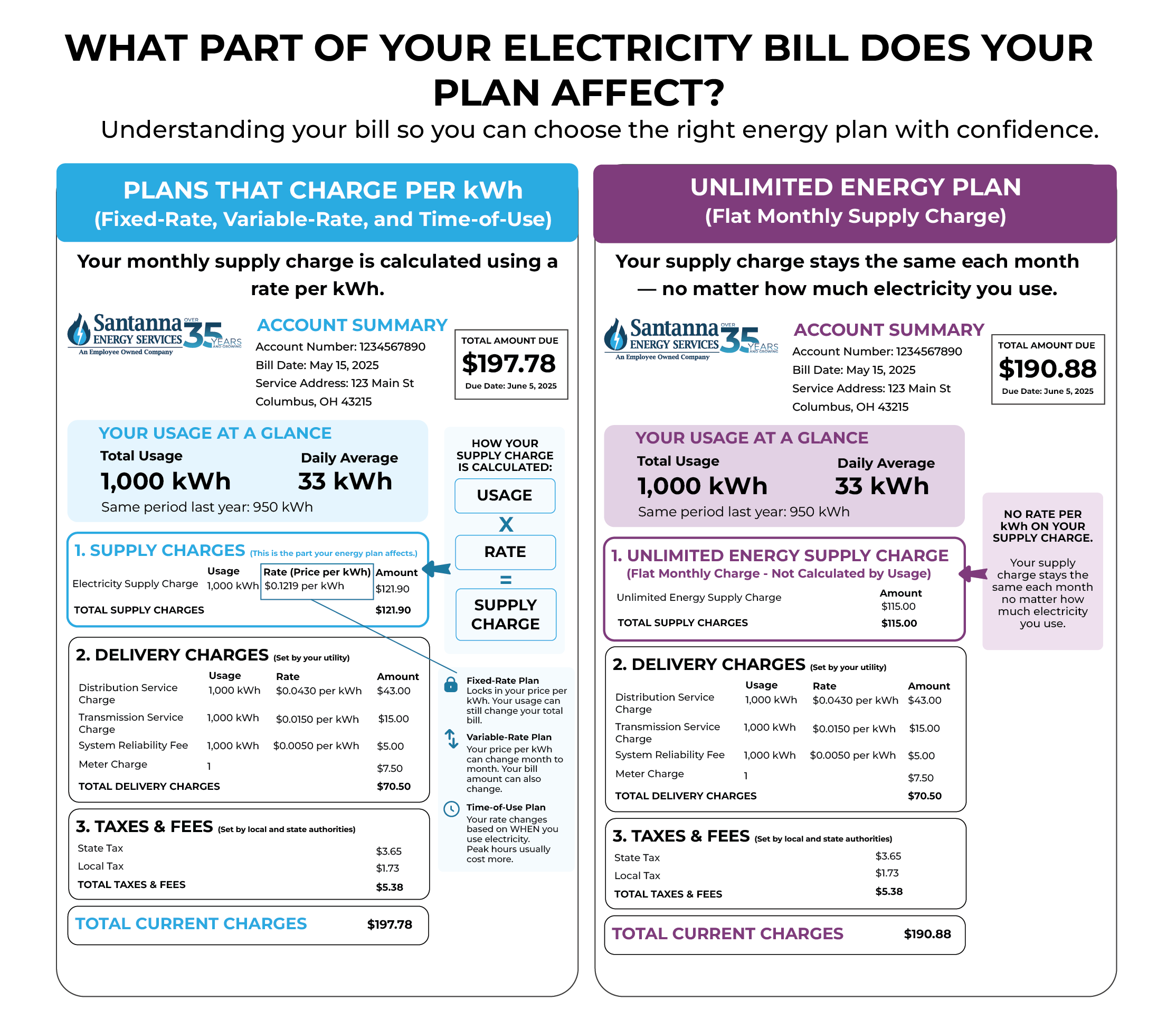
Electric bill supply charges are the cost of the actual electricity your home uses each month. This part of your bill covers the electricity being generated and supplied to your home.
In many electricity bills, the supply charge is based on how many kilowatt-hours (kWh) your household used during the billing period.
Simply put, the more electricity your home uses, the higher the supply portion of the bill may become. For many homeowners, this is often one of the biggest sections of the entire electricity bill, making up 40-60% in some cases.
Several things can affect electric bill supply charges, including:
- How much electricity your household uses
- Your electricity rate
- Seasonal energy demand
- The type of electricity plan you have
For example, during very hot Midwest summers, air conditioners often run much longer to keep homes comfortable.
That increased cooling usage can raise the supply portion of the bill because the household is consuming more electricity throughout the day. The same thing can happen during cold winters when electric heating systems, space heaters, or other appliances are used more often.
What Is the Difference Between Supply Charges and Supply Rates?
Supply charges and supply rates are connected, but they are not the same thing.
Your supply rate is the price you pay for each kilowatt-hour (kWh) of electricity you use. Your supply charge is the total amount you pay after your electricity usage is multiplied by that rate.
For example:
- Supply rate = 12 cents per kWh
- Electricity used = 1,000 kWh
- Supply charge = $120
This distinction matters because many homeowners only look at the total bill without realizing how much the electricity rate itself affects the final supply charge.
Can I Control My Supply Charges?
Homeowners can partially control supply charges on an electric bill because this portion is connected to how much electricity the household uses and the electricity rate attached to the plan.
For example, using less electricity for heating, cooling, laundry, or large appliances may help lower the supply portion of the bill over time.
From an energy plan perspective, there are two ways you can control your supply costs:
- Lock in your electricity rate with a Fixed-Rate plan to help protect against changing market rates during your contract term.
- Choose a predictable monthly supply charge with an Unlimited Energy plan to help reduce surprises in your electricity supply costs.*
While you cannot control weather, seasonal demand, or utility delivery costs, you may be able to influence how your electricity supply costs are structured depending on the plans available in your area.
What Is an Electricity Delivery Charge and How Do They Affect My Bill?
An electricity delivery charge accounts the cost of bringing electricity from the power grid to your home.
While supply charges pay for the electricity itself, electricity delivery charges help cover the equipment, systems, and workers needed to safely move electricity to homes and neighborhoods every day. This part of the bill is usually handled by your local utility company.
Delivery charges help pay for things like:
- Power poles
- Utility wires
- Substations
- Transformers
- Electric meter systems
- Maintenance and repair crews
These systems work constantly behind the scenes to keep electricity flowing to homes, especially during storms, heavy summer demand, or freezing Midwest winters.
Even though most homeowners rarely think about the electric grid until the power goes out, maintaining that system is a major part of how electricity reaches homes safely and reliably.
Can I Control My Delivery Charges on My Electricity Bill?
While a small part of your delivery charge is based on usage, which you can control, homeowners usually cannot directly control the majority of their electricity delivery charges because these costs are generally set by the local utility company.
Even if you choose a different electricity supplier, your utility company still delivers electricity to your home and maintains the infrastructure that keeps power flowing safely throughout your area.
Because of that, electricity delivery charges are typically one of the least flexible parts of the electricity bill for most homeowners.
What Are Taxes and Fees on My Electricity Bill?
Unlike supply charges and delivery charges, these taxes and fees on your electricity bill are often required by government agencies, regulators, or utility programs.
Depending on your location, taxes and fees may help fund:
- State and local sales taxes
- Energy efficiency programs
- Renewable energy initiatives
- Grid modernization projects
- Regulatory and administrative costs
Because these charges vary by state, utility company, and local regulations, two homeowners using the same amount of electricity may still see different taxes and fees on their bills.
While taxes and fees are usually one of the smaller portions of an electricity bill, they can still contribute to monthly cost differences over time.
Can I Control the Taxes and Fees on My Electricity Bill?
In most cases, homeowners cannot directly control the taxes and fees that appear on an electricity bill. These charges are typically established by state governments, local municipalities, utility commissions, or utility programs rather than individual electricity suppliers.
How Do Supply Charges, Delivery Charges, and Taxes and Fees Work Together?
Supply charges, delivery charges, taxes and fees, and the electricity rate all contribute to your final monthly electricity bill.
For example, if your household uses 1,000 kWh of electricity during the month and your electricity supply rate is 12 cents per kWh, the electricity supply portion of the bill would be about $120.
If delivery charges for that billing period total $80, your taxes and fees are $10, your total bill would be $210.
This is one reason many homeowners get confused by advertised cents-per-kWh electricity rates. The electricity rate is only one part of the total bill. Your final cost still depends on how much electricity your household uses, delivery charges from the utility company, taxes, fees, and the structure of your electricity plan.
A simple way to think about it is like ordering food delivery. The supply charge is like paying for the meal itself, the delivery charge is the cost of bringing it to your house. Even if the menu price stays the same, your final total can still change depending on how much you order and the additional delivery costs attached to it.
FAQs
What is the largest charge on an electricity bill?
For many homeowners, the supply charge and delivery charge make up the largest portions of the monthly electricity bill. The exact breakdown depends on electricity usage, local utility charges, taxes, fees, and the electricity plan selected.
Why doesn't switching electricity suppliers remove my delivery charges?
Switching electricity suppliers only changes the supply portion of your electricity bill. Even if you switch your energy supplier, you'll still get energy delivered from your local utility. Because of that, you'll continue to pay delivery charges to your utility regardless of which electricity supplier you choose.
Can I remove my delivery charges if I have solar panels?
In most cases, no. Even if your home has solar panels, you typically remain connected to the electric grid so you can receive electricity when your solar system isn't producing enough power.
What is the difference between a fixed-rate and variable-rate electricity plan?
A fixed-rate electricity plan keeps the supply rate more stable for a set period, while a variable-rate plan can change based on energy market conditions and seasonal demand.
Electricity bills can feel confusing at first, but most of them usually come down to three main parts: supply charges, electricity delivery charges, and your taxes and fees. Once homeowners understand how these pieces work together, it becomes much easier to understand why bills change from month to month and what may actually be affecting overall energy costs.
Understanding your electricity bill can also help you spot unusual usage changes earlier, compare electricity plans more confidently, and better understand the difference between supply costs and utility delivery charges. Because honestly, opening your electric bill should not feel like trying to solve a math problem at the kitchen table every month.
And for homeowners who prefer fewer surprises from changing electricity supply costs, plans with more predictable pricing structures, like Santanna's Unlimited Energy plan, may help provide more peace of mind throughout changing seasons and fluctuating energy markets.*
When you understand what is actually on your electricity bill, those monthly charges start feeling a lot less stressful and a lot more manageable.
* Restrictions apply. Enrollment based upon program eligibility. Customers using more than 125% of normal monthly usage as determined by Santanna may be required to switch plans.
Chris Tessler is a seasoned professional in the deregulated energy industry with over 15 years of experience. Throughout his career, he has honed his skills in commodity trading, risk management, and retail energy supplier operations. Chris has a passion for leveraging new technologies to address challenges at the intersection of the energy industry, carbon economy, and climate change, as well as finding innovative ways to promote healthy living and building strong communities in our modern urban environments.