

What Are the Off-Peak Hours for Electricity? And Do They Affect Your Bill?

by Chris Tessler
15.2 min read

Many homeowners notice their electricity bills go up or down despite using the same appliances, the same thermostat settings, and the same routines. If you see this happening to your bill, off-peak hours for electricity usage could be to blame.
Off-peak hours describe the times of day when fewer people are using electricity, and your bill could shift due to this demand. That daily shift affects how the energy system works and helps explain why costs can feel unpredictable.
But what do off-peak hours mean for you as a homeowner, and is every homeowner subject to this shift in demand?
In this guide, you'll learn what off-peak hours actually are, why they exist, and when they matter for your home and when they don't. Let's dive in.
Key Points of This Article:
- Off‑peak hours for electricity are typically late at night or early in the morning—such as 9 p.m. to 9 a.m. in Pennsylvania and 10 p.m. to 6 a.m. in Illinois, when overall electricity demand is lowest.
- Electricity costs more during peak hours because energy systems must work harder to meet high demand, especially in late afternoons and early evenings.
- Only customers on Time‑of‑Use (TOU) or time‑based rate plans benefit financially from off‑peak pricing.
- Running major appliances like dishwashers, washing machines, dryers, EV chargers, and pool pumps during off‑peak hours can help lower electricity costs for customers on TOU plans.
What Are Off-Peak Hours for Electricity?
Off-peak hours are the times of day when fewer people are using electricity, and on some energy plans, electricity used during those times can also cost less.
Electric utilities allow discounted rates during off-peak hours on certain time-based plans, encouraging customers to shift flexible energy use in order to lower demand and stress on the electricity grid during peak electricity hours.
So, when are off-peak hours for electricity? Off-peak hours usually fall late at night or early in the morning, when homes are quieter, and fewer things are running at once. The less electricity homeowners use during hours of high electricity demand, the less electricity the grid has to handle. That's where off-peak hours for electricity use come in handy.
One important thing to keep in mind is that off-peak hours do not automatically mean lower prices for everyone. You have to be enrolled in a specific plan that offers lower rates during off-peak hours to reap the benefit of lower bills.
What Is the Difference Between Peak Hours and Off-Peak Hours?
The difference between peak hours and off-peak hours comes down to how many appliances are running at the same time across many homes and the times they're used.
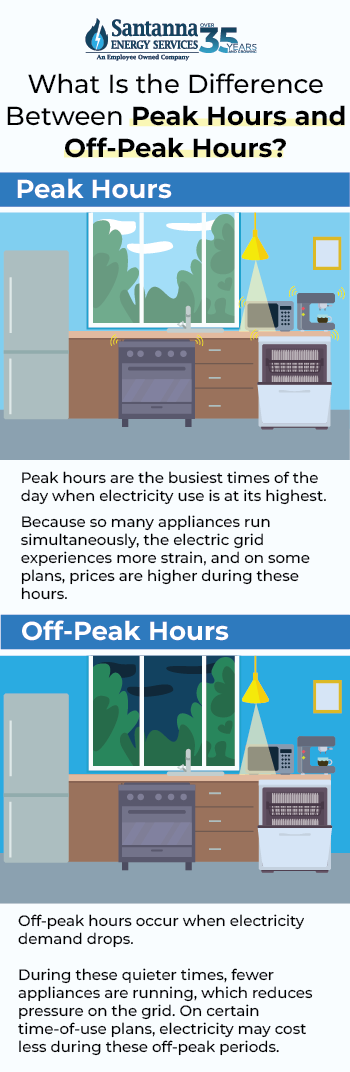
Peak hours are the busiest parts of the day, and when electricity consumption across your area is the highest. This is usually when daily routines overlap, usually around 5pm or so.
During this time, dinner is cooking, someone is taking a shower, laundry might be running, and the heating or air conditioning is working harder because everyone is home. When many homes do these things at once, electricity use adds up quickly, and so can the stress on the energy grid.
On some electricity plans, prices can be higher during these hours, and the electric grid has to work harder to keep up.
Off-peak hours are the quieter times, usually 9pm and into the night. Fewer appliances are running at once, energy use is more spread out, and the electric system is under less pressure.
This pattern is completely normal in households across the country. It's important to note that increases and decreases in electricity charges during off-peak hours only apply to those on a Time of Use energy plan.
Why Electricity Costs More at Certain Times of the Day
Think about a normal weekday evening at home. Lights are on, dinner is cooking, laundry might be running, and the heat or AC is working a little harder. In one home, that feels normal. When thousands of homes do this at the same time, the electric system gets very busy.
During these busy hours, more electricity is needed all at once. Electricity has to be made and delivered right when it's used, so the system has to work harder to keep up.
The U.S. Energy Information Administration explains that electricity use is usually highest in the late afternoon and early evening, when most people are home using lights, appliances, and heating or cooling together. During these peak periods, utilities may need to turn on additional power plants to handle demand that are more expensive to operate.
This increases the cost of supplying electricity at that moment. However, whether you personally pay more at that time depends on your specific rate plan, because only certain plans adjust prices based on the time of day.
Do Extreme Midwest Summers and Winters Affect Peak Demand?
The weather definitely affects peak demand for electricity. Extreme Midwest weather can push peak demand higher, and it happens for a simple reason: more homes need more energy at the same time to stay comfortable.
In the summer, a hot, humid afternoon often means air conditioners are running across the neighborhood. As the day stays warm into the early evening, many homes keep cooling while also cooking dinner, doing laundry, and turning on lights. That "everyone is doing the same thing at once" pattern is what creates a bigger demand spike.
In the winter, the same idea shows up in a different way. When temperatures drop, heating systems run longer and more often to keep indoor spaces steady. Cold snaps can also make your home lose heat faster, especially in older Midwest houses, which means the system has to work harder just to maintain the same comfort level.
When Are Off-Peak Hours for Electricity?
Off-peak hours are generally the times when fewer people across the country are using electricity at the same time.
On many time-based plans, peak hours tend to fall in the late afternoon and early evening, often around 4:00pm to 9:00 p.m. Off-peak hours most often happen overnight and early in the morning, commonly from about 9:00 or 10:00 p.m. until 6:00 or 7:00 a.m.
Some plans also treat weekends and holidays as off-peak, since daily routines are different from weekdays.
One important reminder is that there is no single off-peak schedule that applies to every home in the U.S. The exact hours depend on your utility and your rate plan. Some plans use fixed time blocks, while others adjust by season or don't change prices by time of day at all.
Next, let's look at how off-peak hours can vary by location and what that means in your area.
What Are the Off-Peak Electricity Hours in My Area?
If you're wondering 'what are the off-peak electricity hours in my area', you're asking the right question. While off-peak hours follow similar patterns nationwide, the exact timing can shift based on location, weather, and local energy use.
Across much of the Midwest, off-peak hours generally line up with the quieter parts of the day. Overnight hours are often off-peak, and many plans also treat early mornings or weekends as lower-demand times. Peak demand usually shows up in the late afternoon and early evening, when homes are busiest.
Below are the off-peak electricity hours in Ohio, Pennsylvania, and Illinois:
Off-Peak Electricity Times in Ohio
In Ohio, off-peak hours can fluctuate by season, but generally run on weekdays from about 10:00 p.m. to 6:00 a.m., and all day on weekends.
This pattern is common and expected in Ohio. Weekday evenings after dinner and overnight tend to be calmer for the electric system, while weekends don't follow the same workday rush as weekdays.
It's important to remember that not every Ohio household is on a time-based plan. If your rate does not change by time of day, these hours help explain energy demand patterns, even if they don't change your price.
Off-Peak Electricity Times in Pennsylvania
In Pennsylvania, off-peak hours often show up in early morning and late-night windows, when household activity is lower, according to Pennsylvania Public Utility Commission.
On many time-of-use plans, off-peak hours are around 9:00 p.m. to 9:00 a.m. These are the times when fewer appliances are running at once across the region.
Pennsylvania also commonly treats overnight hours as especially low demand, which is why some plans highlight those periods clearly.
It's important to note that off-peak pricing applies only if you are enrolled in a time-of-use rate. If you are on a fixed-rate plan, your price does not change by hour, even though these demand patterns still exist.
Off-Peak Electricity Times in Illinois
In Illinois, off-peak times are generally overnight from 10:00 p.m. to 6:00 a.m., as well as all day on weekends and major holidays. These periods reflect when electricity use across homes and businesses is typically lower.
Peak demand in Illinois often happens on weekday afternoons and early evenings, especially during hot summer months when air conditioning use increases.
This setup is very common and does not mean you need to change how you live. It simply explains when the electric system is under less pressure and why some plans use these time blocks.
What Are the Best Things to Run During Off-Peak Hours at Home?
If your electricity plan allows for it, off-peak hours are a good time to run appliances that use more electricity but don't need your attention right away.
The reason is simple: these appliances draw a steady amount of power and running them during quieter hours helps avoid stacking a lot of electricity use during already busy times, leading to lower bills.
Here's how that plays out with common household appliances.
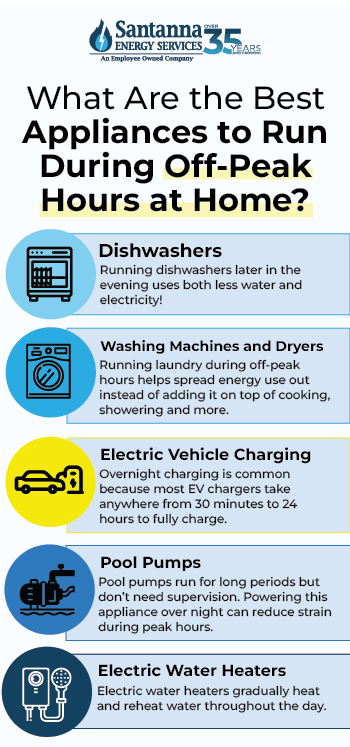
Dishwashers
Dishwashers use electricity for heating water and running the motor over a set cycle. Running them later in the evening or overnight works well because no one needs the kitchen at that time, and the cycle can finish without interrupting anything else.
Washing Machines and Dryers
Washers and dryers can use a lot of electricity in a short window, especially dryers. Running laundry during off-peak hours helps spread energy use out instead of adding it on top of cooking, showers, and heating or cooling.
Electric Vehicle Charging
Charging an EV pulls power for several hours at a time. Overnight charging is common because most EV chargers take anywhere from 30 minutes to 24 hours to fully charge.
Charging overnight avoids adding extra demand during afternoon and evening hours when the grid is busiest.
Pool Pumps
Pool pumps run for long periods but don't need supervision. Scheduling them overnight or early in the morning keeps them from running during peak demand hours without affecting pool care.
Electric Water Heaters (when applicable)
Electric water heaters gradually heat and reheat water throughout the day. Heating water during lower-demand hours can reduce strain on the system, even if it doesn't change your price.
The key thing to remember is this: these are options, not rules. Many Midwest homes run these appliances whenever it's convenient. Off-peak awareness simply gives you flexibility and understanding, not pressure to change how you live.
What Are Time-of-Use (TOU) Plans and How Do They Work?
When you hear people talk about off-peak hours saving money, they're usually talking about Time-of-Use (TOU) plans.
With a TOU plan, the price of electricity changes depending on the time of day. Electricity costs more during peak hours, when demand is high, and less during off-peak hours, when fewer people are using power.
On paper, that sounds simple. Use electricity at the right times and pay less. In real life, it can be harder to manage.
Peak hours often line up with normal routines. Dinner needs to be cooked. Showers happen. Laundry gets done. Heating or cooling is running because everyone is home. To really benefit from a TOU plan, you usually need a flexible schedule and the ability to move energy-heavy tasks later at night or early in the morning.
For some households, that works. For many homes, it doesn't. When most electricity use naturally happens during peak hours, a TOU plan can feel stressful and unpredictable, and in some cases, even cost more.
How Time-of-Use (TOU) Plans Play Out in a Midwest Home
Imagine a typical weekday evening in your home.
Around 5:30 p.m., dinner is cooking, the dishwasher is loaded, laundry is running, and the air conditioner is still on. On a TOU plan, all of that electricity is being used during peak hours, when prices are usually the highest.
Later that night, around 11:00 p.m., the house quiets down. If the dishwasher runs then, or an electric vehicle charges overnight, that electricity falls into the off-peak window, when prices are lower.
This example shows why TOU plans can feel tricky. Peak hours often line up with real life, especially for families and working households. To benefit consistently, you need the flexibility to shift certain tasks outside of busy hours.
For some homes, that's doable. For many Midwest households, evenings are already full, and changing routines isn't realistic.
Do Off-Peak Hours Apply to Everyone, or Only Certain Plans?
Off-peak hours exist for everyone because electricity use naturally rises and falls throughout the day. The electric system has busier times, when many homes are using power at once, and quieter times, when fewer things are running. That part applies to every household.
What doesn't apply to everyone is off-peak pricing. You only pay different prices by time of day if you're on a time-based plan, like a Time-of-Use plan. These plans are designed to reflect the higher cost of supplying electricity during busy hours and the lower cost during quieter hours.
Many homeowners are on fixed-rate, variable-rate, or flat-fee plans where the price stays the same all day. In those cases, off-peak hours won't change what you pay at 7 p.m. versus 11 p.m.
The utility or supplier still manages higher costs during peak times, but those costs are spread out over time instead of changing your price by the hour.
So off-peak hours help explain how the electric system works, but whether they affect your bill depends on how your plan is set up.
Do Off-Peak Hours Apply If You Have a Fixed-Rate Plan?
If you have a fixed-rate plan, your rate during peak and off-peak hours is the same. It doesn't matter if you use electricity in the afternoon, late at night, or early in the morning.
When homeowners choose fixed rates, it's usually because they prefer one steady rate instead of watching the clock.
Even so, understanding off-peak hours can still be helpful. It explains why electricity demand rises and falls during the day and why bills often increase during extreme weather.
How Off-Peak Hours Can Affect an Electricity Bill
Now let's look at how this can affect a bill.
Imagine your home is on a time-of-use plan in Illinois. Most of your electricity is used in the early evening while you're cooking dinner, doing laundry, starting the dishwasher, and keeping the air conditioner running. On a TOU plan, those evening hours often cost the most.
If you're able to shift just a few flexible tasks, like running the dishwasher overnight or doing laundry later in the evening, some of your electricity moves into off-peak hours where prices are lower. In a hypothetical example, that kind of shift could save about a dollar a day, which adds up to around $30 over a month.
The key thing to understand is that those savings depend on how flexible your routine is. If your evenings are already busy and fixed, those savings may be harder to reach consistently. That's why understanding off-peak hours is helpful, even if you decide that a predictable, steady plan fits your life better.
How Understanding Off-Peak Hours Helps You Choose the Right Energy Plan
Knowing about off-peak hours can also help when you're picking an energy plan.
Some homes have flexible schedules. Laundry can wait, dishes can run later, or charging happens overnight. Those homes may be fine with plans where timing matters.
Other homes run on set routines. Evenings are busy, mornings are rushed, and electricity is used when it's needed. For those households, having the same price all day often feels easier.
There's no right or wrong choice. Understanding off-peak hours just helps you choose a plan that fits your life, instead of trying to fit your life around a plan.
FAQs
Are off-peak hours always cheaper?
No. Off-peak hours are only cheaper if you are on a time-of-use (TOU) or time-based pricing plan. If your plan has a single rate or flat monthly pricing, the cost does not change by hour.
Does using electricity at night lower energy costs?
Sometimes, but only on plans where prices change by time of day. For many households, nighttime use does not change the price because their rate stays the same all day.
Does having a smart meter affect off-peak pricing?
A smart meter does not automatically change your price. It simply allows utilities to measure usage by time of day. Pricing only changes if you choose a time-based rate.
Is it worth changing my routine just for off-peak hours?
For many households, no. Time-based pricing works best for homes that already have flexible schedules. Comfort and routine should always come first.
Off-peak hours simply explain why electricity use feels busier at certain times of day and quieter at others. Understanding that pattern can make your electric bill feel less confusing, especially during hot summers and cold winters. It also helps explain why some plans focus on timing, while others focus on predictability.
If having steady supply charges and easier budgeting matters to you, Santanna's Unlimited Energy plan is one option worth exploring. It's designed to keep your supply charges predictable, so managing your household energy costs feels simpler and free from surprises.*
* Restrictions apply. Enrollment based upon program eligibility. Customers using more than 125% of normal monthly usage as determined by Santanna may be required to switch plans.
Chris Tessler is a seasoned professional in the deregulated energy industry with over 15 years of experience. Throughout his career, he has honed his skills in commodity trading, risk management, and retail energy supplier operations. Chris has a passion for leveraging new technologies to address challenges at the intersection of the energy industry, carbon economy, and climate change, as well as finding innovative ways to promote healthy living and building strong communities in our modern urban environments.