
What Causes a House To Lose Energy? 18 of the Most Common Culprits

by Tyler Castle
21.8 min read
Your energy bill arrives, and it’s higher than last month’s, but nothing in your routine has changed. Or maybe one room feels draftier than the rest, or your furnace seems to run nonstop in the winter. If any of this sounds familiar, your home may be quietly wasting energy and costing you more than you realize.
When warm or cool air escapes through cracks, poor insulation, or aging systems, your comfort drops and your energy use climbs. Understanding where and why that happens isn’t just about saving money; it’s about keeping your home cozy, efficient, and stress-free year-round.
Luckily, you’re in the right place if you’re looking to break down what causes a home to lose energy. With 35 years of experience as an energy supplier and having powered thousands of homes across the Midwest, we know all about energy loss and what it takes to keep your losses minimal.
At Santanna, we don’t just talk about energy efficiency, we practice it. In our internal survey, 70% of our employee-owners said they actively look for ways to reduce energy loss in their own homes.
In this guide, we’ll break down the most common reasons homes lose energy, how to spot the problem areas, and practical steps you can take to fix them. Ready to make your home more efficient and your bills more predictable? Let’s get started.
Key Points of This Article:
- Most homes lose energy through air leaks, poor insulation, and inefficient heating and cooling systems; all of which can be fixed with simple upgrades.
- Small habits like leaving lights on, running half loads, or ignoring air leaks can quietly increase your monthly energy use and costs.
- Regular maintenance, proper insulation, and ENERGY STAR-certified appliances help reduce waste and improve comfort year-round.
- Reducing energy loss isn’t about one major fix; it’s about small, consistent improvements that make your home more efficient in every season.
Why Homes Lose Energy
Every home, no matter how new or well-built, naturally loses some energy over time. But when that energy loss becomes excessive, it leads to higher utility bills, uncomfortable rooms, and systems that have to work harder than they should. And most of the time, this energy loss is something YOU can prevent!
So, what’s really going on behind the walls and under the roof? Let’s break down the most common reasons why homes lose energy:
Energy moves in three main ways: Conduction, when heat travels through solid materials like walls, windows, or floors; convection, when warm or cool air escapes through gaps and cracks, often around windows, doors, or ducts; and radiation, when heat is absorbed or reflected off surfaces, such as sunlight streaming through untreated windows in summer.
With these ideas in mind, there are three major ways your home can lose energy. According to ENERGY STAR, most homes waste 25% to 40% of energy through air leaks, poor insulation, and inefficient equipment – conduction, convection, and wear and tear!
Most energy escapes through heating and cooling inefficiencies, but homes also lose energy through other ways. Here are some of the most common ways a house loses energy:
Lighting That Doesn’t Convert Enough Energy
Incandescent and halogen bulbs waste roughly 90% of their energy as heat rather than light. This is a massive waste of energy, and while light bulbs won’t completely blow up your bill, think about how many bulbs you have in your house. If you’re hosting parties or working from home where light is constantly being used, this loss of energy can add up over time.
Water Heating and Plumbing Loss
Heating water is the second-largest energy expense in most homes, accounting for 18% of total energy use, according to the U.S. Department of Energy. So, improper heating temperatures and cracks in your pipes can make a big dent in terms of energy loss.
Setting your water heater to 120°F, adding an insulating jacket, and wrapping hot-water pipes reduce standby heat loss. Fixing leaky faucets and showerheads also saves both energy and water. So, this is a double benefit!
Lifestyle and Usage Patterns
Sometimes, energy loss has less to do with your house and more to do with habits. Leaving lights or chargers on, running half-full laundry loads, or setting the thermostat too high or low for long periods all add up.
Regional Factors
Fluctuating seasons amplify every small inefficiency. High humidity, long heating seasons, and older housing make homes more prone to both air loss and electrical waste. With every season, it’s important to keep this in mind as you monitor your energy habits.
Understanding why homes lose energy is important because small inefficiencies add up quickly. If you don’t actively monitor these factors in your home or daily habits, you could be regularly surprised by your energy bill.
What Causes a House to Lose Energy: 18 Common Culprits
As an energy supplier with decades of experience helping Midwest homeowners manage their usage, we’ve seen just how many small details can impact efficiency.
Now that we’ve covered why homes lose energy, let’s explore what’s causing it. Here are 18 of the most common (and preventable) reasons your home might be wasting energy.
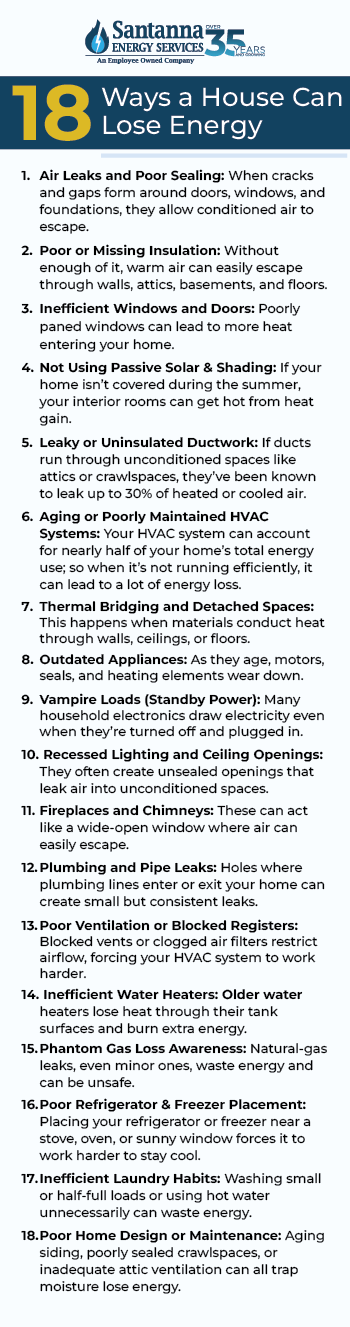
1. Air Leaks and Poor Sealing
When thinking about what causes a house to lose energy, air leaks should be the first factor you investigate.
When cracks and gaps form around doors, windows, and foundations, they allow conditioned air to escape and unconditioned air to sneak in. This constant air exchange forces your furnace or AC to run longer to maintain the same temperature.
To fix this issue, use weatherstripping on doors, caulk around window frames, and seal openings where plumbing or electrical lines enter your home. According to ENERGY STAR, sealing air leaks can save up to 10% on total energy costs.
2. Poor or Missing Insulation
Insulation acts as a thermal barrier, slowing or even stopping the flow of heat. Without enough of it, warm air can easily escape through walls, attics, basements, and floors during winter, while hot outdoor air can seep in during summer. The result is uneven comfort and higher bills year-round.
To check your home for insulation issues, start with your attic. If you can see the floor joists below your feet, you likely need more insulation.
To check insulation in your walls, touch the exterior walls on a cold day. If they feel chilly or you notice drafts near outlets or baseboards, insulation may be lacking.
For basements, look for uninsulated rim joists (the area where the foundation meets the floor framing) and exposed concrete or block walls. Cold air entering here can potentially cool your entire first floor.
No matter where you need insulation, consider adding fiberglass batts, blown-in cellulose, or spray foam to combat energy loss in these areas. In colder Midwest climates, it is recommended to use R-38 to R-60 insulation for attics to ensure significant energy savings throughout the year.
For a more professional approach, consider scheduling a home audit with a professional to spot cold spots behind drywall or in other areas of concern in your home.
3. Inefficient Windows and Doors
Old or single-pane windows and unsealed doors are major contributors to heat transfer. They allow warm air to pass through the glass and framing materials, making your heating or cooling system work overtime to compensate. In the same way, if you have old windows that don’t close or are broken, this adds to the energy loss.
Consider upgrading to ENERGY STAR-certified double-pane windows with Low-E coatings (low emissivity that helps reduce the amount of ultraviolet rays that pass through the pane). If replacement isn’t possible right now, apply window film, add storm windows, or use thermal curtains to improve insulation.
4. Not Using Passive Solar & Shading
If your home isn’t covered during the summer, your interior rooms can get hot from heat gain.
Strategically landscaping or adding exterior shading can reduce indoor heat gain and your need to turn up your thermostat to compensate for the extra heat.
If you’re going to the plant route, we recommend planting leafy trees on the south or west side of your home so that it blocks direct sun in warmer months but allows sunlight during winter, naturally regulating indoor temperature.
5. Leaky or Uninsulated Ductwork
Don’t take this one for granted. Heat loss in homes can also be attributed to leaky or poorly insulated ductwork. Ducts that run through unconditioned spaces, like attics or crawlspaces, can leak up to 30% of heated or cooled air. That means a large portion of the air you’re paying to heat or cool never reaches your living spaces.
To prevent this, seal all visible joints with mastic sealant or metal-backed tape and wrap ducts in insulation sleeves to help maintain consistent temperatures.
6. Aging or Poorly Maintained HVAC Systems
Your HVAC system can account for nearly half of your home’s total energy use, so when it’s not running efficiently, it can be one of the biggest culprits behind what’s causing your house to lose energy.
Over time, dust buildup, clogged filters, worn components, and even minor air leaks in ductwork can make your system work twice as hard to deliver the same comfort level. The result? Higher utility bills, uneven temperatures, and unnecessary strain on your equipment.
To keep your system in top shape and to reduce this energy loss, replace filters every 1–3 months, schedule annual tune-ups, and consider upgrading to an ENERGY STAR-rated unit if your appliance is over 10 years old. According to ENERGY STAR, new high-efficiency units can save up to 20% on heating and cooling costs.
7. Thermal Bridging and Detached Spaces
Heat always seeks balance. It moves from warm areas to cool ones, and your home’s structure can unintentionally help it escape through what we call thermal bridging.
Thermal bridging happens when materials like wood, steel, or concrete conduct heat through walls, ceilings, or floors. When spaces such as garages, basements, or attics aren’t properly insulated, they act as “energy leaks,” allowing heat to move freely in and out of your living areas.
To reduce this heat loss, add continuous insulation to exterior walls and seal doorways between conditioned and unconditioned spaces to prevent heat transfer through connected surfaces.
8. Outdated Appliances
Older or inefficient appliances can quietly waste energy every day. As they age, motors, seals, and heating elements wear down, causing them to work harder and use more electricity to do the same job. Even if you haven’t used an appliance for a long time but still keep it plugged in, it can drain energy over time.
For example, an old refrigerator or washing machine can use nearly twice as much power as newer, energy-efficient models.
Replace outdated appliances with ENERGY STAR-certified models to save 10-50% on energy costs. Until then, unplug rarely used appliances like an extra fridge in the garage, and keep coils and filters clean to help them run more efficiently.
9. Vampire Loads (Standby Power)
Many household electronics draw electricity even when they’re turned off and plugged in. This is a hidden drain known as vampire power. Devices like TVs, gaming consoles, coffee makers, and phone chargers are the biggest culprits of vampire power, and that total energy loss can add up over time.
One way to reduce this waste is by using smart power strips that automatically cut power when devices are turned off or fully charged. You can also unplug electronics you don’t use often to prevent unnecessary energy use.
Take your energy efficiency a step further by using smart plugs or home-energy monitors. These devices track how much power electronics draw even when they’re “off.” Set schedules or automate shut-offs for devices like TVs and routers overnight or while you’re away. The average U.S. household spends $100-$200 a year on standby power alone, according to the U.S. Department of Energy.
10. Recessed Lighting and Ceiling Openings
Recessed lights and attic access doors often create unsealed openings that leak air into unconditioned spaces. These gaps may seem small, but they can cause significant energy loss across multiple fixtures.
To combat this loss, install airtight trim kits or insulation covers over can lights, and use weatherstripping on attic access doors to keep air from escaping.
11. Fireplaces and Chimneys
Few features add charm like a fireplace, but when it’s not in use, it can act like a wide-open window. Warm air from inside rises and escapes through the chimney, while cold air seeps in from outside. Over time, this constant air exchange can raise heating costs and dry out your indoor air without proper coverage.
To make sure you’re protecting yourself and your bill from this energy loss, always close the damper when the fireplace isn’t in use. Also helpful, consider installing glass fireplace doors to create an additional barrier that limits heat loss, or use a chimney balloon to block airflow when you don’t need a fire.
12. Plumbing and Pipe Leaks
Holes where plumbing lines enter or exit your home can create small but consistent leaks that allow air to flow freely. In addition, hot water pipes without insulation lose heat quickly before the water even reaches your faucet.
Here’s how to check and fix this issue: Seal pipe openings with expanding foam or caulk and wrap hot water pipes with foam sleeves to help retain heat and reduce wasted energy. Next, insulate hot-water pipes with foam sleeves or wrap to reduce standby heat loss, and repair any leaking faucets.
13. Poor Ventilation or Blocked Registers
Blocked vents or clogged air filters restrict airflow, forcing your HVAC system to work harder. In some cases, poor ventilation can trap moisture, making your home feel uncomfortable and reducing air quality.
To prevent this, always keep vents clear of furniture and curtains so that your air can spread evenly throughout your home. Next, clean registers regularly, and replace filters every 1–3 months to maintain good airflow.
14. Inefficient Water Heaters
Older water heaters lose heat through their tank surfaces and burn extra energy to maintain temperature. Even modern units lose some heat if they’re not properly insulated. That “standby loss” adds up, especially in cold Midwest basements.
Always set your water heater to 120°F to slow mineral buildup and corrosion in your water heater and pipes. Then wrap it with an insulating blanket, and consider upgrading to a tankless or high-efficiency unit to cut standby heat loss.
15. Phantom Gas Loss Awareness
Natural gas leaks, even minor ones, waste energy and can be unsafe. If you ever smell sulfur or notice unexplained bill increases, contact your utility immediately for a leak inspection. These “phantom losses” can come from aging connectors, loose fittings, or pilot lights that burn continuously.
Watch out for a sulfur or rotten egg smell or hissing sounds, as this can be an indicator of a gas leak. Also, a sudden spike in your gas bill with no change in usage could indicate a hidden issue.
If you suspect a gas leak, don’t take this issue lightly. For more helpful information on gas leaks, visit our blog.
16. Poor Refrigerator & Freezer Placement
Energy loss can come from where you least expect it, including your fridge.
Appliances that generate or remove heat need breathing room. Placing your refrigerator or freezer near a stove, oven, or sunny window forces it to work harder to stay cool, especially in summer. That added strain increases energy use and shortens the lifespan of the compressor.
To avoid this energy loss, plan to keep your refrigerator at least 2–3 inches away from walls for proper ventilation, and avoid placing your unit in direct sunlight or near heat sources whenever possible.
17. Inefficient Laundry Habits
Yep, even your laundry machine might be quietly wasting energy! Washing small or half-full loads, using hot water unnecessarily, or over-drying clothes can all contribute to energy waste.
You can improve the energy efficiency of your laundry routine by washing loads in cold water and air-drying your clothes when possible. This is a given with any laundry routine, but clean out your lint trap! Not only does this prevent fire hazards, but it also improves your machine’s airflow and efficiency.
18. Poor Home Design or Maintenance
Sometimes, energy loss is built right into the bones of the house. Aging siding, poorly sealed crawlspaces, or inadequate attic ventilation can all trap moisture and reduce your home’s ability to maintain stable indoor temperatures. Cracks in foundations or warped window frames can also create steady leaks that go unnoticed for years.
As your home ages, regularly inspect exterior siding and caulking annually for gaps or wear. Always keep extra insulation on hand in case you need to pad your attic or basement, and plan seasonal maintenance checks, especially before extreme weather, to ensure everything is ready to endure Mother Nature.
Simple DIY Steps to Check If Your Home Is Losing Energy
Having trouble spotting signs of energy loss? You’re not alone! While some signs of energy loss are easy to notice, others hide in plain sight. The good news is you don’t need special tools or training to find the biggest problem areas in your home. Here are a few quick checks you can do to help you spot where energy is escaping and your home is falling short:
1. The candle or incense test
Hold a lit candle, stick of incense, or smoke pen near windows, doors, electrical outlets, or baseboards. If the smoke wavers, flickers, or gets pulled in one direction, that’s a draft and a clear sign of air leakage and energy loss.
2. Inspect your attic and basement
These are the biggest energy loss zones. In the attic, look for bare spots or low insulation (you should not see the floor joists). In the basement, check for gaps along rim joists, exposed concrete, and unsealed vents. Cold air from below can cool your floors and make your furnace run overtime.
If you notice cobwebs moving or feel temperature differences, that’s air movement and a sign of energy loss.
3. Check your air filters and vents
Dirty filters, dusty ducts, or blocked registers restrict airflow, forcing your HVAC system to push harder. This increases both wear and energy use. Check your air filters every season and replace them every three months. Make sure vents are open and clear of furniture, curtains, or rugs.
4. Look for daylight around doors
Turn off interior lights during the day and check around door frames and window edges. If you can see sunlight sneaking in, conditioned air is escaping the same way. Add or replace weatherstripping and caulk to seal these leaks.
DIY checks are a great start, but they can only reveal so much. For a more accurate and comprehensive look, consider scheduling a home energy audit. Professionals use specialized tools like blower door tests and thermal cameras to detect hidden leaks and insulation gaps you can’t see.
How to Calculate Heat Loss in Your Home
If your home feels drafty or your energy bills keep rising, it helps to know how much heat your home might be losing. Understanding this gives you a clearer picture of where to focus your fixes, whether that’s adding insulation, sealing gaps, or upgrading windows.
Here’s an easy way to estimate the heat loss in your home:
- Find the size of the area. Start with the surface area that might be losing heat, such as a wall or window, in square feet. Larger surfaces mean more space for heat to escape. A big, bare wall or large window can release much more heat than a smaller, insulated section.
- Know the material’s insulation value. Some materials hold heat better than others. For example, thick insulated walls keep heat in, while thin glass windows let it escape more easily. Materials with poor insulation transfer heat faster, which means your heating system has to work harder to maintain the same indoor temperature.
- Note the temperature difference. The bigger the gap between the indoor and outdoor temperatures, the more heat your home will lose through that surface. The greater the difference between inside and outside temperatures, the faster heat will move out of your home. On very cold days, even small gaps in insulation make a big impact.
You can get a rough estimate of heat loss by multiplying these three factors together:
Heat Loss = Area × U-value × Temperature Difference (ΔT)
Here’s a hypothetical example of calculating heat loss for a home in Ohio, where it’s 25°F outside and 70°F inside — a 45-degree difference. If you have a 20-square-foot single-pane window (U-value 1.0), your heat loss would be:
20 × 1.0 × 45 = 900 BTUs per hour
That means every hour, that window loses enough heat to make your furnace work harder to stay warm. If you replace it with a double-pane window (U-value 0.5), your heat loss drops to 450 BTUs per hour, cutting that energy waste in half.
For a more accurate picture, you can use free online heat loss calculators or schedule a home energy audit for the most accurate calculation of heat loss in your home. Professionals use infrared cameras and blower door tests to measure where your home is leaking energy.
How Energy Loss Changes from Winter Heating to Summer Cooling
Energy loss doesn’t happen the same way year-round; it flips with the seasons. In winter, warm indoor air naturally rises and escapes through the attic, roof, and upper walls, while cold outdoor air sneaks in through cracks, windows, and basements. This process, called the stack effect, makes your furnace work harder to replace the warmth that’s constantly leaking out.
In summer, the direction reverses. Hot outdoor air seeps in through those same leaks, and sunlight heats your roof, walls, and windows, forcing your air conditioner to run longer. Poor insulation and unsealed gaps trap even more heat indoors, making cooling harder and more expensive.
The takeaway: Whether you’re heating or cooling, air movement and insulation play the biggest roles in how much energy your home uses, helping keep your comfort steady and your bills more predictable.
How to Prevent Energy Loss in Your Home
Preventing energy loss isn’t about one big change; it’s about a few smart habits and upgrades that work together to make your home more efficient. Now that you know what causes energy loss in your home, here are some extra tips on how to prevent it. Pairing these with what you’ve learned above can really make a difference:
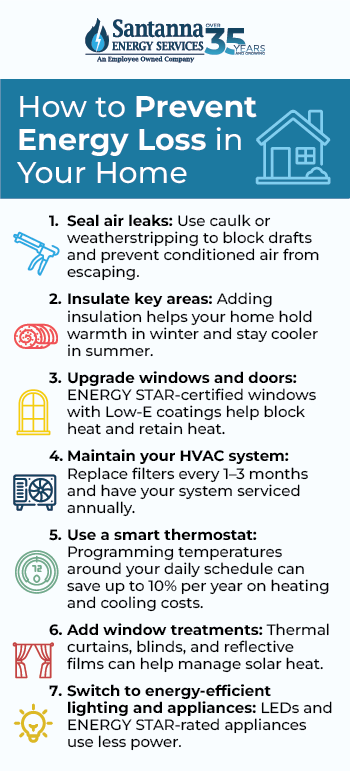
- Seal air leaks: Gaps around windows, doors, and outlets are small but add up fast. Use caulk or weatherstripping to block drafts and prevent conditioned air from escaping.
- Insulate key areas: The attic, walls, and basement are the biggest sources of heat transfer. Adding insulation helps your home hold warmth in winter and stay cooler in summer.
- Upgrade windows and doors: ENERGY STAR-certified windows with Low-E coatings help block summer heat and retain winter heat, improving comfort year-round.
- Maintain your HVAC system: Replace filters every 1–3 months, have your system serviced annually, and keep vents clear of furniture and dust to ensure efficient airflow.
- Use a smart thermostat: Programming temperatures around your daily schedule can save up to 10% per year on heating and cooling costs.
- Add window treatments: Thermal curtains, blinds, and reflective films can help manage solar heat gain and reduce winter drafts.
- Switch to energy-efficient lighting and appliances: LEDs and ENERGY STAR-rated appliances use less power, reduce heat output, and lower your overall energy load.
In areas like Illinois, Ohio, and Pennsylvania, where temperatures swing from freezing winters to humid summers, preventing energy loss isn’t just about comfort — it’s about long-term savings and protecting your home from unnecessary wear and tear.
Does a Double-Paned Window Decrease Convection Heat Loss?
A double-paned window can help reduce convection heat loss by adding an extra layer of protection between the inside and outside air. The space between the two panes is filled with air or gas, which acts as insulation. This layer slows down how quickly warm air from inside your home cools when it meets the cold surface of the window.
In single-pane windows, warm indoor air hits the cold glass, cools down, and sinks, creating a drafty feeling near the window. Double-paned windows stop that from happening by keeping the inside pane closer to your room temperature.
How Does Adding a Glass Panel Decrease Heat Loss?
Windows are a major source of heat loss, accounting for 25%–30% of home heating and cooling energy use, according to the U.S. Department of Energy (DOE). Adding an extra glass panel (like a storm window or double-pane upgrade) helps by creating an insulating air space between panes. This trapped air slows the transfer of heat, reducing both conduction and convection.
Think of it as adding another layer of insulation. The extra barrier keeps warm air in during winter and hot air out during summer, helping your HVAC system work more efficiently.
If you still have single-pane windows, consider ENERGY STAR-certified double-pane windows or storm windows. This upgrade can save you up to $583 per year while improving comfort and reducing drafts year-round.
Every home loses energy in some way, but understanding how and why it happens helps you take control of your comfort and costs. When your home holds heat in the winter and keeps cool air inside during the summer, your energy system works less, your bills stay lower, and your space feels more comfortable year-round.
Even the most efficient home can’t control fluctuations in energy charges, which is why we created our Unlimited Energy Plan.
Unlimited Energy keeps your supply charge predictable, no matter how much energy you use* or how extreme the weather gets, so you always know what to expect. If this sounds like a great plan to you, explore our Unlimited Energy plan today to learn more!
* Restrictions apply. Enrollment based upon program eligibility. Customers using more than 125% of normal monthly usage as determined by Santanna may be required to switch plans.
Tyler is an experienced energy professional, having worked for Santanna Energy Services, for the past four years. He is passionate about renewable energy and believes that diversifying the energy grid is the key to a sustainable future. Tyler is dedicated to supplying consumers with the best possible energy solutions and works diligently to make sure that Santanna can deliver the highest quality service.