

Are Energy-Efficient Hot Tubs Worth It? Energy Costs and Efficiency Explained

by Jenna Mendez
Updated: July 31, 2026
20 min read
Key Points of This Article:
- Energy‑efficient hot tubs use strong insulation, tight covers, and steady temperature control to reduce heat loss and lower overall electricity use, costing $166-$622 a season to run.
- Outdoor temperature, tub size, and proper maintenance (like clean filters and wind protection) greatly affect how much energy a hot tub uses year‑round.
- Energy‑efficient hot tubs are worth it when well‑insulated and properly maintained, as they can significantly reduce long‑term energy costs and improve performance depending on climate and usage habits.
Is a hot tub actually worth the energy cost, or does it turn into another monthly expense that is hard to control? For many homeowners across the U.S., this question comes up either before buying a hot tub or shortly after the first few higher electric bills arrive.
Hot tubs are often called “energy efficient,” but it can be hard to understand what that really means. One hot tub says it saves money, another talks about insulation, and another mentions smart controls. When you add cold winters and keeping the hot tub outside, it gets even harder to know what actually makes a difference in energy use.
Luckily, you’ve come to the right place. Here at Santanna Energy Services, we love to use our energy expertise to help our readers understand how energy efficiency works and electricity-hungry items like hot tub affects your energy bill. Let us crunch the numbers so you don’t have to.
What Makes a Hot Tub Energy Efficient?
Energy-efficient hot tubs are models that lose less heat and use less electricity to maintain temperature. It is not about extra features; it is about how well the hot tub holds heat and how often the heater needs to run.
Also, because roughly 75% of a hot tub’s energy use goes toward heating the water and maintaining its temperature, choosing a model that excels at retaining heat and minimizing heater run time can make a meaningful difference in long-term operating costs.
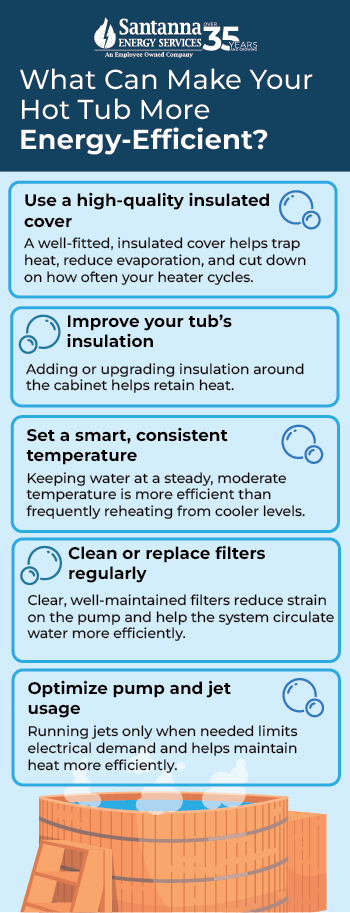
To maximize efficiency from your hot tub, a combination of insulation quality, a tight-fitting cover, and steady temperature control working together can do the trick for energy savings. When these basics are done well, energy use stays lower and can lead to potentially lower energy bills.
Good Insulation (High R-value)
The “R-value” measures the effectiveness of a hot tub’s insulation. A higher R-value means better heat retention and the less likely your hot tub’s heating system has to work hard. Better Insulation slows heat loss from the hot tub’s outer shell and plumbing.
This is especially important in the Midwest during winter, where cold air pulls heat away faster.
The best R-value for peak energy-efficiency should fall between R‑30 to R‑35.
A Thick, Well-Sealed Cover
The cover sits directly over warm water, where heat escapes fastest. A thick cover that seals tightly helps trap heat and reduces heater run time.
For stronger energy performance, choose a cover that are at least 4 to 6 inches thick with a tapered design, meaning they are thicker in the center and slightly thinner at the edges to help shed rain and snow.
High-density foam cores with a vapor barrier are especially important because waterlogged foam loses insulating power over time. A tight seal around the edges, reinforced hinges, and locking straps also help prevent warm air from slipping out.
Steady Temperature Control
Keeping the water at a consistent temperature uses less energy than frequent adjustments. Fewer heating cycles mean your hot tub has to use less energy over time, which can lead to steadier monthly bills.
If you want help and automation with temperature control, most modern hot tubs are equipped with smart thermostats that can adjust settings automatically and allow you to control them through your mobile phone.
Clean Filtration and Good Water Flow
Similar to an air conditioner, a clogged filter makes hot tub pumps work harder and use more electricity. To prevent this, clean filters help the system run efficiently. You should clean your hot tub’s filter every 4-6 weeks
Wind Protection and Placement
Wind increases heat loss because moving air pulls warmth away from the hot tub cabinet and cover faster than still air.
Even a well-insulated tub can lose heat more quickly if it is placed in an open, exposed area. Installing fencing, privacy panels, lattice screens, pergolas, or strategic landscaping like shrubs can help block prevailing winds and create a more stable microclimate around the tub.
The more protected the placement, the less often the heater has to cycle on to replace lost heat, which can help lower overall energy use.
Right-Sizing of the Hot Tub
Larger tubs hold more water and lose more heat simply because there is more surface area and volume to keep warm. Heating hundreds of extra gallons that rarely get used can quietly increase monthly electricity costs.
Choosing a size that matches how many people regularly use the hot tub, rather than the maximum number it can hold, helps avoid unnecessary energy waste.
How Many Watts Does a Hot Tub Use?
On average, a residential hot tub uses between 1,500 and 6,000 watts when heating. This higher wattage happens when the water temperature needs to be raised, such as after filling the tub or following extended use.
Once the hot tub reaches its set temperature, watt usage drops because the heater cycles less often.
For example, a heater that draws 5,000 watts while actively heating may only cycle on for short intervals throughout the day once the target temperature is reached. During those maintenance cycles, overall average wattage can effectively drop to a fraction of that peak draw because the system is no longer heating continuously.
During normal operation, most energy goes toward maintaining heat and running circulation and filtration systems, not continuous heating.
How Much Electricity Does a Hot Tub Use?
A hot tub uses electricity every day to keep the water warm, clean, and ready to use. In the Midwest, hot tubs running during winter can use anywhere from 300 to 1,200 kilowatt-hours (kWh) per month, depending on the size and wattage of the hot tub.
During warmer months, when outdoor temperatures reduce heat loss, electricity use is lowered to about 150 to 750 kWh per month. The exact amount of electricity a hot tub uses depends on insulation quality, how well the cover seals, wind exposure, and the temperature setting, but colder weather almost always leads to higher energy use because heat escapes faster.
Energy-efficient hot tubs can reduce overall electricity use because they are built with better insulation, tighter seals, and smarter heating controls that minimize heat loss and reduce unnecessary heater run time over the long term.
How Much Electricity Does a Hot Tub Use Per Day, Week and Month?
Wondering about the bigger picture? To make electricity use easier to understand, here are typical usage ranges for a residential hot tub.
These estimates assume you use your hot tub regularly, you have a covered tub, there’s average warmer weather, and the tub heater cycles on and off. Here’s what you can expect:
Average Energy Consumption of a Hot Tub by Size Per Month, Week, Day and Year
| Hot Tub Size | Wattage (24/7) | Per Day (kWh) | Per Week (kWh) | Per Month (kWh) | Per Year (kWh) |
| Small (2–4 people) | 3,000–4,000 W | 5-15 | 35-105 | 150-450 | 1,825-5,475 |
| Medium (4–6 people) | 4,000–5,000 W | 7-18 | 49-126 | 210-540 | 2,555-6,570 |
| Large (6–8+ people) | 5,000–7,500 W | 10-25 | 70-125 | 300-750 | 3,650-9,125 |
Comparing the midpoint wattage of a small hot tub (about 3,500 watts) to a large model (about 6,250 watts), that is roughly a 79% increase in peak wattage.
In practical terms, choosing a larger tub can be similar to adding the equivalent of a 1,500‑watt space heater running several extra hours per day during heating cycles. Over weeks and months, that difference in size alone can noticeably increase total energy consumption.
How Much Does It Cost to Run a Hot Tub?
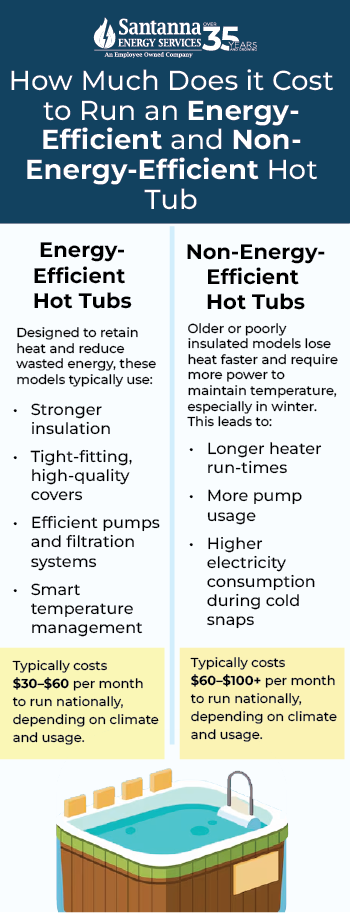
The cost to run a hot tub mainly depends on two things: how many hours it runs each day and how much you pay for electricity.
We’ve crunched the numbers, and in the winter season alone at the U.S. average electricity rate of 18.44 cents per kilowatt-hour (as of May 2026), a hot tub can cost you anywhere from $166-$622+ to heat, depending on size.
Hot tubs usually cost more to run in winter because cold air pulls heat out of the water faster, so the heater has to work harder. In warmer months, they usually cost less because the water stays warm more easily.
Average Cost to Run a Hot Tub During Winter Season (at U.S. Average of 18.44 cents per kWh)
According to our estimates, a uses around 150-750 kilowatt-hours per month and can cost you anywhere from $55.32 per month to run.
Our calculations are based on 24/7 operation with the heater cycling on and off over a 90-day winter season. Looking for more about how much a hot tub will cost you throughout the winter and summer seasons? Check out our estimates:
Average Cost to Run a Hot Tub in Winter*
| Hot Tub Size | Wattage (24/7) | Per Day (kWh) | Cost Per Day | Per Week (kWh) | Cost Per Week | Per Month (kWh) | Cost Per Month | Full Winter Season (kWh) | Full Winter Season Cost |
| Small (2–4 people) | 3,000–4,000 W | 10-25 | $1.84–$4.61 | 70-175 | $12.91-$32.27 | 300-750 | $55.32-$138.30 | 900-2,250 | $165.02-$414.90 |
| Medium (4–6 people) | 4,000–5,000 W | 15-30 | $2.77–$5.53 | 105-210 | $19.36-$38.72 | 450-900 | $82.98-$165.96 | 1,350-2,700 | $248.94-$497.88 |
| Large (6–8+ people) | 5,000–7,500 W | 20-40 | $3.69–$7.38 | 140-280 | $25.82-$51.63 | 600-1,200 | $110.64-$221.28 | 1,800-3,600 | $331.92-$663.84 |
*Disclaimer: *These estimates assume the hot tub is powered on continuously, but that the heater and pumps cycle on and off to maintain water temperature. Actual energy use and cost will vary based on tub size, insulation quality, cover use, outdoor weather, temperature settings, and local electricity rates.
Our estimates help show what to expect, but costs can fluctuate depending on your individual usage habits. Your real cost can change based on how well your hot tub is insulated, the weather outside, where the hot tub is placed, and how often you use it.
Average Cost to Run a Hot Tub During Warmer Season (at U.S. Average of 18.44 cents per kWh)
Looking for how the costs of running your hot tub fluctuate in the summer? We’ve got you covered.
Our estimate is based on a hot tub that stays powered on 24 hours per day, with the heater cycling on and off over a 275-day warmer season. With less heat loss, heaters cycling less often, daily energy use is typically lower, even though the warmer season lasts longer.
Here’s what you can expect your hot tub to cost you in terms of electricity use in the summer:
Average Cost to Run a Hot Tub During Warmer Months
| Hot Tub Size | Wattage | Per Day (kWh) | Cost Per Day | Per Week (kWh) | Cost Per Week | Per Month (kWh) | Cost Per Month | Full Warmer Season (kWh) | Full Warmer Season Cost |
| Small (2–4 people) | 3,000–4,000 W | 5-15 | $0.92–$2.77 | 35–105 | $6.45–$19.36 | 150–450 | $27.66–$82.98 | 1,375–4,125 | $253.55–$760.65 |
| Medium (4–6 people) | 4,000–5,000 W | 7-18 | $1.29–$3.32 | 49–126 | $9.04–$23.24 | 210–540 | $38.72–$99.58 | 1,925–4,950 | $354.69–$912.75 |
| Large (6–8+ people) | 5,000–7,500 W | 10-25 | $1.84–$4.61 | 70–175 | $12.91–$32.27 | 300–750 | $55.32–$138.30 | 2,750–6,875 | $570.08–$1,267.68 |
*Disclaimer: These estimates are based on 24 hours of heating time per day *but the heater and pumps cycle on and off during warmer months. Actual energy use and cost can vary depending on the hot tub model you choose, insulation quality, outdoor weather, and local electricity rates.
As you can see when comparing seasonal ranges, winter operating costs are significantly higher than warmer-month costs across every size category.
For example, a large hot tub that may cost roughly $55–$138 per month in warmer months can increase to about $111–$221 per month in winter. That represents nearly a 100% increase at the upper end of the range.
Even small hot tubs show a similar seasonal jump, with monthly costs potentially doubling when colder temperatures force the heater to cycle more frequently.
The greater the temperature difference between the water and outdoor air, the harder the heater has to work.
Outdoor temperature plays a big role in how much electricity a hot tub uses. Heat naturally moves from warm water to colder air, so the bigger the temperature gap, the faster heat escapes.
As outdoor temperatures drop, the heater has to run more often to replace that lost heat. Colder weather can noticeably increase heater run time, which is why hot tubs cost more to operate in winter than in warmer months.
Wind can make this worse by pulling heat away faster, and a poorly sealed cover allows even more heat to escape, forcing the heater to work harder and use more electricity.
Average Cost to Run a Hot Tub Throughout the Year in The Midwest
Looking for local estimates? We’ve crunched those, too! It costs anywhere from $7-$35 a week to run your hot tub in Ohio, $7-$37 to a week to run your hot tub in Illinois and $8-$40 a week to run your hot tub in Pennsylvania.
Our winter estimates are based on hot tubs running 24/7 to maintain water temperature during cold Midwest weather, when heat loss happens faster due to low temperatures, wind, and snow.
And our warmer season estimates assume 4 to 8 hours of heating per day, since milder outdoor temperatures reduce heat loss and the heater runs less often.
Average Cost to Run a Hot Tub in Ohio at 17.66¢ per kWh*
| Hot Tub Size | Wattage | Per Day (kWh) | Cost Per Day | Per Week (kWh) | Cost Per Week | Per Month (kWh) | Cost Per Month | Cost Per Year |
| Small (2–4 people) | 3,000–4,000 W | 6–18 | $1.06–$3.18 | 42–126 | $7.42–$22.25 | 180–540 | $31.79–$95.36 | $386.75–$1,160.26 |
| Medium (4–6 people) | 4,000–5,000 W | 9–21 | $1.59–$3.71 | 63–147 | $11.13–$25.96 | 270–630 | $47.68–$111.26
|
$580.13–$1,353.64 |
| Large (6–8+ people) | 5,000–7,500 W | 12–29 | $2.12–$5.12 | 84–203 | $14.83–$35.85 | 360–870 | $63.58–$153.64
|
$773.51–$1,869.31 |
Average Cost to Run a Hot Tub in Illinois at 18.31¢ per kWh*
| Hot Tub Size | Wattage | Per Day (kWh) | Cost Per Day | Per Week (kWh) | Cost Per Week | Per Month (kWh) | Cost Per Month | Cost Per Year |
| Small (2–4 people) | 3,000–4,000 W | 6–18 | $1.10–$3.30 | 42–126 | $7.69–$23.07 | 180–540 | $32.96–$98.87 | $400.99–$1,202.97 |
| Medium (4–6 people) | 4,000–5,000 W | 9–21 | $1.65–$3.85 | 63–147 | $11.54–$26.92 | 270–630 | $49.44–$115.35 | $601.48–$1,403.46 |
| Large (6–8+ people) | 5,000–7,500 W | 12–29 | $2.20–$5.31 | 84–203 | $15.38–$37.17 | 360–870 | $65.92–$159.30 | $801.98– $1,938.11 |
Average Cost to Run a Hot Tub in Pennsylvania at 20.17¢ per kWh*
| Hot Tub Size | Wattage | Per Day (kWh) | Cost Per Day | Per Week (kWh) | Cost Per Week | Per Month (kWh) | Cost Per Month | Cost Per Year |
| Small (2–4 people) | 3,000–4,000 W | 6–18 | $1.21–$3.63 | 42–126 | $8.47–$25.41 | 180–540 | $36.31–$108.92 | $441.72–$1,325.17 |
| Medium (4–6 people) | 4,000–5,000 W | 9–21 | $1.82–$4.24 | 63–147 | $12.71–$29.65 | 270–630 | $54.46–$127.07
|
$662.58–$1,546.03 |
| Large (6–8+ people) | 5,000–7,500 W | 12–29 | $2.42–$5.85 | 84–203 | $16.94–$40.95 | 360–870 | $72.62–$175.48 | $883.45–$2,135.00 |
*These charts use a blended annual estimate of kilowatt-hour usage from both the winter and warmer season to reflect how hot tubs operate across the year as a whole. Those blended daily values were then converted to weekly, monthly, and yearly costs using each state’s average electricity rate.
Across the same hot‑tub sizes, Illinois costs about 3.7% more per week than Ohio, while Pennsylvania costs about 14.2% more than Ohio and 10.1% more than Illinois.
In dollar terms, that's roughly $0.55–$0.93 more per week in Illinois vs. Ohio, and $2.11–$3.61 more in Pennsylvania vs. Ohio, and $1.56–$2.67 more in Pennsylvania vs. Illinois.
Keep in mind that actual costs vary based on the hot tub model, insulation quality, cover condition, placement, weather exposure, and local electricity rates. Well-insulated tubs with tight covers usually stay near the lower end of the range.
How Hot Tub Settings Affect Your Energy Use
Not all hot tub settings use the same amount of electricity. Small changes, like turning on the jets or raising the temperature a few degrees, can noticeably change how much energy your hot tub uses each day.
But how much do these settings really affect your electricity usage of your hot tub and can it really blow your hot tub budget? The short answer is no, but because winter conditions increase heat loss, the extra energy use can add more to your monthly costs than you expected.
How Common Hot Tub Settings Impact Energy Consumption
| Hot Tub Setting | What Happens | How It Affects Energy Use |
| Jets / Bubbles On | Powerful pumps push water and air through jets | Moderate increase while jets are running |
| Higher Temperature Setting | Heater works longer to maintain hotter water | High increase, especially in cold weather |
| Lower Temperature Setting | Heater runs less often | Lower overall energy use |
| Frequent Temperature Changes | Heater must reheat water often | Higher energy use than steady settings |
| Cover Left Open | Heat escapes quickly from the water | Significant increase, especially in winter |
| Long Filtration Cycles | Pumps run for extended periods | Small to moderate increase |
The settings that affect energy use the most are water temperature and heat loss, not how often you use the jets. Keeping heat in the tub is far more important than limiting soak time.
This is exactly where energy-efficient hot tubs stand out, because better insulation, tighter cabinet seals, and higher-quality covers are designed to reduce heat loss before it ever becomes a cost issue. That way, you can adjust your settings to your comfort level without paying through the nose for it.
How Much Does a Hot Tub Increase Your Electric Bill?
A hot tub can add up to $300 in a single month if it runs continuously, especially in colder months when the heater has to work harder to keep the water warm.
For many households, that could represent a noticeable percentage increase over their typical electric bill, particularly if the home already relies heavily on electric heating.
To put that into perspective, if your average monthly electricity bill is around $150 to $200, adding a hot tub in peak winter could increase your total bill by 50% or more, depending on usage and insulation quality.
The impact is usually less dramatic in warmer months, but it is still important to factor into your overall energy planning.
These costs vary based on hot tub size, insulation quality, outdoor temperatures, and local electricity rates, but winter usage is almost always the most expensive because heat is lost faster in cold, windy conditions.
Switching to an energy-efficient hot tub can help reduce your energy usage and cut your energy costs over time.
Best Size Hot Tub for Energy Efficiency
The size of your hot tub makes a big difference in how much electricity it uses.
The best size hot tub for energy efficiency is typically a small to medium model that closely matches how many people regularly use it.
Smaller hot tubs use less energy because they hold less water and lose less heat. Medium hot tubs use more electricity than small ones but can still be efficient if they are well insulated and properly sized for your household. Large hot tubs use the most electricity because they hold more water, lose heat faster, and take longer to stay warm.
If you usually soak alone or with one other person, a small hot tub is often the most energy-efficient choice.
If you use your hot tub with family or friends, a medium size may be a better fit, even though it costs a little more to run. Bigger hot tubs than you need often lead to higher energy bills without much extra benefit.
How to Make Your Hot Tub More Energy Efficient
You can lower hot tub energy use by focusing on a few practical changes that reduce heat loss and unnecessary heater run time. Each of the steps below targets one of the main reasons hot tubs use more electricity than expected.
1. Use a Thick, Well-Sealed Hot Tub Cover
The cover is one of the biggest factors in energy efficiency. Warm air rises, and without a tight seal, heat escapes quickly from the water surface.
If your cover feels heavy, looks cracked, or does not sit flat, it may be letting heat out. A good cover should be thick, dry inside, and seal tightly around the edges. When the cover works well, the heater runs less often.
2. Reduce Wind Exposure Around the Hot Tub
Wind pulls heat away faster than still air. If your hot tub is in an open area, adding a wind barrier can make a real difference. Fences, privacy panels, lattice screens, or shrubs can all help.
Even partial wind protection can slow heat loss and keep water temperature more stable, especially during Midwest winters.
3. Keep the Water Temperature Steady
Frequent temperature changes usually increase energy use. Each time you turn the temperature up, the heater has to work harder to recover. A steady setting, usually around 100°F to 102°F, is more efficient than constant adjustments.
If you only use the hot tub on weekends, lowering the temperature slightly during the week and raising it the day before use can help control costs.
4. Review Filtration and Heating Schedules
Hot tubs run filtration cycles to keep water clean, but longer cycles mean more pump run time and higher electricity use. Check your control settings and follow the manufacturer’s recommended schedule. The goal is clean water without running pumps longer than needed.
5. Keep Filters and Water Clean
Dirty filters slow water flow and make the system work harder. Rinse filters regularly and replace them when they wear out. Balanced water also protects the heater and helps it run efficiently. Basic maintenance supports lower energy use over time.
6. Check Insulation and Cabinet Condition
If your hot tub is older, insulation may have settled or gaps may have formed around the cabinet. Missing or damaged insulation allows heat to escape through the sides and plumbing. Sealing gaps and repairing insulation helps the tub hold heat longer and reduces heater run time.
This simply means, the less heat your hot tub loses, the less electricity it needs. Small changes that reduce heat loss can lead to steadier temperatures and lower energy costs over time.
Should You Leave Your Hot Tub on All the Time?
It is usually more efficient to leave a hot tub on all the time rather than turning it off and reheating it repeatedly.
Hot tubs are designed to maintain temperature continuously. Letting the water cool and then reheating it often uses more electricity than keeping the water warm, especially in cold Midwest climates where heat is lost faster.
If you will not use the hot tub for several days, lowering the temperature a few degrees can reduce energy use without the high cost of reheating from cold. This works best when the hot tub is well insulated and the cover seals tightly.
In Midwest winters, turning a hot tub completely off is rarely cost-effective, but modest temperature reductions can help control energy use when the tub is idle.
How Hot Should a Hot Tub Be for Comfort and Efficiency?
According to Wellis’, a good balance of comfort and efficiency is usually 98°F to 100°F. This range feels warm and relaxing for most people, but it does not make the heater work as hard as higher settings.
Many hot tubs can be set up to 104°F, which is often the maximum. That temperature can feel great for short soaks, but it usually costs more to maintain, especially in the Midwest during winter. The hotter the water is, the faster it loses heat to cold air. That means the heater turns on more often, which increases electricity use.
Keeping a steady temperature usually uses less energy than frequent adjustments.
FAQs
Is my hot tub running all the time, or only when heating??
Your hot tub runs 24/7 to maintain water temperature, even when no one is using it. That does not mean it uses full power all day, but it is always working in the background. How much electricity it uses depends on how well the hot tub holds heat.
Are full-foam insulation tubs better than perimeter-insulated ones?
In general, full-foam insulation helps reduce heat loss and keeps water temperature more stable, especially in cold climates.
Is it worth replacing an older hot tub just to save energy?
Replacing a hot tub only for energy savings usually does not pay off quickly. Replacement makes more sense when repairs or insulation problems already exist.
Energy-efficient hot tubs can be worth it, but savings depend on insulation quality, usage habits, climate, and planning for predictable energy costs, not just a label.
When you understand what drives energy use, it becomes easier to make smart choices and avoid surprises on your electric bill.
If predictable energy costs matter to you, an Unlimited Energy plan might be right for you. Santanna’s Unlimited Energy plan is one option that can help keep your supply charge more predictable, even as usage changes with the seasons or new equipment like a hot tub is added to your home.**
** Restrictions apply. Enrollment based upon program eligibility. Customers using more than 125% of normal monthly usage as determined
Jenna Mendez is an experienced energy content professional who has spent four years researching, writing, and managing authoritative educational content for Midwest energy consumers at Santanna Energy Services. As a lifelong Illinois resident, Jenna brings firsthand knowledge of the region’s climate, communities, and household energy needs to her work.
She specializes in translating complex energy topics into clear, practical guidance about electricity and natural gas costs, appliance energy use, energy efficiency, and everyday home living. Drawing on industry research, Santanna customer data, and insights from experienced energy professionals, Jenna incorporates this knowledge into her content to help homeowners better understand their energy choices and make informed decisions for their households.