

What Are BTUs for Air Conditioners? How They Affect Energy Use

by Tyler Castle
Updated: July 31, 2026
18.2 min read
Key Points of This Article:
- BTUs (British Thermal Units) measure how much heat an air conditioner can remove per hour, directly affecting how well a space cools and how long the unit must run; a common rule of thumb is about 20 BTUs per square foot if you’re looking to size your air conditioning unit.
- Properly sized air conditioners cool more steadily, manage humidity better, and help reduce electricity usage and monthly cooling bills over time.
If you have ever bought an air conditioner that technically cools the room but still leaves you sweating, or you have watched your system run and run and wondered why the electric bill jumped, BTU sizing is often part of the story. In humid Midwest summers, the wrong BTU choice can mean a room that feels uneven, sticky, or never quite “done cooling,” even when the thermostat says it should be.
As an energy supplier for more than 35 years, we help Midwest homeowners make sense of everyday energy questions and break down common energy-related terms, like explaining the purpose of a BTU and what it means for your home.
In this guide, you will learn what BTUs mean for air conditioners, how BTUs affect energy use and your monthly cooling costs, and how to choose the right BTU range for your space. Let’s get started.
What Are BTUs for Air Conditioners?
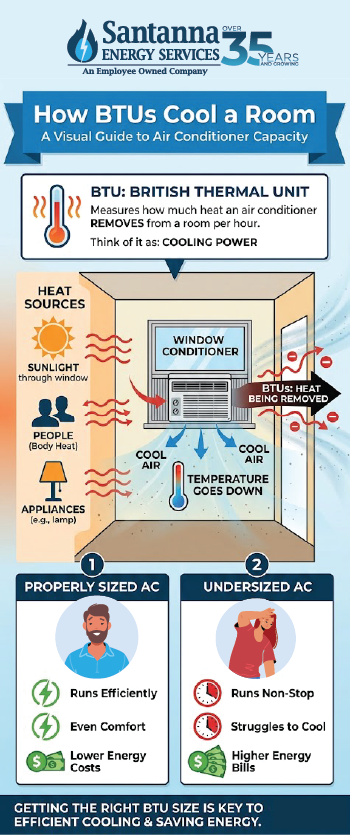
BTUs (which stands for British Thermal Unit) tell you how much and how quickly air conditioner can remove heat from a room each hour. This number affects how well the AC cools your space and how long it has to run to reach the temperature you want.
One BTU is the amount of heat needed to raise one pound of water by 1°F. BTUs are a simple way to describe how heat moves in and out of a space, which is exactly what your heating and cooling system manages every day.
Heating systems add heat to your home, while air conditioners remove heat from it. That’s why BTUs are used to describe the capacity of both types of equipment; they measure how much heat a system can add or remove.
For air conditioners, the BTU rating tells you how much heat the unit can remove from a room each hour. When you see an air conditioner rated at 10,000 BTUs, it means the unit can remove about 10,000 units of heat from the room every hour.
Why the BTU Size of Your Air Conditioner Matters for Your Home’s Comfort and Energy Use
BTU sizing can affect electricity costs over time because it changes how long your air conditioner has to run to keep a room comfortable.
Imagine two similar rooms using air conditioners that draw about 1 kilowatt (1 kW) of electricity while running. If the AC is properly sized for the space, it might run about 6 hours per day during warm weather and the total energy consumption equals about 6 kilowatt- hours (kWh) per day, or about 180 kWh over a 30-day month. Using the U.S. average electricity price of 17.24 cents per kWh, that would cost roughly $31 per month to run that unit.
Now imagine the AC is too small for the room. Assuming similar efficiency, and because it struggles to keep up with the heat coming in from sunlight, people, and appliances, it may need to run about 10 hours per day to maintain the same temperature. That equals about 10 kWh per day, or about 300 kWh per month. At the same electricity rate, that would cost about $52 per month.
This difference in run time illustrates why BTU sizing directly affects both comfort and cost.
In this example, the undersized unit costs about $21 more each month simply because it has to run longer to remove the same amount of heat. Over the course of a summer, that extra runtime can easily add up to $60 to $100 or more, depending on how hot the season is and how often the AC runs.
This is why choosing the right BTU size matters. The goal is not to buy the biggest unit, but to choose one that can cool your space efficiently without forcing the system to run longer than necessary.
What Factors Affect How Many BTUs Your Air Conditioner Needs?
Choosing the right BTU size is not just about room size; it depends on how the space actually behaves throughout the day.
Before selecting a BTU rating, consider the real-world factors that influence how hard your air conditioner has to work to keep the room comfortable.
Square Footage of the Room
Square footage affects BTU needs because larger rooms contain more air and usually gain more heat throughout the day. A bigger space generally requires more cooling capacity to bring the temperature down and keep it comfortable. Most basic sizing guides start with square footage as the baseline, then adjust for other factors like sunlight, insulation, and ceiling height.
Sun Exposure and Shade
A sunny room usually needs more BTUs because sunlight adds heat throughout the day. West-facing windows can make a room heat up fast in the afternoon, which can lead to longer AC runtime.
Ceiling Height and Room Shape
Higher ceilings often need more BTUs because there is more air to cool. Long rooms, open spaces, or odd layouts can also make it harder for cool air to spread evenly.
Insulation and Air Leaks
Drafty windows, gaps around doors, and weak insulation let warm air leak in and cool air leak out. That increases the heat your AC has to remove and can lead to longer run time.
Number of People Using the Room
People give off heat. If a room is regularly used by more than two people, it can feel warmer and may need more BTUs to stay comfortable.
Heat-Producing Appliances
Kitchens, laundry rooms, and rooms with lots of electronics often need more BTUs. Cooking, dryers, and computers add heat that the AC has to remove.
Floor Level (upstairs vs basement)
Upstairs rooms often need more BTUs because heat rises and attic heat can build up. Basements usually need fewer BTUs because they stay naturally cooler.
How Many BTUs Per Square Foot Do You Need?
Most homeowners can start with about 20 BTUs per square foot when estimating how much cooling a room needs. But keep in mind that the bigger your house is, the more BTUs you’ll need to meet your cooling capacity.
To find out how many BTUs per square foot your home needs, start by measuring your room’s size. Measure the length and width, then multiply both numbers to get the square footage. Once you know the square feet of all the rooms you’re looking to cool, multiply that number by 20 BTUs to estimate the cooling capacity needed.
For example, imagine a bedroom that measures 180 square feet. Using the rule of thumb of 20 BTUs per square foot, you multiply 180 × 20, which suggests about 3,600 BTUs. Since most room air conditioners start around 5,000 BTUs, a 5,000 BTU unit would likely be the closest practical choice for that space.
Typical Room Size to BTU Chart for Home Cooling
| Room size (sq ft) | Capacity needed (BTU/h) |
| 100 to 150 | 5,000 |
| 150 to 250 | 6,000 |
| 250 to 300 | 7,000 |
| 300 to 350 | 8,000 |
| 350 to 400 | 9,000 |
| 400 to 450 | 10,000 |
| 450 to 550 | 12,000 |
| 550 to 700 | 14,000 |
| 700 to 1,000 | 18,000 |
| 1,000 to 1,200 | 21,000 |
| 1,200 to 1,400 | 23,000 |
| 1,400 to 1,500 | 24,000 |
| 1,500 to 2,000 | 30,000 |
| 2,000 to 2,500 | 34,000 |
What Is Considered a Good BTU Rating for an Air Conditioner?
A good BTU rating for an air conditioner is the one that matches your room size and real-life conditions, but a common starting guideline is about 20 BTUs per square foot. For example, a 150 to 250 square foot bedroom often works well with a 5,000 to 6,000 BTU unit, while a 300 to 450 square foot living room may need around 8,000 to 10,000 BTUs.
However, square footage is only the starting point. Sunlight, ceiling height, insulation, airflow, and humidity can all change how much cooling a room needs. Rooms with large windows, strong afternoon sun, or warmer upstairs locations may need slightly more cooling capacity, while shaded rooms, basements, or well-insulated spaces may need less.
When the BTU size is close to what the room actually needs, the AC can cool at a steady pace, maintain more even temperatures, and remove humidity more effectively. The result is a space that feels comfortable without the system running longer than necessary.
What Happens If Your Air Conditioner BTUs Are Too Low?
If your AC BTUs are too low, the unit often runs for long stretches but still struggles to keep the room comfortable, which can raise energy use and wear it out faster.
A low BTU unit is basically underpowered for the amount of heat coming into the space. You might notice the room cools very slowly, never quite reaches the temperature you want, or feels okay in the morning but falls behind in the afternoon, especially in humid Midwest weather.
Say you put a 6,000 BTU window unit in a sunny upstairs bedroom that gets hot every afternoon. It may start out fine in the morning, but once the sun hits, the room warms up faster than the unit can cool it. The AC ends up running almost nonstop, and you still feel like you are chasing comfort, especially around late afternoon and early evening.
This can affect your energy use because the AC has to run longer to try to catch up. Even though the unit is smaller, long runtime can add up to more kWh over the month. It can also feel frustrating because you are paying for cooling time without getting the comfort you expected.
You may also see more strain on the unit. When a smaller AC runs constantly, it can wear down parts faster and may need more frequent maintenance.
What Happens If Your Air Conditioner BTUs Are Too High?
If your AC BTUs are too high, the unit can cool the room too quickly and shut off too soon, which can waste energy and leave the air feeling clammy.
An oversized unit removes temperature fast, but comfort is not only about temperature. In many Midwest homes, humidity is a big part of why a room feels sticky. When the AC shuts off quickly, it may not run long enough to pull enough moisture from the air, so the room can feel cool but damp.
Say you put a 12,000 BTU unit in a small bedroom that really only needs something closer to 6,000 to 8,000 BTUs. The room might feel cold within a few minutes, so the unit shuts off. But a little while later, it kicks back on again. Meanwhile, the air still feels kind of sticky, so you turn the temperature down even more hoping it will feel better, and now the unit is cycling on and off all day while comfort still feels off.
Oversizing can also lead to frequent on-and-off cycling. That stop-and-start pattern can be inefficient and can cause uneven temperatures.
BTUs vs. Watts: What’s the Difference and How Do They Affect Energy Use?
BTUs and watts describe two different things about your air conditioner, and understanding both helps explain how efficiently your AC cools your space and how much electricity it uses.
BTUs measure cooling power. When you see 8,000 BTUs or 10,000 BTUs on a label, that number tells you how much heat the air conditioner can remove from the air each hour. It helps you choose a unit that is strong enough to cool your room.
Watts measure electricity use. Watts tell you how much power the air conditioner pulls while it is running. Your electric bill is based on kilowatt-hours (kWh), which measure how much electricity the unit uses over time.
This is why two air conditioners with the same BTU rating can still use different amounts of energy. One model may use fewer watts to produce the same cooling, which means it is more efficient. Another model may use more electricity to produce the same BTUs.
In simple terms, BTUs tell you how strong the cooling is, while watts help determine how much electricity your AC uses while cooling your space. Your final energy cost depends on the unit’s efficiency, its wattage, and how long it runs each day.
How Do BTUs Affect Energy Use and Your Monthly Cooling Bill?
BTUs for air conditioners affect your monthly cooling bill because the BTU size you choose changes how long your air conditioner has to run. The longer your AC runs, the more electricity it uses.
Think of BTUs as cooling capacity. When the BTU size matches your room, the AC can cool the space at a steady pace and shut off normally once the temperature is reached.
If the BTU rating is too low, the unit may run much longer trying to catch up, especially during hot and humid Midwest afternoons. If it is too high, the unit may cool too quickly and turn on and off more often, which can also waste energy.
For example, imagine a room air conditioner that uses about 1 kilowatt (1 kW) of power while running.
If the unit is properly sized and runs 6 hours per day, it uses about 6 kilowatt-hours (kWh) per day. If the unit is undersized and has to run 10 hours per day to keep up, it uses about 10 kWh per day.
That is 4 extra kWh each day simply because the system has to run longer.
Over a 30-day month, that adds up to 120 extra kWh. Using the U.S. average electricity price of 18.44 cents per kWh (May 2026, U.S. Energy Information Administration), that equals about $22.13 more on your monthly bill.
This is why BTU sizing matters for energy use. The goal is not to buy the biggest unit, but to choose a size that cools your space efficiently without forcing the AC to run longer than necessary.
How Much Power Does a 10,000 BTU Air Conditioner Use?
A 10,000 BTU air conditioner usually uses about 700 to 1,000 watts while running, depending on the model and its efficiency.
Because efficiency varies between models, two 10,000 BTU units can use slightly different amounts of power. The most accurate way to check is to look at the wattage listed on the unit’s label or in the owner’s manual.
For a simple example, an LG Wi-Fi Enabled 10,000 BTU window air conditioner uses about 870 watts while running.
If the unit runs 6 hours per day, it would use about 5.22 kilowatt-hours (kWh) per day.
Over 30 days, that equals about 156.6 kWh per month.
Using the U.S. average electricity price of 18.44 cents per kWh as of May 2026, that would cost about $29 per month to run that unit for 6 hours a day.
How Many BTUs Are in a 3 Ton Air Conditioner?
A 3 ton air conditioner is 36,000 BTUs per hour because 1 ton of cooling equals 12,000 BTUs per hour.
Air conditioners for whole homes are often described in “tons,” while window and portable units are usually labeled in BTUs. They are just two ways of talking about cooling capacity. The conversion is simple: 1 ton = 12,000 BTUs per hour.
A 3 ton system is common for central air setups because it delivers enough cooling power for many average-size homes, depending on insulation, layout, sun exposure, and how airtight the home is.
The key thing to remember is that tonnage is not a “better or worse” number. It is a capacity number. If the capacity is too large or too small for the home, the system can run in inefficient patterns that affect comfort and energy use.
How Many BTUs Are in a 4 Ton Air Conditioner?
A 4 ton central AC system uses 48,000 BTUs per hour.
A 4 ton air conditioner has more cooling capacity than a 3 ton system, which is why it is sometimes used in larger homes or homes with higher cooling needs. Higher cooling needs can come from things like poor insulation, more sun exposure, high ceilings, lots of windows, or a more open layout where cooled air spreads across a bigger area.
This matters for energy use because a larger system is not automatically more efficient. If a 4 ton system is oversized for the home, it may cool too quickly and cycle on and off more often, which can reduce comfort and waste energy. If it is properly sized, it can cool steadily and keep temperatures more even.
How Many BTUs Are in a 5 Ton Air Conditioner?
A 5 ton central AC system uses 60,000 BTUs per hour.
A 5 ton central AC system is a high-capacity option that may be used for very large homes or homes with unusually high cooling demand. But bigger is not automatically better.
If the home does not actually need that much cooling capacity, the system may cycle on and off too often and may not manage humidity well, especially during humid Midwest summers.
That is why tonnage should be based on the home’s real cooling needs, not just square footage. Insulation levels, air leaks, duct airflow, window exposure, and layout all affect what size is actually appropriate.
What Home Upgrades Reduce BTU Air Conditioner Demand and Help Your AC Run Less?
Home upgrades reduce BTU demand by lowering how much heat and humidity enter your home, so your AC can cool more easily and run fewer hours.
When your home lets less heat in, you often need less cooling power to stay comfortable, and your AC does not have to run as long to hold your set temperature. That can mean fewer kWh used during peak summer weeks.
Here are the home upgrades that usually make the biggest difference for comfort and energy use, especially in many Midwest homes.
Air Sealing in the Right Places
Small gaps around windows, doors, attic hatches, and plumbing openings can let warm, humid air leak in all day. Sealing those leaks reduces the heat load your AC must remove. It also helps rooms cool more evenly, so you are not lowering the thermostat just to fix one warm spot.
Attic Insulation and Attic Heat Control
In summer, a hot attic can radiate heat down into upstairs rooms. Better insulation helps block that heat from entering the living space. If your attic ventilation is blocked or your insulation is thin, upstairs rooms often feel harder to cool and your system can run longer.
Window Heat Control
Windows can add a lot of heat, especially on the west and south sides. Simple steps like blackout curtains, shade, or reflective window film can reduce solar heat gain. That can make a room feel cooler without changing the AC size and can shorten runtime on hot afternoons.
Duct Sealing and Airflow Improvements for Central AC
If you have central air, leaky ducts or weak airflow can waste cooled air before it reaches the rooms that need it. When airflow is improved, the home cools faster and more evenly. That helps reduce the temptation to overcool the whole house for one warm room. This is not a DIY project for everyone, but it is a common reason homes feel uneven.
Humidity Control Basics
If your home feels sticky, it may not be a BTU issue alone. High humidity can make the house feel warmer, which often leads people to turn the thermostat lower. Bathroom fans, kitchen exhaust fans, and addressing damp basements can reduce indoor moisture. When humidity is more controlled, you can often feel comfortable at a slightly higher temperature setting, which can lower energy use.
Shading and Outdoor Heat Reduction
Exterior shading can reduce heat gain before it even hits the walls and windows. Awnings, shade trees, or even closing blinds during peak sun can reduce the cooling load in sunny rooms. This can be a long-term improvement that makes your home easier to cool year after year.
FAQs
Why Does My AC Feel Weak Even If It Has Enough BTUs?
Even if your AC has the right BTU size, it can still feel weak if airflow is restricted or if the unit cannot remove heat effectively. Common causes include a dirty air filter, dirty coils, blocked vents, or furniture blocking airflow from a window unit. High humidity can also make a room feel warmer than it actually is, which can make the AC seem less effective even when it is working properly.
Is It Better to Slightly Oversize or Undersize an AC?
Neither. The best choice is to right-size the unit for your room or home. An oversized AC can cool the room too quickly and shut off before removing enough humidity, which can leave the air feeling clammy. An undersized AC may struggle on hot days and run for long periods trying to keep up.
Can the Right BTU Size Fix Humidity Problems?
BTUs can help with humidity control, but they do not fix humidity by themselves. When an AC is properly sized, it runs long enough to remove some moisture from the air while cooling. However, indoor humidity is also affected by ventilation, air leaks, insulation, and moisture sources in the home. Oversized units are especially likely to leave the air feeling damp because they shut off too quickly to remove enough moisture.
BTUs tell you how much cooling power your AC can deliver, and the right size helps your home cool steadily without wasted run time. The key takeaway is simple: when BTUs match your space and conditions, you get better comfort and are less likely to overwork your system.
During humid summer days, AC run time can increase, and longer run time often means more electricity use and higher bills. Getting the sizing right helps you avoid the “one hot room” problem that leads homeowners to lower the thermostat for the whole house.
If you also want more predictability during high-usage months, it can help to look at your energy plan too. Santanna’s Unlimited Energy plan is one option that can make supply charges* feel more predictable and budgeting easier, and you can explore it anytime if that kind of peace of mind sounds helpful.
* Restrictions apply. Enrollment based upon program eligibility. Customers using more than 125% of normal monthly usage as determined by Santanna may be required to switch plans.
Tyler is an experienced energy professional, having worked for Santanna Energy Services, for the past four years. He is passionate about renewable energy and believes that diversifying the energy grid is the key to a sustainable future. Tyler is dedicated to supplying consumers with the best possible energy solutions and works diligently to make sure that Santanna can deliver the highest quality service.