
How Much Electricity Does a Washing Machine Use?

by Tyler Castle
11.1 min read
Key Points of This Article:
- Most washing machines use about 0.4 to 1.4 kWh per load (400–1,400 watts), depending on settings like cycle type and water temperature.
- Monthly electricity use of a washing machine can range from around 4 kWh (small households) to 80+ kWh (large families) based on how often laundry is done.
- The largest energy use during washing comes from heating water, not the washer motor itself.
- Running a washing machine typically costs about $0.71 to $16.06 per month, depending on usage and household size.
Doing laundry may feel like a small part of your routine, but the way you wash clothes can affect your household energy use more than many homeowners realize.
Most washing machines use roughly 0.4 to 1.4 kWh of electricity per load depending on your model, cycle time and water use. Now imagine this energy use multiplied by multiple loads of laundry a week.
We've crunched the numbers, so you don't have to.
In this guide, you will learn how much electricity washing machines typically use, what can make laundry costs go up, and a few easy ways to make your laundry routine more energy efficient without giving up comfort or convenience.
Does the Washing Machine Use a Lot of Electricity?
Washing machines usually do not use as much electricity as many homeowners think, especially compared to larger household appliances like dryers, water heaters, and air conditioners.
Most washing machines use roughly 400 to 1,400 watts per load depending on the wash settings, water temperature, and cycle type selected.
In many homes, running a single load of laundry uses about the same amount of electricity as a refrigerator uses over the course of a day.
Larger families, homes with children, athletes, pets, or households frequently washing towels and bedding may also notice higher laundry-related energy use simply because the washer runs more often.
Overall, washing machines are generally considered moderate energy-use appliances. Still, because laundry is part of most weekly routines, even small changes in how you wash clothes can make a difference in long-term household energy use and utility costs.
How Much Electricity Does a Washing Machine Use?
A washing machine typically uses about 0.4 to 1.4 kWh of electricity per load depending on the model, cycle settings, water temperature, and how often the machine runs throughout the week.
In many homes, washing machines can use around 4 kWh of electricity for smaller households that do about 12-15 loads of laundry to 80 kWh or more for larger families that do about 48-52 loads of laundry a month.
Even though washing machines generally use less electricity than dryers or air conditioners, laundry is still a regular part of most households.
Average Washing Machine Electricity Use Based on Household Laundry Habits (Based on average washing machine energy use of 400 to 1,400 watts per load)
| Household Size | Laundry Frequency | Average Electricity Use Per Load | Time of Use | Average Weekly Electricity Use | Average Monthly Electricity Use | Average Yearly Electricity Use |
| Single Person | 2–3 loads/week | 0.4–0.8 kWh | 2 hrs/week | 0.8–2.4 kWh | 4–10 kWh | 42–125 kWh |
| Couple | 4–5 loads/week | 0.5–1 kWh | 4 hrs/week | 2–5 kWh | 9–22 kWh | 104–260 kWh |
| Family of 4 | 7–10 loads/week | 0.8–1.2 kWh | 7 hrs/week | 6–12 kWh | 26–52 kWh | 312–624 kWh |
| Large Family | 12–15 loads/week | 1–1.4 kWh | 10 hrs/week | 12–21 kWh | 52–91 kWh | 624–1,092 kWh |
Disclaimer: Actual electricity use may vary depending on washer model, cycle settings, water temperature, load size, appliance age, and laundry frequency. Warm and hot water cycles may increase total energy use.
Average Washing Machine Electricity Consumption: Front-Load vs. Top-Load LG Washing Machines
| Washer Type | Average Wattage (W) | Average Electricity Use Per Load | Estimated Weekly Electricity Use | Estimated Monthly Electricity Use | Estimated Yearly Electricity Use |
| Front-Load Washer | 1,000–1,500 W | 0.4–0.8 kWh | 1.6–5.6 kWh | 7–24 kWh | 84–291 kWh |
| Top-Load Washer | 1,200–1,800 W | 0.5–1 kWh | 2–7 kWh | 9–30 kWh | 104–364 kWh |
Disclaimer: These estimates are based on average LG washing machine energy ranges and estimated household laundry habits. Actual electricity use may vary depending on washer model, cycle settings, water temperature, load size, appliance age, and laundry frequency.
What Factors Affect Washing Machine Energy Consumption?
In many homes, the washer motor itself uses relatively little electricity compared to the energy needed to heat water during warm or hot wash cycles.
Here are some of the biggest factors that can affect washing machine energy consumption:
- Water Temperature: Cold water cycles usually use the least amount of energy because the machine does not need to heat the water, which can help lower energy costs.
- Load Size: Running several small loads throughout the week may use more energy overall than washing fewer full loads. Full loads generally help maximize efficiency because the machine washes more clothes during each cycle.
- Cycle Selection: Heavy-duty and sanitize cycles often run longer and may use hotter water, which can increase electricity use.
- Washer Age and Efficiency: Older washing machines often use more water and electricity than newer models. Some ENERGY STAR® certified washers are designed to use about 30% less water and 20% less energy while improving overall efficiency.
- Frequency of Laundry: Larger households, families with children, homes with athletes, or households washing seasonal items like blankets and winter clothing may naturally use more electricity because the washer runs more often throughout the week.
What Uses the Most Electricity During Laundry?
The largest portion of the energy used during a laundry cycle can come from heating the water, which uses around 1,800 to 5,000 watts per load.
Dryers also tend to use significantly more electricity than washing machines because they generate heat for longer periods to dry clothes completely.
Bulky items like towels, blankets, jeans, and winter clothing usually hold more moisture and often require longer drying times, which can increase electricity use even more.
Frequently washing clothes in hot water or running the dryer multiple times a day may gradually increase monthly utility costs, especially in larger households with frequent laundry routines.
How Much Does It Cost to Run a Washing Machine?
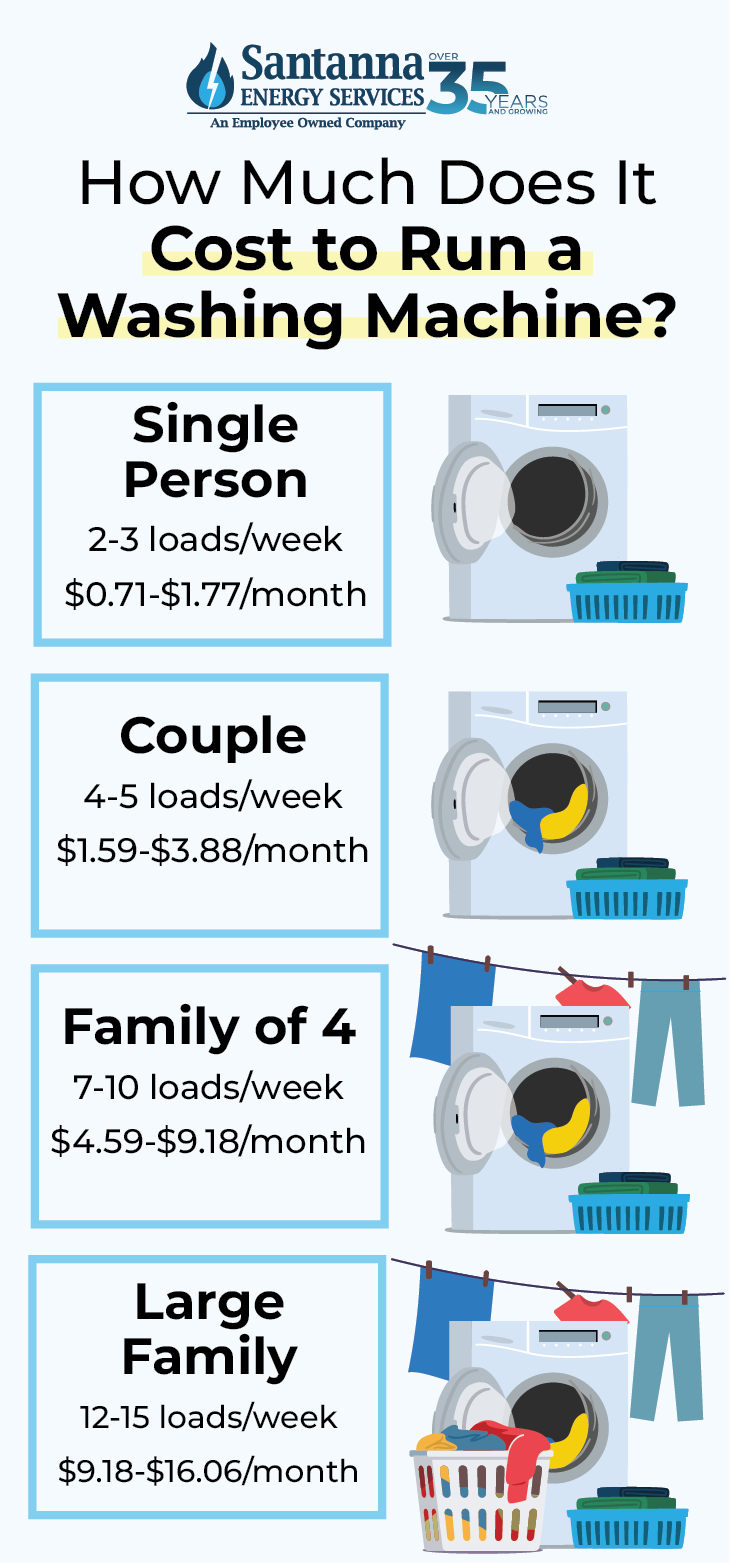
The cost to run a washing machine typically costs $0.71 to $16.06 per month, using the U.S. average residential electricity rate of 17.65 cents per kWh as of February 2026 according to the Energy Information Administration.
Average Washing Machine Electricity Cost Based on Laundry Frequency
(Based on average washing machine energy use of 400 to 1,400 watts per load at 17.65 cents per kWh as of February 2026, according to the EIA)
| Household Size | Laundry Frequency | Average Electricity Use Per Load | Time of Use | Average Weekly Cost | Average Monthly Cost | Average Yearly Cost |
| Single Person | 2–3 loads/week | 0.4–0.8 kWh | 2 hrs/week | $0.14–$0.42 | $0.71–$1.77 | $7–$22 |
| Couple | 4–5 loads/week | 0.5–1 kWh | 4 hrs/week | $0.35–$0.88 | $1.59–$3.88 | $18–$46 |
| Family of 4 | 7–10 loads/week | 0.8–1.2 kWh | 7 hrs/week | $1.06–$2.12 | $4.59–$9.18 | $55–$110 |
| Large Family | 12–15 loads/week | 1–1.4 kWh | 10 hrs/week | $2.12–$3.71 | $9.18–$16.06 | $110–$193 |
Disclaimer: These estimates reflect the electricity used by the washing machine itself and are based on average household laundry habits. Actual costs may vary depending on electricity rates, washer model, cycle settings, water temperature, appliance efficiency, and laundry frequency.
Average Washing Machine Cost: Front-Load vs. Top-Load LG Washing Machines
(Using the U.S. average residential electricity rate of 17.65 cents per kWh as of February 2026, according to the EIA.)
| Washer Type | Average Wattage (W) | Average Electricity Use Per Load | Estimated Cost Per Load | Estimated Weekly Cost | Estimated Monthly Cost | Estimated Yearly Cost |
| Front-Load Washer | 1,000–1,500 W | 0.4–0.8 kWh | $0.07–$0.14 | $0.30–$0.70 | $1.30–$3 | $16–$36 |
| Top-Load Washer | 1,200–1,800 W | 0.5–1 kWh | $0.09–$0.18 | $0.40–$0.90 | $1.70–$4 | $21–$47 |
Disclaimer: These estimates are based on typical LG washing machine energy ranges and average household laundry usage. Actual electricity costs may vary depending on the washer model, cycle settings, water temperature, load size, appliance age, and laundry frequency. Warm and hot water cycles may also increase total laundry-related energy costs.
How Can You Calculate Your Washing Machine Energy Consumption?
You can estimate how much electricity your washing machine uses by checking the energy used per load, estimating how often you do laundry, and multiplying that usage by your electricity rate.
To calculate electricity usage, use this formula:
kWh = Watts × Hours Used / 1000
For example, if a washing machine uses about 1 kWh during a load, that means it uses 1 kilowatt-hour of electricity for that cycle. To estimate cost, multiply the kWh used by your electricity rate using this formula:
Laundry Cost = kWh Used × Electricity Rate
If your electricity rate is 17.65 cents per kWh, a 1 kWh load would cost about 18 cents to run.
However, total laundry costs can increase when using warm or hot water cycles because heating water often uses more energy than the washing machine itself.
Your washing machine's design, settings, and laundry habits can also affect how much electricity and water your household uses over time.
How Much Electricity Do Different Washing Machine Cycles Use?
Different washer cycles can use between 0.82 kWh and 2.30 kWh of electricity per cycle, depending on the cycle length and water temperature settings.
For this example, our dryer wattage and cycle times are based off the settings and wattage of the GE 7.8 cu. Ft. Front Load Washer that uses 1,300 watts.
Average Washing Machine Electricity Consumption by Cycle Type
(Based on estimated energy consumption of a 1,300-watt electric washer)
| Dryer Cycle Type | Average Cycle Time | Average Electricity Use Per Cycle | Estimated Weekly Electricity Use | Estimated Monthly Electricity Use | Estimated Yearly Electricity Use |
| Regular or Normal Cycle | 55 minutes | 1.19 kWh | 8.33 kWh | 36.10 kWh | 433.16 kWh |
| Whites | 1 hour 3 minutes | 1.37 kWh | 9.59 kWh | 41.56 kWh | 498.68 kWh |
| Bulky | 1 hour 4 minutes | 1.39 kWh | 9.73 kWh | 42.16 kWh | 505.96 kWh |
| Sanitize | 1 hour 46 minutes | 2.30 kWh | 16.10 kWh | 69.77 kWh | 837.20 kWh |
| Cold Wash | 1 hour 2 minutes | 1.34 kWh | 9.38 kWh | 40.65 kWh | 487.76 kWh |
| Quick Wash | 20 minutes | 0.43 kWh | 3.01 kWh | 13.04 kWh | 156.52 kWh |
| Delicates | 38 minutes | 0.82 kWh | 5.74 kWh | 24.87 kWh | 298.48 kWh |
Disclaimer: Actual electricity use may vary depending on washer model, load size, moisture level, cycle settings, and household laundry habits.
How Can You Reduce Washing Machine Energy Use?
While a single load may not seem like it uses much electricity, laundry is part of most regular household routines, and those habits can gradually affect long-term energy use and utility costs over time.
Below are some simple ways to help reduce unnecessary laundry-related energy use while still keeping clothes clean and everyday routines comfortable.
Wash Full Loads When Possible
Every time the washer runs, it uses electricity and water regardless of how many clothes are inside.
According to a Santanna Energy Services survey of employee-owners, 63% said they typically wait until they have a full load of laundry before running their washing machine.
Running fewer full loads may help reduce unnecessary energy use while also lowering wear on the washing machine over time.
Use Cold Water More Often
Cold water cycles usually use less energy because the washer does not need to heat the water during the cycle.
In our internal survey data, several Santanna employee-owners reported switching most loads to cold water as one of their primary energy-saving laundry habits.
The American Cleaning Institute (ACI) also notes that washing clothes in cold water may help reduce household carbon emissions by up to 1,600 pounds each year.
Use Eco Cycles
Many newer washing machines include eco or energy-saving cycles designed to use less water and electricity during everyday laundry loads. These settings often adjust water levels, cycle length, and wash intensity to improve overall efficiency while still cleaning clothes effectively.
Choose Shorter Cycles for Everyday Laundry
Heavy-duty and longer wash cycles are not always necessary for lightly worn clothes. Choosing shorter cycles for regular laundry may help reduce both electricity and water use because the machine runs for less time during each load.
Clean the Washer Regularly
Keeping the washing machine clean may help it run more efficiently over time. Dirt buildup, detergent residue, and clogged filters can sometimes affect washer performance and cause the machine to work harder than necessary.
Avoid Overloading the Machine
Overloading the washer can place extra strain on the motor and make it harder for clothes to move properly during the cycle. Clothes may come out less clean or wetter than usual, which can sometimes lead to rewashing or longer dryer times that increase overall energy use.
Upgrade Older Washing Machine Models
Older washing machines often use more water and electricity than newer high-efficiency models. For households doing laundry frequently, upgrading an outdated washer may help reduce long-term water and energy use.
Run Laundry During Off-Peak Hours
Running laundry during off-peak hours may help some households better manage energy costs depending on their electricity plan and local utility structure.
FAQs
Do front-load washers use less electricity than top-load washers?
Yes, front-load washers generally use less electricity and water than traditional top-load washers because they use less water and spin clothes more efficiently.
How long do washing machines last?
Most washing machines last about 10 years on average, although some models may last longer with proper care and regular maintenance. How often the machine is used, the size of laundry loads, and how well the washer is maintained can all affect its lifespan over time.
Washing machines themselves are usually not the biggest electricity users in a home, but water temperature, laundry frequency, and drying habits can all affect how much energy your household uses over time.
And while energy-efficient habits can help lower laundry-related costs, having a more predictable energy supply charge may also help make everyday budgeting for your energy use feel a little less like sorting socks fresh out of the dryer.
Santanna’s Unlimited Energy plan is designed to help provide more stable supply pricing for homeowners who want greater consistency in their household energy costs.*
When energy habits and a predictable plan work together, it becomes easier to stay focused on keeping your home comfortable instead of worrying about unexpected energy surprises. Explore Santanna’s Unlimited Energy plan to learn more.
* Restrictions apply. Enrollment based upon program eligibility. Customers using more than 125% of normal monthly usage as determined by Santanna may be required to switch plans.
Tyler is an experienced energy professional, having worked for Santanna Energy Services, for the past four years. He is passionate about renewable energy and believes that diversifying the energy grid is the key to a sustainable future. Tyler is dedicated to supplying consumers with the best possible energy solutions and works diligently to make sure that Santanna can deliver the highest quality service.