

What Uses the Most Electricity in a Home?

by Tyler Castle
Updated: August 17, 2026
11.4 min read
Key Points of This Article:
- Heating and cooling systems consume the most electricity in a home, often accounting for nearly half of total energy use.
- Water heaters, lighting, refrigerators, washers/dryers, ovens, and dishwashers follow as major contributors, with older or inefficient models using significantly more power.
- Small devices like LED bulbs, phone chargers, routers, alarm clocks, and ceiling fans use very little electricity compared to large appliances.
- Household energy use varies based on home size, number of occupants, climate, appliance efficiency, and daily habits, with monitoring tools helping identify high‑use devices.
Electricity bills can sometimes come as a surprise. In fact, in a recent internal survey we found that 88% of respondents have been surprised by their electricity bill in the past and by how much energy their home actually uses.
Whether you're looking to cut down your energy bill or you're just curious about which appliances are power-hungry, understanding what uses the most electricity in your home is a smart place to start.
Not all appliances are created equal—some are silent energy hogs even when you're not using them. In this guide, we'll break down which appliances use the most electricity, compare common household items side by side on their energy consumption, and share some practical tips to help you save energy without sacrificing comfort or convenience.
What Is the Average Electricity Usage per Household?
In the U.S., the average home uses about an average of 899 kWh per month.
A home’s electricity consumption can differ significantly based on its size, the number of occupants, and the types of appliances in use. Understanding your household’s kilowatt-hour (kWh) usage – how much electricity your home uses – can give you a clearer picture of your electric bill, help you highlight opportunities to cut back on energy, and serve as a helpful starting point for sizing a potential solar energy system.
Tracking your electricity usage—whether through your utility provider’s dashboard, a smart home monitor, or monthly bill comparisons—puts you in control of your energy costs and opens the door to long-term savings.
What Uses the Most Electricity in a Home?
Appliances are the root of any well-functioning home and are the leading causes to high energy bills. If you’re wondering what uses the most electricity in your home when it comes to appliances, let us do the work for you:
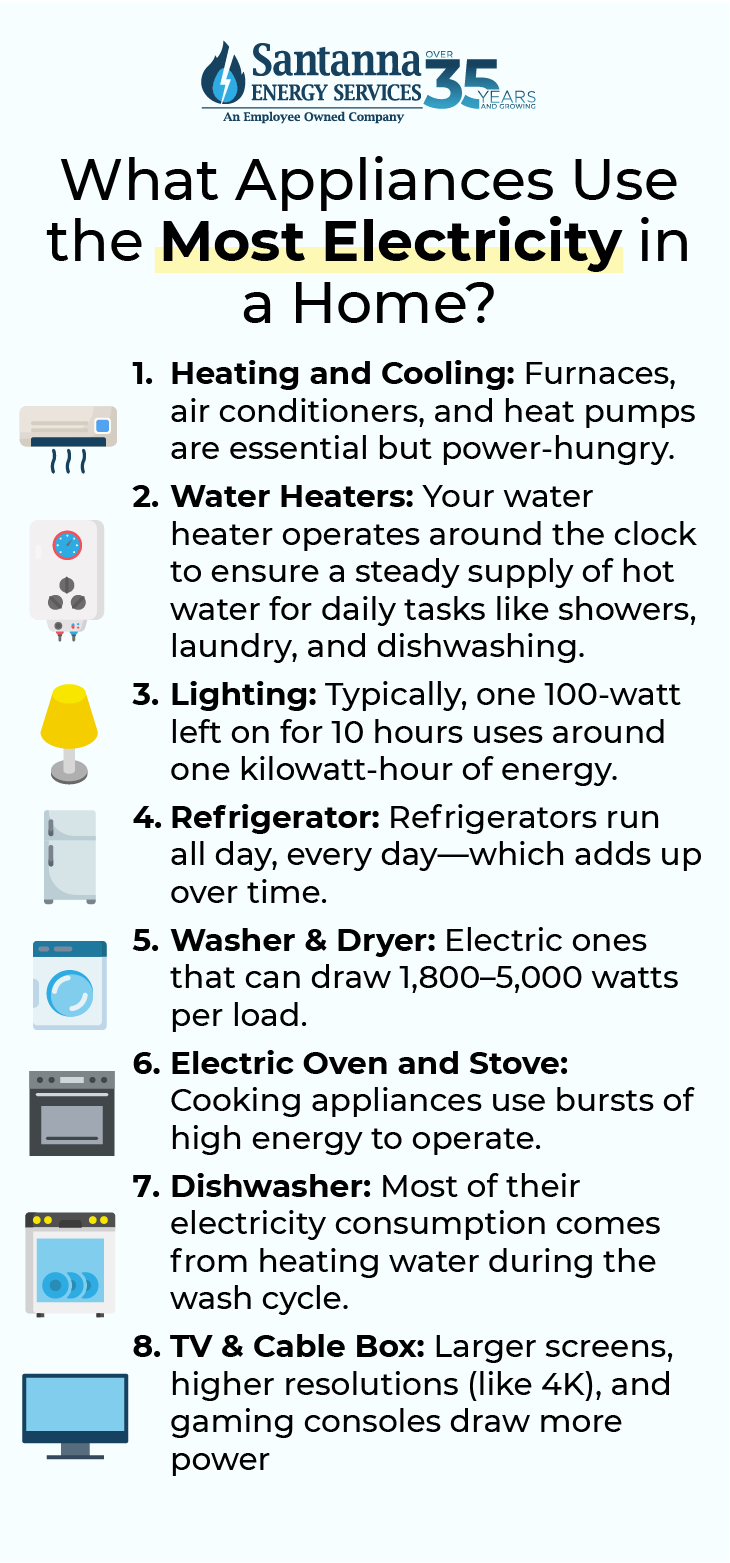
1. Heating and Cooling (estimated energy consumption is between 45–50%)
Appliances in the heating and cooling category are by far the largest energy consumer in your home. Furnaces, air conditioners, and heat pumps are essential but power-hungry—especially if your home isn’t well-insulated or you’re using outdated systems.
While these appliances use a lot of energy, if your home has poor insulation, leaky ductwork, outdated equipment, and a malfunctioning thermostat, this can all spike your energy usage from these appliances and lead to energy loss and higher bills.
According to Energy.gov, a programmable thermostat and regular HVAC maintenance can significantly reduce your usage with these appliances.
2. Water Heater (estimated energy consumption is 12%)
Your water heater operates around the clock to ensure a steady supply of hot water for daily tasks like showers, laundry, and dishwashing, so it’s no wonder it uses so much energy! Traditional tank heaters are less efficient than newer tankless or ENERGY STAR-certified models. This is because tank heaters continuously heat and store water—even when it’s not being used—leading to unnecessary energy consumption.
To improve performance and reduce energy use, consider insulating your water heater tank and pipes. Additionally, lowering the thermostat setting to 120°F can help save energy while still providing comfortable hot water for everyday needs. Regular maintenance and upgrades can go a long way in boosting your water heater’s efficiency and lifespan.
3. Lighting (estimated energy consumption is between 9–12%)
Typically, one 100-watt left on for 10 hours uses around one kilowatt-hour of energy. Now imagine that times the hundreds of light bulbs in your home; if you’re hosting a party any time soon, the energy can add up.
Though lighting used to be a top energy drainer, the widespread shift to LED technology has reduced its impact. ENERGY STAR LEDs use at least 75% less energy and last 25x longer than incandescent bulbs.
Keep in mind that homes with lots of recessed lighting, exterior floodlights, or older incandescent bulbs will use significantly more electricity. To further reduce your light bulb energy usage, try turning off the light completely when you leave a room and switch to dimmer switches and use darker settings when full light isn’t necessarily needed.
4. Refrigerator (estimated energy consumption is 8%)
If you’re still wondering what uses the most electricity in a home, move into the kitchen and straight at your refrigerator. Refrigerators run all day, every day—which adds up over time. Older models (10+ years or older) are often the culprits of high energy use since they’re the least efficient.
Switching to an ENERGY STAR-certified refrigerator helps you save energy and reduce your utility bills, all while keeping the modern features you need. To save more energy, avoid overstuffing your fridge or placing them near a heat source can reduce efficiency. With more in your fridge, there’s less cool air that can circulate which can actually lead the temperature in your fridge to rise.
5. Washer and Dryer (estimated energy consumption is 5%)
Washers and dryers are some more appliances that use the most electricity. Washers use energy to run cycles, but dryers are the real guzzlers—especially electric ones that can draw 1,800–5,000 watts per load —making them one of the most energy-intensive appliances in the home. Frequently washing small loads and high-heat drying cycles drive up usage.
Opting for dryers equipped with moisture sensors can help reduce energy waste by automatically shutting off when clothes are dry. Choosing cold water settings for laundry helps conserve energy, especially since heating water accounts for a large portion of a washer’s energy use. Additionally, air drying clothes on a rack or clothesline whenever possible can drastically cut down on energy consumption.
6. Electric Oven & Stove (estimated energy consumption is 3%)
Also on the list of what uses the most electricity in a household, look no further than your oven and stove. 64% of Americans are choosing to cook from home for the majority of their meals. With more people cooking from home, this means the more energy your appliances will consume. Cooking appliances use bursts of high energy to operate and this is especially electric ovens and stovetops which can lead to higher energy consumption.
To minimize energy loss, consider using convection ovens and induction cooktops which are more energy-efficient alternatives. For reheating or small meals, use a microwave or air fryer—they consume significantly less power.
7. Dishwasher (estimated energy consumption is 2%)
Though modern dishwashers are fairly efficient, they are still among the list of what uses the most electricity in a home. Most of their electricity consumption comes from heating water during the wash cycle. Pre-rinsing dishes under running water is another common habit that wastes both water and energy, especially if your dishwasher is designed to handle lightly soiled dishes. ENERGY STAR dishwasher models can save you 18% or more on energy by switching to more efficient models.
Using the eco or energy-saving mode can significantly reduce both water and electricity usage by extending cycle time while using lower temperatures. Similarly, choosing the air-dry setting instead of the heated dry cycle helps cut down on energy without compromising results.
8. TV and Cable Box (estimated energy consumption is 2%)
Flat-screen TVs, gaming systems, and cable boxes may seem minor, but their energy use adds up—especially when left on standby. Larger screens, higher resolutions (like 4K), and gaming consoles draw more power while DVRs and cable boxes often stay on 24/7 further contributing to energy loss.
To cut your losses, consider choosing ENERGY STAR-rated entertainment gear that uses up to 25% more energy-efficient than standard models. For even more energy savings, consider unplugging your TV or game counsel altogether when you know you’re going to be out of the house for an extended period of time.
What Do Our Energy Experts Notice Using the Most Electricity?
We asked Santanna Energy Services employee-owners which appliances or devices, besides air conditioning, they believe use the most electricity in their homes.
Refrigerators were one of the most commonly mentioned appliances, while several employee-owners pointed to computers, TVs, and other electronics. Others called out seasonal devices, including space heaters in the winter and fans in the summer.
These responses highlight an important point: the appliances that have the biggest impact on your electricity use can depend on both how much power they draw and how often you use them.
What Appliances Use the Least Amount of Electricity?
While we’ve chatted about what uses the most electricity in a home, let’s take a look at what uses the least amount of electricity! The answers might surprise you:
1. LED Light Bulbs
LED light bulbs are among the most energy-efficient appliances in your home, using only 8–12 watts per bulb—significantly less than traditional incandescent bulbs. In fact, LEDs consume up to 75% less energy and last up to 25 times longer, making them a smart long-term investment for both your electricity bill and the environment. Even if you have multiple LED bulbs throughout your home, their total energy consumption remains minimal compared to other household devices.
2. Phone Chargers
Phone chargers use around 2–6 watts while charging and less than 1 watt in standby. Compared to other appliances in your home, phone chargers draw very little power. Charging your phone daily adds just a few cents to your monthly electric bill, but it’s always a good idea to unplug your charger after use. Even when they’re plugged into a socket, they still draw energy.
3. Wi-Fi Router
Wi-fi routers typical use around 6–15 watts of energy which makes this home device pretty energy efficient. Their only stipulation is that they do have to run 24/7 which means they’re continuously drawing energy. Despite running continuously, routers are designed for low power draw.
Even running nonstop, a router typically costs under $2/month, making it one of the most efficient “always-on” devices.
4. Clock Radio or Digital Alarm Clock
Despite becoming increasingly obsolete, digital alarm clocks don’t waste that much energy. Digital alarm clocks typically use around 1–3 watts of power making them highly efficient enough though they run 24/7. Even modern alarm clocks use minimal standby power—less than 1 kWh per month.
5. Ceiling Fans
Ceiling fans typically don’t use a lot of energy even when they’re run 24/7. Fans have a typical energy usage of 30–75 watts. For example, running at a normal speed at 60.9 watts a ceiling fan only uses around 1 kWh of energy and would cost you less than $0.22 a day to operate. Compared to air conditioning, ceiling fans provide a cooling effect at a fraction of the cost.
What Factors Influence Your Household Electricity Usage?
While it’s hard to find the exact energy usage of your household appliances and break down exactly what uses the most electricity in a home. Keep in mind that there’s a series of factors that can affect your overall home energy consumption and here are some of the most common:
For instance, home size greatly affects your energy usage. Larger homes generally require more energy for heating, cooling, and need more power for extra rooms and devices. Similarly, more people usually means more devices, more lighting, more laundry, and higher hot water usage. The more people in your home, the higher the overall usage.
Homes in hotter climates often use more electricity due to higher air conditioning needs. In contrast, colder regions may use other heating sources but still have high winter energy demands. This can lead to fluctuations in energy consumption during peak seasons. Older appliances, especially refrigerators, water heaters, and HVAC systems, are less efficient and use more power and can lead to higher electricity bills.
Lastly, how often you cook, do laundry, stream content, or work from home can greatly affect your monthly kWh use. The more you do in your home, the more energy you use.
What Uses More Electricity: A Comparison of Common Appliances
When it comes to managing your home’s energy usage, understanding which appliances use the most electricity can help you make smarter choices. From refrigerators and dishwashers to microwaves and space heaters, some devices draw significantly more power than others.
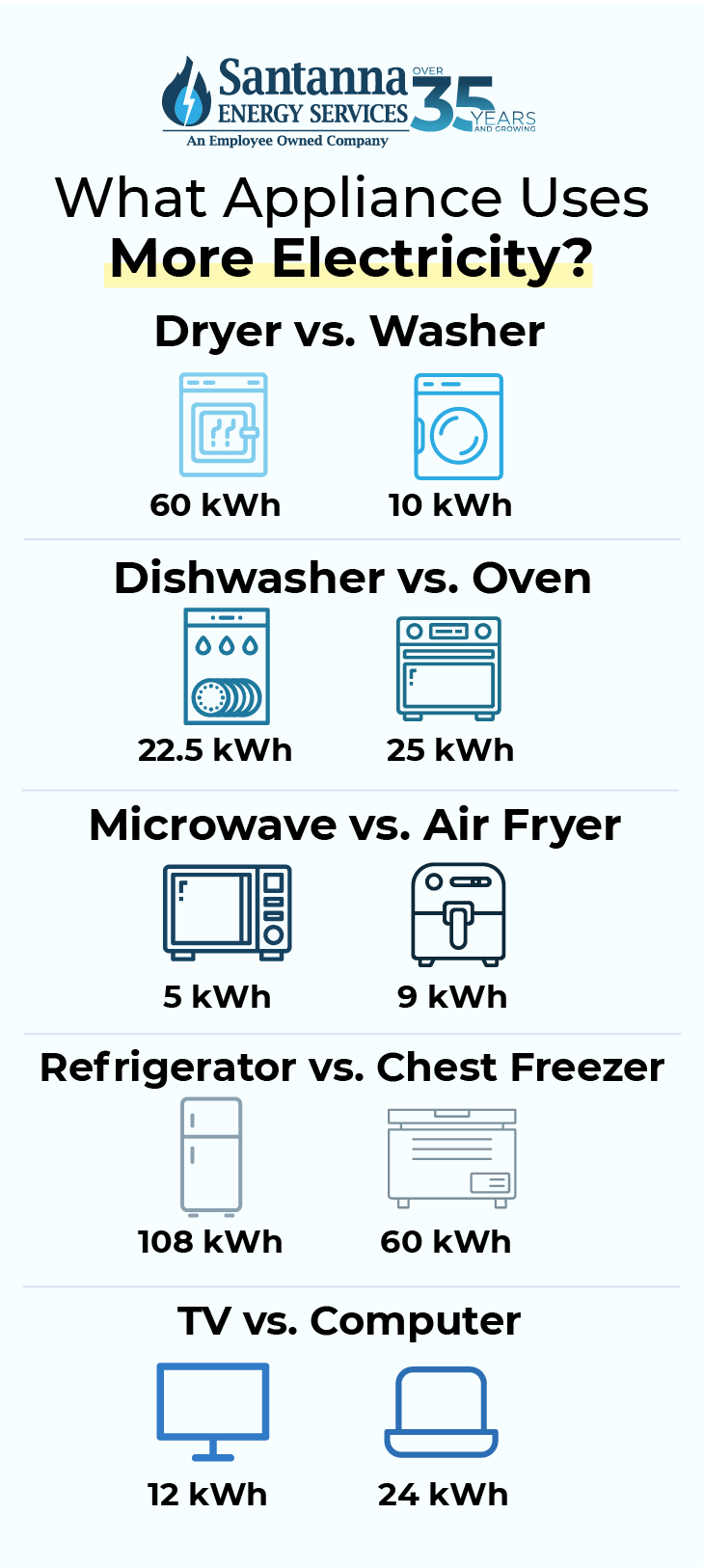
Let’s compare some of the most similar appliances and see which ones have the biggest impact on your electric bill:
Which Appliances Uses More Electricity? (Per Day)
| Appliance A | Estimated Monthly kWh A | Appliance B | Estimated Monthly kWh B |
| Dryer | 60 kWh | Washer | 10 kWh |
| Dishwasher | 22.5 kWh | Oven | 25 kWh |
| Microwave | 5 kWh | Air Fryer | 9 kWh |
| Refrigerator | 108 kWh | Chest Freezer | 60 kWh |
| TV | 12 kWh | Computer | 24 kWh |
| Ceiling Fan | 18 kWh | Portable Space Heater | 135 kWh |
| Electric Kettle | 3 kWh | Coffee Maker | 5 kWh |
| Window AC Unit | 180 kWh | Central AC | 630 kWh |
| Electric Fireplace | 135 kWh | Space Heater | 135 kWh |
| Electric Blanket | 36 kWh | Heated Mattress Pad | 27 kWh |
Understanding what uses the most electricity in a home is the first step toward smarter energy habits and real savings. From heating and cooling systems to everyday appliances and hidden phantom loads, every watt adds up. By tracking your usage, making efficient upgrades, and adjusting daily habits, you can take control of your electricity costs—and make your home more comfortable and sustainable in the process.
But managing your energy use isn’t just about cutting back—it’s about choosing the right energy plan that fits your lifestyle. Explore our plans today and find the one that powers your life with ease.
Tyler is an experienced energy professional, having worked for Santanna Energy Services, for the past four years. He is passionate about renewable energy and believes that diversifying the energy grid is the key to a sustainable future. Tyler is dedicated to supplying consumers with the best possible energy solutions and works diligently to make sure that Santanna can deliver the highest quality service.