
Why Isn’t My Dryer Getting Hot Enough?

by Tyler Castle
Updated: September 8, 2026
12.4 min read
Key Points of This Article:
- A dryer that isn't heating often has a simple cause, like a clogged lint filter, blocked vent, or incorrect settings. Damp clothes, longer drying times, or repeated cycles can help point to the most likely problem.
- Cleaning the lint filter, checking the vent, and verifying the settings can often restore drying performance.
- Running two 45-minute cycles instead of one can double the energy cost from about $0.41 to $0.83 per load.
- If you notice a burning smell, gas odor, smoke, or no heat after the basic checks, stop using the dryer and call a qualified repair professional.
Many people assume a dryer that isn't getting hot has reached the end of its life. The good news is that's often not the case.
If your clothes are still damp after a full cycle or you're running the same load more than once, it might be simpler than you think. From a clogged lint filter to a blocked vent, several common issues can keep your dryer from heating properly.
As an energy supplier serving Midwest homeowners, we know that appliances work best when they're running efficiently. That's why we're here to walk you through the most common reasons your dryer isn't getting hot, what you can safely check yourself, and when it's time to call a repair professional.
Why Isn't My Dryer Getting Hot Enough?
A dryer that isn't getting hot enough is often caused by restricted airflow, incorrect settings, power or gas supply issues, or worn internal components. In many cases, it's still producing some heat, just not enough to dry clothes efficiently.
The good news is that many of these problems are easy to check yourself. Let's take a closer look at the most common causes:
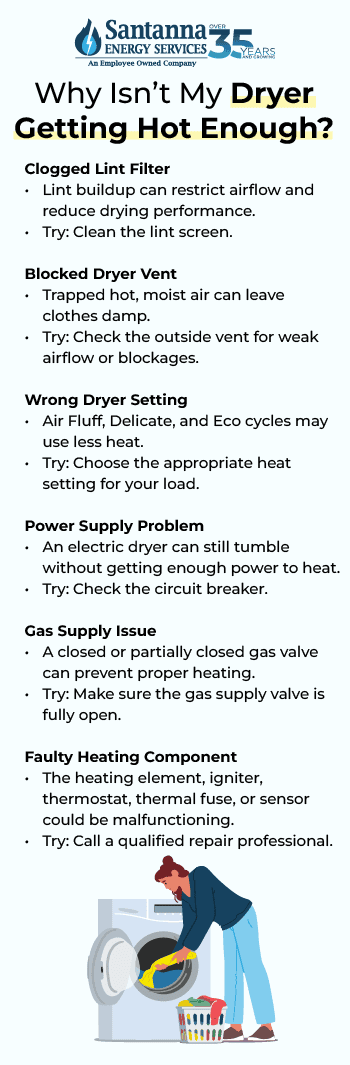
Clogged Lint Filter
A clogged lint filter restricts airflow, making it harder for your dryer to circulate heat and remove moisture. If your clothes stay damp or take longer to dry, cleaning the lint filter is a good place to start.
Not only can a clogged lint filter cause a dryer not to dry, but, according to the National Fire Protection Association (NFPA), U.S. fire departments responded to an estimated 16,000 home structure fires between 2010 and 2014, with 92% of fires involving clothes dryers and 26% of them caused by a clogged lint filter.
Blocked Dryer Vent
A blocked dryer vent traps hot, moist air inside the dryer, reducing drying performance and making the appliance work harder. traps hot, moist air inside the dryer, reducing drying performance and making the appliance work harder.
Lint is the most common cause of why your dryer isn't heating, but leaves, bird nests, snow, or ice can also block the vent. If your clothes need two or three cycles to dry or the outside vent has weak airflow, a blocked vent may be the cause.
Incorrect Dryer Settings
Before assuming something is wrong, double-check the cycle you've selected. Settings like Air Fluff, Delicate, or Eco use lower temperatures and may not be suitable for heavier loads such as drying towels or heavier clothing.
Heating Element Failure
If the drum spins but your clothes never get warm, the heating element, which produces the heat that dries your clothes, may have failed.
If you've already checked the lint filter, vent, settings, and circuit breaker, but your dryer still isn't heating, contact a qualified appliance repair professional immediately.
Gas Burner or Igniter Problems (Gas Dryers)
Gas dryers rely on a burner and igniter to produce heat. If either isn't working properly, the dryer may tumble normally without heating, and the system should be inspected by a qualified professional.
Thermal Fuse or Thermostat Failure
Your dryer uses safety devices that help control temperature and protect the appliance from overheating. If one of these parts fails, the dryer may stop heating properly or shut the heat off too early.
Because these safety components are inside the appliance, repairs are best left to a professional.
Power Supply Problems
An electric dryer may still tumble even if it isn't receiving enough power to heat. A quick check of your circuit breaker is a safe first step, but if the problem continues, further diagnosis should be left to a qualified professional.
Moisture Sensor or Control Board Problems
Many modern dryers use moisture sensors to detect how wet your clothes are and automatically adjust the drying time.
If these components fail, the dryer may stop heating too soon or end the cycle before your clothes are dry, which could be a reason your dryer isn't hot enough.
How to Tell Which Problem You Might Have
The symptoms your dryer shows can often point to the most likely cause. While they can't confirm the problem, they can help you decide what to safely check first and when it's time to call a repair professional.
A few common symptoms can often tell you where to start looking:
Common Signs and Possible Causes of a Dryer That Isn’t Heating
| If You Notice… | It May Be… |
| Clothes stay cold throughout the cycle | A heating element problem (electric dryers), a gas supply or igniter issue (gas dryers), or a power supply problem |
| Clothes feel warm but are still damp after one cycle | A clogged lint filter, blocked dryer vent, or restricted airflow |
| The dryer runs normally, but there’s no heat | A tripped circuit breaker, heating element problem, or another heating component issue |
| The dryer shuts off before clothes are dry | A moisture sensor or control board problem |
| A burning smell while the dryer is running | Lint buildup restricting airflow or another issue causing the dryer to overheat. Stop using the dryer and have it inspected if the smell continues. |
| Very little air is coming from the outside vent | A blocked dryer vent or an obstruction at the exterior vent opening |
Remember that more than one issue can happen at the same time. A clogged lint filter and a blocked dryer vent, for example, can both restrict airflow and make clothes take longer to dry. Starting with the simple, safe checks can often help you rule out the most common causes before calling for repairs.
What You Can Safely Check Before Calling for Repairs if Your Dryer Is Not Getting Hot
Before scheduling a repair, there are a few simple things you can safely check yourself. The good news is that many heating problems are caused by common issues like restricted airflow or incorrect settings.
Let’s take a look at what to check first:
Check the Lint Screen
Clean the lint screen before running another cycle. Even a small amount of lint can restrict airflow and make your dryer less efficient.
If your clothes still take longer than usual to dry, move on to the dryer vent.
Inspect the Outside Dryer Vent
While the dryer is running, go outside and check the vent where warm air exits your home. You should feel a steady flow of warm air, and the vent flap should open freely.
Remove any visible lint, leaves, or debris around the vent opening if it’s safe to do so. If airflow is still weak, the vent may need professional cleaning.
Verify the Dryer Settings
Make sure you’ve selected the right drying cycle for your load. Settings like Air Fluff, Delicate, or Eco use lower temperatures and may not provide enough heat for towels, jeans, or other heavy fabrics.
Switch to a regular or higher-heat cycle and see if drying performance improves before moving on to the next checks.
Check the Circuit Breaker (Electric Dryers)
If you have an electric dryer, check whether the dryer’s circuit breaker has tripped. Sometimes the drum will still spin even when the heating system isn’t receiving the power it needs.
If the dryer’s circuit breaker has tripped, reset the breaker by switching it completely to the OFF position first, then firmly back to ON. If it trips again, stop using the dryer and contact a qualified appliance repair professional or electrician.
Make Sure the Gas Supply Valve Is Open (Gas Dryers)
If you have a gas dryer, make sure the gas shutoff valve is fully open, as a closed or partially closed valve can prevent the dryer from heating properly.
If the valve is already open and the dryer still isn’t heating, don’t inspect the gas components yourself. If you smell natural gas, stop using the dryer immediately, leave the area if necessary, and contact your gas utility or a qualified appliance repair professional.
When Should You Stop Using the Dryer and Call for Repairs?
If your dryer still isn’t heating after the basic safety checks, it’s time to have it inspected by a professional. Some problems are simple to resolve, but others can become safety hazards or require professional repairs.
Stop Using the Dryer Immediately If You Notice:
- A burning smell. This could be caused by excessive lint buildup, overheating, or an electrical problem.
- A natural gas odor around a gas dryer. Stop using the dryer immediately, leave the area if necessary, and follow your gas utility’s safety guidance.
- Smoke coming from the dryer or vent. This may signal overheating or another serious issue.
- The circuit breaker keeps tripping. Repeatedly resetting the breaker without finding the cause can be unsafe.
- Unusual sounds, such as grinding, squealing, or buzzing. These noises may indicate a mechanical or electrical problem that should be checked immediately.
- The dryer becomes unusually hot to the touch. Excessive heat around the outside of the appliance can be a sign of restricted airflow or another issue.
Contact a Repair Professional If:
- The dryer produces no heat at all, even after you’ve completed the basic checks.
- Cleaning the lint filter and checking the dryer vent doesn’t improve drying performance.
- Drying times continue getting longer even with smaller loads.
- The dryer shuts off before clothes are dry.
- The dryer starts heating inconsistently or only heats during part of the cycle.
- You suspect an internal component, such as the heating element, igniter, thermostat, or moisture sensor, isn’t working properly.
- The same problem keeps coming back after you’ve already addressed the obvious causes.
A qualified appliance repair professional can safely diagnose internal electrical, gas, and heating components. Addressing the problem early may also help reduce unnecessary energy use and prevent additional wear on your dryer.
Can a Dryer That Isn’t Heating Increase Your Energy Bill?
A dryer that isn’t heating properly can increase your energy bill because it often has to run longer or through multiple cycles to dry the same load of clothes. Even if it’s producing some heat, reduced heating performance means it’s using more electricity or natural gas while drying your clothes less efficiently.
For example, if a load of towels normally dries in one 45-minute cycle but requires a second cycle, an electric dryer using about 3 kilowatts (kW) while heating would consume about 2.25 kilowatt-hours (kWh) per cycle. At the U.S. average residential electricity rate of 18.44 cents per kWh (EIA, May 2026), that’s about $0.41 for one cycle and about $0.83 if you have to run the same load twice.
Those extra cycles may not seem like much at first, but they can add up over time, especially if you do laundry several times a week.
The exact increase depends on your dryer, local energy prices, and how often you do laundry, but the idea is simple: the longer your dryer has to run to dry the same clothes, the more energy it uses. Fixing the problem early can help improve drying performance, reduce unnecessary electricity or natural gas use, and shorten laundry day.
How to Help Prevent Dryer Heating Problems
The good news is that many dryer heating problems can be prevented with a few simple habits. Let’s take a look at how you can help keep your dryer running efficiently:
- Clean the Lint Filter After Every Load: Removing lint after every load helps maintain proper airflow and reduces the amount of lint that can build up inside the dryer and vent system.
- Inspect and Clean the Dryer Vent Regularly: Lint can build up inside the vent over time, even if you clean the lint filter regularly. Check the outside vent occasionally to make sure air is flowing freely, and have the vent cleaned if airflow becomes restricted.
- Avoid Overloading the Dryer: Packing too many clothes into one load makes it harder for warm air to circulate. Drying medium-sized loads helps clothes dry more evenly and can reduce the need for extra drying cycles.
- Use the Right Drying Cycle: Choose the drying cycle that matches the type of laundry you’re drying. Using a low-heat setting for heavy fabrics may leave clothes damp and require additional drying time.
- Don’t Ignore Longer Drying Times: If your dryer suddenly takes much longer to dry clothes, don’t ignore it. Addressing the problem early can help reduce unnecessary energy use, limit wear on the dryer, and prevent small issues from becoming bigger repairs.
FAQs
Is it safe to keep using a dryer that isn’t heating?
It depends on the cause, but you should stop using the dryer immediately if you notice a burning smell, smoke, a gas odor, or repeated circuit breaker trips because these can indicate a safety hazard.
How often should I clean my dryer vent?
Inspect your dryer vent regularly and clean it at least once a year, or more often if you use your dryer frequently or notice longer drying times or reduced airflow.
Is it worth repairing a dryer that isn’t heating?
Yes, in many cases, but if the repair cost is 50% or more of the price of a comparable new dryer, especially if your current dryer is older or has other problems, replacing it is often the better long-term investment.
Can a thermal fuse be reset?
No, a dryer’s thermal fuse cannot be reset and must be replaced after it blows because it is designed as a one-time safety device.
Many homeowners assume a dryer that isn’t getting hot means it’s time for a replacement, but the good news is that’s often not the case. Common issues like a clogged lint filter, blocked dryer vent, incorrect settings, or a simple power problem can often be resolved before a major repair is needed.
Checking these common causes early can help restore drying performance, reduce unnecessary energy use, and let you know when it’s time to call a qualified appliance repair professional. Once your dryer is running efficiently again, it’s also worth thinking about the energy it uses every day.
While keeping appliances in good working order helps avoid wasted electricity or natural gas, choosing the right energy plan can help reduce surprises on the supply portion of your bill. Explore Santanna’s Unlimited Energy Plan to see how it can help provide a predictable supply charge* while you keep your home and appliances running efficiently.
* Restrictions apply. Enrollment based upon program eligibility. Customers using more than 125% of normal monthly usage as determined by Santanna may be required to switch plans.
Tyler is an experienced energy professional, having worked for Santanna Energy Services, for the past four years. He is passionate about renewable energy and believes that diversifying the energy grid is the key to a sustainable future. Tyler is dedicated to supplying consumers with the best possible energy solutions and works diligently to make sure that Santanna can deliver the highest quality service.