

How Long Do Home Battery Backups Last? Lifespan & Blackout Runtime Explained

by Brennan Lambrecht
Updated: November 10, 2026
17.3 min read
Key Points of This Article:
- Most lithium home batteries backups last 10–15 years overall, but that's separate from how many hours a single full charge can power your home during one outage.
- lithium iron phosphate batteries can undergo 6,000-10,000+ charge cycles over 10 to 15 years, whereas lead-acid batteries can manage only about 300 to 1,000 cycles over 3 to 5 years.
- Your household's electricity use matters more than the capacity alone. A 13.5 kWh battery might run essentials for close to a day, or drain in a few hours if it's also carrying central AC or electric heat.
- Prioritizing appliances during an outage extends runtime for that one event, while following manufacturer temperature and charging guidance protects the battery's lifespan over the years.
A home battery backup may be designed to last for years, but that doesn't mean it can keep your home powered for days during an outage. Battery lifespan and blackout runtime are two different things, and it's easy to confuse the two when deciding whether a battery can meet your home's backup needs.
How long a battery lasts over its lifetime depends on factors such as its age, battery type, charge cycles, and operating conditions. But during a blackout, the bigger question is how much electricity the battery stores and how quickly your refrigerator, lights, HVAC, and other essentials use it.
At Santanna, we know that the way your home uses electricity can make a big difference in how long your battery backup lasts. We're here to help you understand how long home batteries typically last, what affects their lifespan and blackout runtime, and how you can make the most of your stored energy when the power goes out.
How Long Do Home Battery Backups Last?
Many modern home battery backups can last about 10 to 15 years, but the expected lifespan can vary considerably depending on the battery's composition. Lithium-based home batteries generally offer a longer useful life than traditional lead-acid batteries, although the exact number of years and charge cycles varies by battery design and use.
Here is a general comparison of the common battery types homeowners may come across:
Typical Lifespan of Home Battery Types
| Battery Type | Example Brands and Models | Typical Lifespan | What Homeowners Should Know |
| Lithium iron phosphate (LFP/LiFePO4) | Enphase IQ Battery 5P | Around 10–15 years or potentially longer, depending on the system | Designed for a high number of charge cycles and commonly used for stationary energy storage |
| Nickel manganese cobalt (NMC) | SolarEdge Energy Bank | Around 8-12 years, depending on the system and use | A lithium-ion chemistry that offers high energy storage in a relatively compact space |
| Lead-acid (AGM/Gel) | Trojan Solar AGM batteries, such as the Solar SAES 12 205 | Often around 3–5 years under frequent cycling, although lifespan varies widely by use | An older battery technology that generally has a shorter cycle life than lithium-ion batteries |
Note: Actual lifespan varies by battery design, usage, temperature, depth of discharge, and manufacturer specifications. These are general ranges in lifespan across home battery backup types.
Think about the battery in your phone. After several years, the phone may still work, but a full charge probably does not last as long as it did when the phone was new. A home battery can experience a similar gradual decline.
As a home battery ages, it may still charge and provide backup power but store less electricity than it could when it was first installed. That could eventually mean less stored energy is available for your refrigerator, lights, Wi-Fi, and other essentials when you need backup power.
How Does a Home Battery's Warranty Relate to Its Lifespan
Most lithium home battery manufacturers back their systems with a 10-year warranty that guarantees the battery will retain at least 70% of its original capacity by the end of that period, with unlimited charge cycles covered along the way.
This coverage depends on the manufacturer and model, and coverage may include a set number of years, charge cycles, or energy throughput, along with a minimum retained capacity.
What Affects the Lifespan of a Home Battery Backup?
A home battery's lifespan is mainly affected by its composition, how often and how deeply it is used, temperature, and operating conditions. These factors can affect how quickly the battery wears down and loses some of its ability to store electricity over time.
Let's take a look at a few more factors that can affect how long your home backup battery lasts:
Charge Cycles and Frequency of Use
Every time a home battery charges and discharges, it experiences a small amount of wear. A battery that charges and discharges frequently will go through these cycles faster, which can gradually reduce how much electricity it can store.
For example, discharging a 10-kWh battery halfway (5 kWh) on two separate days adds up to roughly one full cycle. Cycles accumulate based on total energy moved through the battery, not on the number of times it's plugged in or turned on.
Depth of Discharge
How much of the battery you use before recharging can also affect its lifespan. Regularly using a large portion of the battery's available energy may contribute to more wear over time. However, modern home batteries typically have built-in controls that help keep charging and discharging within safe operating limits.
As a rough illustration, a household that routinely drains its battery from 100% down to 20% before recharging is putting more cumulative wear on the cells than one that cycles between 90% and 50%.
Temperature
Very hot or cold conditions can affect how well a battery performs and how it ages. Prolonged exposure to high temperatures can accelerate battery deterioration, while very cold temperatures can temporarily reduce the energy some batteries can deliver. This can be especially relevant in the Midwest, where a battery installed in a garage or other unconditioned space may experience both hot summers and freezing winters.
Check the operating range for your specific model. For example, Tesla lists Powerwall 3's ambient operating range as −4°F to 122°F. That does not mean it performs equally well throughout that range.
Freezing outdoor weather also does not necessarily mean the battery cells are below freezing. Depending on the model, built-in controls may warm the cells or restrict charging to protect them. In the Midwest, where garages and outdoor installations experience seasonal temperature swings, ask your installer how your chosen system manages heat and cold.
Installation and Operating Conditions
Where a battery is installed can affect the conditions it experiences every day. Excessive heat, moisture, poor airflow, or other conditions outside the manufacturer's recommendations may affect its performance and accelerate aging.
Battery Management and Manufacturer Settings
Modern home batteries have built-in controls that manage charging, discharging, temperature, and other operating limits. These controls help protect the battery from conditions that could contribute to unnecessary wear. Following the manufacturer's recommended settings and operating guidance may help the battery perform as intended throughout its useful life.
How Many Charge Cycles Does a Home Battery Last?
Most lithium iron phosphate (LFP) home batteries are rated for roughly 6,000 to 10,000+ charge cycles before capacity falls to about 80% of the original capacity rating, which is one reason LFP has become the dominant chemistry for home battery storage.
By comparison, lead-acid batteries are typically rated for only about 300 to 1,000 cycles, a major factor in their shorter 3–5-year lifespan. NMC lithium-ion, another common home battery chemistry, generally lasts between 1,000 and 2,000 cycles.
A "cycle" is one full charge-and-discharge sequence, not necessarily one calendar day. A battery that only discharges partway before recharging (a shallow cycle) uses up less of its rated cycle life than one that is regularly drained close to empty. That's part of why two households with the same battery can see very different lifespans.
How Do You Know When a Home Battery Needs to Be Replaced?
A home battery may need to be replaced when it can no longer store enough electricity to provide the backup power your household needs, or when the manufacturer or a qualified professional identifies a performance or safety problem. Age alone does not necessarily mean it is time for a new battery. How well the battery still performs is usually more useful to consider.
Some signs that your home battery may be nearing replacement include:
- Noticeably shorter backup runtime: Your battery does not keep essential devices powered as long as it once did, even when your electricity use is similar.
- Reduced usable capacity: Your battery system reports that it can store significantly less energy than it did when new.
- Charging or performance problems: The battery has trouble charging normally or consistently providing the expected power.
- Repeated battery or system warnings: Persistent alerts or error messages may indicate a problem that needs attention.
- Reaching the manufacturer's capacity threshold: Your battery's remaining capacity may eventually fall to a level where the manufacturer considers its performance significantly reduced.
A gradual decline in capacity is normal as a battery gets older, so shorter runtime does not automatically mean the battery has failed. The more practical question is whether it still has enough stored electricity to meet the backup needs you rely on during an outage.
If your battery shows persistent warnings, unusual behavior, or signs of physical damage, do not open, repair, modify, or troubleshoot its internal components yourself. Follow the manufacturer's guidance and have potential battery faults or safety concerns evaluated by a qualified professional.
How Long Can a Home Battery Power Your House During an Outage?
A home battery may provide about 8 to 12 hours of backup power during an outage, depending on the battery's capacity and charge level. Actual runtime can be longer or shorter depending on how much usable energy your battery has and how much electricity your home uses while the power is out.
Using that average, you can get a simple estimate of how long your home battery could last:
Estimated runtime = (battery capacity ÷ average daily home electricity use) × 24 hours
For example, here's the calculation for a 13.5 kWh battery:
(13.5 kWh ÷ 29 kWh) × 24 = 11.2 hours
That 29 kWh/day figure comes from Energy Information Administration data showing that the average U.S. household uses roughly 10,500–10,800 kWh per year (about 29 kWh per day) so it's a reasonable planning baseline. However, your own household's actual daily use may run higher or lower depending on home size, appliances, and climate control.
Outages are more common than many homeowners realize: U.S. electricity customers experienced an average of about 11 hours of power interruptions in 2024, according to the U.S. Energy Information Administration. So, if you're considering a home backup battery for your home, now is the time to do it!
Estimated Home Battery Runtime by Capacity
| Battery Capacity | Estimated Runtime at 29 kWh/Day |
| 5 kWh | About 4 hours |
| 10 kWh | About 8 hours |
| 13.5 kWh | About 11 hours |
| 20 kWh | About 17 hours |
| 27 kWh | About 22 hours |
Disclaimer: The estimates below are hypothetical and assume the home uses electricity at a rate equal to about 29 kWh per day throughout the outage. They also assume the listed battery capacity is usable, and the battery begins fully charged. Actual runtime may be shorter or longer depending on your battery system, available charge, system losses, and your household’s electricity use.
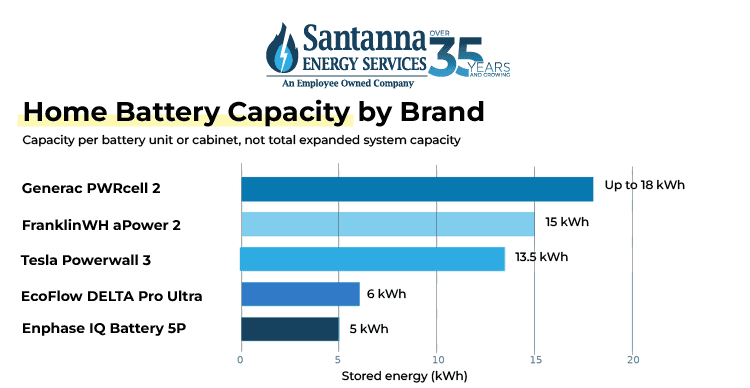
Home Battery Capacity by Brand for Power Outages
| Home Battery | Battery Capacity | Expandable Capacity | What It Means During an Outage |
| Enphase IQ Battery 5P | 5 kWh usable per battery | Multiple compatible batteries can be combined | Starts with a smaller amount of stored energy, but adding batteries can increase the energy available for longer outages |
| EcoFlow DELTA Pro Ultra | 6 kWh per battery | Up to 90 kWh in a full system | Lets you start with less storage and add capacity if you want more energy available for longer outages |
| Generac PWRcell 2 | 9–18 kWh per cabinet | Up to 36 kWh with two cabinets | Gives you several storage sizes, so the system can be sized around how much backup energy your household wants available |
| Tesla Powerwall 3 | 13.5 kWh per Powerwall | Expansion available, with 13.5 kWh added per expansion unit | Provides more stored energy in one battery, with additional capacity available to extend backup duration |
| FranklinWH aPower 2 | 15 kWh per battery | Up to 225 kWh with 15 batteries per aGate | Has the largest single-battery capacity in this comparison and can be expanded substantially for greater backup needs |
Disclaimer: Battery capacities and expansion options are based on manufacturer information available at the time of writing. Actual usable capacity and available configurations may vary by model, system setup, installation, and manufacturer updates. Always check the manufacturer’s current specifications when comparing home battery systems.
More battery capacity means more stored electricity is available when the power goes out, but it does not guarantee a specific number of backup hours. How long that energy lasts depends heavily on what your household keeps running.
Why Can the Same Battery Last Longer in One Home Than Another?
The same home battery can provide very different backup runtimes in two homes because every household uses electricity differently. Even if two homes have batteries with the same usable capacity and charge level, the home drawing less electricity will generally make its stored energy last longer.
For example, one household may use its battery mainly for a refrigerator, Wi-Fi, a few LED lights, and phone charging during an outage. Another may try to keep those essentials running along with central air conditioning, an electric water heater, televisions, and other appliances. The second home will use its stored electricity much faster.
How Can You Make a Home Battery Last Longer?
You can help your home battery last longer by using stored electricity wisely during an outage and following the manufacturer's recommendations for everyday operation and care. These two habits can help in different ways: one can stretch your available backup power, while the other can help protect the battery's useful lifespan over the years.
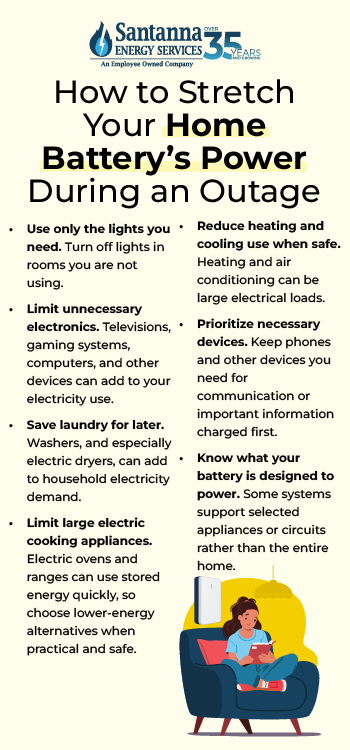
Extending Battery Runtime During a Blackout
During an outage, every appliance or device you run uses some of the electricity stored in your battery. Prioritizing what you really need can help that available energy last longer until grid power returns.
- Use only the lights you need. Turn off lights in rooms you are not using.
- Limit unnecessary electronics. Televisions, gaming systems, computers, and other devices can add to your electricity use.
- Save laundry for later. Washers, and especially electric dryers, can add to household electricity demand.
- Limit large electric cooking appliances. Electric ovens and ranges can use stored energy quickly, so choose lower-energy alternatives when practical and safe.
- Reduce heating and cooling use when safe. Heating and air conditioning can be large electrical loads. Small thermostat adjustments may help conserve stored energy when weather conditions allow. If you lose heat along with power, our guide on how to heat your home without electricity covers safe backup options.
- Prioritize necessary devices. Keep phones and other devices you need for communication or important information charged first.
- Know what your battery is designed to power. Some systems support selected appliances or circuits rather than the entire home, so knowing your system can help you plan what to prioritize.
You do not necessarily need to turn everything off. Think about what your household truly needs until the power comes back on. Refrigeration, necessary lighting, communication devices, and other important needs can come first, while less important electricity use can wait.
Help Extend Your Battery's Useful Lifespan
A home battery will naturally age over time, but using it under the conditions for which it was designed can help protect its long-term performance. You generally do not need to manage the battery yourself because modern systems have built-in controls that handle much of the charging and discharging.
A few good habits can help:
- Follow the manufacturer's recommended settings. These settings are designed to keep the battery operating within proper charging and discharging limits.
- Keep the battery within its recommended temperature range. Prolonged exposure to extreme temperatures can accelerate battery aging.
- Follow maintenance guidance. Use the manufacturer's recommendations for inspections, system updates, and other routine care.
- Pay attention to warnings. Persistent alerts, unusual behavior, or noticeable performance changes may be signs that the system needs attention.
- Leave internal battery work to a professional. Do not open, modify, or attempt to repair battery components yourself. Follow manufacturer advice or contact a qualified professional when service is needed.
The difference is simple: using less electricity during a blackout can help the available charge last longer, while proper use and care can help the battery itself remain useful for longer.
FAQs
Can a Home Battery Power a Home All Night?
Yes, a home battery can last all night if it has enough usable capacity to meet your household's electricity needs. Prioritizing a refrigerator, necessary lights, Wi-Fi, and phone charging can extend runtime, while running larger loads such as air conditioning or electric heating can drain the battery much faster.
Can a Home Battery Run for Several Days During an Outage?
A home battery may provide backup power for several days if electricity use is kept low or the battery can recharge from a source such as solar. A battery relying solely on its stored charge may run out much sooner, especially when powering large electrical loads. Multiple batteries can provide more stored energy, but actual runtime still depends on household electricity use.
A study in 2022 by Berkley Lab confirmed that solar-plus-storage systems with 10 kWh of storage meeting basic backup needs over a three-day outage in virtually all U.S. counties when heating and cooling were excluded.
What Happens When a Home Battery Runs Out During an Outage?
When a home battery reaches its minimum available charge during an outage, it generally stops supplying backup power until it can recharge. Many systems keep a small reserve rather than allowing the battery to discharge completely. That reserve exists mainly to protect the battery itself.
If grid power is still unavailable, recharging will depend on whether the system has another compatible energy source, such as properly configured solar panels.
How Does Battery Capacity Change as a Home Battery Ages?
Like many rechargeable batteries, a home battery gradually loses some of its ability to hold electricity as it gets older. This means that while the battery can still function normally, it may store less energy than it did when new. Over time, this can reduce how long the battery can provide backup power during an outage.
This is the same decline manufacturers describe in their warranty terms. These terms typically guarantee the battery won't fall below a set percentage of capacity for a set number of years. So if you want a reference for what's normal, your warranty documentation is a good place to start.
What Should I Use During a Power Outage: A Home Battery or a Portable Generator?
It depends on how long you expect the outage to last and how hands-on you want to be. A home battery turns on automatically, runs silently, and needs no fuel, but its runtime is limited to its stored capacity unless it's paired with solar.
A portable generator can run as long as you keep supplying fuel, which makes it useful for extended multi-day outages. Still, it needs to be started, fueled, and run outdoors, away from windows and doors, because of the risk of carbon monoxide. Some households use both: a battery for quiet, everyday-easy backup of essentials, and a generator as a longer-duration backstop. Our guide to sizing a generator for your home walks through that comparison in more detail.
Is a Bigger Home Battery Always Better?
Not necessarily; a larger battery stores more energy and can run more of your home for longer, but it also costs more, takes up more physical space, and may be more capacity than you need if you're mainly covering essentials like a refrigerator, lights, and Wi-Fi. A right-sized battery you'll actually rely on is generally a more sensible choice than an oversized one that costs more without meaningfully improving your household's preparedness for an outage.
A home battery can serve your home for years and give you useful backup power when an outage happens. Knowing how your battery works, what you want to keep powered, and how much electricity your home uses can help you make the most of the energy you have stored.
The same understanding can help with your everyday energy choices, too. With Santanna's Unlimited Energy plan, you can enjoy a more predictable monthly supply charge during your plan term, and have fewer surprises with the supply portion of your energy costs.* See if our Unlimited Energy plan is a good fit for your home.
With the right preparation, you can feel more confident about keeping your home powered when it matters most.
* Restrictions apply. Enrollment based upon program eligibility. Customers using more than 125% of normal monthly usage as determined by Santanna may be required to switch plans.
Brennan Lambrecht is a marketing professional with six years of experience in creating helpful content for customers. At Santanna, Brennan focuses on researching emerging energy technologies, including virtual power plants, distributed energy resources, home battery storage, and energy-grid innovation. His research is informed by direct conversations with companies operating in the virtual power plant and battery storage space, giving him valuable industry insight into how these technologies work and what they could mean for energy consumers.