
Are Smart Thermostats Worth It? Pros, Savings & What to Know

by Jenna Mendez
Updated: October 28, 2026
18.2 min read
Key Points of This Article:
- Smart thermostats can be worth it for homeowners who regularly use heating and cooling and plan to use features such as scheduling, remote control, occupancy sensing, and energy reports.
- Smart thermostats may help reduce energy use by avoiding unnecessary heating and cooling, with reported average savings of around 8%, though actual savings vary by home, climate, HVAC system, and habits.
- The biggest benefits are convenience, better temperature control, and automation, but homeowners should weigh those against the higher upfront cost, setup time, Wi-Fi reliance, and possible HVAC compatibility issues.
Smart thermostats can lower your energy bills and make managing your home’s temperature easier. How much value you get out of a smart thermostat depends on how you heat and cool your home, your daily routine, your HVAC system, and how you use its features. With so many claims about energy savings and smart home technology, it can be difficult to know if the investment will actually pay off for your household.
So, are smart thermostats worth it? In this guide, we’ll break down how smart thermostats work, when they’re actually worth buying, and how much you can realistically expect to save.
What Is a Smart Thermostat and How Does It Work?
A smart thermostat automatically manages your home’s heating and cooling based on your settings, schedule, or daily routine. Unlike a traditional thermostat that requires manual adjustments, a smart thermostat can connect to your home’s Wi-Fi, allowing you to control the temperature from a smartphone, tablet, or other connected device.
Rather than relying only on manual adjustments, many smart thermostats can help automate your heating and cooling throughout the day. Depending on the model, they may use features such as:
- Scheduling automatic temperature adjustments when you’re asleep, at work, or away from home.
- Remotely control your home’s temperature from almost anywhere with a mobile app.
- Occupancy sensing to detect when no one is home and temporarily switch to an energy-saving setting.
- Geofencing that uses your smartphone’s location to adjust the temperature when you’re leaving or heading home.
- Learning capabilities on some models that recognize your routine over time and automatically suggest or create schedules.
- Energy reports that provide insights into your heating and cooling habits, helping you better understand your home’s energy use.
The goal of these features is simple: to help reduce unnecessary heating and cooling while keeping your home comfortable. Instead of relying on you to remember every thermostat adjustment, a smart thermostat makes those changes automatically based on your household’s optimal heating and cooling use.
Are Smart Thermostats Worth It?
Smart thermostats can be worth buying for homeowners who regularly monitor their home’s temperature and will actually use the smart features. According to ENERGY STAR, homeowners using smart thermostats have reported average heating and cooling savings of around 8%.
If your household has a predictable schedule, spends part of the day away from home, or uses heating and air conditioning regularly throughout the year, a smart thermostat may help you manage energy use more efficiently.
For many homeowners, the convenience of automatic temperature adjustments and better control over their heating and cooling is just as valuable as the opportunity to reduce energy use.
Brennan Lambrecht, Growth Marketing Coordinator at Santanna Energy Services, upgraded from a manual thermostat after finding a smart model on sale. As a renter, he first received permission from his landlord. While he reports slightly lower bills and energy use since installing it, convenience has been the biggest benefit.
“Smart thermostats are worth it. I think the real value in it is the convenience of scheduling and adjusting temperature from my phone,” Brennan says.
His experience illustrates why a smart thermostat can be worthwhile beyond potential savings: it can make managing your home’s temperature easier, even when you don’t notice a change in comfort.
In an internal survey of our Employee Owners, those who own a smart thermostat cited the scheduling feature as one of their most-used features.
Their experiences highlight how a smart thermostat can make temperature management easier to fit into a household’s routine.
Ultimately, whether a smart thermostat is worth it depends on how well its features fit your lifestyle. Your daily routine, local climate, home’s insulation, HVAC system, and heating and cooling habits all play a role in determining how much value you’ll get from one.
Do Smart Thermostats Save Money?
Smart thermostats can help lower your energy bills by reducing unnecessary heating and cooling. On average, a smart thermostat can save about $50 on your heating and cooling bills annually, according to ENERGY STAR, although actual savings vary from home to home.
Instead of running your heating or air conditioning longer than necessary, a smart thermostat helps adjust the temperature automatically based on your schedule, whether anyone is home, and other energy-saving settings. For many households, these automatic adjustments can add up over time.
Another potential way to save with your smart thermostat, if it’s available through your utility, is through a thermostat demand response program. These programs may offer bill credits or rewards for allowing small, temporary temperature adjustments during periods of high energy demand.
What Affects How Much You Can Save With a Smart Thermostat?
Not every home will save the same amount. How much a smart thermostat helps depends on several factors, including:
- How often you use your heating and cooling system. Homes that rely heavily on heating in winter or air conditioning in summer often have more opportunities to reduce unnecessary energy use.
- Your daily routine. Households that are empty during the day or follow a predictable schedule typically benefit more from automated temperature adjustments.
- Your home’s insulation and air sealing. A well-insulated home stays comfortable longer, so your HVAC system doesn’t have to work as hard.
- The efficiency of your HVAC system. While a smart thermostat can’t make an older system perform like a new one, it can help reduce unnecessary runtime.
- Your local climate and energy prices. Homes in areas with colder winters, hotter summers, or higher electricity or natural gas rates may see greater savings because heating and cooling account for a larger share of household energy use.
A smart thermostat isn’t designed to dramatically reduce your energy bills overnight. Instead, it helps make energy-efficient habits easier to maintain every day. The more consistently you use its scheduling and automation features, the more likely you are to see meaningful savings over time.
What’s the Recommended Temperature for my Smart Thermostat to Save Money?
Looking to potentially save more with your smart thermostat? Setting the right temperature during the right seasons and times can pay off.
We recommend setting your temperature in the summer to 70–78°F when at home, with higher settings (82–88°F) recommended at night or when away.
In the winter, turn your thermostat to 68–70°F during the day, dropping to 64–66°F at night and 60–62°F when away.
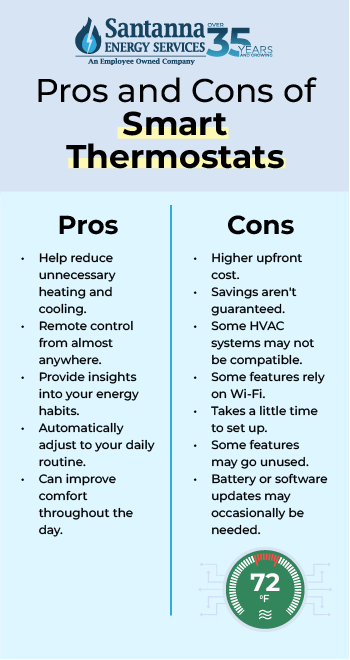
Pros and Cons of Smart Thermostats
Smart thermostats offer more convenience and greater control over your home’s heating and cooling, but they’re not the right fit for every household. While many homeowners appreciate the potential energy savings and automation, it’s important to weigh the benefits against the costs and understand whether the features match your lifestyle.
For example, Brennan uses a daily schedule as a starting point, then adjusts it when his plans change. “We have schedules set as a baseline for every day, and then if we are going to be gone for an extended period, we will go into the app and adjust,” he explains. This approach combines automatic scheduling with occasional adjustments that reflect his household’s actual needs and why he values his smart thermostat.
Looking for more pros of a smart thermostat? We’ve got you covered with more you should consider below:
Pros of Smart Thermostats
- Help reduce unnecessary heating and cooling. Smart thermostats can automatically adjust the temperature when you’re asleep or away from home, helping you avoid using energy when it isn’t needed.
- Remote control from almost anywhere. Most smart thermostats let you adjust your home’s temperature using a smartphone app, whether you’re at work, on vacation, or simply relaxing on the couch.
- Provide insights into your energy habits. Many models include reports showing how your heating and cooling system is used, helping you identify opportunities to use energy more efficiently.
- Automatically adjust to your daily routine. Depending on the model, some smart thermostats can follow schedules you’ve created or learn your typical routine over time, reducing the need for manual adjustments.
- Can improve comfort throughout the day. Instead of coming home to a house that’s too hot or too cold, your thermostat can have your preferred temperature ready before you arrive.
Cons of Smart Thermostats
- Higher upfront cost. Smart thermostats generally cost between $50 and $300 compared with about $10 to $150 for traditional or non-programmable thermostats, so it may take time for potential energy savings to offset the higher purchase price.
- Savings aren’t guaranteed. A smart thermostat doesn’t automatically lower your energy bill. How much you save depends on your home’s heating and cooling habits, insulation, HVAC system, and thermostat settings.
- Some HVAC systems may not be compatible. Older heating and cooling systems, or certain thermostat wiring configurations, may require additional equipment or not support every smart thermostat model.
- Some features rely on Wi-Fi. Remote access, mobile app controls, and certain smart features typically require an internet connection. However, most smart thermostats can still control your home’s temperature if your Wi-Fi goes down, although some advanced features may be unavailable.
- Takes a little time to set up. To get the most benefit, you’ll likely need to spend some time creating schedules, adjusting settings, or learning how to use the mobile app.
- Some features may go unused. If you only use it like a basic thermostat, you’re paying for features you won’t use.
- Software updates may occasionally be needed. Like many connected devices, some smart thermostats require periodic updates to keep features running smoothly.
Overall, a smart thermostat is often most valuable for homeowners who want greater convenience, better control over their home’s temperature, and an easier way to manage heating and cooling. If you’re mainly looking for the lowest upfront cost or already manage your thermostat efficiently every day, the additional features may not provide as much value.
How Much Does a Smart Thermostat Cost?
Smart thermostat prices can vary a lot, ranging from $50 to $300, depending on the model and features you choose. This broad price range includes everything from basic smart thermostats to premium models with advanced features and smart home integration.
In general, the more features a smart thermostat offers, the higher the price is likely to be. Models with capabilities like learning your routine, room sensors, detailed energy reports, or voice assistant compatibility often cost more than those with basic scheduling and remote control.
If you can’t install a smart thermostat yourself, no worries! Smart thermostat installation from a professional will cost around $200-$500 according to First Mechanical.
How Long Could It Take to Pay for Itself?
If you purchase a smart thermostat for $150 and qualify for a $50 rebate, your upfront device cost would be $100. If it saves your household $50 per year in heating and cooling costs, it would take about two years for those savings to cover the purchase price. This is an illustrative example, not a guaranteed payback period.
Is Your HVAC System Compatible With a Smart Thermostat?
Many smart thermostats work with common heating and cooling systems, including gas furnaces, central air conditioners, electric furnaces, and heat pumps. However, compatibility depends on the specific thermostat model, your equipment, and your existing wiring. Before buying, check these three things:
- Your heating and cooling equipment. Make sure the thermostat supports your system type, including any heat pump, backup heat, or multi-stage equipment. Some high-efficiency or communicating HVAC systems work best with a controller recommended by the equipment manufacturer.
- Your thermostat wiring and power requirements. Some smart thermostats require a common wire, often called a C-wire, to provide continuous power. If your current setup does not include one, it may limit the types of thermostats you can install. Depending on the model and system, a compatible power adapter may be an option if your home does not have one.
- Any additional installation costs. A power adapter, new wiring, or professional installation can increase the total cost of upgrading. Knowing what your system needs before purchasing can help you decide whether the investment makes sense.
Use the thermostat manufacturer’s compatibility checker or installation guide to confirm the requirements for your specific model.
Smart vs. Programmable vs. Wi-Fi vs. Regular Thermostats: What’s the Difference?
The biggest difference between these thermostats is how much they automate your home’s heating and cooling. A regular thermostat requires manual adjustments; a programmable thermostat follows schedules you set; a Wi-Fi thermostat lets you control the temperature remotely; and a smart thermostat combines remote control with additional features to automate temperature changes.
Comparison of Smart, Wi-Fi, and Traditional Thermostats
|
Feature |
Smart Thermostat | Wi-Fi Thermostat | Programmable Thermostat |
Regular Thermostat |
| Automation | Automatically adjusts based on schedules and smart features | Manual or scheduled adjustments with remote control | Follows schedules you create | Manual adjustments only |
| Scheduling | Yes | Yes | Yes | No |
| Remote access | Yes | Yes | No | No |
| Learning capabilities | Available on some models | Usually no | No | No |
| How it helps manage energy use | Can automate adjustments that reduce unnecessary heating and cooling. | Lets you adjust settings remotely and use schedules where available. | Makes planned temperature adjustments automatically. | Lets you reduce heating and cooling through manual adjustments. |
| Typical cost | Moderate to high ($50 – $300) | Moderate ($80 – $280) | Low to moderate ($20 – $150) | Lowest ($10 – $150) |
| Best for | Homeowners looking for convenience, automation, and better control over heating and cooling | Homeowners who want to adjust the temperature from anywhere | Households with predictable daily schedules | Homeowners who prefer simple manual control |
A Wi-Fi thermostat connects to the internet so you can adjust your home’s temperature remotely through an app, and many models also let you create schedules. Smart thermostats typically include Wi-Fi connectivity plus additional automation, such as learning your routine or adjusting temperatures based on whether anyone is home, although features vary by model.
The price ranges in the chart overlap because pricing depends on the specific model, brand, features, and available discounts. A basic smart thermostat can therefore cost less than a Wi-Fi model with fewer automation features; a higher price doesn’t necessarily mean a more advanced thermostat.
A more advanced thermostat does not guarantee greater savings. A programmable thermostat with a schedule that consistently reduces heating and cooling when you’re asleep or away may save as much as a smart thermostat whose energy-saving features go unused.
Can a Smart Thermostat Increase Your Home’s Value?
Yes, a smart thermostat can make your home more appealing to potential buyers, but it’s unlikely to increase its resale value on its own significantly. Instead of adding a large amount to your home’s selling price, it’s better viewed as a desirable smart home feature that can enhance your home’s overall appeal.
Many buyers appreciate features that make a home more comfortable, convenient, and energy efficient. A smart thermostat can show that the home has been updated with modern technology and offers benefits such as automatic scheduling, remote temperature control, and improved heating and cooling management.
Are There Rebates or Incentives for Smart Thermostats?
Yes, many homeowners may qualify for rebates or incentives that help lower the cost of a smart thermostat. These offers are commonly available through electric or natural gas utilities, energy-efficiency programs, or thermostat manufacturers, although the amount and eligibility requirements vary by location.
For example, homeowners in Ohio may qualify for an instant $75 rebate through AEP Ohio’s Power Rewards: Smart Thermostat program when purchasing an eligible smart thermostat through its marketplace. Customers who enroll an eligible thermostat may also qualify for additional rewards through the program.
In Illinois, the Ameren Illinois Energy Efficiency Program offers rebates of up to $125 on qualifying ENERGY STAR® smart thermostats, helping reduce the upfront cost of upgrading.
In Pennsylvania, eligible Philadelphia Gas Works (PGW) residential customers can receive an instant $70 rebate on qualifying smart thermostats through the utility’s residential rebate program. If your utility is PPL Electric, you also may be eligible for a $50-$100 rebate for installing a smart thermostat as well.
PECO also currently offers a $50 rebate on smart thermostats too!
In Michigan, DTE Energy’s Energy Efficiency Program offers an instant $50 rebate on qualifying ENERGY STAR® certified smart thermostats for eligible residential customers, helping lower the upfront cost of upgrading.
Because these offers vary by utility and may change throughout the year, it’s a good idea to check what’s currently available before purchasing a smart thermostat.
You can also look for incentives through:
- Your electric or natural gas utility
- Your state’s energy-efficiency program
- The ENERGY STAR Rebate Finder
- The thermostat manufacturer’s website
Spending just a few minutes checking for available rebates could lower the upfront cost of upgrading to a smart thermostat.
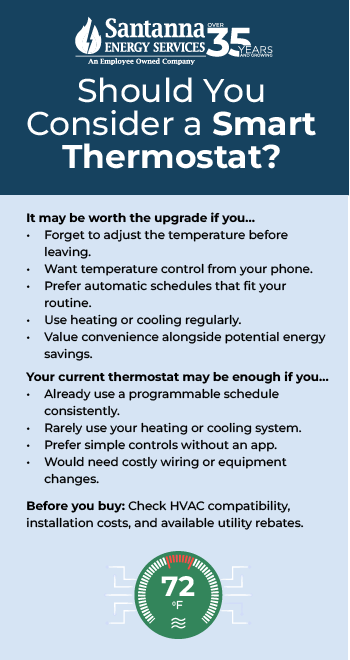
Is a Smart Thermostat Right for Your Home?
The right thermostat is the one that fits your home’s heating and cooling needs, daily routine, and lifestyle. While a smart thermostat can be a worthwhile upgrade for many homeowners, its value depends on how you use your heating and cooling system and whether you’ll take advantage of its energy-saving features.
A smart thermostat is probably worth it if you…
- Use your heating or air conditioning regularly throughout the year.
- Often forget to adjust the thermostat before leaving home or going to bed.
- Have a predictable work, school, or family schedule.
- Want to control your home’s temperature from your smartphone while you’re away.
- Would like better insights into your heating and cooling habits and energy use.
- Value convenience along with the potential to use energy more efficiently.
You may want to keep your current thermostat if you…
- Rarely use your heating or cooling system.
- Already use a programmable thermostat consistently and are happy with the results.
- Spend most of the day at home and rarely change the temperature.
- Prefer the lowest upfront cost and don’t need smart features.
- Have an HVAC system that isn’t compatible without costly upgrades.
- Are satisfied with your current thermostat and don’t feel the need for additional features.
Ultimately, a smart thermostat is worth it when its features match the way you live. If it helps you better manage your home’s heating and cooling while reducing unnecessary energy use, it can be a worthwhile investment. If your current thermostat already meets your household’s needs, using it effectively can still help you keep your home comfortable and manage your energy use wisely.
FAQs
Do smart thermostats work without Wi-Fi?
Yes, most smart thermostats continue to control your home’s heating and cooling without Wi-Fi. However, features such as remote control via a mobile app, energy reports, software updates, and certain smart home integrations may not work until your internet connection is restored.
Do smart thermostats save money in winter?
Yes, smart thermostats can help save money in winter by reducing unnecessary heating when you’re asleep or away from home. The actual savings depend on your heating habits, your home’s insulation, your HVAC system, and how consistently you use energy-saving features like scheduling and automatic temperature adjustments.
How long does a smart thermostat last?
Most smart thermostats last about 10 to 20 years, although their lifespan depends on the model, usage, and software support. Keeping the thermostat updated and following the manufacturer’s recommendations can help it continue operating properly for many years.
Can I install a smart thermostat myself?
Yes, many smart thermostats are designed for DIY installation, but it depends on your home’s HVAC system and wiring. Before purchasing, use the manufacturer’s compatibility checker to ensure the thermostat is compatible with your system. If you’re unsure about compatibility or installation, consider contacting a qualified HVAC professional.
Are there privacy or data concerns with smart thermostats?
Smart thermostats can collect information such as temperature settings, heating and cooling activity, and occupancy patterns. If you enable location-based features like geofencing, the connected app may also use your phone’s location to help determine when you’re home or away. Before buying, review the manufacturer’s privacy policy and available data controls. To help protect your account, use a strong, unique password, enable two-factor authentication when available, keep software updated, and limit optional location permissions or connected services you don’t need.
Why should I buy an ENERGY STAR® certified smart thermostat?
An ENERGY STAR certified smart thermostat has been independently certified to deliver energy savings based on real-world data from homes. This gives you added confidence in its energy-saving capabilities, although your actual savings depend on your HVAC system, daily routine, and thermostat settings. Certification can also matter when applying for rebates: many utility and energy-efficiency programs require an ENERGY STAR certified model. Before purchasing, check your program’s eligible-model list, HVAC requirements, and application rules, since certification alone doesn’t guarantee rebate eligibility.
Beyond reducing unnecessary energy use, a smart thermostat can make managing your home’s comfort easier through features like automatic scheduling, remote access, and better temperature control. The key is choosing a thermostat that matches your lifestyle, your HVAC system, and the features you’ll actually use.
Pairing smart energy habits with the right electricity plan can also help you better manage your home’s energy usage. If you’re looking for more predictable electricity supply charges and fewer surprises throughout the year*, explore Santanna’s Unlimited Energy Plan to see how it can help provide greater confidence in the supply portion of your electricity bill while keeping your home comfortable.
Because when your thermostat works with your lifestyle, staying comfortable and managing your home’s energy becomes that much easier.
* Restrictions apply. Enrollment based upon program eligibility. Customers using more than 125% of normal monthly usage as determined by Santanna may be required to switch plans.
Jenna Mendez is an experienced energy content professional who has spent four years researching, writing, and managing authoritative educational content for Midwest energy consumers at Santanna Energy Services. As a lifelong Illinois resident, Jenna brings firsthand knowledge of the region’s climate, communities, and household energy needs to her work.
She specializes in translating complex energy topics into clear, practical guidance about electricity and natural gas costs, appliance energy use, energy efficiency, and everyday home living. Drawing on industry research, Santanna customer data, and insights from experienced energy professionals, Jenna incorporates this knowledge into her content to help homeowners better understand their energy choices and make informed decisions for their households.