
How Many Watts Is a Fast Charger? iPhone, Samsung, Google Pixel & More

by Jenna Mendez
Updated: October 28, 2026
12.5 min read
Key Points of This Article:
- Most modern smartphones support fast charging between 20W and 45W, while laptops typically require 45W to 140W or more.
- A charger's wattage indicates its maximum output, so a higher-watt charger won't charge your phone faster than the phone's supported limit.
- Fast charging delivers energy more quickly without necessarily using significantly more electricity, and daily phone charging typically costs only about $1 to $2 per year.
- Choose a compatible, certified charger and cable that meet your device manufacturer's charging specifications for safe, efficient charging.
Many people assume that a higher-watt phone charger automatically uses a lot more electricity and noticeably increases their electric bill. In reality, a charger's wattage tells you the maximum amount of power it can deliver, not how much electricity it constantly uses.
With so many chargers labeled 20W, 30W, 45W, 65W, or even 100W, it's easy to wonder which one is right for your device, whether a higher-watt charger is safe, and if fast charging will cost more and use more electricity over time.
In this guide, you'll learn how many watts different fast chargers use, how much electricity they actually consume, what they cost to operate, and how to choose the right charger for your device with confidence.
How Many Watts Is a Fast Charger?
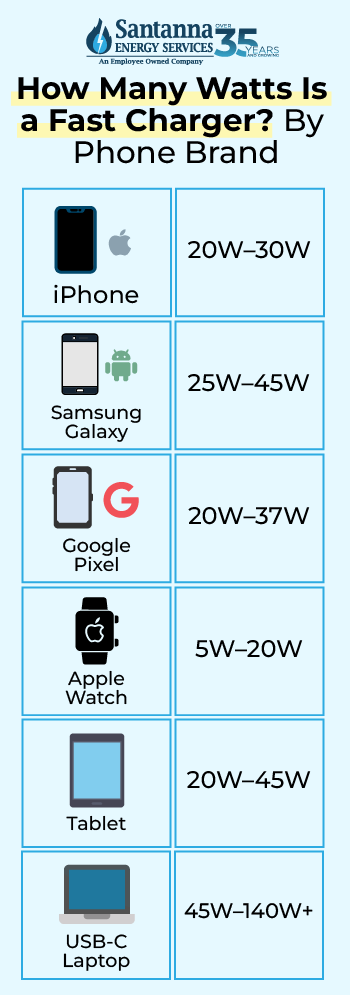
A fast charger typically delivers 15W to 140W, depending on the device it's charging. Some high-powered chargers can provide 100 watts or more for larger devices like laptops. Most modern smartphones support fast charging between 20W and 45W, while tablets and laptops often require higher-watt chargers.
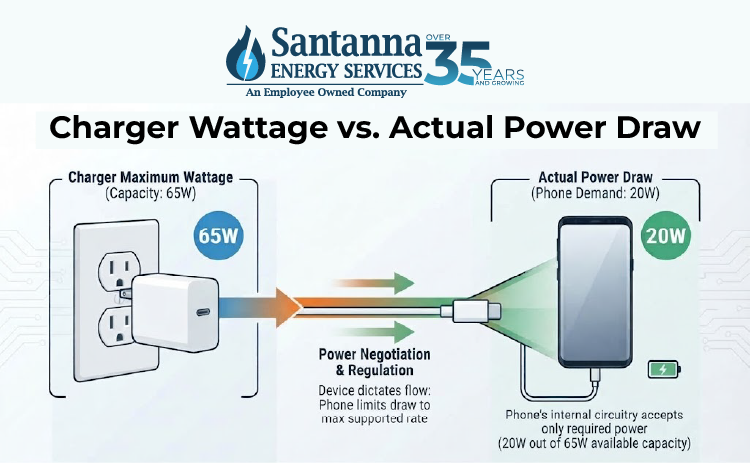
The wattage printed on a charger tells you the maximum amount of power it can deliver, not the amount of electricity it always uses. For example, plugging your phone into a 65W charger doesn't mean it constantly draws 65 watts; this means your phone can only handle 65 watts of max power.
For homeowners, this means you don't need to worry that buying a higher-watt charger will dramatically increase your electric bill. In most cases, it simply gives compatible devices the ability to charge more quickly while still using only the power they need. The higher the wattage, the quicker your device will charge.
In a small internal survey of 12 Santanna employee-owners, charging speed was the most frequently mentioned consideration when choosing a phone charger, followed by price and cord length. Their responses highlight why choosing a charger involves more than wattage: compatibility, reliability, and everyday convenience matter, too.
Typical Fast Charging Wattages and Performance by Device
|
Device |
Typical Fast Charging Wattage |
Typical Fast Charging Performance |
| iPhone | 20W–30W | Up to 50% in about 30 minutes with a compatible 20W+ USB-C charger. Some newer models can reach 50% in about 20 minutes with higher-watt adapters. |
| Samsung Galaxy | 25W–45W | Supports Fast Charging or Super-Fast Charging depending on the model. Charging speed varies, with higher-end Galaxy phones supporting up to 45W. |
| Google Pixel | 20W–37W | Up to 50% in about 30 minutes on supported Pixel models using Google’s recommended fast charger. |
| Apple Watch | 5W–20W | Supported models can reach up to 80% in about 45 minutes using a compatible fast charging cable and power adapter. |
| Tablet | 20W–45W | Most tablets support faster charging than smartphones because of their larger batteries, but charging times vary by model. |
| USB-C Laptop | 45W–140W+ | Charging time depends on battery size and charger wattage. Many laptops support fast charging but generally take longer than smartphones because of their much larger batteries. |
These ranges reflect what most current devices support, but exact charging speeds vary by model. Before buying a new charger, check your device manufacturer’s recommended charging specifications to make sure you’re choosing a charger and cable that are compatible with your device.
How Many Watts Is an iPhone Fast Charger?
An iPhone fast charger is typically rated at 20 watts or higher. Apple recommends using a 20W USB-C power adapter or higher for fast charging, while some newer iPhone models can take advantage of higher-watt USB-C chargers under the right conditions.
According to Apple, many compatible iPhone models can charge to up to 50% in about 30 minutes when used with a compatible fast charger.
How Many Watts Is a Samsung Galaxy Fast Charger?
Many Samsung Galaxy smartphones support 15W Fast Charging, 25W Super Fast Charging, or 45W Super Fast Charging, depending on the model. When paired with a compatible charger and cable, supported Galaxy devices can charge significantly faster than older Samsung phones.
Higher-end Galaxy models generally support faster charging than entry-level models, so checking your phone’s recommended charging wattage can help you choose the right charger.
How Many Watts Is a Google Pixel Fast Charger?
Most recent Google Pixel phones support fast charging between 20W and 37W. Google states that some supported Pixel models can reach up to 50% charge in about 30 minutes when used with a compatible 30W USB-C fast charger.
How Many Watts Is a Laptop Fast Charger?
Laptop fast chargers typically use between 45W and 140W or more, depending on the laptop’s size and performance. Because laptops have much larger batteries than smartphones, they require higher-watt chargers to recharge efficiently.
Here are some common charger wattages offered by popular laptop manufacturers:
- Apple MacBook: 30W, 35W, 67W, 70W, 96W, or 140W
- Dell laptops: Commonly between 65W and 130W
- HP laptops: Commonly 45W and 65W
- Lenovo laptops: Commonly 45W, 65W, 100W, or 135W
- ASUS laptops: Commonly 45W, 65W, or 90W
- Acer laptops: Commonly 45W, 65W, or 100W
Although laptop chargers have much higher wattage ratings than phone chargers, many USB-C laptop chargers can also safely charge compatible smartphones and tablets.
How Many Watts Is an Apple Watch Fast Charger?
Apple Watch fast charging typically uses 5W to 20W, depending on the model and charger. Newer Apple Watch models that support fast charging can reach up to about 80% battery in around 30 minutes when used with Apple’s fast charging cable and a compatible USB-C power adapter.
Because the Apple Watch has a much smaller battery than a smartphone, it doesn’t require nearly as much power to recharge quickly. For most users, the benefit of fast charging is convenience, allowing you to quickly add enough battery before heading out for the day or wearing the watch overnight for sleep tracking.
Does a Higher-Watt Charger Charge Your Phone Faster?
No, a higher-watt charger doesn’t always charge your phone faster because your phone, not the charger, determines how much power it can accept. A charger’s wattage tells you the maximum amount of power it can provide, but your phone only draws the amount it’s designed to use.
For example, if your phone supports 25W fast charging, plugging it into a 100W charger won’t make it charge four times faster. Your phone will typically draw only about 25 watts, because that’s the maximum charging speed it was designed to support. The extra power simply isn’t used.
The opposite is also true. If your phone supports 45W fast charging but you use a 20W charger, your phone can only charge as fast as the charger can supply power. In that case, charging will take longer because the charger has reached its maximum output.
Think of it like filling a reusable water bottle from a large faucet. A bigger faucet can deliver more water, but the bottle only holds so much. Likewise, a higher-watt charger has more power available, but your phone only takes what it needs.
Does Fast Charging Use More Electricity?
No, a fast charger doesn’t use more electricity than a standard charger; a fast charger delivers energy more quickly, allowing your phone to recharge in less time.
Regardless of the charging power, a smartphone with a 20-watt-hour battery typically uses about 0.020 kWh of electricity for a full charge whether it’s charged with a 5W standard charger or a 20W fast charger. This is because your phone’s battery has a fixed capacity.
For example, imagine charging the same phone from 0% to 100%. A 5W standard charger may take several hours to deliver about 0.020 kWh of electricity, while a 20W fast charger can deliver roughly the same amount of electricity in much less time.
It’s also important to remember that a charger doesn’t operate at its maximum wattage during the entire charging session. As your battery fills, especially after about 80%, your phone automatically slows the charging speed to help manage heat and protect the battery. This means the charger spends less time operating at its highest power level.
For homeowners, the takeaway is simple: using a fast charger is unlikely to have a noticeable impact on your monthly electric bill. The biggest benefit of fast charging is saving time, not using more electricity.
How Much Electricity Does It Take to Charge a Phone?
Charging a smartphone uses very little electricity. Most full phone charges use only about 0.015 to 0.020 kilowatt-hours (kWh) of electricity, depending on your phone’s battery size and charging efficiency. That’s only a tiny fraction of the electricity most homes use each day.
To put phone charging into perspective, it helps to compare watt-hours and kilowatt-hours. Phone batteries are measured in watt-hours, while electric bills are measured in kilowatt-hours. Since 1 kWh equals 1,000 Wh, even a relatively large smartphone battery uses only a small fraction of a kWh per full charge.
Converting a Phone Battery’s Capacity into Electricity Use
|
Phone Battery Capacity |
Approximate Electricity Used |
| 10 Wh | 0.010 kWh |
| 12 Wh | 0.012 kWh |
| 15 Wh | 0.015 kWh |
| 18 Wh | 0.018 kWh |
| 20 Wh | 0.020 kWh |
| 22 Wh | 0.022 kWh |
| 25 Wh | 0.025 kWh |
| 30 Wh | 0.030 kWh |
Note: These figures represent the battery's energy capacity. The actual electricity drawn from the wall may be slightly higher because a small amount of energy is naturally lost as heat during charging.
Understanding how much electricity your phone uses helps put fast charging into perspective. Even though a fast charger may deliver more power while charging, the total amount of electricity needed to recharge your phone is still very small. The next question is what that means for your wallet and how much it actually costs to charge a phone.
How Much Does It Cost to Fast Charge a Phone?
Fast charging a smartphone typically costs less than one cent per day, making it one of the least expensive ways to use electricity in your home. Although a fast charger delivers more power over a shorter period, the total electricity needed to fully charge your phone remains very small.
The example below assumes a typical smartphone with a 20 Wh battery, charged once per day using a fast charger.
The estimates below use the U.S. average residential electricity price of 18.44 cents per kWh as of May 2026, according to the U.S. Energy Information Administration (EIA). Actual charging times vary depending on your phone, charger, battery level, and charging conditions.
Estimated Cost to Fast Charge a Smartphone
|
Typical Smartphone Battery |
Electricity Used | Approximate Fast Charging Time (0–100%) | Cost Per Full Charge | Cost Per Week (7 charges) | Cost Per Month (30 charges) |
Cost Per Year (365 charges) |
| 15 Wh | 0.015 kWh | 45–75 minutes | $0.0028 | $0.02 | $0.08 | $1.01 |
| 18 Wh | 0.018 kWh | 45–80 minutes | $0.0033 | $0.02 | $0.10 | $1.21 |
| 20 Wh | 0.020 kWh | 50–85 minutes | $0.0037 | $0.03 | $0.11 | $1.35 |
| 22 Wh | 0.022 kWh | 50–90 minutes | $0.0041 | $0.03 | $0.12 | $1.48 |
| 25 Wh | 0.025 kWh | 60–95 minutes | $0.0046 | $0.03 | $0.14 | $1.68 |
| 30 Wh | 0.030 kWh | 70–110 minutes | $0.0055 | $0.04 | $0.17 | $2.02 |
Even if you fast charge your smartphone every day, it typically costs only about $1 to $2 per year in electricity. That makes fast charging one of the lowest-cost ways to use electricity in your home, with little to no noticeable impact on your monthly electric bill.
Frequently Asked Questions
Can fast charging hurt battery life?
Not significantly. Modern smartphones automatically manage charging speed and temperature to help protect the battery. While batteries naturally wear out over time, using a compatible, certified fast charger isn’t likely to noticeably shorten your battery’s lifespan.
Is 20 watts considered fast charging?
Yes. A 20W charger is generally considered fast charging for modern smartphones, especially iPhones and many Android devices. While some premium phones support even higher charging speeds, 20W is enough to charge many compatible phones significantly faster than a standard 5W charger.
Is 45 watts a lot for a phone charger?
Yes, 45W is considered a high-power phone charger. Many premium smartphones can take advantage of 45W charging, while others will simply charge at the maximum speed they support. A 45W charger can also be useful for charging compatible tablets.
Can I use a lower-watt charger to charge my phone?
Yes. A lower-watt charger will still charge your phone, but it will usually take longer to reach a full battery. For example, a phone that supports 45W fast charging will still charge with a 20W charger, just at a slower rate.
Is it safe to use a 100W charger with my phone?
Yes, in most cases. Modern smartphones only draw the amount of power they’re designed to accept, so a 100W charger won’t force extra power into your phone. As long as you’re using a compatible, certified charger and cable, it’s generally safe.
Will a fast charger work with an older phone?
Yes. Most fast chargers are backward compatible, meaning they can charge older phones safely. However, older devices that don’t support fast charging will simply charge at their normal speed.
Can I use my laptop charger for my phone?
Usually, yes. Many USB-C laptop chargers can safely charge smartphones because modern devices automatically negotiate how much power to use. Your phone will only draw the amount of power it supports.
Does wireless fast charging use the same wattage?
No. Wireless fast charging typically uses 15W to 25W, depending on your phone and charger. Wired fast charging usually supports higher wattages and is generally faster and more energy efficient.
Does the charging cable matter?
Yes. A charging cable can affect how quickly your phone charges. To get the fastest charging speeds, use a cable that’s compatible with your charger and your phone’s recommended charging standard.
Can I leave my phone on a fast charger overnight?
Yes, in most cases. Modern smartphones automatically slow or stop charging once the battery is full to help protect battery health. Using a compatible, certified charger and cable helps ensure safe overnight charging.
Fast chargers may deliver more power than standard chargers, but they don’t automatically use significantly more electricity or lead to noticeably higher electric bills. The most important thing to remember is that your phone only draws the amount of power it was designed to accept, regardless of how many watts the charger can provide. Choosing a compatible charger helps you charge your devices safely and efficiently, while the actual cost of charging your phone remains surprisingly low for most households.
At Santanna, we believe understanding how your everyday devices use electricity helps you make smarter energy decisions at home. While charging your phone has only a small impact on your monthly bill, other parts of your home’s electricity use can be much less predictable. If you’re looking for more predictable electricity supply charges and fewer surprises from month to month, explore Santanna’s Unlimited Energy Plan to see how it can help make budgeting your home’s electricity supply costs a little easier.*
* Restrictions apply. Enrollment based upon program eligibility. Customers using more than 125% of normal monthly usage as determined by Santanna may be required to switch plans.
Jenna Mendez is an experienced energy content professional who has spent four years researching, writing, and managing authoritative educational content for Midwest energy consumers at Santanna Energy Services. As a lifelong Illinois resident, Jenna brings firsthand knowledge of the region’s climate, communities, and household energy needs to her work.
She specializes in translating complex energy topics into clear, practical guidance about electricity and natural gas costs, appliance energy use, energy efficiency, and everyday home living. Drawing on industry research, Santanna customer data, and insights from experienced energy professionals, Jenna incorporates this knowledge into her content to help homeowners better understand their energy choices and make informed decisions for their households.