

Risks of Variable-Rate Energy Plans: What Homeowners Should Know

by Chris Tessler
Updated: July 24, 2026
22.4 min read

Key Points of This Article:
- The risks of variable-rate energy plans include price volatility, seasonal rate spikes, and budget uncertainty, which can cause higher or unpredictable bills even when your energy usage stays the same.
- Variable-rate energy plans charge a supply rate that can change month to month based on market conditions like weather, seasonal demand, fuel costs, and energy supply, meaning your rate is not locked in.
- These risks often become more noticeable during summer and winter, when energy demand is higher and rate increases can stack on top of already increased energy use.
- Variable-rate plans may work for homeowners who closely monitor their bills and value flexibility, but they can be stressful or costly for those who prefer stable, predictable monthly energy expenses.
For many homeowners, a sudden increase in their energy bill can feel unexpected. One month your bill seems steady, and next, it jumps, even though nothing in your daily routine has changed. It’s frustrating, especially when you’re trying to manage your energy costs and avoid surprises.
In many cases, the reason comes down to something that is easy to overlook: the type of energy plan you’re on, and the risks that come with it. In fact, we took an internal survey and found that at one point, 35% of our Employee-Owners were enrolled in a variable-rate energy plan. Making this plan one of the most common energy plan options out there.
As an energy supplier serving the Midwest for over 35 years, we’ve seen how variable-rate plans can lead to sudden changes in what people pay. When rates follow the market instead of staying more consistent, those shifts can show up directly on your bill and lead to significant bill shock.
In this guide, you’ll learn what variable-rate energy plans are, the real risks behind changing rates, and how those risks can affect your energy bill over time, so you can decide what kind of plan fits your home and your comfort level.
What Are Variable-Rate Energy Plans and How Do They Work?
A variable-rate energy plan is a type of energy plan where the rate you pay for electricity or natural gas can change month to month with fluctuations in the energy market.
In simple terms, on a variable rate plan, this means your rate is not locked in. It can go up or down depending on what is happening in the energy market. And the reasons your rate changes are often out of your control; being influenced by factors like weather, seasonal demand, fuel costs, and overall energy supply.
Here’s how a variable-rate plan works in real life with official EIA average rates: Your energy bill is calculated based on how much energy you use and the rate you are charged for each unit of energy.
With a variable-rate plan, that price per kilowatt-hour or therm can change from one billing period to the next.
According to the Energy Information Administration (EIA), average residential electricity prices increased from 17.4¢ per kilowatt-hour in 2025 to 18.4¢ in 2026; that’s about a 5.7% jump in just one year.
On a variable-rate plan, increases like this can flow straight through to your bill. For example, at 10,800 kWh per year (about 900 kWh/month), that same 1¢ per kWh change adds roughly $108 to your annual electricity costs, without using any more power.
A variable rate can offer flexibility and may be lower during certain periods, but it can also change when demand increases, making it a risky plan to enroll in if you’re not keeping up to date with market changes. That can make your costs feel less predictable, especially during seasons when your home is already using more energy.
What Factors Affect Rate Changes in a Variable-Rate Energy Plan?
The rate in a variable-rate energy plan changes based on shifts in the energy market, which are influenced by supply, demand, and external conditions.
It means that your rate is not random. It responds to real-world factors that affect how energy is produced, delivered, and used across your region.
Some of the most common factors that affect rate changes in a variable-rate energy plan include:
- Weather conditions: Extremely hot summers or cold winters increase energy use, which can push rates higher.
- Seasonal demand: When more homes are using air conditioning or heating at the same time, overall demand rises.
- Fuel costs: The price of natural gas and other fuels used to generate electricity can affect the rate you pay.
- Energy supply levels: If there is less available supply due to outages or constraints, prices may increase.
- Grid conditions and reliability: When the energy grid is under pressure, rates may adjust to reflect demand.
- Regional market activity: Prices can vary depending on what is happening in your local energy market.
These factors are outside your control, and they can directly affect what you pay from one month to the next if you’re on a variable-rate plan.
What Are the Real Risks of Variable-Rate Energy Plans?
The real risks of a variable-rate energy plan come from less predictable and being more exposed to changes outside your control.
When demand rises or supply shifts, those changes can show up directly in what you pay, even if your household energy use stays about the same.
For homeowners, these risks often build over time. They may not always be obvious in a single bill, but they tend to show up more clearly during high-usage seasons like summer and winter, when both energy use and pricing pressure are higher.
To better understand the risks of variable-rate energy plans, let’s look at their disadvantages and how they can affect your monthly bill:
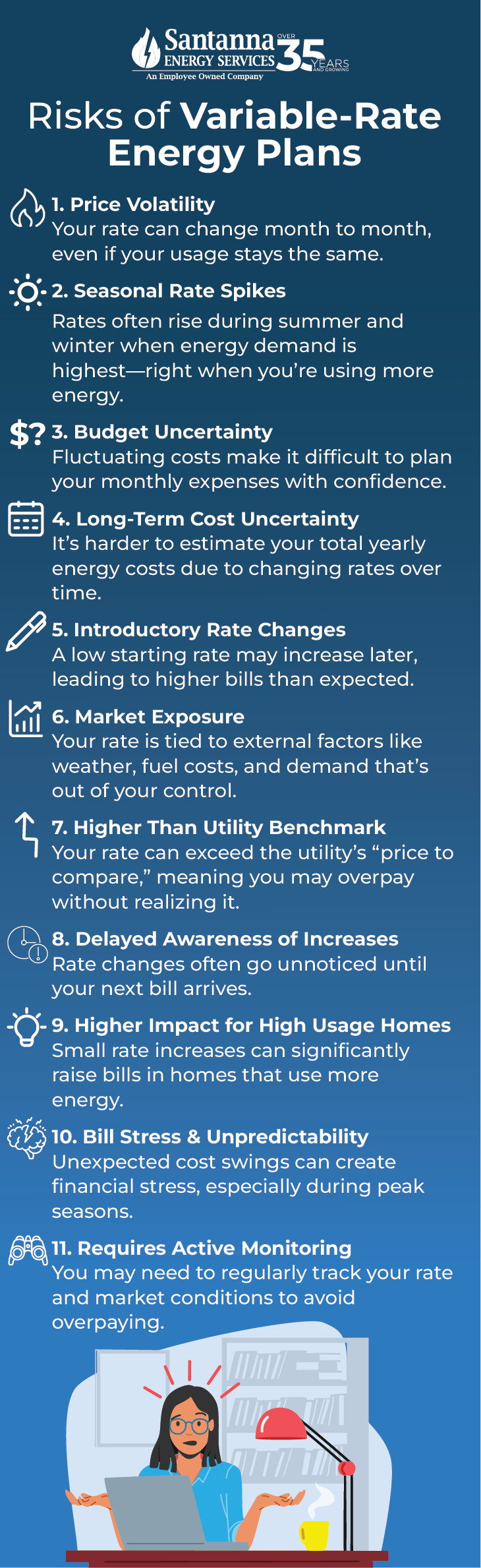
Price Volatility
Price volatility means your energy rate can change from one billing period to the next. And a lot of the factors that cause this volatility are out of your control.
For homeowners, this becomes noticeable when your bill increases even though your energy use has stayed about the same. Because the rate you pay for energy is not protected, it becomes harder to anticipate what you will pay from month to month.
Seasonal Rate Spikes
Seasonal rate spikes happen when energy demand increases during hot summers and cold winters.
During these periods, your home is already using more energy for cooling or heating. If your rate also rises at the same time while on a variable rate plan, your bill can increase more than expected because both usage and rate are going up together.
If you live in an area prone to extreme weather (especially in places that aren’t built for prolonged cold, like parts of Texas) seasonal rate spikes can hit harder on a variable-rate plan.
As one Santanna employee-owner put it after experiencing an unexpected winter storm: “I knew my bill could fluctuate month to month [on a variable rate plan], but when that storm hit, there was nothing I could do, and my bill was super high.”
Often on a variable-rate plan, the risks of variable-rate plans often show up at the worst possible time when extreme weather is already pushing your household energy use higher, making homeowners feel like their energy bill is out of their control.
Budget Uncertainty
Budget uncertainty on a variable-rate plan can mean your monthly energy costs are harder to plan for in the short term.
For homeowners managing regular expenses, a bill that changes from month to month can make it difficult to estimate what to expect, especially during extreme weather when costs are already higher.
Long-Term Cost Uncertainty
Similar to budget uncertainty, long-term cost uncertainty makes energy expense more of a long-term problem if you’re not on the right plan. It can be harder to predict what you will pay over the course of a year making things like vacations, home upgrades, and even planning a family harder to budget for if you’re unsure of your long-term energy costs.
While rates may be lower during some months, higher prices during peak seasons can offset those periods. This makes it difficult for homeowners to estimate their total yearly energy costs with confidence.
Introductory Rate Changes
If you’re signing up for an energy plan for the first time, some providers offer an introductory rate that occurs when a plan starts with a lower price and later shifts to a higher market-based rate.
For homeowners, this can make the plan seem more affordable at first than it actually is over time. Once the lower rate ends, the increase can appear quickly on your bill if you are not expecting it.
Market Exposure
Market exposure means your energy rate is influenced by conditions outside your home.
Fuel costs, supply levels, weather events, and overall demand can all affect pricing. With a variable-rate plan, these external factors can directly impact what you pay, even if your household usage stays the same.
But luckily if you’re within a deregulated energy market, you have the power to choose an energy supplier that allows you to have more choices over what you can and cannot control within your energy plan.
Rate Higher Than the Utility Price to Compare
The Price to Compare is the utility’s “baseline” rate, meant to help you quickly see whether another offer is actually a better deal. With a variable-rate plan, your supply price can drift above that benchmark, sometimes without an obvious red flag on your bill.
If you’re paying even slightly more per kWh than the Price to Compare, you may be overpaying every month for the same electricity.
Delayed Awareness of Rate Changes
One of the biggest risks of variable-rate plans comes from rate increases that fly under the radar. Unless you’re monitoring your bill every day, homeowners don’t notice their rate has changed until they get their next monthly bill.
For homeowners, this can lead to higher costs building up over several billing cycles before the issue becomes clear. By the time the change is recognized, you may have already paid more than expected.
Higher Impact in High-Usage Homes
Variable-rate plans tend to hit hardest in high-usage homes because every penny change in your rate gets multiplied across more kilowatt-hours. If you have a larger home, older insulation, electric heat, or heavy air-conditioning use, a small rate increase can turn into a noticeable jump in your monthly total.
For example, a 2¢ per kWh increase adds about $20 in a month at 1,000 kWh, and even more if your home uses above-average energy in peak seasons.
Increased Stress From Unpredictable Bills
Unpredictable energy costs can create added stress for households that prefer consistent monthly expenses.
According to The Energy Information Administration, average residential electricity prices increased from about 16.2¢ per kilowatt-hour in 2022 to 18.4¢ per kilowatt-hour in 2026, an increase of nearly 14% over four years.
For homeowners, not knowing what the next bill will look like can make it harder to feel in control of household finances, especially during already expensive seasons.
Active Rate Monitoring Required
A variable-rate plan often requires you to stay aware of your rate and review your bill regularly.
Because the price can change from month to month, you may need to watch for increases and decide when to switch plans if the rate no longer fits your budget. If you do not keep track of these changes, you may end up paying more over time without realizing it.
For homeowners who prefer a more hands-off approach, this added effort can make long-term energy costs harder to manage.
Why Many Homeowners End Up on a Variable-Rate Plan Without Realizing It
Many homeowners are on a variable-rate energy plan without actively choosing one, and this happens by default rather than by decision, especially in a regulated energy market.
Here’s an in depth look on why this happens:
- The utility is the default provider. If you don’t actively choose a supplier, your utility automatically becomes your energy supplier, often placing you on a variable-rate plan by default.
- Limited awareness of energy choice. Many homeowners assume the utility is their only option. They may not realize they can compare suppliers.
Luckily, those in a deregulated energy market have the power to choose a supplier and an energy plan that better fits their lifestyle.
- Utility bills don’t clearly highlight alternatives. Bills often show the “price to compare,” but they rarely explain if you can, that you can switch suppliers. Because of this, many homeowners stay on the default plan without reviewing other options.
- Homeowners can end up on a variable rate plan after their fixed-rate plan expires. Many homeowners intentionally choose a fixed-rate plan for stability, but sometimes, once the contract term ends, the plan can automatically convert to a variable rate if no new plan is selected.
For many homeowners, this means they are exposed to changing energy prices without realizing it.
That is why understanding your energy plan matters more than you might think. Your bill is shaped not just by how much energy you use, but also by the type of rate attached to your plan.
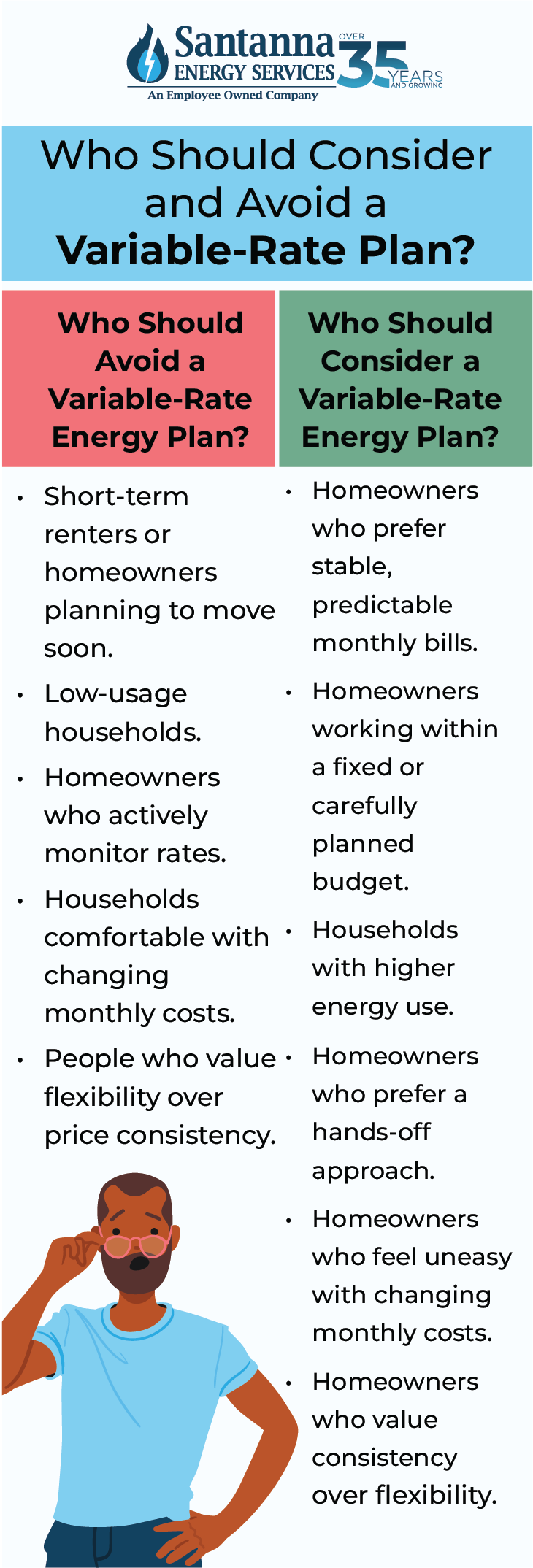
Who Should Consider a Variable-Rate Energy Plan?
A variable-rate energy plan may be worth considering if you are comfortable with changing monthly prices, want more flexibility, and are okay with some variation in your energy costs over time.
These plans can make sense in certain situations, especially if you understand that the price is not locked in and are open to adjusting as rates change.
They may work well for:
- Short-term renters or homeowners planning to move soon: If you do not expect to stay in your home for long, you may prefer a plan that offers more flexibility without a longer-term pricing structure.
- Low-usage households: If your home does not use much electricity or natural gas, changes in the rate may have a smaller effect on your total bill.
- Homeowners who actively monitor rates: If you regularly review your bill, watch for rate changes, and stay aware of plan details, you may feel more comfortable managing a variable-rate option.
- Households comfortable with changing monthly costs: Some homeowners are okay with the idea that one month may be lower and another may be higher, as long as they understand how the pricing works.
- People who value flexibility over price consistency: If keeping your options open matters more to you than having a steady supply rate, a variable plan may align with your preferences.
In the end, it comes down to your comfort with changing prices, your budget, and how much flexibility you want in your energy plan.
Who Should Avoid a Variable-Rate Energy Plan?
A variable-rate energy plan may feel less comfortable for homeowners who prefer steady monthly costs, want more consistency, and would rather avoid changes in their energy bill over time.
These plans may require more attention and flexibility, especially since the price is not locked in and can change with market conditions.
They may be less suitable for:
- Homeowners who prefer stable, predictable monthly bills: If you value knowing what to expect each month, changing rates may feel harder to manage.
- Homeowners working within a fixed or carefully planned budget: If your expenses are closely managed, unexpected changes in your energy bill may be more difficult to absorb.
- Households with higher energy use: If your home uses more energy for heating or cooling, rate increases can have a larger impact on your total bill.
- Homeowners who prefer a hands-off approach: If you do not want to regularly monitor your rate or review plan details, a variable plan may require more attention than you prefer.
- Homeowners who feel uneasy with changing monthly costs: If fluctuations in your bill would feel stressful, a more stable pricing structure may feel easier to manage.
- Homeowners who value consistency over flexibility: If having a steady rate matters more than keeping your options open, a variable plan may not align with your preferences.
In short, a variable-rate plan may feel less comfortable if you prefer stable monthly costs and want to avoid unexpected changes in your energy bill.
How Can a Variable-Rate Plan Affect Your Energy Bill Over Time?
A variable-rate plan can affect your energy bill over time by causing your total cost to change as the rate moves up or down, even if your energy use stays about the same. Let’s put this into real dollars:
For example, let’s say you use 1,000 kWh in a month. If your electricity rate is 10 cents per kWh, without any other taxes, fees and delivery charges factored in, your bill would be about $100. If that rate rises to 14 cents per kWh and your usage stays the same, the your electricity bill would increase to $140. That is a $40 difference in one month without using more electricity.
This becomes more noticeable during summer and winter, when your home typically uses more energy for cooling or heating. If your usage increases and your supply rate rises at the same time, your highest bills of the year can become harder to manage.
Over time, these changes can make your energy costs feel less predictable from month to month and across seasons. Even if your usage stays fairly consistent, your total bill may still change because the rate itself is changing.
What Should You Do To Reduce Risk With a Variable-Rate Energy Plan?
You can reduce risk with a variable-rate energy plan by staying aware of how your rate is changing, comparing it with other plan options, and by making sure it still fits your budget and comfort level over time.
Let’s look at the key steps you can take to reduce the risks of variable-rate energy plans:
Check Your Current Rate Type on Your Bill
You may not realize you’re on a variable-rate plan until your bill starts changing. Checking your rate type helps you understand whether higher costs are coming from your usage, your price, or both, and you can make adjustments within your plan or energy use to potentially cut costs.
Compare Your Rate to the Utility’s Price to Compare
Next, look at your utility’s price to compare and see how your current rate stacks up. This gives you a simple benchmark to help you tell whether your plan is still competitive. If your variable rate is noticeably higher, that may be a sign that your current plan is costing more than you expected, and it may be time to switch.
Track Your Contract or Renewal Date
Keep track of your contract end date or renewal date, so you know when your current rate may change. You may start on a fixed-rate plan and later move into variable pricing after the term ends or begin with a low introductory rate that adjusts later.
By knowing these dates in advance, you give yourself time to review your options and switch to a new plan before the change takes effect if you’ve felt the risks of a variable-rate plan and you’re uncomfortable with them.
This helps you stay in control of the rate you pay instead of being automatically moved into a pricing structure you may not have intended to stay on.
Monitor Your Monthly Rate Changes
This helps you know when to conserve more energy at home to help keep your bill from going up. As a rule of thumb, we advise you to conserve energy during the summer and winter months when rates tend to spike the most.
When your rate increases, using less energy can help offset the higher price and prevent your total cost from rising more than expected.
Consider Switching if the Price Changes Feel Hard to Manage
If your monthly costs keep changing in a way that feels stressful or difficult to budget for, it may be time to consider a different plan. The goal is not just finding a low rate for one month, but choosing a plan that feels easier to manage over time.
Review Your Plan Before High-Usage Seasons
Take time to review your plan before summer or winter. These are high-usage seasons, so any increase in your rate can have a bigger impact on your bill. Checking ahead gives you a chance to make changes before costs rise.
Keep Copies of Plan Details and Notices
Save your enrollment details, renewal notices, and any rate-related emails or letters. This makes it easier for you to check what you agreed to, when your rate may change, and whether a promotional rate is ending.
Pay Attention to Patterns, Not Just One High Bill
One high bill does not always mean there is a problem with your plan. Weather and seasonal usage can affect your costs. What matters more is whether you notice a pattern of rising rates, repeated bill swings, or costs that no longer match your expectations.
Even small steps, like reviewing your bill and knowing your renewal date, can help you stay more in control of your energy costs.
Is a Variable-Rate Plan Your Only Option for An Energy Plan?
A variable-rate plan is just one way your energy price can be structured, and it’s not your only option if you live in a deregulated energy market. You have options like fixed-rate plans or flat-fee plans that offer a different level of rate stability and predictability.
If you’re trying to decide what works best for your home, it helps to see how these options compare side by side:
Variable-Rate vs Fixed-Rate vs Flat-Fee (Unlimited Energy) Plans: Key Differences at a Glance
| Feature | Variable-Rate Plan | Fixed-Rate Plan | Flat-Fee (Unlimited Energy) Plan |
| Price Stability | Low | High | High |
| Monthly Bill Predictability | Low | Moderate | High |
| Exposure to Market Changes | High | Low | Low |
| Seasonal Price Spikes | Likely | Low | Low |
| Flexibility | Often high | Moderate (contract-based) | Moderate (contract-based) |
| Budgeting Ease | Difficult | Easy | Easiest |
| How Pricing Works | Rate changes over time | Rate stays the same per unit | Supply charge stays consistent regardless of usage |
With a variable-rate plan, your price can rise or fall with the market. This means the rate you pay for electricity may change even if your usage stays about the same, especially during high-demand seasons.
With a Fixed-Rate plan, the rate you pay for energy supply stays the same for a set period and won't be affected by fluctuations in the market, but your bill can change with usage.
With a flat-fee or Unlimited Energy plan, your supply charge stays consistent regardless of how much energy you use during the billing period.* This can make your bill feel more predictable, even during months when your usage is higher.
So, when you're deciding, it helps to think about what matters most to you.
If you're comfortable with changing prices and want more flexibility, a variable-rate plan may work for your situation.
If you want more rate certainty and stability, a Fixed-Rate plan may be easier to manage.
If you're looking for predictable monthly supply costs, even during high-usage months*, a flat-fee or Unlimited Energy plan may be worth exploring.
The goal is not to choose the "best" plan overall, but to choose the one that fits how you want your energy costs to behave from month to month.
How To Check What Type of Energy Rate Structure You're On
You can check what type of energy rate you're on by reviewing your energy bill or your supply agreement.
For many homeowners, this is not always obvious at first. Your bill includes both delivery charges from your utility and supply charges from your energy supplier, and the rate type is usually listed in the supply section.
Here are a few simple ways to check:
Look at Your Energy Bill
Start with your most recent bill and find the supply section. Look for terms like "fixed rate" or "variable rate". If your rate changes from one bill to the next, you may be on a variable-rate plan.
Review Your Supply Agreement or Welcome Email
When you signed up, you likely received a contract, welcome email, or enrollment confirmation.
- Look for your rate type (fixed or variable)
- Check the term length (for fixed-rate plans)
- See if there is an introductory rate period
This document explains how your rate is structured and when it may change.
Check for Renewal or Expiration Notices
If you were previously on a fixed-rate plan, your contract may have ended.
- Look for emails or letters about renewal or expiration
- If no new plan was selected, your account may have rolled into a variable rate
This is a common reason homeowners see unexpected changes in their bill.
Compare Your Rate Month to Month
Take a quick look at your last 2–3 bills and compare the supply rate.
- If the rate stays the same, you are likely on a fixed-rate plan
- If the rate changes, you may be on a variable-rate plan
This simple check can give you a quick answer without needing to dig through paperwork.
Knowing your rate type helps you understand why your bill changes and what you can do about it.
If you're unsure what plan you're on, taking a few minutes to check your bill or review your account can give you more clarity. You can also contact your energy supplier directly to confirm your rate type and understand how your pricing works. This can help you make more informed decisions about your energy costs.
FAQs
Can a variable-rate energy plan change every month?
Yes. Variable rates can adjust monthly based on market conditions, demand, and supply factors.
Are variable rates always cheaper than fixed rates?
Not always. They may start lower, but they can increase over time and may cost more during high-demand periods.
Why do variable rates go up in summer and winter?
Energy demand increases during extreme temperatures, which can drive up market prices and raise variable rates.
How do I know if I'm on a variable-rate plan?
You can check your energy supply agreement or your bill. It will usually indicate whether your rate is fixed or variable.
Variable-rate energy plans offer flexibility, but they also expose your bill to changing market conditions, which can make costs less predictable over time. Fixed-rate plans provide more stability by keeping your rate consistent, helping you plan your monthly energy costs with more confidence.
For many Midwest homeowners, this matters most during high-usage seasons like summer and winter, when both energy use and prices can rise at the same time. Understanding how your rate works is just as important as how much energy you use when it comes to managing your bill.
If more predictable costs and easier budgeting are important to you, our Fixed-Rate Energy plan offers rate certainty and stability, while our Unlimited Energy plans offer a consistent supply charge no matter your usage.*
* Restrictions apply. Enrollment based upon program eligibility. Customers using more than 125% of normal monthly usage as determined by Santanna may be required to switch plans.
Chris Tessler is a seasoned professional in the deregulated energy industry with over 15 years of experience. Throughout his career, he has honed his skills in commodity trading, risk management, and retail energy supplier operations. Chris has a passion for leveraging new technologies to address challenges at the intersection of the energy industry, carbon economy, and climate change, as well as finding innovative ways to promote healthy living and building strong communities in our modern urban environments.