

Does Unplugging Appliances Save Electricity? How Standby Power Affects Your Energy Bill

by Jenna Mendez
Updated: August 11, 2026
9.8 min read
Key Points of This Article:
- Unplugging appliances does save electricity, unplugging multiple high-use devices can save an average household $53–$107 per year.
- Standby power (also called phantom or vampire energy) is the electricity devices use while plugged in but not actively running, and it can account for 5–10% of a home’s total energy use, quietly increasing monthly bills.
- The most practical approach for saving energy from unplugging devices is to focus on convenience-friendly solutions—such as smart power strips, switched outlets, or timers—to reduce wasted energy without disrupting daily routines.
Unplugging devices feels like it should lower your electric bill, but does it actually make a noticeable difference?
In this guide, you’ll learn whether unplugging appliances actually saves electricity, how standby power affects your energy bill, which devices are worth your attention, and what simple changes can help you manage your energy use more confidently without overcomplicating your routine. Let’s get into it!
What Is Standby Power (Phantom Energy)?
Standby power, sometimes called phantom energy consumption or vampire power, is the electricity a device uses when it is plugged in but not actively being used.
This type of energy use exists mostly for convenience. It helps devices turn on quickly, remember settings, keep time, stay connected to the internet, or respond right away when you press a button.
Standby power adds up because it runs all day, not just when you are using the device. According the Energy.gov, standby power accounts for 5 percent to 10 percent of residential energy use, and could cost the average U.S. household as much as $100 per year.
When several devices are doing this at the same time, like TVs, gaming consoles, cable boxes, and chargers, their combined energy use can total more and show up more noticeably on your bill.
Does Unplugging Appliances Save Electricity?
According to the U.S. Department of Energy, standby power can account for up to 10% of an average household’s annual electricity use. Unplugging an appliance can save you anywhere between $0.04 to $2.65 per month, but only certain devices make a meaningful difference based on how much standby power they use and how long they stay plugged in.
Devices that tend to make the biggest difference are those that continue drawing power in the background all day, such as TVs, gaming consoles, coffee makers, and phone chargers. These devices often stay connected, update in the background, or stay ready to turn on instantly, which means they keep drawing electricity the entire time they are plugged in.
On the other hand, smaller items like phone chargers or basic kitchen appliances without displays use very little standby power. Unplugging them may save a tiny amount, but it usually will not have a noticeable impact on your energy bill.
How Much Electricity Do Appliances Use on Standby Power?
Appliances that remain plugged in typically use about 0.2 to 14.14 kWh per month per device, depending on the type, and this small but continuous use can add up when multiple items stay plugged in.
Here’s a simple calculation of how much electricity common household devices use when left plugged in:
Estimated Standby Power Use of Common Household Appliances (24/7 Plugged In)
| Appliance | Standby Power (Watts) | Per Hour (kWh) | Per Day (kWh) | Per Week (kWh) | Per Month (kWh) | Per Year (kWh) |
| Cable Boxes | 20 W | 0.02 | 0.48 | 3.36 | 14.4 | 175 |
| Gaming Consoles | 12 W | 0.012 | 0.29 | 2.02 | 8.6 | 105 |
| Coffee Maker | 2 W | 0.002 | 0.05 | 0.34 | 1.4 | 18 |
| Phone Chargers | 0.3 W | 0.0003 | 0.007 | 0.05 | 0.2 | 3 |
| TVs | 5 W | 0.005 | 0.12 | 0.84 | 3.6 | 44 |
| Air Fryer | 1 W | 0.001 | 0.024 | 0.17 | 0.7 | 9 |
| Computer Monitor | 3 W | 0.003 | 0.07 | 0.50 | 2.2 | 26 |
| Wi-Fi Router | 8 W | 0.008 | 0.19 | 1.34 | 5.8 | 70 |
Disclaimer: These electricity usage figures are estimates based on typical standby power ranges for common household appliances. Actual energy use may vary depending on the device model, settings, and how long it stays plugged in, but these examples reflect realistic averages for most homes.
Most devices use only a small amount of electricity on standby, but the ones that stay on all day, like cable boxes and gaming consoles, add up the fastest. When several of these are plugged in across your home, their combined energy use can become noticeable on your monthly bill.
Does Unplugging Appliances Save Money on Your Electric Bill?
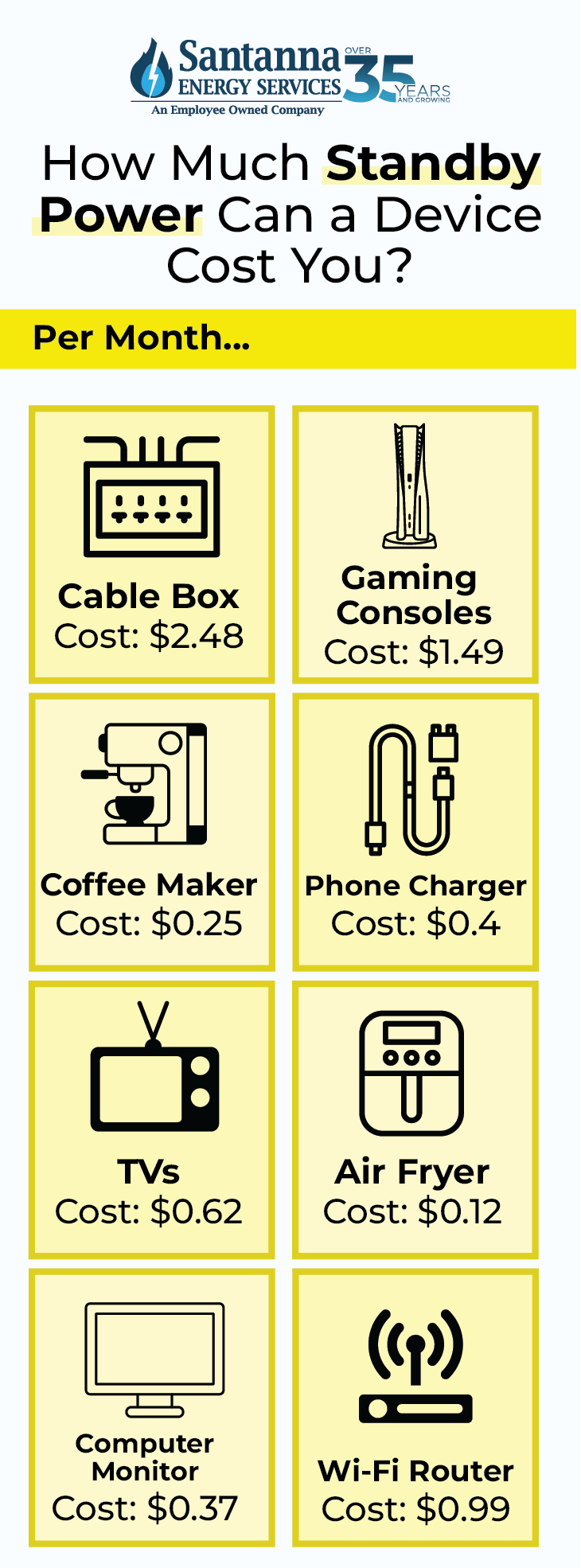
Unplugging a single device can reduce your electricity bill by about $0.04 to $2.48 per month. Higher-use electronics like cable boxes and gaming consoles make the most noticeable difference.
Even though each device uses a small amount, that energy runs all day and becomes part of your total monthly usage.
Using the same standby energy estimates from earlier and an average electricity rate of 18.44 cents per kWh (May 2026, U.S. Energy Information Administration), here’s how much energy you can save each month by unplugging specific appliances:
Estimated Cost of Common Household Appliances on Standby Power Use (24/7 Plugged In)
| Appliance | Standby Power (Watts) | Estimated Hourly Cost ($) | Estimated Daily Cost ($) | Estimated Weekly Cost ($) | Estimated Monthly Cost ($) | Estimated Yearly Cost ($) |
| Cable Boxes | 20 W | $0.0037 | $0.09 | $0.62 | $2.65 | $32.30 |
| Gaming Consoles | 12 W | $0.0022 | $0.05 | $0.37 | $1.59 | $19.38 |
| Coffee Maker | 2 W | $0.0004 | $0.01 | $0.01 | $0.27 | $3.23 |
| Phone Chargers | 0.3 W | $0.0006 | $0.001 | $0.01 | $0.04 | $0.48 |
| TVs | 5 W | $0.0009 | $0.02 | $0.15 | $0.66 | $8.08 |
| Air Fryer | 1 W | $0.0002 | $0.004 | $0.03 | $0.13 | $1.62 |
| Computer Monitor | 3 W | $0.0006 | $0.01 | $0.010 | $0.40 | $4.85 |
| Wi-Fi Router | 8 W | $0.0015 | $0.03 | $0.25 | $1.06 | $12.92 |
Disclaimer: These figures are hypothetical but based on typical standby power ranges for common household devices. They are calculated using average usage patterns to give a realistic estimate of how standby energy can add up over time.
In a typical household, especially in a family of four, reducing standby power can reduce your electricity bill by roughly $50-$100 per year.
For example, let’s consider four phone chargers (about $0.17 per month total), three TVs (about $1.98 per month), one computer monitor ($0.40 per month), and one Wi-Fi router ($1.06 per month) can add up to around $3.61 per month, or about $43 per year in standby power alone.
If you also include a gaming console ($1.59 per month) and a cable box ($2.65 per month), that total can rise to about $7.86 per month, or roughly $94 per year. With all these devices together, standby power could cost a family of four $137 alone.
Should You Unplug Your Appliances When They’re Not in Use?
Yes, unplugging can help improve energy efficiency and reduce small ongoing costs, especially when you focus on devices that continue using power in the background.
A practical approach is to look for appliances that are not always needed but still draw standby power.
It may make sense to unplug appliances that are:
- Used occasionally or only during certain seasons
- Always in standby mode, such as TVs, cable boxes, and gaming consoles
- Grouped together in one area, like entertainment or office setups
These are often the easiest places to reduce wasted energy without affecting your daily routine.
For other devices, it is usually more practical to manage them differently. For example:
- Devices you use daily can stay plugged in for convenience
- Hard-to-reach outlets can be easier and safer to control with a power strip
- Low standby devices, such as phone chargers, have very little impact on overall energy use
The goal is to focus on simple changes that improve efficiency, help lower small costs over time, and keep your home comfortable, safe, and easy to manage.
Why Is It Important to Unplug Appliances When Not in Use?
Unplugging appliances is important because it helps reduce unnecessary energy use, improve overall efficiency, and give you better awareness of how energy is used in your home over time.
Reduces Wasted Energy
Unplugging stops standby power, which is energy used by devices even when they are not in use. While each device uses a small amount, turning off that constant background use helps reduce unnecessary energy over time.
Helps You Stay More Aware of Your Energy Use
Taking time to unplug or switch off certain devices can make you more aware of what stays powered throughout the day. This awareness often leads to better habits and more intentional energy use in other areas of your home.
Supports Overall Energy Efficiency
Unplugging is a simple step that fits into a bigger picture. It helps reduce small, ongoing energy use and supports a more efficient home without requiring major changes or upgrades.
Helps Reduce Clutter and Unused Power Sources
Unplugging devices that are not regularly used can also help clear up outlets and reduce the number of active power sources around your home. This can make your space easier to manage and organize.
Can Help Protect Devices Over Time
Keeping devices unplugged when not in use, especially during storms or long periods away, can help reduce exposure to power surges and unnecessary wear from being constantly connected.
Unplugging is not something you need to do all the time or for every device. It is a small, practical step that can help improve efficiency and reduce wasted energy gradually over time.
How Can You Reduce Standby Power Without Affecting Comfort?
You can reduce standby power by making a few simple adjustments that lower background energy use without changing how your home feels day to day.
Use Smart or Advanced Power Strips to Control Multiple Devices
Plug TVs, gaming consoles, and other electronics into one power strip so you can turn them all off at once. This helps stop standby power without unplugging each device.
Smart or advanced power strips can also cut power automatically or with a switch, making it an easy way to reduce energy use while keeping things simple.
Use Smart Plugs or Timers for Automatic Shutoff
Smart plugs and timers can turn devices off automatically at certain times, such as overnight or when you are away. This works well for items like coffee makers, chargers, and small electronics that do not need constant power.
Turn Off Power at the Outlet When Possible
If your outlet has a switch, turning it off can stop power completely. This works the same as unplugging but is faster and easier for everyday use, especially for devices that stay plugged in behind furniture.
Choose Energy-Efficient Appliances When Upgrading
Newer appliances are designed to use less standby power. ENERGY STAR certified products are built to reduce unnecessary energy use both during operation and when idle.
Unplug Devices You Rarely Use
Items that are only used occasionally, such as guest room electronics, extra appliances, or seasonal items, can stay unplugged until you need them. This helps prevent unnecessary energy use over long periods without affecting your routine.
Adjust Settings on Always-On Electronics
Many devices use features like instant-on, background updates, or always-on displays.
Switching to sleep or energy-saving modes on gaming consoles, smart TVs, streaming devices, and printers can reduce background energy use without affecting how you use them.
Build Simple Habits That Fit Your Routine
Focus on a few easy habits, like turning off power strips before bed or keeping unused rooms powered down.
You do not need to change everything. Small, consistent actions can reduce standby power over time while keeping your home comfortable and easy to manage.
FAQs
What uses the most electricity in a home?
Heating and cooling systems use the most electricity in a home, accounting for about 45% to 50% of total energy use.
Does leaving chargers plugged in waste electricity?
Yes, leaving chargers plugged in uses a very small amount of electricity, but the energy use is typically minimal when no device is connected.
Is phantom energy dangerous?
Phantom energy, also known as standby power, is not harmful on its own, but it can raise your electricity costs over time and contribute to higher overall energy use and emissions according to Wired.
So, does unplugging appliances save electricity? In many cases, yes, especially for always-on electronics. The biggest difference comes from understanding where energy is quietly being used and making simple, consistent choices that improve efficiency over time.
Even with these habits in place, bills can still fluctuate with seasonal usage or high-demand months. That’s where a plan like Unlimited Energy can help. Unlimited Energy keeps your supply charges steady regardless of usage spikes,* so your monthly supply costs stay predictable while you focus on the changes that really matter.
Jenna Mendez is a Midwest native with lifelong roots in Illinois and time spent in Ohio during college, giving her a deep understanding of the Midwest region’s people, climate, and energy needs. She brings firsthand experience and local insight to topics that matter to Midwest homeowners, especially energy efficiency, sustainability, and home living. Jenna specializes in writing about eco-friendly living, all things Midwest, renewable energy, and practical ways to reduce energy costs. Jenna brings a trusted, and local hometown voice to every article she writes, helping readers live well, and sustainably, right where they are.