
What Makes a Ceiling Fan Energy Efficient? How To Choose One for Your Home

by Tyler Castle
24.3 min read
When cooling costs start to climb, many homeowners look for simple ways to stay comfortable without constantly turning up the air conditioner. Ceiling fans are often one of the first things people consider because they feel like an easy, affordable solution.
At the same time, there is a lot of confusion about how fans actually work and how energy-efficient ceiling fans can save you energy. This can leave homeowners unsure whether using one helps or simply adds to their electric bill.
As an energy supplier with more than 35 years of experience serving Midwest homes, we thrive when we can use our expertise in energy efficiency to help readers like you understand your choices for saving energy.
Understanding how a ceiling fan is energy efficient is one of those small details that can make a noticeable difference in comfort and spending.
Key Points of This Article:
- Features like DC motors, ENERGY STAR certification, proper sizing, and correct seasonal direction can significantly improve how efficiently a ceiling fan performs in your home.
- Highly efficient ceiling fans can use as little as about 3 watts on low speed and around 16 watts on high, which equals roughly 0.003 to 0.016 kWh per hour, a very small amount compared to appliances that actively heat or cool your home.
- Adding a light to a ceiling fan does not automatically increase energy use significantly, since the electricity it uses depends on the type of bulb, especially whether it is LED or an older style bulb.
- Ceiling fans do not cool the air itself, but when used properly, they can help you rely less on your heating or air conditioning, which is where real energy savings begin.
What Is an Energy-Efficient Ceiling Fan?
An energy-efficient ceiling fan moves more air while using less electricity, helping you stay comfortable without needing to run the fan as hard or as long.
If you’re shopping for a ceiling fan, it’s easy to focus only on wattage. Lower watts must mean lower energy use, right? Not always. True efficiency is not just about using the least amount of power. It’s about how effectively that power is used to circulate air throughout the room
Two fans can use the same amount of electricity and still feel very different. One may create a strong, comfortable breeze, while another barely changes how the room feels. That difference comes down to how well the fan is designed to move air, not just how much power it draws.
From an energy-efficiency standpoint, what really matters is how much comfort you are getting for the electricity you are paying for. That is the number that makes a difference on your bill over time, because a truly energy efficient ceiling fan delivers noticeable comfort at low or medium speeds, so you do not feel the need to turn it up or leave it running longer than necessary.
Are Ceiling Fans Energy Efficient?
Yes, ceiling fans are energy efficient when they are used to support your heating or cooling system, but should not replace it. According to Energy Star, energy-efficient ceiling fans are 44% more efficient than conventional fans.
If you live in the Midwest, you have probably experienced a humid summer afternoon when the air conditioner is running, but the room still feels slightly warm or stuffy. That is where a ceiling fan can make a noticeable difference, not as a cooling system, but as a comfort tool.
Ceiling fans don’t lower the temperature of the air. Instead, they move air across your skin, which helps your body release heat and feel cooler. That’s why turning on a fan can make a room feel more comfortable almost right away, even though the thermostat setting hasn’t changed.
Running a ceiling fan does add a small amount of electricity use. But the real energy benefit comes from what that added comfort allows you to adjust. When a fan helps you feel comfortable at a slightly higher summer thermostat setting, your air conditioner doesn’t have to work as hard or run as often.
The U.S. Department of Energy explains that using a ceiling fan can allow homeowners to raise the thermostat by about 4°F without sacrificing comfort. When that happens, the air conditioner doesn’t have to run as often, which can reduce overall cooling energy use.
The simple truth is that ceiling fans save energy only when they change how you operate your heating or cooling system. Running a fan in an empty room just adds electricity use. Using it in occupied spaces, while allowing for lighter thermostat settings, is where energy efficiency becomes practical and noticeable on your bill.
The key takeaway is that ceiling fans can support lower cooling costs, but not every fan performs the same. So, let’s take a closer look at what actually makes a ceiling fan energy efficient.
What Makes Ceiling Fans Energy Efficient?
A ceiling fan is energy efficient when it moves plenty of air while using less electricity, especially at lower speeds.
It should make the room feel comfortable without needing to run on high all the time. That’s why some fans feel better, run quieter, and use less energy than others. Let’s take a look at the key factors that make a ceiling fan energy efficient:
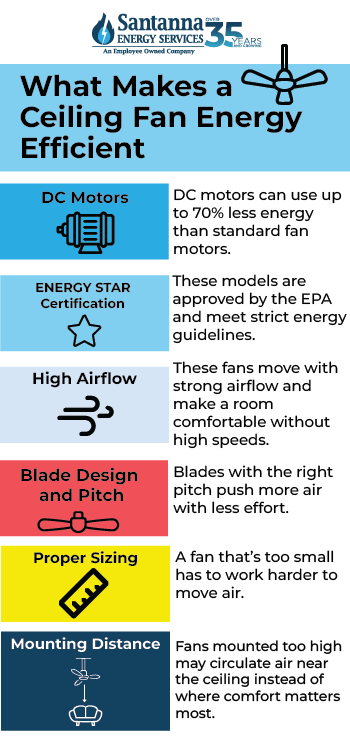
DC Motors
Many modern energy-efficient ceiling fans use DC motors because they can use up to 70% less energy while running smoothly and quietly, according to The Henley. For most homeowners, this simply means the fan can keep air moving comfortably at low or medium speeds without drawing extra power. You get steady airflow without needing to run the fan at full speed.
ENERGY STAR Certification
ENERGY STAR-certified ceiling fans are tested to meet higher standards for airflow and electricity use.
That improvement usually comes from better motor technology, optimized blade design, and often integrated LED lighting. If you want a simple shortcut when shopping, this label is a good place to start.
High Airflow Efficiency
Energy efficiency is not about how fast the blades spin. It’s about how much air the fan actually moves through the room. A fan with strong airflow can make a space feel comfortable without running at high speed, which usually means less electricity is used over time.
Blade Design and Pitch
Blade shape and angle play a big role in how efficiently a fan moves air. Blades with the right pitch push more air with less effort from the motor. This is why two fans that look similar can feel very different once turned on, because well-designed blades move air smoothly instead of relying on higher speeds.
Proper Sizing and Installation
Even the most efficient fan won’t perform well if it’s the wrong size or installed incorrectly. A fan that’s too small has to work harder to move air, while one mounted too close to the ceiling may not circulate air where people actually sit or sleep. Choosing the correct fan size and mounting height allows air to move through the room efficiently without extra effort from the motor.
Ceiling Height and Mounting Distance
Ceiling height affects how well airflow reaches the living space. Fans mounted too high may circulate air near the ceiling instead of where comfort matters most. Using the proper downrod length helps position the fan at the right height so airflow reaches people, not just the ceiling.
Integrated LED Lighting
If your ceiling fan includes a light, the type of lighting matters. Integrated LED lighting uses less electricity than older bulbs and gives off less heat. That helps keep rooms more comfortable in warm weather and keeps overall energy use lower.
Smart Technology and Controls
Smart controls help reduce wasted energy by making it easier to operate the fan efficiently. Features like timers, remotes, or smart controls do not save energy on their own. What they do is make it easier to turn the fan off when you leave a room or keep it running at lower speeds, which prevents unnecessary energy use without sacrificing comfort.
Build Quality and Balance
A well-built, balanced fan runs more smoothly and efficiently over time. Less wobble means less strain on the motor, and that can improve efficiency and extend the life of the fan. Quiet, stable fans are also more comfortable to use at lower speeds, which supports better energy habits.
Fan Direction and Seasonal Use
Using the correct fan direction improves efficiency in both summer and winter. In summer, fans should spin counterclockwise to push air downward and create a cooling breeze.
In winter, fans should spin clockwise at a low speed to gently move warm air down from the ceiling. When direction is set correctly, the fan works with your heating or cooling system instead of against it.
Room Layout and Airflow Path
Clear airflow allows a ceiling fan to operate more efficiently. Tall furniture, ceiling beams, or bulky fixtures can interrupt airflow and reduce effectiveness. When air moves freely through the room, the fan can deliver comfort at lower speeds without working harder.
Consistent Usage Habits
Energy efficiency depends not just on the fan itself, but on how it’s used. Fans work best when they’re used in occupied rooms and turned off when no one is there. Steady, intentional use helps avoid unnecessary energy use while still supporting comfort.
Whole-Home Efficiency Support
Ceiling fans perform best in homes that already support good temperature control. Insulation, sealed windows and doors, and sensible thermostat settings all help the fan feel more effective. When the home holds temperature well, the fan doesn’t have to work as hard to create comfort.
Energy efficiency is not about one perfect feature. It is about how design, sizing, airflow, and everyday use all work together to support comfort in your home without wasted electricity.
How Much Electricity Does an Energy-Efficient Ceiling Fan Use?
When homeowners think about energy use, it helps to start with electricity itself before worrying about cost.
Highly energy efficient ceiling fans can use as little as about 2.9 watts on low speed and up to around 16.2 watts on high speed.
At a typical everyday setting, this works out to roughly 0.0029 to 0.0162 kilowatt-hours (kWh) per hour of use.
Energy-efficient ceiling fans do not use one fixed amount of power. Their electricity use changes based on speed.
How much electricity a fan uses depends mainly on the type of fan and how long it runs. To keep things simple and consistent, the table below shows estimated electricity usage based on typical wattage for different fan types, assuming 8 hours of use per day.
Electricity Usage of Energy-Efficient vs Standard Household Fans (Based on 8 Hours of Use Per Day)
| Fan Type | Typical Wattage | kWh per Hour | kWh per Day (8 hrs) | kWh per Week (7 days) | kWh per Month (30 days) | kWh per Year (365 days) |
| Energy-Efficient Ceiling Fan (Low Speed) | 2.9W | 0.003 | 0.02 | 0.16 | 0.70 | 8.47 |
| Energy-Efficient Ceiling Fan (High Speed) | 16.2W | 0.016 | 0.13 | 0.91 | 3.89 | 47.3 |
| Ceiling Fan | 60 W | 0.06 | 0.48 | 3.36 | 14.4 | 175.2 |
| Box Fan | 40 W | 0.04 | 0.32 | 2.24 | 9.6 | 116.8 |
| Pedestal Fan | 60 W | 0.06 | 0.48 | 3.36 | 14.4 | 175.2 |
| Tower Fan | 35 W | 0.035 | 0.28 | 1.96 | 8.4 | 102.2 |
| Wall-Mounted Fan | 70 W | 0.07 | 0.56 | 3.92 | 16.8 | 204.4 |
| Window Fan | 70 W | 0.07 | 0.56 | 3.92 | 16.8 | 204.4 |
| Exhaust Fan | 20 W | 0.02 | 0.16 | 1.12 | 4.8 | 58.4 |
The wattage ranges and usage estimates shown here are based on commonly reported values summarized in the blog Do Ceiling Fans Use a Lot of Electricity? Watts, Usage and Types. Actual electricity use may vary depending on fan model, speed setting, and motor efficiency.
What stands out here in terms of energy consumption is the gap between how much energy an efficient ceiling fan uses compared to a standard fan. An energy-efficient ceiling fan uses a fraction of the electricity of a standard ceiling fan over time, around 95% less energy.
The difference may seem small hour by hour, but over weeks and months, the lower wattage adds up to significantly less total electricity use.
This is why energy-efficient fans are often better suited for rooms where fans run regularly, such as bedrooms or living areas, without noticeably increasing overall household energy use.
How Energy-Efficient Ceiling Fan Energy Use Compares to Common Household Appliances (Based on 8 Hours of Use Per Day)
| Appliance | Power (Watts) | kWh per Hour | kWh per Day (8 hrs) | kWh per Week | kWh per Month | kWh per Year |
| Energy-Efficient Ceiling Fan (Low Speed) | 2.9W | 0.003 | 0.02 | 0.16 | 0.70 | 8.47 |
| Energy-Efficient Ceiling Fan (High Speed) | 16.2W | 0.016 | 0.13 | 0.91 | 3.89 | 47.3 |
| Ceiling Fan | 60 W | 0.06 | 0.48 | 3.36 | 14.4 | 175.2 |
| Television | 100 W | 0.1 | 0.8 | 5.6 | 24 | 292 |
| Microwave Oven | 1,000 W | 1 | 8 | 56 | 240 | 2,920 |
| Air Conditioner | 3,000 W | 3 | 24 | 168 | 720 | 8,760 |
| Space Heater | 1,500 W | 1.5 | 12 | 84 | 360 | 4,380 |
| Refrigerator | 500 W | 0.5 | 4 | 28 | 120 | 1,460 |
| Hair Dryer | 1,000 W | 1 | 8 | 56 | 240 | 2,920 |
| Laptop | 100 W | 0.1 | 0.8 | 5.6 | 24 | 292 |
| Dishwasher | 1,800 W | 1.8 | 14.4 | 100.8 | 432 | 5,256 |
Disclaimer: These numbers come from the blog How to Calculate Electricity Usage: For Your Bill & Appliances and are meant to give a helpful estimate.
Even if you leave an energy-efficient ceiling fan running for hours, it still uses much less electricity than appliances that actually heat or cool your home, like your air conditioner, a space heater, or even a microwave.
The main thing to know is that ceiling fans do use some electricity, but not very much. They are not trying to heat the room or cool it down. They simply move air so you feel more comfortable.
What makes ceiling fans helpful is that they do not replace your larger appliances, but they can help you rely on them a little less. And that is usually where the real savings start to show up.
How Energy Efficient Ceiling Fan Energy Use Compares to Air Conditioning
When you compare ceiling fans to air conditioning, the difference in electricity use becomes very clear.
According to ENERGY STAR, an energy-efficient ceiling fan uses about 0.0029 kWh per hour on low speed and up to about 0.0162 kWh per hour on high speed, since it only needs enough power to run a small motor that moves air.
A window air conditioner, by comparison, commonly uses about 1.0 kWh per hour (1,000 watts) because it actively removes heat from the room using a compressor and cooling system.
This means a window air conditioner uses roughly 5 to 50 times more electricity per hour than a ceiling fan, depending on fan efficiency and AC size. This difference is normal and expected, because air conditioners are doing much heavier work than simply moving air.
This gap explains why energy-efficient ceiling fans are considered low-energy comfort tools. Their real value is not in replacing air conditioning, but in helping you feel comfortable so the air conditioner does not need to run as often or as long.
Does an Expensive Ceiling Fan Mean Better Efficiency?
Not always. A higher price does not automatically mean a ceiling fan uses less energy.
Some more expensive fans are more efficient because they include features like better motors, improved blade design, or ENERGY STAR certification. Those features can help the fan move air more effectively while using less electricity.
However, many fans cost more simply because of their style, finish, or brand name. A fan that looks nicer does not necessarily move more air or save more energy.
The most efficient ceiling fan is one that fits your room, moves air well at lower speeds, and is used correctly. A well-sized, reasonably priced fan can often be just as efficient as a more expensive option.
Do Energy-Efficient Ceiling Fans with Lights Use More Electricity?
Not necessarily. Adding a light to a ceiling fan does not automatically mean it will use a lot more electricity. It depends on the type of lighting, not the fan itself.
A ceiling fan and its light use electricity separately. The fan uses power to move air, while the light uses power to create light. In most cases, the fan motor uses a steady, low amount of electricity, and the light adds a small extra load usually about 13 watts or roughly 0.013 kWh for each hour it runs when an LED light is turned on.
Where lighting choice makes a difference is heat. Older incandescent bulbs give off a lot of warmth while they are on. That extra heat can make the room feel warmer, which may cause your air conditioner to run more often. During hot summer months, that can quietly work against your cooling efforts.
Fans with integrated LED lights use much less electricity and produce very little heat. That helps keep the room comfortable and prevents the light from adding unnecessary warmth.
When looking for energy-efficient fan lighting, focus on fixtures that use built-in LED lighting or are designed to work with LED bulbs. LEDs last longer, use less electricity, and do not warm up the room. It is an easy upgrade that supports comfort without adding stress to your energy bill.
How To Choose the Right Energy-Efficient Ceiling Fan for Your Home
Now that you know what affects a fan's efficiency, the next step is choosing one that actually fits your space and comfort needs. Choosing an energy-efficient ceiling fan does not have to feel complicated, because most homeowners simply want a fan that feels comfortable, does not waste electricity, and works well in their room.
These practical checkpoints can help you choose the right energy-efficient ceiling fan for your home:
Choose the Right Fan Size for the Room
When choosing a ceiling fan, start by looking at the size of the room. Larger rooms need larger fans to move air effectively, while smaller rooms work better with smaller fans.
Choosing the right size matters because a fan that fits the room can circulate air evenly and keep you comfortable without needing to run at high speeds because when the size is right, the fan works efficiently and feels comfortable instead of weak or overpowering.
Look for Strong Airflow, Not Just Low Wattage
It is easy to assume that a fan using fewer watts is always more efficient, but airflow matters just as much. Look for fans designed to move a lot of air at lower or medium speeds. When airflow is strong, the room feels comfortable sooner and the fan does not need to run as long or as fast, which helps reduce unnecessary electricity use over time.
Check for ENERGY STAR Certification
When shopping, look for ceiling fans with ENERGY STAR certification because these fans have been tested for both energy use and airflow performance. Choosing a certified fan gives you confidence that it is designed to move air efficiently instead of simply spinning fast. When you choose an ENERGY STAR fan, you are more likely to get reliable comfort with lower energy use.
Pay Attention to the Motor Type
The motor inside the fan plays a big role in how efficiently it runs. Fans with DC motors are designed to use less electricity and operate more smoothly than traditional motors. Choosing a fan with a DC motor can result in quieter operation and better efficiency, especially at the lower speeds most homeowners use every day.
Match the Fan to Your Ceiling Height
Ceiling height affects how well air moves through a room. Fans installed too close to the ceiling may not circulate air where people actually sit or sleep.
Choosing the correct mounting option, such as a downrod for higher ceilings, allows air to reach the living space more effectively. When the fan is mounted properly, it provides better comfort without needing extra power.
Think About Blade Design, Not Just Appearance
Blades are not just decorative. Their shape and angle determine how much air the fan can move.
Choosing a fan with well-designed blades helps move air more efficiently across the room. When blade design is right, the fan feels more effective and does not need to work as hard to keep the space comfortable.
Choose LED Lighting If the Fan Includes a Light
If your ceiling fan includes a light, choose one designed for LED lighting or built with integrated LEDs. LED lights use less electricity and give off less heat than older bulbs. When lighting is energy efficient, it helps keep the room cooler and prevents the light from adding extra warmth that could affect comfort.
Consider How You Will Control the Fan
How you control the fan affects how efficiently it is used. Remote controls, wall switches, or timers make it easier to turn the fan off when you leave a room or adjust the speed as needed. When the fan is easy to control, you are more likely to use it efficiently instead of leaving it running unnecessarily.
Think About Where You Will Use the Fan Most
Some rooms benefit more from ceiling fans than others. Bedrooms, living rooms, and upstairs spaces often feel warmer and are used for longer periods of time. Choosing energy-efficient fans for these areas helps improve comfort where it matters most and makes better use of the fan's energy-saving potential.
Remember That How You Use the Fan Matters
Even the best ceiling fan will not save energy if it runs in empty rooms. Fans are designed to cool people, not spaces. When you use the fan only when someone is in the room and turn it off when you leave, you get the most comfort and efficiency from your choice.
What Is the Most Energy-Efficient Ceiling Fan for Your Home?
According to ENERGY STAR, the AERATRON AE+2WI60L ceiling fan with a light kit is listed among the most energy-efficient ceiling fans based on tested performance. It has a ceiling fan efficiency rating of 483.0 CFM per watt (CFM/W), which means it moves a large amount of air for every unit of electricity it uses.
That high CFM/W number matters because energy efficiency is about airflow, not just low power use. A fan with a higher efficiency rating can make a room feel comfortable at lower speeds, which helps reduce unnecessary electricity use.
That said, there is no single "best" ceiling fan for every home. The most energy-efficient fan for you still depends on room size, ceiling height, and how the fan is used day to day. Even a top-rated fan can waste energy if it is the wrong size or left running in an empty room.
Think of efficiency ratings as a helpful guide, not the final decision-maker. The right energy efficient ceiling fan for your home is the one that feels comfortable, fits your space, and does its job without wasting electricity.
How Can Ceiling Fans Improve HVAC Energy Efficiency in Each Season?
Ceiling fans help your heating and cooling system by moving air more evenly through your home. They don't replace your HVAC system. They simply help it work more efficiently by improving comfort. Let's take a closer look at how ceiling fans improve HVAC efficiency in each season:
Summer: Helping Your Home Feel Cooler
In summer, your air conditioner does most of the work. A ceiling fan helps by creating a breeze that makes you feel cooler while the temperature stays the same.
When a fan is running in a room you're using, many homeowners find they can set the thermostat a little higher and still feel comfortable. This helps the air conditioner run less often. Fans should be turned off when no one is in the room, since they cool people, not spaces.
Fall and Spring: Reducing Extra Heating and Cooling
During spring and fall, temperatures can change throughout the day. Ceiling fans can help keep rooms comfortable without turning the heat or air conditioning on as often.
On warmer afternoons, a fan may provide enough comfort on its own. On cooler mornings, gentle air movement can help spread warmth that's already in the home.
Winter: Spreading Warm Air Evenly
In winter, warm air tends to rise and collect near the ceiling. This can make rooms feel cooler at floor level.
Running a ceiling fan on a low setting helps push that warm air back down into the room. When heat is spread more evenly, the heating system does not have to work as hard to keep the home comfortable.
Ceiling fans help your home feel more comfortable so your heating and cooling system does not have to work as much. Used the right way and in the right season, fans are simple tools that support steady comfort all year long.
How You Should Use a Ceiling Fan to Stay Energy Efficient All Year
Using a ceiling fan efficiently isn't about fancy settings or constant adjustments. It's about a few simple habits that help your home feel comfortable without using extra energy. Here are some smart ways to use a ceiling fan to stay energy efficient all year round:
Use the Fan Only When You're in the Room
Ceiling fans cool people, not rooms. When no one is there to feel the airflow, the fan isn't helping with comfort. Turning the fan off when you leave the room is one of the easiest ways to avoid wasted electricity.
Adjust the Fan Direction for the Season
In warmer months, the fan should spin so it pushes air downward. This creates a breeze that helps you feel cooler.
In colder months, the fan should run at a low speed in the opposite direction to gently pull air upward. This helps move warm air down from the ceiling without creating a chill.
Use the Lowest Speed That Feels Comfortable
Running a fan at high speed is not always necessary. Many homeowners find that low or medium speeds provide plenty of comfort. Using the lowest effective speed keeps energy use lower and reduces wear on the fan.
Let the Fan Support Your Thermostat
Fans work best when they help you adjust how you use heating or cooling. In summer, a fan may allow you to raise the thermostat slightly and still feel comfortable. In winter, better air circulation can help rooms feel warmer without turning the heat up.
Keep the Fan Clean and Well-Maintained
Dust buildup on blades can reduce airflow and make the fan work harder than it needs to. Cleaning the blades regularly helps the fan move air more efficiently and keeps performance consistent.
Think of Fans as Comfort Helpers
Ceiling fans are not meant to replace heating or cooling systems. Their job is to improve how comfortable a room feels so those systems don't have to work as hard. When used thoughtfully, fans become simple, low-energy tools that support comfort all year long.
When Do Ceiling Fans Help and When Are They a Waste of Energy?
As energy professionals, we see this all the time. Ceiling fans can absolutely help lower energy use, but only when they are used intentionally.
It really comes down to how and when they are running. Sometimes they support comfort and reduce strain on your heating or cooling system. Other times, they are simply adding to your electricity use without doing much at all. Let's break down the difference.
When Ceiling Fans Help
Ceiling fans help when someone is in the room. The moving air helps your body feel cooler in summer and helps warm air move around in winter. This can make a room feel more comfortable without turning the heat or air conditioner up as much.
Fans are most helpful in rooms where people spend time, like bedrooms, living rooms, or upstairs rooms that feel warmer.
When Ceiling Fans Are a Waste of Energy
Ceiling fans waste energy when they run in empty rooms because they do not cool the air itself, they only cool people. Fans can also waste energy if they are too big, too small, or always run on high speed when lower speeds would feel just fine.
A simple way to remember is that, if you are in the room, a ceiling fan can help. If no one is in the room, turn the fan off. Using fans this way helps your home stay comfortable without using extra energy.
How Can Ceiling Fans Fit into a Bigger Plan for Predictable Home Energy Costs?
Ceiling fans help support predictable energy use by improving comfort without adding much electricity. When rooms feel comfortable, homeowners are less likely to keep changing the thermostat, which helps heating and cooling systems run more steadily.
Over time, this steadier use can reduce sudden spikes in heating or cooling. Small habits, like using fans only when rooms are occupied and choosing the lowest comfortable speed, help keep daily energy use more consistent.
That kind of consistency pairs naturally with our Unlimited Energy plan, which focuses on predictable supply charges rather than month-to-month surprises.* Together, simple comfort habits and predictable energy planning can make home energy use easier to manage.
Ceiling fans are simple tools that help your home feel more comfortable without using much electricity. When used the right way, they help your heating and cooling system work more smoothly.
When your home feels comfortable, you are less likely to keep changing the thermostat. That helps reduce sudden changes in energy use and makes your monthly usage more predictable. Small comfort tools, paired with smart habits, give homeowners better control over how energy is used.
If predictable energy costs matter to you, those steady habits can be supported by predictable energy planning. Santanna's Unlimited Energy plan is one option designed to offer predictable supply charges and fewer surprises throughout the year.*
The goal is simple. Better comfort, better habits, and energy use that feels easier to manage.
* Restrictions apply. Enrollment based upon program eligibility. Customers using more than 125% of normal monthly usage as determined by Santanna may be required to switch plans.
Tyler is an experienced energy professional, having worked for Santanna Energy Services, for the past four years. He is passionate about renewable energy and believes that diversifying the energy grid is the key to a sustainable future. Tyler is dedicated to supplying consumers with the best possible energy solutions and works diligently to make sure that Santanna can deliver the highest quality service.