

Ideal Ceiling Fan Direction in the Winter & Summer

by Tyler Castle
Updated: August 17, 2026
5 min read
Key Points of This Article:
- In winter, fans should rotate clockwise at a low speed to push warm air downward and improve heat distribution.
- In summer, fans should rotate counterclockwise to create a cooling breeze that helps reduce reliance on air conditioning.
- Changing fan direction is simple using a toggle switch or remote, and choosing the right fan size and model improves overall efficiency.
Have you ever wondered about your ceiling fan direction and if it matters? While ceiling fans are often associated with cooling during the summer months, they can also play a crucial role in maintaining warmth and reducing heating costs in the winter. But how, when and why should you do this? We’re here to help!
We’ll cover all this and more so that you can maximize your comfort and savings through the changing seasons.
Which direction should my ceiling fan turn in the winter?
According to Energy.gov, your ceiling fan should turn clockwise in the winter. Energy.gov suggests using your fan at a low speed during the winter.
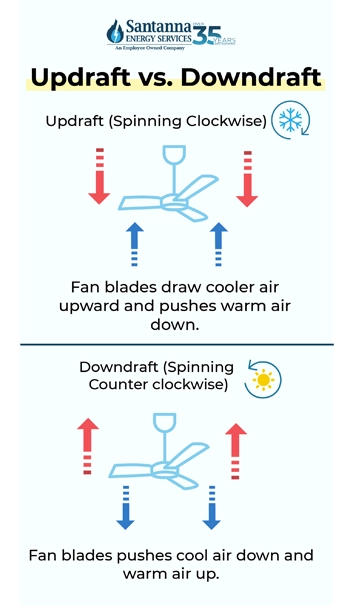
Using fans in a room can help circulate warm air. The fans push cool air upward and warm air downward along the walls. This creates a gentle updraft. As warm air naturally rises and collects near the ceiling, running the fan in this direction helps to distribute it more evenly throughout the room.
If you plan on running your fan 24/7 during the winter, be sure to adjust your thermostat temperature a few degrees to save on energy efficiency.
Which direction should my ceiling fan turn in the summer?
Wondering what direction your ceiling fan should go in the summer? Energy.gov advises operating your ceiling fan in a counterclockwise direction.
This counterclockwise rotation creates a downward airflow that produces a wind-chill effect, making you feel cooler without actually lowering the room’s temperature. The same concept proves true for outdoor weather!
Running a ceiling fan is a great choice to stay cool during the summer. In some areas of the world where summer temperatures are on the milder side, using a ceiling fan could eliminate your need for air conditioning altogether. Which ultimately helps you save energy and can lower your electricity bills.
If you’re planning on running your ceiling fan for most of the summer, remember to adjust your thermostat for more energy savings! Energy.gov recommends raising your thermostat temperature 4 degrees higher if you’re using your fan. This adjustment should result in no reduction of comfort in your home environment.
What happens when you reverse your ceiling fan direction?
When you set your ceiling fan clockwise, it changes the angle at which the ceiling fans rotate. This creates an updraft that draws cooler air upward and pushes warm air down into your living space.
Setting your ceiling fan direction in a counterclockwise motion generates a downdraft. In this position, the fan blades push air downward, creating a cooling breeze that evaporates moisture on your skin, making you feel cooler.
When to change the direction of your ceiling fan
Knowing when to change the direction of your ceiling fan depends on the season, location and your desired comfort level.
Here is a general rule of thumb:
- Summer: In late spring or early summer, you should switch your ceiling fans to rotate in a counterclockwise direction.
- Winter: In Early winter change the direction of your ceiling fan to rotate clockwise.
- Transition Periods: During the transitional seasons of spring and fall, when temperatures can fluctuate, you may need to adjust the direction of your ceiling fan accordingly. Pay attention to changes in weather and adjust the fan direction to maintain optimal comfort.
How to change your ceiling fan direction
Depending on your model, changing your ceiling fan direction is quite simple.
- The first thing you need to do is to turn off your ceiling fan completely. Make sure the blades have come to a complete stop and watch your fingers and head before coming eye-to-eye with your fan!
- On most ceiling fans, there is a toggle switch located on the side of the base of the fan just above the blades.

3. Switch your fan direction by flicking the toggle; flipping your switch downward usually turns on “summer mode” but this will vary by brand. Try a couple of test runs in each direction to see how the fan rotates to determine the correct direction and toggle switch. Be sure to stand AWAY from the blades before you test so you don’t get injured.
How to change the ceiling fan direction on your remote-control ceiling fan
If you have a remote-controlled ceiling fan, changing your direction doesn’t require stepstools. Most remote-controlled ceiling fans come with a setting on their remote to change their direction. Here’s generally how you can do it:
- Make sure your remote is paired with your ceiling fan.
- Turn off your fan and wait for your blades to come to a complete stop.
- Press and hold the fan button on the handheld remote control. The light on the control will blink when it has successfully changed your settings.
- Step away from the ceiling fan blades and turn your fan back on.
Understanding the importance of ceiling fan direction can significantly impact both your comfort and energy savings throughout the year. Whether it’s creating a cooling breeze during the summer or distributing warm air more efficiently in the winter, the direction in which your ceiling fan rotates plays a crucial role in maintaining optimal indoor conditions.
There's peace of mind in knowing you'll pay the same monthly amount for your electricity or natural gas supply without any uncertainty — no matter what. Santanna's Unlimited Energy option protects your bills from fluctuating supply charges no matter the changes in seasons. For over 35 years, Santanna has served customers in Illinois, Indiana, Pennsylvania, Michigan, and Ohio. Our mission is to provide innovative and cost-effective energy solutions that will help our customers achieve their energy goals.
Tyler is an experienced energy professional, having worked for Santanna Energy Services, for the past four years. He is passionate about renewable energy and believes that diversifying the energy grid is the key to a sustainable future. Tyler is dedicated to supplying consumers with the best possible energy solutions and works diligently to make sure that Santanna can deliver the highest quality service.