
Why Is My Upstairs So Hot? Common Causes in Summer and Winter

by Jenna Mendez
Updated: September 8, 2026
17.4 min read
Key Points of This Article:
- A slightly warmer upstairs is normal, but a difference of more than 5°F may point to an airflow, insulation, or air-leak problem.
- To keep your upstairs from getting warmer, start with simple fixes like changing dirty filters, keeping vents open, using ceiling fans correctly, blocking sunlight, and sealing air leaks.
- If the upstairs stays hot after trying simple fixes, or your HVAC system runs constantly, consider having an HVAC professional check the problem.
- If your HVAC system runs longer to cool a hot upstairs, an extra 100–200 kWh could add about $19–$38 to your electricity bills.
Wondering why your upstairs is so hot? Your upstairs is usually hotter because heat naturally rises, upper floors are more exposed to the sun and roof heat, and your home's insulation, airflow, and heating or cooling system don't always keep both floors at the same temperature.
At Santanna Energy Services, we've been supplying energy to the Midwest for over 35 years while helping residents better understand their energy use, and we've seen how common a hot upstairs is during the year and how it can point to a bigger issue with energy efficiency.
In this guide, we'll explain why your upstairs gets hot, what the most common causes are, and what you can do to make your home more comfortable and energy efficient year-round. Let's dive in.
Is It Normal for Upstairs to Be Hotter Than Downstairs?
Yes, in many two-story homes, it's normal for the upstairs to be slightly warmer than downstairs during hot summer afternoons or after several hours of direct sunlight because warm air naturally rises and upper floors often receive more heat from the roof and sun.
In a survey of Santanna Energy Services employees, 12 out of 17 respondents (71%) said their homes have rooms or floors that are consistently warmer than others. When we asked which areas tend to get the hottest, upstairs rooms were a recurring answer, especially second-floor bedrooms.
It's important to pay attention to when the problem happens. If your upstairs is only hotter during the hottest part of the summer, the sun and attic heat may be the biggest contributors.
If it stays much hotter all year long, even in winter, the cause is more likely related to airflow, insulation, or how your heating and cooling system distributes air throughout your home.
Typical Temperature Differences Between Upstairs and Downstairs
| Temperature Difference | What It May Mean |
| 1–3°F warmer | Usually normal in many two-story homes. Heat naturally rises, and upper floors often receive more sunlight. |
| 3–5°F warmer | Common in older or larger homes, but it may also suggest uneven airflow or insulation that could be improved. |
| More than 5°F warmer | Often points to a problem such as poor attic insulation, air leaks, uneven airflow, ductwork issues, or an HVAC system struggling to cool or heat both floors evenly. |
A difference of just a few degrees between floors can be normal, but a larger gap may be worth a closer look.
Why is My Upstairs So Hot? The Most Common Reasons
Your upstairs is usually hotter because heat naturally rises, upper floors are more exposed to the sun and roof heat, and your home's insulation, airflow, and heating or cooling system don't always keep both floors at the same temperature.
While a small temperature difference between floors is normal, a much hotter upstairs can mean your home is having a harder time keeping both floors at a comfortable temperature.
Let's take a closer look at the most common reasons your upstairs stays hot throughout the year:
Heat Naturally Collects on the Second Floor
According to the National Oceanic and Atmospheric Administration, heat naturally gathers on the upper floor and rises because hot air is lighter than cold air, which is one reason your upstairs may feel warmer than downstairs.
In summer, heat from the roof, attic, and sunlight can make the second floor even hotter. In winter, warm air from your heating system can collect upstairs, so the temperature difference can happen year-round.
Heat Enters Your Home Faster Than It Can Be Removed
Your upstairs can become too hot when more heat enters your home than your cooling system can remove. Heat commonly enters through the roof, attic, windows, and small air leaks around the upper floor. Once that heat builds up, it becomes much harder for your air conditioner to keep upstairs rooms comfortable.
This can be even more noticeable in homes with large west- or south-facing windows or very little shade during summer.
Conditioned Air Isn't Reaching Your Upstairs Evenly
Your heating and cooling system can't keep every room comfortable if heated or cooled air isn't reaching the upstairs efficiently. Uneven airflow can happen because of long duct runs, leaky ductwork, blocked vents, dirty air filters, or differences in how air naturally moves through your home.
That can leave the downstairs feeling comfortable while the upstairs is still trying to catch up.
Poor Attic Insulation
Poor attic insulation can make your upstairs harder to keep comfortable in both summer and winter. In summer, more attic heat can make its way into the rooms below, while in winter, more of your home's warmth can escape through the attic.
When that happens, your heating or cooling system may need to run longer to keep your home comfortable, which can also increase energy use.
What Makes Upstairs Hotter During Summer?
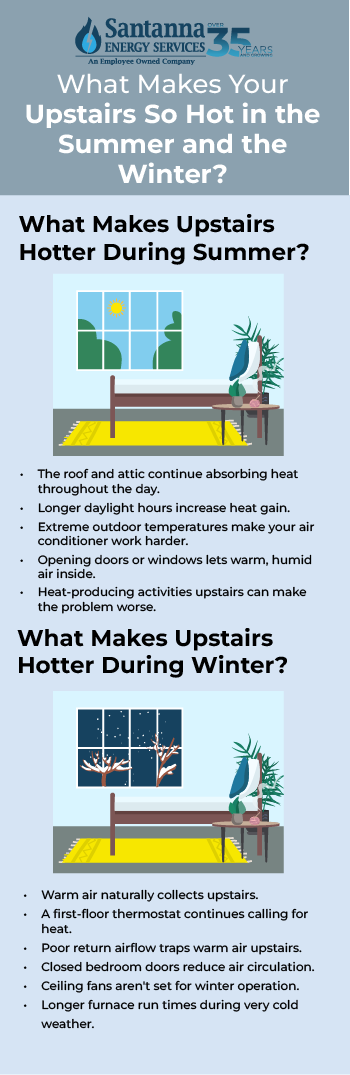
Your upstairs gets hotter during summer because the second floor is exposed to hours of intense sunshine and outdoor heat that your air conditioner has to overcome. Even if your cooling system is working properly, hot weather can create conditions that make upstairs rooms much harder to keep comfortable than the rest of the house.
Here are some of the common causes that makes your upstairs hotter during summer:
- The roof and attic continue absorbing heat throughout the day. Even after the outdoor temperature begins to cool, the attic can continue releasing stored heat into the rooms below, making upstairs bedrooms feel hottest during the late afternoon or early evening.
- Longer daylight hours increase heat gain. During summer, the sun shines on your home for more hours each day, giving west- and south-facing rooms more time to absorb heat through windows and exterior walls.
- Extreme outdoor temperatures make your air conditioner work harder. On very hot days, your AC has to remove heat from your home while new heat continues entering from outside. This can make it difficult for the second floor to reach the same temperature as downstairs.
- Opening doors or windows lets warm, humid air inside. Frequently going in and out, opening upstairs windows, or bringing in humid outdoor air can quickly warm the second floor and make it feel less comfortable, even while the AC is running.
- Heat-producing activities upstairs can make the problem worse. Running electronics, using a hair dryer, exercising, or simply spending time upstairs can add extra heat that your air conditioner has to remove.
These summer conditions can make your upstairs much hotter than the rest of your home, especially on hot, sunny days.
What Makes Upstairs Hotter During Winter?
You might be wondering: why is my upstairs so hot during the winter? Your upstairs can feel hot because warm air naturally rises and your heating system may not warm both floors evenly. This can leave the second floor feeling warmer than you want, even when the temperature downstairs feels just right.
Let's take a closer look at the most common reasons your upstairs gets hotter during winter:
- Warm air naturally collects upstairs. As your heating system warms your home, the warmest air gradually rises and gathers on the second floor, making upstairs bedrooms and hallways feel warmer than downstairs.
- A first-floor thermostat continues calling for heat. Because many thermostats are located downstairs, the furnace may keep running until the first floor reaches the desired temperature, even if the upstairs is already warm.
- Poor return airflow traps warm air upstairs. Without enough return airflow, heated air stays on the second floor instead of circulating evenly back through your heating system.
- Closed bedroom doors reduce air circulation. During winter, many people keep bedroom doors closed to stay warm or for privacy. This can reduce airflow between rooms and cause heat to build up upstairs.
- Ceiling fans aren't set for winter operation. If ceiling fans remain off or continue spinning in the summer direction, warm air stays near the ceiling instead of being gently pushed back into the room to improve comfort.
- Longer furnace run times during very cold weather. During cold spells, your furnace naturally runs more often to keep up with outdoor temperatures. As warm air continues circulating, the upstairs may become noticeably warmer before the downstairs reaches the thermostat setting.
Because of these winter conditions, it's not uncommon for homeowners to lower the thermostat downstairs while opening an upstairs bedroom window just to make sleeping more comfortable.
Can a Hot Upstairs Increase Your Energy Bills?
Yes, a hot upstairs can indirectly increase your energy costs if it causes your HVAC system to run longer than it otherwise would.
Hypothetically, if running your heating or cooling system often adds an extra 100-200 kWh to your cooling costs, this can increase your electricity bill by $19 to $38. The temperature difference itself doesn't raise your bill, but the extra time your HVAC system spends running usually does.
To calculate this estimate, we used the April 2026 rate of 18.83¢ per kWh.
During the summer, many homeowners lower the thermostat because the upstairs still feels warm. This often causes the air conditioner to run longer, even though the downstairs may already be cool.
During the winter, the opposite can happen. Your furnace may continue heating until the downstairs reaches the thermostat setting, even if the upstairs is already warm.
The good news is that improving airflow, insulation, or air sealing can help your heating and cooling system maintain a more even temperature between floors. When your home stays comfortable without your HVAC system running as long, it can use energy more efficiently while helping keep your electricity use under control.
Why Is My Upstairs So Hot? How To Tell What's Causing It
The easiest way to narrow down why your upstairs is so hot is to pay attention to when it happens and which rooms are affected. These patterns can provide helpful clues about what may be causing the temperature difference.
Before making changes or calling an HVAC professional, let's take a closer look at what your hot upstairs may be telling you:
If Your Upstairs Is Only Hot During the Summer
Your home is likely gaining more heat than your air conditioner can remove. Heat from the roof and attic, direct sunlight through windows, poor attic insulation, or uneven airflow are often the main causes of why your upstairs is so hot.
Start by checking your attic insulation, closing blinds during the afternoon, replacing a dirty air filter, and making sure vents aren't blocked.
If Your Upstairs Stays Hot All Year
If the temperature continues to stay hot upstairs through both summer and winter, the issue is usually related to how your home distributes and retains heated or cooled air.
Uneven airflow, leaky ductwork, poor attic insulation, thermostat placement, or air leaks may all be contributing. Improving insulation, sealing air leaks, and having your airflow evaluated can often make the biggest difference.
If Only One Upstairs Bedroom Feels Much Hotter Than the Others
A problem limited to one room usually means something specific is affecting that space. It may receive more afternoon sunlight, have less airflow from the vents, or sit directly beneath the hottest part of the attic.
Check whether the vent is fully open, reduce direct sunlight with blinds or curtains, and look for gaps around windows or doors.
If Your Heating or Cooling System Runs for a Long Time, But the Upstairs Is Still Uncomfortable
This usually means your system is working harder without solving the underlying problem. Too much heat may be entering the upstairs, or enough heated or cooled air may not be reaching the second floor.
Instead of continually adjusting the thermostat, inspect the air filter, make sure vents are open, and consider having your ductwork or airflow checked if the problem continues.
Your Upstairs Becomes Hottest During the Late Afternoon or Early Evening
Heat has likely been building up throughout the day. The roof, attic, and west- or south-facing windows continue absorbing sunlight for hours, making upstairs rooms feel warmest later in the day.
Keeping blinds closed during peak sunlight and improving attic insulation can help reduce heat gain.
Your Upstairs Feels Too Warm During Winter While the Downstairs Stays Comfortable
Warm air naturally collects upstairs, and a thermostat located downstairs may continue calling for heat even after the second floor is warm enough. Using your ceiling fan on the winter setting, keeping return vents clear, and improving airflow between floors can help distribute heat more evenly.
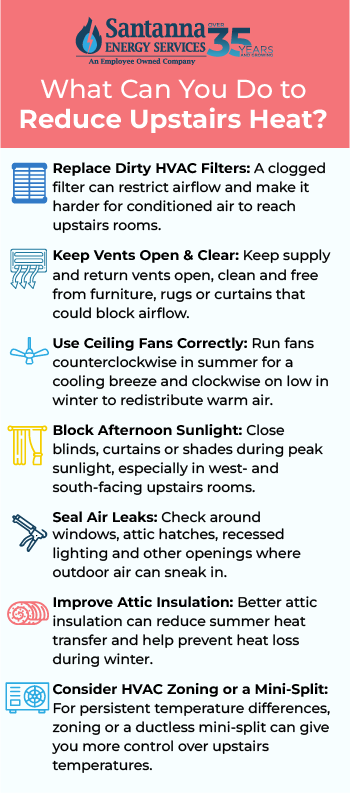
What Can You Do To Reduce Upstairs Heat?
You can make a hot upstairs more comfortable by starting with simple changes around your home before moving on to bigger improvements. Some fixes may be easy to try yourself, while others may need help from an HVAC professional.
It makes sense to start simple and work your way up. Here are a few things you can try:
Replace Dirty HVAC Filters
A clean HVAC filter helps your heating and cooling system move air more efficiently throughout your home. When a filter becomes clogged with dust and debris, it can reduce airflow, making it harder for conditioned air to reach upstairs rooms.
Check your filter regularly and replace it according to the manufacturer's recommendations. While changing the filter won't solve every upstairs temperature problem, it's one of the easiest and most affordable ways to help your HVAC system perform at its best.
Keep Supply and Return Vents Open and Clean
Your heating and cooling system works best when air can move freely into and out of every room. Make sure supply vents that deliver heated or cooled air stay open, clean, and free from obstructions such as furniture, rugs, or curtains. Return vents should also remain open and clean so air can circulate back through the system efficiently.
Over time, dust, pet hair, and other debris can build up on vents and reduce airflow. Regularly cleaning your vents can help your heating and cooling system distribute air more evenly throughout your home.
Closing vents in rooms you don't use might seem like a way to push more air upstairs, but in many homes, it can actually disrupt airflow and make temperature differences worse. Instead, keep both your supply and return vents open and clean so your heating and cooling system can operate as efficiently as possible.
Use Ceiling Fans Correctly
Ceiling fans don't lower the temperature, but they help move air around the room, which can make you feel more comfortable.
During summer, set your ceiling fan to rotate counterclockwise. This pushes air downward, creating a cooling breeze that helps you feel cooler. During winter, run it clockwise at a low speed to help move warm air that collects near the ceiling back into the room and distribute heat more evenly.
Using your ceiling fan in the right direction can also help improve comfort in both summer and winter without changing the thermostat setting.
Block Excess Sunlight
Reducing the amount of direct sunlight entering your upstairs can significantly reduce heat gain during the summer. Rooms with large west- or south-facing windows often absorb the most heat in the afternoon.
Closing blinds, curtains, or shades during the hottest part of the day helps keep sunlight from warming your floors, walls, and furniture. While this won't eliminate the problem entirely, it can reduce the amount of extra heat your air conditioner has to remove.
Seal Air Leaks
Sealing small gaps around your home helps keep conditioned air inside and unwanted outdoor temperatures outside. Even small air leaks can allow hot summer air to enter or heated winter air to escape, making your upstairs harder to keep comfortable.
Focus on common areas such as attic hatches, windows, recessed lighting, and openings around wiring or plumbing. Reducing these leaks can improve comfort throughout your home while helping your heating and cooling system work more efficiently.
Improve Attic Insulation
If your attic insulation isn't providing enough protection, improving it can make a noticeable difference in upstairs comfort. Insulation slows the movement of heat between your attic and your living space, helping your upstairs stay cooler during summer and reducing heat loss during winter.
Because insulation affects your home's energy performance year-round, it's often one of the most effective long-term improvements for homes with persistent temperature differences.
Consider Zoned Heating and Cooling or a Mini-Split
If your upstairs remains uncomfortable after trying simpler improvements, it may be worth considering a zoning system or a ductless mini-split. These options give you more control over temperatures in different parts of your home instead of relying on a single thermostat for the entire house.
A zoned HVAC system uses separate controls for different areas of your home, while a mini-split provides heating and cooling to a specific room or section without relying entirely on your home's ductwork.
When Should You Call an HVAC Professional?
If your upstairs stays much hotter than downstairs even after you've tried some simple fixes, it may be time to call an HVAC professional. A persistent temperature difference could mean there's a larger issue that needs a closer look.
Consider calling an HVAC professional if you notice any of these signs:
- Your upstairs stays much hotter than downstairs even after replacing the air filter, checking vents, and reducing direct sunlight.
- The airflow from upstairs vents feels weak compared to other rooms in your home.
- Only one upstairs room is consistently uncomfortable, while the rest of the house feels normal.
- Your air conditioner or furnace seems to run almost constantly but still struggles to keep your home at a comfortable temperature.
- Your energy bills continue increasing without a clear reason, especially if your heating or cooling habits haven't changed.
An HVAC professional can determine whether the problem is related to airflow, ductwork, insulation, thermostat placement, or another issue that's preventing your home from maintaining an even temperature.
The sooner you identify the underlying cause, the easier it can be to improve comfort throughout your home and avoid making your heating or cooling system work harder than necessary.
FAQs
Will closing vents downstairs help cool upstairs?
No. Closing downstairs vents is generally not recommended because it can disrupt your home's airflow and may make your heating and cooling system less effective.
Should I leave my ceiling fan on all day?
No. Ceiling fans cool people, not rooms, so you should turn them off when no one is using the room to avoid wasting electricity.
Why is my upstairs bedroom so hot?
A single upstairs bedroom can feel hot because of something like more direct afternoon sunlight, weak airflow from the vents, blocked or closed vents, air leaks around windows or doors, or the room sitting beneath a hotter part of the attic.
Why is my upstairs so hot and my downstairs so cold?
Your upstairs may be hot while your downstairs feels cold because warm air naturally rises and your HVAC system may not be distributing air evenly between floors. A thermostat located downstairs can also keep the system running until the first floor reaches the set temperature, even if the upstairs is already warm. Uneven airflow, leaky ductwork, poor return airflow, dirty filters, or poor insulation can all make the temperature difference worse.
Why is my second floor so hot in the winter?
Your second floor can feel hot in the winter because heated air rises and collects upstairs while a first-floor thermostat may continue calling for heat. Poor return airflow, closed bedroom doors, ceiling fans set in the wrong direction, or long furnace run times during cold weather can also trap warm air upstairs.
When your upstairs stays too hot, it's easy to keep lowering the thermostat or running your HVAC system longer, which can increase your home's electricity use. While improving comfort starts with addressing the underlying issue, having more predictable electricity supply charges can also make it easier to manage your energy costs when your home needs more cooling or heating throughout the year.
Explore Santanna's Unlimited Energy Plan to see how it can help provide more predictable electricity supply charges and fewer surprises on the electricity supply portion of your bill*, especially during the months when your home needs more cooling or heating.
* Restrictions apply. Enrollment based upon program eligibility. Customers using more than 125% of normal monthly usage as determined by Santanna may be required to switch plans.
Jenna Mendez is a Midwest native with lifelong roots in Illinois and time spent in Ohio during college, giving her a deep understanding of the Midwest region’s people, climate, and energy needs. She brings firsthand experience and local insight to topics that matter to Midwest homeowners, especially energy efficiency, sustainability, and home living. Jenna specializes in writing about eco-friendly living, all things Midwest, renewable energy, and practical ways to reduce energy costs. Jenna brings a trusted, and local hometown voice to every article she writes, helping readers live well, and sustainably, right where they are.