

Whole Home Battery vs Generator: Which Backup Power System Is Better?

by Tyler Castle
Updated: September 11, 2026
15.2 min read
Key Points of This Article:
- Whole home batteries are generally better for homeowners prioritizing quiet operation, minimal maintenance, automatic backup, and solar compatibility.
- Generators are generally better for extended outages because they can continue operating as long as fuel remains available.
- Whole home battery systems typically cost about $12,000–$22,000+, while standby generators generally cost about $7,000–$15,000, depending on system size and installation.
- A typical 10–20 kWh home battery can support essential loads for hours, while a properly fueled generator may operate for several days.
Power outages caused by major events are becoming an important consideration for homeowners evaluating backup power. According to the U.S. Energy Information Administration, U.S. electricity customers experienced nearly nine hours of interruptions attributed to major events in 2024, compared with an annual average of nearly four hours from 2014 through 2023.
When the lights go out, you might be battling between choosing a whole home battery and a generator to continue to power your home. With so many options and opinions, this decision might seem impossible. But fear not! We've done the research, comparing a battery backup vs a generator, so you don't have to.
In this guide, you'll learn how each backup system works, how they compare in real-world situations, what they can power, how much they cost, and which option may be the better fit for your household and energy needs.
What's the Difference Between a Home Backup Battery and Generator?
A whole home battery backup and a generator both help keep your home powered during an outage, but they work in very different ways and fit different household needs.
A whole home battery backup stores electricity ahead of time, either from the grid or from solar panels, and then automatically uses that stored energy when the power goes out. It runs quietly in the background, so your home feels almost normal during an outage. There is no fuel to manage and no engine noise, which makes it a simple and low-disruption option for keeping essential parts of your home running like lights, the refrigerator, Wi-Fi, and other basic needs.
When an outage happens, a generator produces electricity by burning fuel such as gas, propane, or natural gas. A generator allows you to run appliances for longer periods, but it also comes with more hands-on responsibilities like fuel storage and maintenance, and it has a noticeable engine noise while it is running.
The right choice depends on how your household prefers to handle outages and whether simplicity or longer runtime matters more to you.
Not sure which option is right for your home? Take a close look at the key differences between a whole home battery backup and a generator below to help you decide.
Home Backup Power Comparison: Battery Backup vs Generator
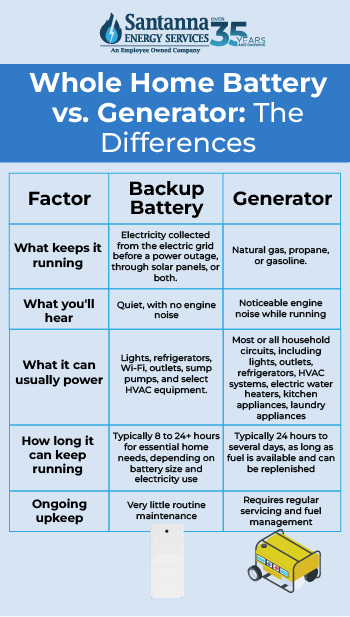
| Factor | Whole Home Battery Backup | Generator |
| What keeps it running | Electricity collected from the electric grid before a power outage, solar panels, or both | Natural gas, propane, or gasoline |
| What you’ll hear | Quiet, with no engine noise | Noticeable engine noise while running |
| How to turn it on | Most systems switch on automatically | Standby models start automatically, while portable models require manual setup and fuel management. |
| What it can usually power | Lights, refrigerators, Wi-Fi, outlets, sump pumps, and select HVAC equipment, with larger battery systems also capable of powering appliances such as central air conditioners, electric water heaters, or well pumps. | Most or all household circuits, including lights, outlets, refrigerators, HVAC systems, electric water heaters, kitchen appliances, laundry appliances, and other high-energy loads, depending on generator size and available fuel. |
| How long it can keep running | Typically 8 to 24+ hours for essential home needs, depending on battery size and electricity use | Typically 24 hours to several days, as long as fuel is available and can be replenished |
| Ongoing upkeep | Very little routine maintenance | Requires regular servicing and fuel management |
| Pros |
|
|
| Cons |
|
|
If your priority is simple, quiet, and automatic backup power for essential needs, a whole home battery backup is usually the better fit.
If your priority is longer runtime and the ability to power more appliances during extended outages, a generator may be the better fit.
We asked 18 Santanna Energy Services employee-owners which backup power system they would choose if they were purchasing one today. 67% said they would choose a home battery, while 33% preferred a generator.
Employees who preferred batteries mentioned factors such as affordability, safety, lower maintenance, solar compatibility and avoiding fuel dependency. Generator supporters were more likely to consider effectiveness for their home's needs or noted that they were more familiar with generators than home battery systems.
Ultimately, the right choice depends on how you want your home to function when the power goes out.
Battery Backup vs Generator: The Full Comparison
Both whole home battery backups and generators provide reliable backup power, but the better choice depends on what's most important to you. If you're still deciding between the two, use the comparisons below to see which option may be the better fit based on your priorities.
Looking for the safest option? Choose a whole home battery.
A whole home battery stores electricity instead of producing it through combustion, so it doesn't create exhaust fumes or carbon monoxide while operating; which could be produced while using a generator.
According to the U.S. Customer Product Safety Commission, nearly 100 consumers die in the U.S. each year from CO poisoning from portable generators.
When professionally installed, a battery provides a safe and reliable backup solution with fewer moving parts than a generator.
Looking for the lowest-maintenance option? Choose a whole home battery.
A whole home battery requires very little routine maintenance because it has no engine, fuel system, or oil that needs regular servicing. Once installed, most systems simply recharge automatically and remain ready for the next outage. Generators, on the other hand, require periodic inspections, engine maintenance, and fuel management to help ensure they'll operate when needed.
Looking for the quietest backup power? Choose a whole home battery.
Because a battery supplies stored electricity rather than generating it with an engine, it operates almost silently. This makes it a good option for homeowners who want backup power without engine noise, especially during overnight outages or in neighborhoods where noise may be a concern.
Looking for the longest runtime? Choose a generator.
A generator can continue producing electricity for as long as fuel is available, making it a better choice for extended outages that may last many hours or several days. A battery, by comparison, has a limited amount of stored electricity before it needs to be recharged from the grid or solar panels.
Looking to power more of your home? Choose a generator.
A properly sized generator can usually power more household circuits and multiple high-energy appliances at the same time than a typical residential battery system. While larger battery systems can support appliances such as central air conditioning or well pumps, most homeowners size batteries to keep essential circuits running and manage stored energy more efficiently during an outage.
Looking for the lowest upfront cost? Choose a generator.
In many cases, a standby generator costs less to purchase and install than a whole home battery system with similar backup capability. However, it's also important to consider long-term ownership costs, including fuel, routine maintenance, and periodic servicing.
Looking for solar compatibility? Choose a whole home battery.
A whole home battery is designed to work with solar panels by storing excess solar energy that would otherwise be sent back to the grid. During a power outage, that stored energy can continue powering your home, even when your solar panels aren't actively producing enough electricity.
Looking for the most energy-efficient option? Choose a whole home battery.
A battery stores electricity for later use and doesn't burn fuel while providing backup power. Because there is no combustion process, it operates more efficiently than a generator, which continuously consumes natural gas, propane, or gasoline to produce electricity whenever it's running.
Which Backup Power System Performs Better in Real-Life Situations?
While comparing features is helpful, real power outages don't always happen the same way. Here's a slew of real-life scenarios and whether a generator vs a battery backup is the best option:
Short Evening Power Outage
A whole home battery backup is often the better fit.
For outages lasting a few hours, a battery can automatically restore power within seconds and quietly keep essential lights, refrigeration, internet, and other selected circuits running without engine noise or fuel.
Overnight Power Outage
Both can work well, depending on your backup needs.
A properly sized battery may keep essential circuits powered through the night, depending on your electricity use. If the outage continues into the next day, a generator can continue producing electricity as long as fuel is available.
Multi-Day Storm Outage
A generator often has the advantage.
When outages last several days after severe weather, a generator can continue supplying electricity as long as natural gas, propane, or gasoline is available. A battery's runtime is limited by its stored electricity unless it can be recharged.
Home With Solar Panels During Sunny Weather
A whole home battery backup is often the better fit.
When paired with solar panels, a battery can store excess solar energy and recharge during daylight hours. This can extend backup power without relying entirely on electricity from the grid.
High Heating or Cooling Demand
The best choice depends on proper system sizing, but generators often have an advantage for longer operation.
Running central air conditioning, electric heating, or other high-energy appliances requires a backup system that's properly sized for your home's electrical demand. While larger battery systems can support these loads, generators are often better suited for powering multiple high-energy appliances over extended outages.
Here's what Santanna Energy Services Employee-Owner Jacob Childress had to say about his preference between a generator and a whole-home battery when it comes to cost:
"A generator would be more useful in central Texas as they can be sized to run your entire house, including cooling, but they're generally too costly relative to the likelihood of needing it. A battery [likely] isn't going to run your A/C for any appreciable amount of time, but they're more affordable and can keep lights and refrigerators running."
Can You Combine Whole Home Batteries and a Generator?
You absolutely can combine a whole-home battery with a generator. Instead of choosing one technology over the other, a hybrid setup combines the strengths of both to provide more reliable backup power during outages.
During a power outage, the battery typically responds first, restoring electricity to selected circuits within seconds. If the outage continues and the battery's stored energy begins to run low, the generator can start to supply electricity to the home. In some systems, the generator may also recharge the battery while continuing to power household loads.
This approach can be especially useful in areas where outages range from brief interruptions to multi-day events. For example, if a storm causes a 2-hour outage, the battery may handle the entire event quietly without using any fuel. If the outage lasts 24 hours or longer, the generator can take over or supplement the battery, allowing your home to stay powered as long as fuel is available.
Because you're installing two backup systems instead of one, a hybrid setup generally requires a larger upfront investment.
A whole home battery backup system typically costs between $12,000 and $22,000, while a whole-home standby generator generally costs between $7,000 and $15,000, including installation. Combined, homeowners might expect to invest roughly $19,000 to more than $35,000 before any available tax credits, rebates, or additional electrical upgrades. Actual costs vary depending on the battery capacity, generator size, installation complexity, permitting requirements, and whether the system is integrated with solar panels.
For homeowners who want instant backup power, quiet everyday operation, and the ability to stay powered during extended outages, combining a battery and a generator can provide the advantages of both technologies in a single backup system.
How Does a Whole Home Battery or Generator Affect Your Electricity Bill?
A backup battery vs a generator both have operating costs during a power outage, but those costs come from different energy sources. A battery uses electricity stored ahead of time, while a generator produces electricity by burning fuel.
For perspective, the average U.S. home uses about 1,000 kWh of electricity per month, or roughly 33 kWh per day. Most residential whole home batteries store 10 to 20 kWh of electricity, which is enough to provide a significant portion of a typical day's electricity use, especially when powering essential circuits instead of the entire home.
If you recharge a 10 to 20 kWh battery from the electric grid, it would use about 10 to 20 kWh of electricity. At the U.S. average residential electricity price of 18.34¢ per kWh (June 2026, EIA), a full recharge would cost approximately $1.83 to $3.67, before taxes and other utility charges.
A generator affects your energy costs differently. Instead of using electricity from the grid, it burns natural gas, propane, or gasoline while it's running. For example, a 7-kilowatt standby generator, a common size for many homes, may consume around 80 to 120 cubic feet of natural gas per hour at typical operating loads. At the average residential natural gas price of $18.17 per thousand cubic feet (EIA, April 2026), that works out to roughly $1.45 to $2.18 per hour, or about $35 to $52 to operate continuously for a full 24-hour outage. Actual fuel costs vary depending on the generator's size, electrical load, and local fuel prices.
In simple terms, a whole home battery uses relatively inexpensive electricity that was purchased ahead of time, while a generator replaces grid electricity with an ongoing fuel expense during an outage.
Which Backup Power System Is Right for Your Home?
The right backup power system depends on what matters most to your household. Some homeowners prioritize quiet operation and low maintenance, while others need backup power that can last through extended outages or support more of their home's electrical system. Use the guide below to help narrow down which option best fits your needs:
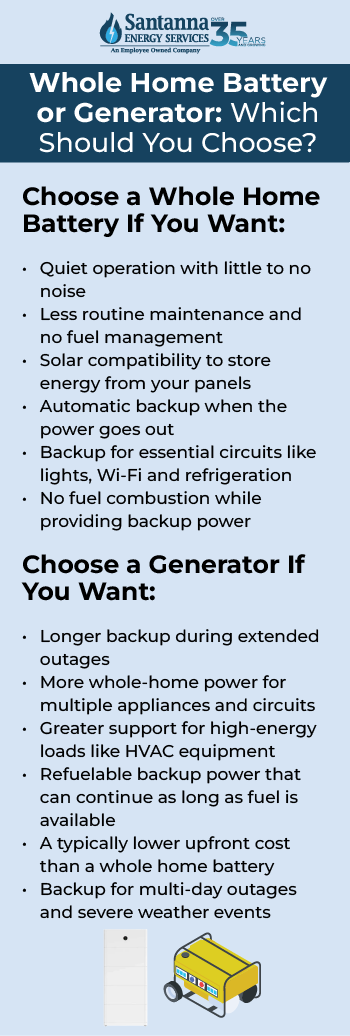
Choose a whole home battery backup if you want:
- Quiet operation with little to no noise while running.
- Low maintenance with no engine oil changes or fuel management.
- Reliable backup for essential lights, appliances, internet, and other selected circuits.
- Easy integration with solar panels to store excess solar energy.
- A backup solution that doesn't require storing natural gas, propane, or gasoline.
Choose a generator if you want:
- Backup power that can run for extended outages as long as fuel is available.
- Support for more of your home's electrical system, including multiple high-energy appliances.
- A lower upfront purchase cost in many whole-home backup installations.
- A fuel-powered backup solution that operates independently of stored battery capacity.
Consider combining both if you want:
- Instant backup power from a battery with a generator ready for longer outages.
- The ability to store solar energy while having fuel-powered backup when battery capacity runs low.
- Added resilience during severe weather or prolonged power outages that may last several days.
Ultimately, the best backup power system isn't the one with the most features. It's the one that matches your home's energy needs, your budget, and how you expect to use backup power when the electric grid is unavailable.
FAQs
Which backup system costs more over time?
Generators often cost less upfront, but they can cost more over time because they require fuel, regular maintenance, and periodic servicing. A whole home battery usually has a higher upfront cost, but it has very little routine maintenance and may help lower electricity costs when paired with solar panels or used to store lower-cost grid electricity. For homeowners focused on long-term ownership costs, a battery can be the more cost-effective option, especially if solar charging or energy savings help offset the initial investment.
Will a whole home battery or generator increase my home's value?
Both backup systems can make a home more appealing by giving buyers added protection during outages and according to Consumer Reports, could increase your home's value by 3-5%. A whole home battery may be especially attractive to buyers who want quiet, low-maintenance backup power or already value solar energy.
Which backup system is better for homes with solar panels?
A whole home battery is usually the better backup system for homes with solar panels because it can store excess solar energy and use it during an outage or when solar production is low. A generator can still provide backup power, but it does not store solar energy or help homeowners use more of the electricity their panels produce.
A whole home battery backup isn't necessarily better than a generator, and a generator isn't automatically the right choice for every home. The best backup power system depends on how long power outages typically last, what you need to keep running, and how you want your home to function when the grid goes down. By understanding how each option works, their costs, and their tradeoffs, you can choose a solution that fits your household's needs instead of simply choosing the most powerful or expensive system.
While a backup power system helps keep your home running during unexpected outages, having a predictable energy plan can help you feel more prepared every day. Santanna's Unlimited Energy Plan offers a predictable supply charge, helping reduce surprises on the supply portion of your bill while you keep your home comfortable through every season.*
Explore the Unlimited Energy plan to see if it's the right fit for your household's energy needs. When the unexpected happens, the best backup plan is the one that keeps your home, your family, and your peace of mind powered.
* Restrictions apply. Enrollment based upon program eligibility. Customers using more than 125% of normal monthly usage as determined by Santanna may be required to switch plans.
Tyler is an experienced energy professional, having worked for Santanna Energy Services, for the past four years. He is passionate about renewable energy and believes that diversifying the energy grid is the key to a sustainable future. Tyler is dedicated to supplying consumers with the best possible energy solutions and works diligently to make sure that Santanna can deliver the highest quality service.