

Which Is More Efficient: Cooking on an Electric Stove vs. A Gas Stove

by Tyler Castle
Updated: July 31, 2026
10 min read
Key Points of This Article:
-
Electric stoves are more energy-efficient, transferring about 75% of their energy to your cookware compared to 32% for gas.
-
Gas stoves cost less to operate in most Midwest states due to lower natural gas prices.
-
Induction cooktops are the most efficient option, offering faster cooking and a cooler kitchen.
-
The best choice depends on your energy rates and cooking habits, with Santanna’s Unlimited Energy plan helping keep costs predictable.
If you’ve ever stood in your kitchen wondering whether to go with a gas stove’s blue flame or an electric stove’s glowing coil, you’re not alone. It is one of those household debates just like choosing central air or window units, or carpet or hardwood. Everyone has an opinion.
But when it comes to efficiency, the answer is not as simple as picking sides. Are we talking about which one heats up faster? Which one keeps your energy bills lower? Or which one is better for your family’s health and the environment?
While this might seem overwhelming, don’t worry, you’re trusted friends at Santanna Energy Services are here to help. With over 35 years of experience as a gas and electricity supplier, and as experts in energy-efficiency, we’ve got you covered with what you need to know.
In this guide, we will cover energy use, cooking performance, costs, safety, and long-term value so that you can make an informed and energy-efficient decision the next time you’re tasked with updating your stove.
What Is a Gas Stove?
A gas stove uses natural gas or propane as fuel to create an open flame that heats your cookware. For many families, the sight of that blue flame feels familiar, and it's one reason why 38% of U.S. households use gas for cooking.
Unlike electric stoves, which rely on heated coils or glass tops, gas delivers heat instantly and can be adjusted with a simple turn of the knob.
How To Cook on a Gas Stove
Cooking on a gas stove is simple. You ignite the burner, place your pan or pot over the flame, and adjust the knob to control the flame size. A larger flame means more heat, while a smaller flame is better for simmering sauces or keeping food warm.
Since heat is coming from an open flame, it is important to use flat-bottom cookware for even cooking and always keep an eye on the flame for safety.
What Is an Electric Stove?
An electric stove uses electrical resistance or electromagnetic fields to heat your cookware instead of an open flame. Most homes with electric stoves use either coil burners or a smooth glass-ceramic top, while newer models may feature induction technology, which uses magnets to heat pots and pans directly.
For direct cooking efficiency, electric stoves are more efficient at transferring energy to food.
How To Cook on an Electric Stove
Cooking on an electric stove is easy but feels different than gas. You turn the knob to heat the coil or smooth-top surface, then place your pan directly on the heating element.
Electric burners may take longer to heat up and cool down, so it helps to preheat your pan and get used to the slightly slower response time. With induction, the pan heats almost instantly, but you'll need cookware that is magnetic.
Cooking on An Electric Stove vs a Gas Stove: Which Is More Efficient Based on Different Cooking Methods
When it comes to cooking, "efficiency" isn't just about bills; it's also about how the stove performs in your kitchen. Homeowners often care most about speed, control, and whether the stove makes everyday cooking easier or harder. Here's how gas and electric compare in terms of efficiency in real life:
Speed, which heats up faster?
Gas gives quick heat because the flame touches the pan right away. In lab tests, induction is often fastest for boiling and also responds very quickly when you turn the heat up or down. Some smooth top electric ranges can boil faster than comparable gas models, but many traditional coil or radiant elements are slower to heat and slower to cool.
Based on research and our expert opinion, gas ovens are the way to go if you're looking for efficient speed.
Temperature Control, Flame vs Element: Which Is More Efficient?
When comparing cooking on an electric stove vs a gas stove, when it comes to temperature control, gas is our winner.
Gas lets you see the flame and change it instantly, which helps when recipes need frequent adjustments. Induction also changes heat very quickly, but it might take a smidge longer to heat and isn't as instant as a gas stove. Electric coil and smooth top elements hold steady once set, but they respond more slowly to changes.
Even Surface Heating and Day-to-Day Cooking
Smooth top electric burners spread heat across the flat bottom of the pan, and many have expandable elements to match pot size, which helps reduce hot spots for foods like pancakes and eggs.
But gas excels at quick changes in heat for sautés and sauces. Think about your routine. If you want a quick response for weeknight stir fries, gas or induction feels easier. If you value steady heat and simple cleanup, an electric may fit better.
Heat in the Kitchen and Wasted Energy
At the burner, induction wastes the least heat into the room, and standard electric generally wastes less than gas. That is one reason kitchens can feel cooler on induction and sometimes on smooth top electric compared with gas for the same task.
Gas stoves lose more heat energy than electric stoves, making them less energy-efficient in the kitchen. However, from a price perspective, it might be surprising to learn that natural gas is actually priced cheaper than electricity. Which means the cost of that wasted energy can still be lower. Meaning cooking with gas often looks more "cost-efficient" on your bill despite the higher heat loss.
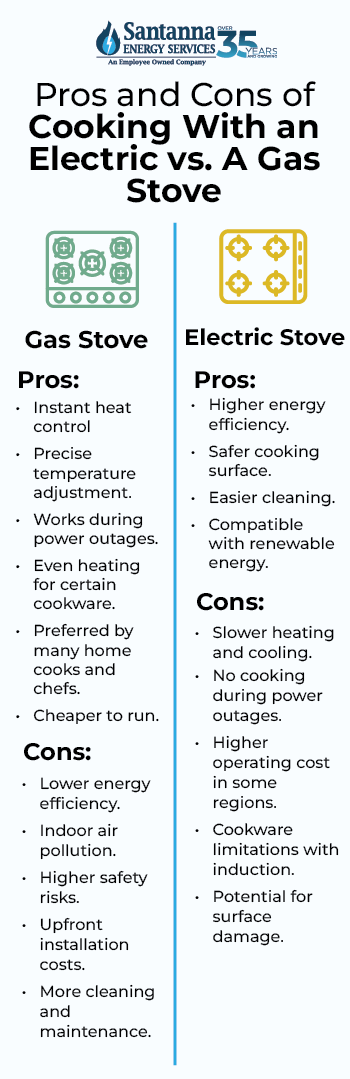
In the end, gas and electric stoves both get the job done, but when it comes to efficiency, the right choice depends on how you cook every day. Gas offers speed and flexibility, while electric provides steadiness and consistency.
Cooking on an Electric Stove vs. A Gas Stove: A Snapshot of Their Efficiency
| Cooktop type | Typical efficiency to pan | What it means in practice | Quick notes |
| Electric stoves | about 75% | Less energy wasted than gas | Steady heat, slower to adjust than gas |
| Induction cooktops | about 85% | Most energy goes straight into the pan | Fast boils, cooler kitchen, needs magnetic cookware |
| Gas stoves | about 32% | More heat lost to room air | Great flame control, good ventilation recommended |
How Much Does It Cost to Cook on an Electric Stove and Gas Stove in the Midwest?
Looking for the numbers beyond efficiency? If you're looking to upgrade your system, costs should play a part in your choice.
Based on our estimate, at the national average of 18.44 cents per kWh as of May 2026, (based on projections from the Energy Information Administration), with a model using around 3,410 watts of power, it costs around $0.63 per hour to cook on an electric stove.
Using a 16,500 BTU gas stove at the national average of 18.17 cents per MCF as of May 2026, it costs around $0.03 per hour to cook on a gas stove.
Looking for a cost breakdown specific to your state? Here's what your costs could look like:
Cost to Cook on an Electric Stove for 2 hours Per Day in the Midwest (Rates from May 2026)
| State | Electric rate (¢/kWh) | Cost per hour ($) | Daily cost, 2 h ($) | Weekly cost ($) | Monthly cost ($) | Yearly cost ($) |
| Ohio | 19.52 | $0.67 | $1.33 | $9.32 | $39.94 | $485.91 |
| Pennsylvania | 21.55 | $0.73 | $1.47 | $10.29 | $44.09 | $536.44 |
| Illinois | 23.85 | $0.81 | $1.63 | $11.39 | $48.80 | $593.70 |
| Michigan | 22.01 | $0.75 | $1.50 | $10.51 | $45.03 | $547.89 |
| National | 18.44 | $0.63 | $1.26 | $8.80 | $37.73 | $459.03 |
Cost to Cook on a Gas Stove 2 hours Per Day (Rates from April 2026)
| State | Gas rate | Cost per hour | Daily cost, 2 h | Weekly cost | Monthly cost | Yearly cost |
| Ohio | $16.89 per MCF | $0.28 | $0.56 | $3.92 | $16.80 | $204.40 |
| Pennsylvania | $18.13 per MCF | $0.30 | $0.60 | $4.20 | $18.00 | $219.00 |
| Illinois | $23.85 per MCF | $0.39 | $0.79 | $5.53 | $23.70 | $288.35 |
| Michigan | $12.51per MCF | $0.21 | $0.42 | $2.94 | $12.60 | $153.30 |
| National | $18.17 per MCF | $0.30 | $0.60 | $4.20 | $18.00 | $219.00 |
Which Stove Saves More on Utility Bills?
Based on the May 2026 U.S. Energy Information Administration (EIA) residential electricity rates provided and the 2 hours per day model, gas wins on operating cost in every case.
At the national average, cooking on a gas stove costs about $0.30 per hour, compared with about $0.63 per hour for an electric stove. That's a savings of approximately $0.33 per hour, meaning gas costs about 52% less to operate than a standard electric stove.
This trend holds true across the Midwest as well:
- Ohio: Gas costs about 58% less per day than electric.
- Pennsylvania: Gas costs about 59% less per day than electric.
- Illinois: Gas costs about 52% less per day than electric.
- Michigan: Gas costs about 72% less per day than electric.
Note that your real cost will vary with burner settings, preheating time, cycling, cookware, and how many hours you cook. If you are considering induction, it can cut kWh use further, but the final bill still depends on your cents per kWh.
FAQs
Do you need special pans for electric or induction stoves?
Standard electric (coil or smoothtop) works with most flat-bottom cookware. Induction needs magnetic cookware. A quick test is if a magnet sticks to the pan bottom.
Do I need a gas line to install a gas stove?
Yes, you need natural gas or propane service plus a standard 120 V outlet for ignition and controls. Hire a qualified installer and follow local code.
Do gas stoves really waste more heat?
Yes at the burner. Induction is up to three times more efficient than gas, and conventional electric is also more efficient than gas.
Can I switch from a gas stove to an electric stove easily?
You will need a 240 V circuit for an electric or induction range, which many gas-only kitchens do not have. Plan for an electrician to add the circuit.
Which is safer in a power outage?
Electric stoves do not work without power. Many gas cooktops can be lit with a match, but some models and most modern gas stoves will not operate because their igniters and controls need electricity.
Which stove lasts longer?
Typical life is about 10 to 15 years for gas stoves and about 13 to 15 years for electric ranges.
Are gas stoves going to be banned in the U.S.?
There is no nationwide ban. DOE has updated efficiency standards for new cooking products. Some places, such as New York State, require most new buildings to be all-electric starting in 2026, while other local gas-hookup bans have faced federal preemption challenges.
There is no single winner for every home. At the burner, electric is more efficient than gas, and induction is the most efficient of all. On the bill, the cheaper fuel in your state often wins. Safety and indoor air are simpler with electric. Gas offers instant flame control and can be very affordable where gas prices are low. The right choice comes down to your local rates, how you like to cook, and how you plan to future proof your kitchen.
If you want predictable budgeting, pair your choice with a plan that keeps costs steady. Santanna's Unlimited Energy electricity and natural gas plan gives you a stable monthly supply charge* for your home's energy, which helps prevent surprise spikes when you cook more or run appliances harder in extreme seasons. That means less stress about usage and more peace of mind for your family.
Ready to make your supply costs predictable and your planning easy? Explore Santanna's Unlimited Energy plan here.
* Restrictions apply. Enrollment based upon program eligibility. Customers using more than 125% of normal monthly usage as determined by Santanna may be required to switch plans.
Tyler is an experienced energy professional, having worked for Santanna Energy Services, for the past four years. He is passionate about renewable energy and believes that diversifying the energy grid is the key to a sustainable future. Tyler is dedicated to supplying consumers with the best possible energy solutions and works diligently to make sure that Santanna can deliver the highest quality service.