

Does Closing Air Conditioning Vents Save Energy? A Potentially Harmful Myth

by Jenna Mendez
Updated: September 1, 2026
8.8 min read
Key Points of This Article:
- Closing air conditioning vents generally does not save energy because most central HVAC systems continue heating or cooling based on the thermostat setting, not the number of open vents.
- Closing vents can restrict airflow, increase pressure in air ducts, and make your heating or cooling system work harder to maintain comfortable temperatures and can add roughly $8 per month, or about $100 per year to your electricity bill.
- For better comfort and efficiency, homeowners should keep vents open, replace dirty filters, improve insulation, seal air leaks, and consider smart thermostats or HVAC zoning for persistent hot and cold spots.
Closing air conditioning vents may seem like an easy way to save energy. After all, if no one is using a room, why pay to cool it?
For many Midwest homeowners, this question often comes up during hot summer months when air conditioning costs increase, or during winter when unused rooms may seem expensive to heat.
Closing your air vents actually doesn't save energy, and could cost you anywhere from $8.35 per month, or roughly $100 per year in extra energy. But why does this happen?
In this guide, we'll explain why closing air conditioning vents actually doesn't save energy, what happens to your HVAC system when vents are closed, and what you can do instead to improve comfort and potentially reduce energy waste.
Does Closing Air Conditioning Vents Save Energy?
Closing air conditioning vents generally does not save energy, especially in unused rooms; closing one vent can restrict airflow, reduce efficiency, and force your HVAC system to use more energy to move air throughout the home.
The idea of closing your vents sounds reasonable, but most central heating and cooling systems are designed to move air throughout the home. When vents in certain rooms are closed, the system may have a harder time distributing air the way it was designed to.
ENERGY STAR says nearly half of the energy used in a typical home goes to heating and cooling, which supports why airflow and HVAC efficiency matter so much.
Why Closing Air Conditioning Vents Doesn't Work in Most Homes
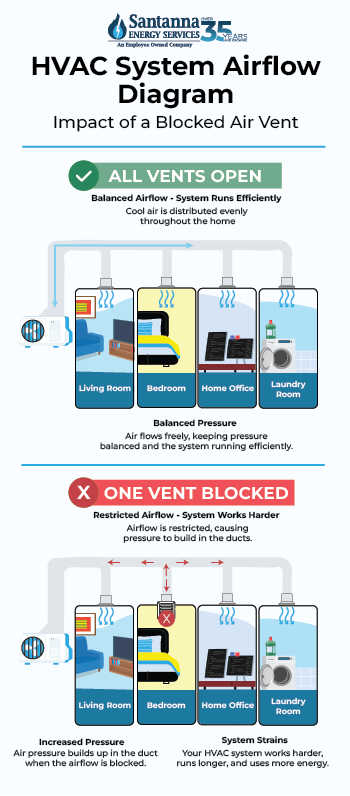
Closing air conditioning vents often doesn't work because most heating and cooling systems are designed to distribute air throughout the entire home.
Closing a vent does not automatically reduce the amount of heating or cooling being produced because most central HVAC systems continue running based on the thermostat setting, not the number of open vents.
Think of closing your air vents like partially blocking a hallway with clutter in your home: People can still move through it, but it becomes less efficient and more difficult to get where they need to go. Airflow works in a similar way.
Closing vents can make it harder for air to move throughout the house, which may reduce efficiency and create uneven temperatures.
Closing your air vents can also increase pressure inside air ducts, potentially causing air leaks and making your heating or cooling system work harder.
According to Energy.gov, duct systems lose energy in two ways: by conduction of heat from the warm surface, and air leakage through small cracks and seams.
How Much Can Closing Your Air Conditioning Vents Increase Your Energy Bill?
Closing air conditioning vents can increase your energy bill by as much as $8 per month instead of lowering it, particularly if restricted airflow causes your system to run longer.
When airflow is restricted, your heating or cooling system may have a harder time maintaining comfortable temperatures throughout the home. As a result, your HVAC system may need to run longer than expected to reach its desired temperature, using more energy in the process.
Closing vents in an unused room can cause an air conditioner to run 30 extra minutes per day to reach its desired temperature which could add roughly 45 kWh of electricity use per month.
At the average residential electricity rate of 18.56 cents per kWh as of March 2026 according to the U.S. Energy Information Administration, that could increase electricity costs by about $8.35 per month, or roughly $100 per year.
The actual impact of closing your vents will vary from home to home. In most cases, any expected savings can be offset if the heating or cooling system has to work harder to maintain comfortable temperatures throughout the home.
Should You Close AC Vents in Unused Rooms?
For most homes with central heating and air conditioning, it is usually better for energy efficiency to keep AC vents open, even in unused rooms.
Most systems are designed to move air throughout the house, so closing vents does not always lead to the energy savings homeowners expect.
If certain rooms feel too hot or too cold, closing vents is often treating the symptom rather than the cause. Common reasons for uneven temperatures include dirty air filters, poor insulation, blocked airflow, leaky ductwork, or rooms that receive more direct sunlight throughout the day.
When Is It Okay to Close Air Conditioning Vents at All?
It may be okay to close air conditioning vents in certain situations, but for most homes, vents should generally remain open.
Some situations where closing vents may be appropriate include:
- Homes with zoned HVAC systems that are specifically designed to direct airflow to different areas of the home.
- Temporary comfort adjustments when a room feels slightly too warm or too cool.
- Rooms that are temporarily unused during a short-term situation, such as a renovation project or deep cleaning.
- When recommended by an HVAC professional as part of a customized airflow or comfort solution.
It's also important to remember that there is no universal number of vents that can be safely closed. Every home and heating and cooling system is different. What has little impact in one home could create airflow or comfort issues in another.
If you're considering closing vents regularly to save energy, it's often more effective to address the underlying cause of hot and cold spots rather than relying on closed vents as a long-term solution.
What Should You Do Instead of Closing Air Conditioning Vents?
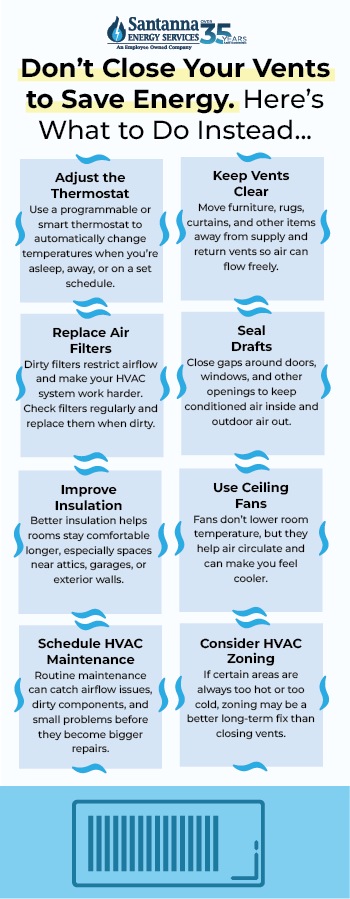
Instead of closing air conditioning vents, focus on improving airflow, reducing energy waste, and addressing the reasons certain rooms feel uncomfortable in the first place. These solutions are more likely to improve comfort and efficiency than simply closing off unused rooms:
Use a Programmable or Smart Thermostat
A programmable or smart thermostat can automatically adjust temperatures when you're asleep, away from home, or following a regular schedule. Rather than closing vents in unused rooms, adjusting temperature settings strategically can often be a more effective way to reduce unnecessary energy use while maintaining comfort throughout the home.
Don't Block Your Air Vents
Furniture, rugs, curtains, and other items can block airflow and make it harder for heated or cooled air to circulate throughout the home. Keeping supply and return vents open and unobstructed allows air to move more freely and can help maintain more consistent temperatures.
Replace HVAC Filters Regularly
Dirty air filters can restrict airflow and make a heating or cooling system work harder than necessary. Check your HVAC filter regularly and replace it according to the manufacturer's recommendations or whenever it appears dirty.
Check and clean your air filters every three months.
Seal Air Leaks Around Doors and Windows
Small gaps and cracks around doors, windows, and other openings can allow conditioned air to escape and outdoor air to enter. Sealing these leaks can help improve comfort and reduce unnecessary energy loss.
Improve Insulation
Poor insulation can make certain rooms harder to keep comfortable, especially rooms located above garages, near attics, or along exterior walls. Improving insulation can help maintain more consistent indoor temperatures throughout the year.
Adding proper insulation can reduce your home's total energy spending by around 10%.
Use Ceiling Fans to Improve Comfort
Ceiling fans do not lower the temperature of a room, but they can help people feel cooler by improving air circulation. This can make rooms feel more comfortable during warmer months without relying solely on air conditioning.
Schedule Routine HVAC Maintenance
Regular HVAC maintenance can help identify airflow problems, dirty components, and other issues that may affect comfort and efficiency. Catching small problems early can often prevent larger issues later.
Consider HVAC Zoning for Persistent Hot and Cold Spots
If certain areas of your home, such as an upstairs level, finished basement, or rarely used wing of the house, are consistently too hot or too cold, a zoned HVAC system may provide a better long-term solution. Zoning allows different areas of the home to be heated or cooled independently, helping improve comfort without relying on closed vents.
FAQs
Should you close AC vents in unused rooms?
No, in most homes with central heating and cooling systems, closing AC vents in unused rooms does not typically save energy and may reduce overall efficiency.
Does closing AC vents make other rooms cooler or warmer?
Not necessarily, because closing vents often changes airflow patterns rather than effectively redirecting heating or cooling to other rooms.
Can closing AC vents damage my air conditioner?
Closing multiple vents for long periods can increase strain on a heating and cooling system and may contribute to airflow-related problems over time.
Is closing AC vents the same as having a zoned HVAC system?
No, a zoned HVAC system is specifically designed to control temperatures in different areas of a home, while simply closing vents is not.
Closing air conditioning vents may seem like a smart way to save energy, but in most homes, it is unlikely to lower energy use the way many homeowners expect. In some cases, it can even create comfort issues or make your heating and cooling system work harder. Instead, focusing on proper airflow, regular maintenance, and reducing energy waste throughout your home is often a more effective approach.
While improving efficiency can help reduce unnecessary energy use, no home is perfectly efficient. That's why your energy plan also plays a role in how predictable your monthly energy costs feel. Santanna's Unlimited Energy plan offers a predictable supply charge, helping protect your peace of mind from unexpected fluctuations and making it easier to plan for your energy costs throughout the year.*
When it comes to saving energy, sometimes the simplest solution isn't closing a vent. It's making informed choices that keep your home comfortable and your energy costs more predictable.
* Restrictions apply. Enrollment based upon program eligibility. Customers using more than 125% of normal monthly usage as determined by Santanna may be required to switch plans.
Jenna Mendez is a Midwest native with lifelong roots in Illinois and time spent in Ohio during college, giving her a deep understanding of the Midwest region’s people, climate, and energy needs. She brings firsthand experience and local insight to topics that matter to Midwest homeowners, especially energy efficiency, sustainability, and home living. Jenna specializes in writing about eco-friendly living, all things Midwest, renewable energy, and practical ways to reduce energy costs. Jenna brings a trusted, and local hometown voice to every article she writes, helping readers live well, and sustainably, right where they are.