

Induction vs Electric Cooktop: What’s the Difference?

by Jenna Mendez
Updated: August 11, 2026
13.7 min read
Key Points of This Article:
- Induction cooktops are more energy-efficient than electric ones, using electromagnetic fields to heat cookware directly, which results in faster cooking and less wasted heat—up to 10% less energy use annually.
- Electric cooktops are more affordable upfront and compatible with all types of cookware, making them a versatile and budget-friendly option for many households.
- Induction cooktops offer better safety and temperature control, with cooler surfaces and instant heat adjustments, while electric cooktops retain heat longer and respond more slowly.
- Choosing between the two depends on your priorities—induction is ideal for speed, precision, and sustainability, while electric suits those seeking simplicity, lower initial costs, and broader cookware compatibility.
When it comes to upgrading your kitchen, the cooktop often takes center stage, but choosing between induction and electric can leave many homeowners scratching their heads. They both plug into an electrical outlet, look nearly identical, and promise efficient cooking.
But behind the glass surface, the way they heat, perform, and impact your energy bills is surprisingly different.
In this guide, we'll break down how induction and electric cooktops work, compare their efficiency, cost, and performance, and help you decide which one fits your home best. Whether you're remodeling or simply curious about saving energy, you're in the right place. Let's get started.
Induction vs Electric Cooktops: Major Differences
Induction and electric cooktops may look alike, but they heat and cook very differently. Understanding how each one works, and how that impacts speed, efficiency, and safety, can help you choose the best fit for your kitchen and energy needs.
When looking at the various factors of an induction vs electric cooktop, here's which model comes out on top:
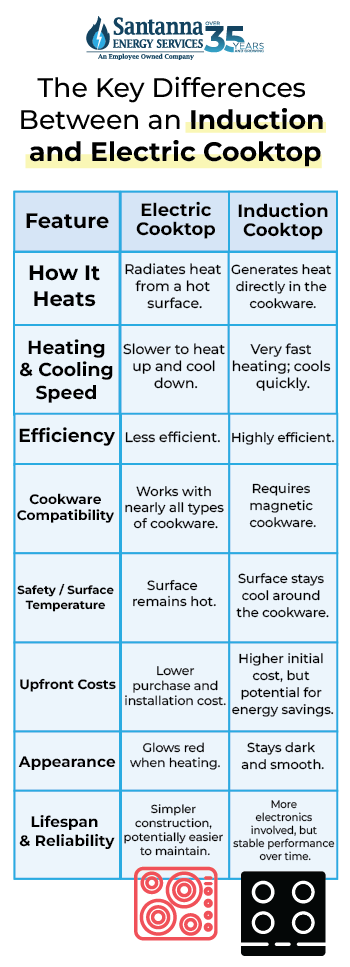
Key Differences Between Induction and Electric Cooktops
| Feature | Electric Cooktop | Induction Cooktop |
| How It Heats | Radiates heat from a hot surface (heating elements beneath the glass) | Generates heat directly in the cookware via electromagnetic field |
| Heating & Cooling Speed | Slower to heat up and cool down | Very fast heating; cools quickly when cookware is removed |
| Efficiency | Less efficient — more energy lost to surroundings | Highly efficient — most energy is delivered to the cookware |
| Cookware Compatibility | Works with nearly all types of cookware | Requires magnetic cookware (e.g., cast iron, magnetic stainless steel) |
| Safety / Surface Temperature | Surface remains hot, which can be a burn or spill hazard | Surface stays cool around the cookware, reducing burn risk and making spills easier to clean |
| Upfront Costs | Lower purchase and installation cost | Higher initial cost, but potential for energy savings over time |
| Temperature Control | Tends to cycle on/off and react more slowly to adjustments | Offers precise, steady control with quicker adjustments |
| Appearance | Glows red when heating; visible hot zones beneath glass. | Stays dark and smooth—no glow, activates only when cookware is detected. |
| Lifespan & Reliability | Simpler construction, potentially easier to maintain | More electronics involved, but stable performance over time |
| Environmental Impact | More heat wasted, higher energy consumption | Less waste, lower energy use, smaller carbon footprint |
| Cooking Quality | Possible hot spots and slower response | Even heat, quick response, better control over delicate cooking |
| Maintenance & Cleaning | Smooth surface is easy to wipe, but spills may bake on | Spill cleanup is easier since the surface stays cooler and less residue burns on |
Heating Speed
Induction cooktops heat up noticeably faster because they generate heat directly inside the cookware. Electric cooktops, on the other hand, take a bit longer since they must heat the surface first and then transfer that warmth to the pot or pan.
When it comes to overall heating speed, induction cooktops take the cake.
Temperature Control
With induction, temperature changes happen almost instantly, allowing you to go from a rolling boil to a gentle simmer with precision. Electric cooktops take more time to adjust because the heating element must cool down or reheat before the temperature responds.
In terms of temperature control, induction models are the best fit.
Cookware Compatibility
Electric cooktops are more versatile; they work with nearly all types of cookware. Induction cooktops need magnetic cookware, such as cast iron or stainless steel. Non-magnetic materials like copper, glass, or aluminum won't heat on induction burners.
Safety Considerations
Electric cooktops stay hot for a while after you turn them off, which can pose a burn risk if touched too soon. Induction cooktops are safer because only the pan gets hot; once you remove it, the surface cools quickly, reducing the chance of burns and accidents.
Energy Efficiency
Induction models are more energy-efficient since nearly all the energy goes directly into heating the cookware. The U.S Department of Energy cites induction cooktops as using 10% less energy than electric cooktops.
Traditional electric cooktops lose some heat through the glass surface and surrounding air, using more energy overall. For energy efficiency, induction cooktops should be your top choice.
Appearance
Electric cooktops often glow red when the heating elements are on, showing visible hot zones under the glass surface. Induction cooktops, however, stay dark and cool unless magnetic cookware is placed on them.
Price & Upfront Costs
Electric cooktops are generally less expensive to buy and install. Induction cooktops cost more upfront but may lower long-term energy costs because they cook faster and waste less electricity.
If your goal is energy efficiency, choose an induction cooktop. If you're looking for upfront savings, choose an electric cooktop.
Ease of Cleaning
Both types feature smooth, flat surfaces that are easy to clean. However, spills on electric cooktops can burn onto the surface if not wiped quickly. Induction surfaces stay cooler, so food residue is less likely to stick.
Lifespan & Reliability
Electric cooktops typically last around 13 years with proper care. Induction cooktops have a slightly shorter lifespan (about 10 years) but tend to maintain performance well over time, thanks to fewer moving parts.
Environmental Impact
Induction cooking wastes less energy and can help lower your overall electricity use, making it the more eco-friendly option. Electric cooktops lose more heat during cooking, requiring more power to reach and maintain the temperature.
If you're looking to reduce your energy waste and make less of an environmental impact, go with an induction cooktop.
Cooking Quality
Induction delivers even, consistent heating across the cookware, helping food cook faster and more uniformly. Electric cooktops can sometimes create hot spots, leading to uneven cooking or longer prep times. An induction cooktop would be your best bet here.
Induction Cooktop vs. Electric Power Consumption
Still deciding which model is right for you? One of the most important things you should factor into your decision is the power consumption of your appliance. Here's what you can expect from induction and electric cooktops:
Power Consumption of an Induction Cooktop vs. An Electric Cooktop
| Usage Period | Electric Cooktop (3,000 W) | Induction Cooktop (3,000 W) | Difference |
| Per Day (1 hr) | 3.0 kWh | 2.7 kWh | -0.3 kWh |
| Per Week (7 hrs) | 21.0 kWh | 18.9 kWh | -2.1 kWh |
| Per Month (30 hrs) | 90.0 kWh | 81kWh | -9.0kWh |
| Per Year (365 hrs) | 1,095 kWh | 985.5 kWh | -109.5 kWh |
Although induction cooktops often have a higher wattage rating, that doesn't mean they use more electricity overall. Wattage represents instantaneous power draw, not the total energy required to complete a task. Because induction transfers heat directly to the cookware, it reaches the desired temperature faster and uses less energy.
According to the U.S. Department of Energy (Energy.gov), induction cooking is the most efficient electric cooking method available. Induction can use up to 10% less total energy than a traditional electric cooktop to cook the same meal.
Cost of Running an Electric Cooktop and an Induction Cooktop
When comparing the cost of an induction cooktop vs. an electric cooktop, the main differences lie in upfront price and long-term efficiency. The charts below show how their operating costs compare side by side, assuming one hour of cooking per day.
Daily, Monthly, and Yearly Cost of an Electric Cooktop at One Hour a Day
| State | Rate | Daily Cost | Weekly Cost | Monthly Cost | Yearly Cost |
| Illinois | 17.25 cents per kWh | $0.52 | $3.62 | $15.53 | $188.89 |
| Ohio | 17.38 cents per kWh | $0.52 | $3.65 | $15.64 | $190.31 |
| Michigan | 20.56 cents per kWh | $0.62 | $4.32 | $18.50 | $225.13 |
| Pennsylvania | 19.52 cents per kWh | $0.59 | $4.10 | $17.57 | $213.74 |
| Indiana | 16.30 cents per kWh | $0.49 | $3.42 | $14.67 | $178.49 |
| Nationally | 17.47 cents per kWh | $0.52 | $3.67 | $15.72 | $191.30 |
All estimates are based on 3,000 watts total draw. Costs assume 1 hour of daily cooking and are calculated using the most recent average residential electricity rates from the U.S. Energy Information Administration (EIA) as of July 2025.
Actual costs may vary depending on usage patterns, burner size, efficiency, and utility delivery charges.
Daily, Monthly, and Yearly Cost of an Induction Cooktop at One Hour a Day
| State | Rate | Daily Cost | Weekly Cost | Monthly Cost | Yearly Cost |
| Illinois | 17.25 cents per kWh | $0.47 | $3.26 | $13.97 | $170.00 |
| Ohio | 17.38 cents per kWh | $0.47 | $3.28 | $14.08 | $171.28 |
| Michigan | 20.56 cents per kWh | $0.56 | $3.89 | $16.65 | $202.62 |
| Pennsylvania | 19.52 cents per kWh | $0.53 | $3.69 | $15.81 | $192.37 |
| Indiana | 16.30 cents per kWh | $0.44 | $3.08 | $13.20 | $160.64 |
| Nationally | 17.47 cents per kWh | $0.47 | $3.30 | $14.15 | $172.17 |
Induction cooktops convert a higher percentage of input energy into usable heat, reducing total electricity use by up to 10% over time.
All estimates are based on 3,000 watts total draw adjusted for 10% less total energy use. Costs assume 1 hour of daily cooking and are calculated using the most recent average residential electricity rates from the U.S. Energy Information Administration (EIA) as of July 2025.
Real-world results may differ slightly since induction cooktops typically heat faster and use less energy than standard electric models.
Both cooktops are similar in size and performance, but they differ in efficiency and long-term cost. An electric cooktop is typically more affordable upfront (typically around $900 for a 3,000-watt cooktop) and compatible with nearly any cookware. A similar induction cooktop is priced around $1,500, but heats faster and uses energy more efficiently, which can help offset its higher initial cost through gradual savings on your electricity bill.
In short, electric cooktops offer budget-friendly versatility, while induction cooktops deliver precision, speed, and energy efficiency. According to Energy.gov, induction cooking transfers up to 90% of its energy directly into the cookware, helping you save electricity and cook more efficiently over time.
Induction vs Electric Cooktops: Which Is Better for Your Kitchen?
Both induction and electric cooktops can make cooking simpler, safer, and more efficient, but they do it in different ways. Induction cooktops generate electromagnetic energy that heats your cookware directly, delivering faster results, precise temperature control, and higher energy efficiency. They waste less heat, keep the surface cool to the touch, and can help lower long-term electricity costs. However, they come with a higher upfront price and require magnetic cookware, which can add to the initial investment.
Electric cooktops, on the other hand, are more budget-friendly and compatible with nearly any type of pot or pan. The tradeoff is that they’re slower to heat up and cool down, less efficient, and retain residual heat that can affect both energy use and safety.
In short, induction is the smarter choice for homeowners who value speed, precision, and energy efficiency, while electric cooktops appeal to those seeking affordability, reliability, and versatility. Choosing between the two ultimately depends on your cooking habits, energy goals, and the level of performance you want in your kitchen.
What to Consider When Deciding Between an Induction vs Electric Cooktop
Choosing between an induction and an electric cooktop is more than just about looks—it’s about finding the right balance of performance, cost, and efficiency for your lifestyle. The difference in how each one cooks can affect your daily routine, energy bills, and even the cookware you already own. Study shows that cooking accounts for about 4–5% of a household’s total energy use, but efficiency varies widely depending on the type of cooktop you choose. Here’s what matters most when deciding:
- Your Existing Cookware: If you already have stainless steel or cast iron pans, induction is ready to go. But if your cookware is mostly glass, copper, or aluminum, you’ll either need an adapter or new pots and pans. Electric cooktops don’t have this limitation—they work with nearly every material.
- Upfront and Long-Term Costs: Electric cooktops cost less to buy and install, while induction cooktops demand a higher initial investment. However, induction transfers up to 90% of energy directly to the pan, compared to about 70% for traditional electric, which can lower utility costs if you cook often.
- Heat-Up and Cool-Down Time: Induction provides almost instant heat and cools as soon as you remove the pan, making it ideal for quick cooking or families with kids. Electric models are slower to heat up and retain warmth longer, which some cooks prefer for steady simmering.
- Ease of Cleaning: Both feature smooth glass tops, but induction surfaces stay cooler—so spills don’t burn on. Electric surfaces can bake spills onto the glass, requiring more elbow grease later.
Buy an Induction Cooktop If…
At the end of the day, the decision is up to you on which cooktop you’d like to purchase. But if you’re still on the fence, you should choose an induction cooktop if some of the following are true:
- You want faster cooking and precise temperature control.
- You prefer a cooler kitchen with less residual heat.
- You value energy efficiency and lower long-term electricity costs.
- You prioritize safety and want a surface that stays cool to the touch.
- You cook often and appreciate quick heating and responsiveness.
- You’re willing to invest more upfront for long-term performance and savings.
- You own or are open to buying magnetic cookware compatible with induction.
- You care about sustainability and better indoor air quality.
Buy an Electric Cooktop If…
If you’re considering an electric cooktop, here’s what to consider in your choice:
- You want a more affordable, easy-to-install cooking option.
- You use a variety of cookware, including glass, aluminum, and ceramic.
- You prefer consistent, steady heat for simmering and slow cooking.
- You want a simple, reliable appliance with low maintenance needs.
- You’re looking for a cooktop that fits your existing electrical setup.
- You cook occasionally and don’t need ultra-fast heating times.
- You want a smooth, modern design that’s easy to clean.
- You prefer a dependable, budget-friendly option that lasts for years.
FAQs
Do induction cooktops get hot?
Only the portion under the cookware gets hot. The cooktop surface itself generally stays cool or only slightly warm because heat is generated in the pan, not the glass top.
Do you need special pans for induction cooktops?
Yes. Induction requires magnetic (ferrous) cookware, like cast iron or magnetic stainless steel. Pans made of aluminum, copper, or glass won’t work unless they have a magnetic base.
How do I know if my cookware is induction-compatible?
Use a magnet: if it sticks firmly to the bottom of the pan, it is likely compatible.
What happens if I use the wrong pan?
If the cookware isn’t magnetic, the induction burner won’t activate, and no heat will be generated. No damage typically occurs, but the pan just won’t warm.
Are all glass-top stoves induction cooktops?
No. Many glass-top stoves are radiant electric models; these still have heating elements under the surface. Only some glass-top stoves use induction technology.
Do electric cooktops need to be vented?
Yes. While electric cooktops don’t burn gas, they still produce heat, smoke, steam, and odors during cooking. A range hood or vent is recommended to remove ventilation by-products and improve air quality.
Is an induction cooktop worth the higher price?
Yes, for many users. If you cook often and value speed, efficiency, and safety, the long-term energy savings can justify the higher upfront cost. Induction can also reduce kitchen heat and improve indoor air quality.
Is there a taste or cooking quality difference between induction and electric?
There is no real taste difference, but induction provides faster, more even heating and better temperature control, resulting in more consistent cooking.
When it comes to induction vs. electric cooktops, the best choice depends on what matters most to you: speed and efficiency, or simplicity and versatility. Both options can make cooking easier and more consistent, but they also draw from your home’s electricity supply every day.
That’s why having the right energy plan matters just as much as the appliance you choose. With Santanna’s Unlimited Energy plan, you can cook, clean, and live comfortably with one steady monthly supply charge, no surprises, no spikes.* Explore the Unlimited Energy plan today and enjoy peace of mind knowing your energy supply costs stay as steady as your warm meals.
* Restrictions apply. Enrollment based upon program eligibility. Customers using more than 125% of normal monthly usage as determined by Santanna may be required to switch plans.
Jenna Mendez is a Midwest native with lifelong roots in Illinois and time spent in Ohio during college, giving her a deep understanding of the Midwest region’s people, climate, and energy needs. She brings firsthand experience and local insight to topics that matter to Midwest homeowners, especially energy efficiency, sustainability, and home living. Jenna specializes in writing about eco-friendly living, all things Midwest, renewable energy, and practical ways to reduce energy costs. Jenna brings a trusted, and local hometown voice to every article she writes, helping readers live well, and sustainably, right where they are.