
What Can I Do To Help My Poorly Ventilated Bathroom? How Proper Ventilation Affects Energy Efficiency

by Jenna Mendez
Updated: August 31, 2026
23.4 min read
Key Points of This Article:
- Poor bathroom ventilation happens when moist air from showers cannot escape fast enough, leading to trapped humidity that can affect comfort, indoor air quality, and even increase energy use.
- Common signs of a poorly ventilated bathroom include lingering fog on mirrors, damp walls or ceilings, recurring musty smells, peeling paint, and mold growth around corners or vents.
- Simple habits like running the exhaust fan before, during, and 20–30 minutes after showers, opening doors or windows, wiping down wet surfaces, and moving damp towels can significantly reduce lingering moisture.
- Improving bathroom ventilation supports energy efficiency by controlling humidity at the source, helping HVAC systems run more efficiently, maintaining balanced indoor comfort, and reducing unnecessary energy costs.
A foggy mirror after a shower is normal, but a bathroom that stays damp long after the steam clears usually isn't.
Trapped humidity can quietly affect more than comfort in a poorly ventilated bathroom. It can impact indoor air quality, encourage moisture problems, and make your heating and cooling system work harder than it should, ultimately increasing your energy bills.
At Santanna Energy Services, we help homeowners understand how everyday home conditions affect comfort and energy use. We know that bathroom ventilation is one of those hidden factors that often gets overlooked, but it can play an important role in how efficiently your home manages moisture and temperature, and a little help with ventilation can go a long way!
In this guide, you will learn what poor bathroom ventilation looks like, why it happens, how it can affect energy efficiency, and which short-term fixes and long-term solutions make the most sense for your home. Let's get started.
What Causes Poor Bathroom Ventilation?
A poorly ventilated bathroom happens when humid air is created faster than it can leave the room. Bathrooms collect a lot of steam in a short amount of time, especially after hot showers, baths, and regular sink use. If that moisture has no clear path out, it stays trapped inside the room and settles on walls, ceilings, mirrors, paint, and other surfaces.
Aside from just humidity, here are some of the most common causes of poor bathroom ventilation:
The Bathroom Has No Exhaust Fan
Having no ventilation fan is especially common in older homes. Without a ventilation fan, the room may rely only on a window, or whatever air happens to move in and out through the door to remove that humidity. That is often not enough to remove the amount of moisture a bathroom creates.
The Fan Is Too Small for the Room
Some bathrooms do have a fan, but it may not be strong enough for the space. A larger bathroom, a bathroom with a high ceiling, or one used by several people in a row creates more moisture and needs stronger airflow to clear it out. If the fan is too small, it may run without removing enough humid air, leaving the room steamy and slow to dry.
The Fan Is Dirty or Blocked
Dust and lint can build up on the fan cover and inside the unit over time. When that happens, airflow drops and the fan becomes less effective. The fan may still turn on and make noise, but it may not be pulling much air out of the room.
The Fan Vents Into the Attic Instead of Outside
A bathroom fan should move moist air outside the home. If it vents into the attic instead, the moisture does not really leave the house. It simply moves to another area, where it can create new problems, like damp insulation, condensation, and mold.
The Fan Is Not Used Long Enough
Many homeowners turn the fan off as soon as the shower ends. The problem is that moisture stays in the air and on surfaces long after the water stops. If the fan does not run long enough, the room does not have a chance to fully dry out.
The Bathroom Has Little Natural Airflow
A bathroom without a window can still work well, but it depends more on the fan. If the room has no window and the door stays closed most of the time, humid air has fewer ways to escape.
The Door Stays Closed and Air Cannot Circulate
For air to leave a room, new air usually needs to come in. If the bathroom stays tightly closed with very little airflow, the fan may struggle to remove moisture efficiently, leading to a poorly ventilated bathroom.
Long, Hot Showers Create Heavy Steam
Sometimes the ventilation setup is not terrible, but the amount of steam is simply too much for the room to handle. Long, hot showers can fill a small bathroom with moisture very quickly.
The Bathroom Is in an Older Home
In many older Midwest homes, bathroom ventilation was not designed for the way people use bathrooms today. Some older bathrooms were built without fans or with weak ventilation systems that no longer work well.
Humid Weather Makes Ventilation Harder
Seasonal humidity can make weak ventilation problems worse. In summer, outdoor humidity slows down the bathroom's ability to dry. In winter, steam can condense more easily on cooler surfaces.
Poor bathroom ventilation is rarely caused by just one problem. In many homes, several small factors work together, such as a weak fan, limited airflow, frequent hot showers, or outdated ventilation.
What Are the Signs of a Poorly Ventilated Bathroom?
Not sure if your bathroom is getting the ventilation it needs? Here are some common signs that your bathroom may not be ventilating moisture properly:
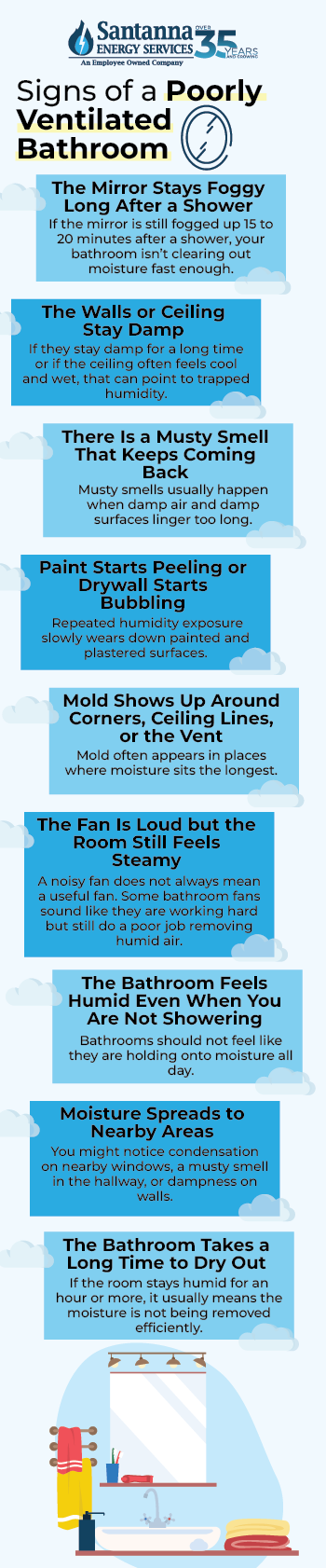
The Mirror Stays Foggy Long After a Shower
If the mirror is still fogged up 15 to 20 minutes after a shower, that is often one of the clearest signs the bathroom is not clearing out moisture well. A little fog right after hot water use is normal. What is less normal is steam that hangs around long after the shower ends. That usually means humid air is not leaving the room fast enough.
The Walls or Ceiling Stay Damp
Bathroom walls and ceilings should start drying out fairly soon after a shower. If they stay damp for a long time, or if the ceiling often feels cool and wet, that can point to trapped humidity. Moisture that keeps settling on surfaces is a sign that the room is not getting enough airflow to dry out properly.
There Is a Musty Smell That Keeps Coming Back
A bathroom that smells musty even after cleaning often has a moisture problem, not just a cleaning problem. Musty smells usually happen when damp air and damp surfaces linger too long. Towels, grout, walls, and corners can all hold onto that moisture. If the smell keeps returning, it is often a clue that the room is staying humid day after day.
Paint Starts Peeling or Drywall Starts Bubbling
When moisture keeps building up in a bathroom, painted surfaces often show it. You may see peeling paint, bubbling paint, soft spots, or drywall that looks swollen near the ceiling or around vents. This happens because repeated humidity exposure slowly wears down the surface.
Mold Shows Up Around Corners, Ceiling Lines, or the Vent
Mold often appears in places where moisture sits the longest. In bathrooms, that is commonly around ceiling corners, near the fan, along grout lines, or where the wall meets the ceiling. If mold keeps coming back after cleaning, poor ventilation may be part of the reason.
The Fan Is Loud but the Room Still Feels Steamy
A noisy fan does not always mean a useful fan. Some bathroom fans sound like they are working hard but still do a poor job of removing humid air. If the fan is on and the bathroom still feels damp or steamy long after use, the fan may be too weak, dirty, blocked, or not vented properly.
The Bathroom Feels Humid Even When You Are Not Showering
If the room often feels sticky or damp even between showers, that can also point to poor ventilation. Bathrooms should not feel like they are holding onto moisture all day.
Moisture Spreads to Nearby Areas
Sometimes the signs do not stay inside the bathroom. You might notice condensation on nearby windows, a musty smell in the hallway, or dampness on walls just outside the bathroom. This can happen when bathroom moisture is not being removed well and starts drifting into nearby spaces.
The Bathroom Takes a Long Time to Dry Out
Another common sign is that the bathroom takes a long time to feel normal again after a shower. If the room stays humid for an hour or more, it usually means the moisture is not being removed efficiently.
To fix the problem, it helps to understand what might be causing the ventilation system to struggle in the first place.
What Can I Do To Help My Poorly Ventilated Bathroom?
You can help a poorly ventilated bathroom by getting humid air out faster, reducing how much moisture stays behind after showers, and making sure the room has enough airflow to dry out properly. But these are just some of the solutions!
If you're looking for more, check out our comprehensive list. We've done the research so you don't have to:
1. Run the Exhaust Fan Before, During, and After the Shower
One of the most helpful things you can do if you're ventilating a bathroom is to turn the exhaust fan on before steam starts building, keep it running while you shower, and leave it on for about 20 to 30 minutes afterward. This gives the fan time to remove moisture while it is being created and also clears out the damp air that lingers after the water is off.
Many bathrooms stay damp simply because the fan gets turned off too soon. Leaving it on longer can make a noticeable difference in how quickly the room dries.
2. Open the Door After Showering To Let Damp Air Escape
If the bathroom stays closed after a shower, humid air has fewer ways to leave the room. Opening the door slightly allows damp air to move out and lets drier air from the rest of the house move in. This helps the room dry out faster.
3. Open the Window if Your Bathroom Has One
If your bathroom has a window, opening it during or after a shower can help release steam more quickly. This works best when the air outside is less humid than the air inside the bathroom. While a window alone may not fully solve the problem, it can improve airflow and support the fan.
4. Wipe Down Wet Surfaces
Even after the shower ends, water left on shower walls, glass, mirrors, sinks, and countertops continues to evaporate back into the room. Wiping down those surfaces with a towel or squeegee removes excess moisture right away, so the bathroom dries faster.
5. Move Damp Towels and Bath Mats Out of the Room
Wet towels and bath mats can hold a lot of water. When they stay damp in the bathroom, they continue releasing moisture into the air. Hanging towels to fully dry and moving very wet bath mats out of the room can help reduce lingering humidity.
6. Check Whether the Fan Is Actually Pulling Air
A bathroom fan can make noise without removing much moisture. One simple test is to hold a piece of tissue near the fan grille while it is running. If the tissue barely moves or does not pull toward the vent, the fan may not be moving enough air.
7. Clean the Fan Grille if Dust Is Blocking Airflow
Dust and lint can build up on the fan cover over time. When that happens, airflow drops and the fan becomes less effective. Cleaning the grille can help the fan pull moist air out of the room more easily.
8. Reduce How Much Steam Builds Up
What can you do to help a poorly ventilated bathroom? Try this: Slightly shorter showers or slightly cooler water can help reduce the amount of moisture the room has to handle. This does not fix ventilation problems by itself, but it can help the room dry out faster.
9. Give the Bathroom Time to Dry Between Showers
If several showers happen back-to-back, moisture can build up before the room has time to dry. Spacing showers out when possible allows the fan and airflow to remove humidity more effectively.
10. Use a Small Dehumidifier if the Room Still Stays Damp
If the bathroom still feels humid even when the fan is running properly, a small dehumidifier can help remove extra moisture from the air. While it is not a replacement for proper ventilation, it can provide helpful support in bathrooms that tend to stay damp.
Be sure to practice electrical safety carefully when using this method. Electricity and water don't mix!
11. Install a Passive Vent
In some bathrooms, a passive vent can help improve airflow, making ventilating a bathroom a piece of cake. Passive vents allow humid air to escape naturally through small openings connected to ducts or vents in the wall or ceiling. They do not use electricity like exhaust fans, but they can help reduce trapped moisture when used alongside other ventilation methods.
12. Add or Improve Insulation
Adding insulation around bathroom ceilings or exterior walls can help reduce condensation on cold surfaces. When warm, humid air from showers hits a cold ceiling or wall, moisture can form more easily. Better insulation helps keep surfaces warmer and reduces the chance of moisture buildup.
13. Pay Attention to Signs That the Bathroom Needs More Than Simple Fixes
If you are running the fan, opening the door, wiping surfaces dry, and reducing steam, but the bathroom still stays damp, smells musty, or shows peeling paint or recurring mold, the issue may be larger than daily habits.
In many cases, the fan may be too small, blocked, or not vented outside properly. When that happens, the bathroom may need a stronger or better ventilation setup.
Improving a poorly ventilated bathroom usually starts with simple habits that help moisture leave the room faster. Running the fan longer, allowing airflow through the door or window, and removing water from surfaces can make a noticeable difference in how quickly the bathroom dries out.
However, these steps work best when the bathroom ventilation system is functioning as it should. If the room remains damp or musty after trying these habits, it often means the problem is not just due to daily use; something in the ventilation system itself may be limiting how well moisture can escape.
What Is a Quick Fix if My Bathroom Ventilation Fan Is Not Working?
If your bathroom ventilation fan isn't working, check out the simplest possible problem first, then see whether the fan is blocked, weak, or not moving enough air. Here's a simple guide on how to troubleshoot:
Step 1: Turn the Fan On and Listen for Any Sound
If you do not hear anything at all, the issue may be with the switch, power supply, or breaker. If you do hear the fan running, that is a sign the motor may still be working, but it does not always mean the fan is removing moisture well. This first step helps you figure out whether the problem is no power or poor airflow.
Step 2: Check the Fan Cover for Dust and Buildup
If the fan turns on but does not seem to help, look at the cover next. Dust and lint can collect on the grille over time and block airflow. If the cover looks dirty, turn off the power and clean it carefully. This is one of the easiest things to check, and sometimes it helps the fan move air better right away.
Step 3: Test Whether the Fan Is Pulling Air
Once the cover is clean, turn the fan back on and hold a piece of tissue near the vent. If the tissue does not pull toward the fan, the airflow may be weak. That usually means the fan is not removing enough moisture from the room, even if it sounds like it is working. This step helps you tell the difference between a noisy fan and a useful fan.
Step 4: Help the Bathroom Dry Out in the Meantime
If the fan is still not clearing steam well, use a few short-term steps to reduce moisture in the room. Leave the bathroom door open after showers, wipe down wet surfaces, and open a window if you have one. These are not permanent fixes, but they can help keep humidity from building up while you figure out whether the fan needs more attention.
Step 5: Watch for Signs That It Needs More Than a Quick Fix
If the fan still does not turn on, smells like something is burning, makes strange noises, or barely moves air after cleaning, the problem is likely bigger than a simple fix. That usually means the fan is worn out, blocked deeper inside, or not working the way it should. At that point, it may need repair or replacement.
How To Ventilate a Bathroom Without Windows
You can ventilate a bathroom without windows by using the exhaust fan correctly, helping air move through the room, and removing moisture before it has time to linger.
A bathroom without windows can still stay dry and comfortable, but it needs another reliable way for humid air to leave the room. Since there is no window to let steam escape naturally, the exhaust fan and the room's airflow become much more important. The goal is to move damp air out, bring drier air in, and keep moisture from sitting on surfaces too long.
Here's how you can help ventilate a bathroom without windows:
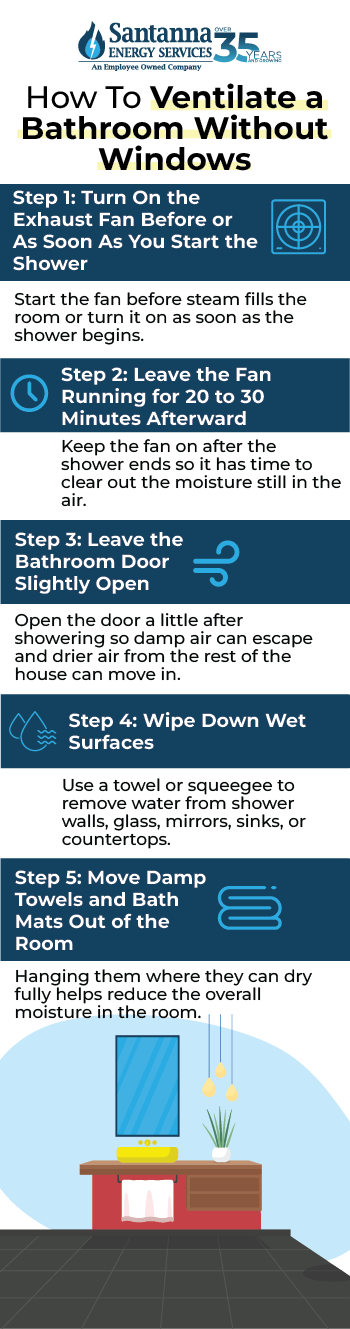
Step 1: Turn On the Exhaust Fan Before or As Soon As You Start the Shower
Start the fan before steam fills the room or turn it on as soon as the shower begins. This helps remove moisture as it is created, rather than waiting until the room is already full of humidity.
Step 2: Leave the Fan Running for 20 to 30 Minutes Afterward
Keep the fan on after the shower ends so it has time to clear out the moisture still in the air. Even when the water stops, wet walls, floors, and fixtures continue releasing moisture into the room.
Step 3: Leave the Bathroom Door Slightly Open
Open the door a little after showering so damp air can escape and drier air from the rest of the house can move in. This allows airflow to pass through the room and helps the fan work more effectively.
Step 4: Wipe Down Wet Surfaces
Use a towel or squeegee to remove water from shower walls, glass, mirrors, sinks, or countertops. ater left on surfaces continues to evaporate into the air, which can keep the room humid longer.
Step 5: Move Damp Towels and Bath Mats Out of the Room
Wet towels and bath mats can release moisture back into the air if they stay damp in the bathroom. Hanging them to dry fully helps reduce overall moisture in the room.
Step 6: Use a Small Dehumidifier if the Room Still Feels Damp
If the bathroom still feels muggy even when you use the fan and door properly, a small dehumidifier can help remove extra moisture from the air. This can be helpful during very humid weather.
Step 7: Watch for Signs the Fan May Not Be Working Well
If the bathroom stays steamy, smells musty, or takes a long time to dry even after following these steps, the fan may be too weak, dirty, blocked, or not vented outside correctly. In that case, the ventilation setup may need improvement.
Even without a window, a bathroom can stay dry with the right fan use, airflow, and moisture control. If the room remains damp after these steps, it may be a sign that the ventilation system needs to be upgraded.
What Size Exhaust Fan Does Your Bathroom Need?
The right exhaust fan size depends on your bathroom's square footage, but a common homeowner rule is about 1 CFM (which measures the volume of air a fan moves per minute) for every square foot of floor space, with a minimum of 50 CFM for very small bathrooms.
CFM stands for cubic feet per minute, which simply means how much air the fan can move each minute. The higher the CFM, the more humid air the fan can remove from the room.
For example, if your bathroom is 8 feet by 10 feet, the room is 80 square feet, so you would typically look for a fan around 80 CFM. If the room is smaller than 50 square feet, a 50 CFM fan is usually the minimum starting point.
Some bathrooms may need more airflow than this basic rule. Rooms with high ceilings, heavy steam from long showers, frequent use, or sizes over 100 square feet often require stronger ventilation. In those cases, fan size is based on fixtures. Add about 50 CFM for each toilet, shower, or standard tub, and about 100 CFM for a jetted tub.
Here is a simple guide homeowners can use as a starting point:
Bathroom Exhaust Fan Sizing Guide
| Bathroom Size | Minimum Fan Size |
| Up to 50 sq. ft. | 50 CFM |
| 51 to 79 sq. ft. | 50 to 80 CFM |
| 80 to 100 sq. ft. | 80 to 100 CFM |
| Larger bathrooms or high ceilings | 100+ CFM, depending on layout |
One more thing to keep in mind is that louder does not always mean better. A fan can sound powerful and still be too small or not move enough air for the room. Choosing the right bathroom exhaust fan size helps the bathroom dry out faster, clears humidity more effectively, and supports better comfort after showers.
How Much Does It Cost to Install a Bathroom Ventilation Fan?
According to Homewyse, the cost to install a bathroom ventilation fan is about $343 to $889 per fan as of January 2026.
Keep in mind that the final price can vary depending on how simple or involved the installation is. Costs are usually lower when the bathroom already has a fan location, electrical wiring, and a duct that vents outside.
Costs can be higher if the installer needs to add or adjust wiring, run new ductwork, change the ceiling opening, or work through a tight attic space. Homes that never had a bathroom fan before may require additional work to create a proper vent path to the outside.
The type of fan can also affect the price. Basic exhaust fans are usually cheaper, while ENERGY STAR–certified fans often cost more upfront because they are designed to remove moisture efficiently while using up to 48% less electricity than standard models and operating more quietly.
How Does Better Bathroom Ventilation Support a More Energy-Efficient Home?
Better bathroom ventilation supports a more energy-efficient home by controlling moisture before it spreads and affects other parts of the house.
When humid air is removed quickly after showers, indoor humidity levels remain more stable throughout the home. Balanced humidity helps rooms feel comfortable without constant thermostat adjustments, especially during humid Midwest summers or cold winters when condensation can form on walls and windows.
Good ventilation also helps protect parts of the home that influence energy performance. When moisture moves into ceilings or attic spaces, it can affect insulation and building materials over time. Damp insulation does not perform as well as dry insulation, which can make it harder to maintain steady indoor temperatures.
Another benefit is that the home dries out faster after daily activities like showering, cleaning, or laundry. When moisture is managed at the source, it is less likely to drift into nearby rooms or build up in hidden areas.
How Does Poor Bathroom Ventilation Affect Comfort, Energy Efficiency, and Your Energy Bill?
Poor bathroom ventilation affects comfort, energy efficiency, and your energy bill by trapping extra moisture in your home, making the air feel warmer and heavier, and forcing your cooling system to work harder to keep the house comfortable.
When humid air is not removed after showers, it lingers in the bathroom and often spreads into nearby rooms, making the home feel warmer, heavier, and less comfortable.
As a result, many homeowners lower the thermostat or let the air conditioner run longer to feel comfortable again.
This matters for energy efficiency because your air conditioner has to do two jobs at once. That extra runtime uses more electricity and puts added strain on the system, especially during hot or humid weather.
Here is a simple example of how ventilating a bathroom can cost you on your energy bills: Imagine you take a hot shower in the morning, turn the fan off right away, and shut the bathroom door.
Twenty minutes later, the mirror is still foggy, the walls still feel damp, and the bathroom still feels warm and stuffy. That moisture does not just disappear. Some of it stays on surfaces, and some of it slowly drifts into the hallway or nearby rooms. Later, the house feels a little clammy, so you lower the thermostat a few degrees to cool down.
What you are noticing may not be a temperature problem on its own. It may be leftover humidity from the bathroom that wasn’t properly removed. Over time, those small adjustments can add up. Even an extra 30 to 60 kilowatt-hours of cooling and fan usage in a month can noticeably increase your electric bill.
Using the U.S. average residential electricity price of 17.24 cents per kWh, as reported by the EIA for December 2025, just 30 extra kWh of cooling and fan use because of a poorly ventilated bathroom can add roughly $5 to your electric bill each month.
Better bathroom ventilation helps remove moisture quickly, keeps the home feeling more balanced, helps surfaces dry faster, and reduces the extra work your HVAC system has to do.
When damp air is removed at the source, comfort improves, indoor humidity stays more manageable, and your home becomes easier and less costly to keep comfortable.
FAQs
Can bathroom ventilation help prevent mold?
Yes, bathroom ventilation can help prevent mold by removing moisture. The EPA says controlling indoor moisture and keeping humidity around 30% to 50% helps prevent mold growth.
How long should I run the bathroom fan after a shower?
Run the bathroom fan for at least 20 minutes after a shower to help ventilate the bathroom.
Is opening a window enough to ventilate a bathroom?
Opening a window can help, but it is not always enough on its own because natural ventilation changes with the weather. Keep in mind that opening windows alone is often insufficient compared with mechanical ventilation.
Why do bathrooms get so humid so fast?
Bathrooms get humid fast because showers add a lot of moisture to the air in a small space, and that moisture can quickly condense on cooler surfaces if it is not vented out.
Why is my bathroom still humid even with the fan on?
Your bathroom may still be humid even with the fan on if the fan is not exhausting enough air, is not vented outside, or is not removing moisture quickly enough for the room.
A poorly ventilated bathroom is more than just a foggy mirror or damp walls. Trapped moisture can affect comfort, indoor air quality, and how efficiently your heating and cooling system runs, especially in Midwest homes where humidity and seasonal weather changes are common.
Simple habits like improving airflow, running the fan longer, and removing moisture quickly can help the bathroom dry faster and prevent humidity from spreading through the rest of the house. When moisture is managed well, the home often feels more comfortable, and your HVAC system does not have to work as hard to maintain balanced temperatures.
After improving the home-side causes of excess humidity and wasted energy, you can also consider the supply side of your energy costs. If your cooling system tends to run longer during humid seasons, you may want to explore Santanna’s Unlimited Energy plan, which can help provide stable supply charges* and make monthly energy costs easier to manage.
* Restrictions apply. Enrollment based upon program eligibility. Customers using more than 125% of normal monthly usage as determined by Santanna may be required to switch plans.
Jenna Mendez is a Midwest native with lifelong roots in Illinois and time spent in Ohio during college, giving her a deep understanding of the Midwest region’s people, climate, and energy needs. She brings firsthand experience and local insight to topics that matter to Midwest homeowners, especially energy efficiency, sustainability, and home living. Jenna specializes in writing about eco-friendly living, all things Midwest, renewable energy, and practical ways to reduce energy costs. Jenna brings a trusted, and local hometown voice to every article she writes, helping readers live well, and sustainably, right where they are.