
Why Does My Breaker Keep Tripping? Causes, Fixes, & When It’s Dangerous

by Tyler Castle
Updated: August 17, 2026
18.6 min read
Key Points of This Article:
- Common causes of a tripped circuit breaker include overloaded circuits, short circuits, ground faults, arc faults, and failing appliances, especially high‑wattage items like space heaters, microwaves, and AC units.
- Repeated or immediate breaker trips are a warning sign, often pointing to wiring problems, moisture, damaged outlets, or a breaker that will not safely reset.
- You can reduce breaker trips by spreading electrical usage, avoiding running high‑wattage appliances together, and upgrading outdated panels or circuits when needed.
Have you ever been cooking dinner, turning on the microwave, or plugging in a space heater when suddenly the lights go out and the breaker trips?
You might start wondering what's going on. Is something wrong with the wiring? Did an appliance suddenly stop working properly? Or is your electrical system simply handling more demand than it was designed for?
In many cases, a breaker tripping is actually doing its job. But if the breaker keeps tripping repeatedly, it usually means something in the system needs attention. If this keeps happening, we've done the research to help you understand why and what you can do about it.
In this guide, you'll learn why your breaker keeps tripping, what the most common causes are, how you can safely troubleshoot the issue, and when it's time to call an electrician. We'll also explain how appliance electricity demand and seasonal energy use can sometimes contribute to breaker problems, and what you can do to help prevent them in the future. Let's get started.
Why Does My Circuit Breaker Keep Tripping?
A circuit breaker usually trips because the circuit is carrying too much electricity, something is wrong with the wiring or an appliance, or the breaker or panel is starting to wear out.
We recently conducted an internal survey, and 80% of Santanna employee-owners who responded have experienced a tripped breaker more than once in the same area of their home.
A tripped circuit breaker can happen when several high-use appliances run at the same time, like a microwave, toaster, coffee maker, or space heater. It can also happen when there is a fault somewhere in the system, such as damaged wiring, moisture near an outlet, or an appliance that is beginning to fail.
A few employee-owners reported that their breakers have tripped with small appliances, such as vacuums and hair dryers.
A breaker that trips once in a while may just be responding to a temporary overload. But if it keeps happening, it usually means there is a real reason behind it.
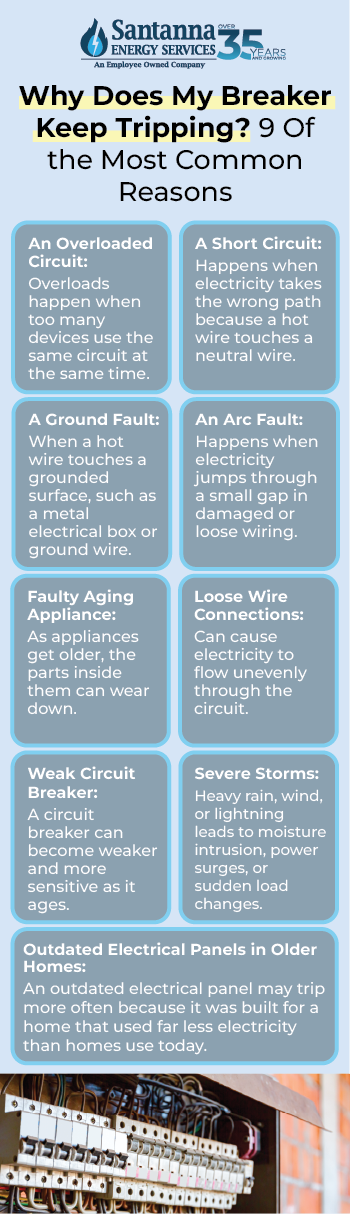
Why Your Circuit Breaker Keeps Tripping: 9 of the Most Common Reasons
Even the simplest reasons can trip your circuit breaker. Let’s take a closer look at the most common reasons a breaker trips so you can better understand what may be going on in your home:
1. An Overloaded Circuit
An overloaded circuit is one of the most common causes of a tripped breaker, and it happens when too many devices use the same circuit at the same time.
Many rooms, outlets, and lights in a home may share one breaker, so it is easier than people realize to put too much demand on a single circuit. In a kitchen, for example, one breaker might be serving the microwave, toaster, coffee maker, and lighting.
If several of those are running at the same time, the circuit may exceed its safe limit, and the breaker will shut off power.
Several of our employee-owners noted that space heaters, window air conditioning units, and microwaves being powered at the same time were common culprits of tripped breakers.
2. You’ve Experienced a Short Circuit
A short circuit happens when electricity takes the wrong path because a hot wire touches a neutral wire.
When that happens, the flow of electricity jumps suddenly, and a short circuit can easily trip your circuit breaker to stop it. A short circuit tripping a breaker is more serious than a simple overload because it can create a lot of heat in a short amount of time.
Short circuits can be caused by damaged cords, loose wiring inside an outlet, worn wire covering, or faulty switches and appliances.
3. There’s Been a Ground Fault
A ground fault occurs when a hot wire contacts a grounded surface, such as a metal electrical box or ground wire, which are parts of the electrical system designed to safely carry stray electricity away from the circuit.
This often happens in places with more moisture, such as kitchens, bathrooms, garages, basements, and outdoor outlets, which can ultimately explain why your breaker keeps tripping.
That is why these areas often have GFCI outlets or breakers, which quickly shut off power when moisture or a ground fault causes electricity to leave its normal path, helping protect you from electric shock.
Ground faults matter because they increase the risk of electric shock. If a breaker trips around water, damp conditions, or a bathroom or kitchen outlet, a ground fault may be the reason.
4. You’ve Experienced an Arc Fault
An arc fault happens when electricity jumps through a small gap in damaged or loose wiring. That small jump can create heat, and over time, that heat can increase the risk of fire.
To prevent arc faults, some homes have AFCI circuit breakers that are designed to detect this type of problem and shut power off before the situation gets worse. If an AFCI breaker keeps tripping, it may be reacting to damaged wiring, a loose connection, or a problem inside a cord or appliance.
5. You Have a Faulty, Aging Appliance (Or Two)
Sometimes the breaker is tripping because one appliance is starting to fail.
As appliances get older, the parts inside them can wear down. A motor may struggle to start, a heating element may pull uneven power, or internal wiring may become damaged. When that happens, the appliance may draw electricity in a way that causes the breaker to trip.
This is common with refrigerators, window AC units, dishwashers, washing machines, and space heaters. If the breaker trips every time one specific appliance turns on, that appliance may be the real problem, not the breaker itself.
6. There Are Loose Wire Connections
Loose wire connections inside an outlet, switch, or junction box can cause electricity to flow unevenly through the circuit, which can explain why your breaker keeps tripping.
When wires are not firmly connected, the electrical current may create extra resistance or small arcs of electricity. This can generate heat and trigger the breaker to shut off power to protect the wiring.
7. You Have a Weak or Aging Circuit Breaker
A circuit breaker can weaken and become more sensitive with age, potentially tripping even when the circuit load appears normal. Over time, repeated tripping, heat, and years of electrical use can wear down the breaker’s internal components. When that happens, the breaker may shut off power sooner than it should, even if the circuit is not technically overloaded.
Like many parts of a home, breakers do not last forever. A worn-out breaker may trip too easily, feel loose in the panel, or refuse to reset even when the electrical load appears normal.
8. Severe Storms
Severe storms can cause a circuit breaker to trip when heavy rain, wind, or lightning leads to moisture intrusion, power surges, or sudden load changes that the electrical system is designed to interrupt for safety.
Breakers trip more often during extreme weather because your home usually uses more electricity in very cold or very hot conditions.
In our internal survey, some respondents specifically noted breakers tripping in garages, where exposure to humidity and temperature swings is more common. Others reported that outdoor or seasonal setups, such as Christmas lights, were more likely to trip breakers during severe weather due to water exposure or damaged wiring.
9. Outdated Electrical Panels in Older Homes
An outdated electrical panel may trip more often because it was built for a home that used far less electricity than homes do today.
Many older homes were not designed for the number of devices people now use every day. Years ago, homes had fewer televisions, fewer kitchen appliances, no home office setups, and no electric vehicle chargers. Today, even everyday living can put more pressure on an older panel.
If breakers are tripping in different parts of the house, or if the problem keeps happening without one clear cause, the panel may no longer match the way the home uses electricity.
In that case, an electrician may recommend adding circuits or upgrading the panel so the system can handle modern demand more safely.
Why Does My Breaker Trip When I Plug Something In?
A breaker usually trips when you plug something in because the appliance, outlet, or circuit is putting too much demand on the circuit.
Sometimes the problem is simple overload. For example, if the circuit is already powering lights, a TV, or other appliances, plugging in one more high-use device can push it past its limit. That is common with things like space heaters, microwaves, hair dryers, and window AC units.
Other times, the issue is with the item you plugged in. An appliance with damaged wiring or a failing motor can trip the breaker as soon as it starts drawing power. A worn outlet, loose connection, or moisture near the outlet can also cause the breaker to shut off power right away.
If this happens, start by unplugging the device you just connected and anything else on that circuit. Then reset the breaker. After that, plug appliances back in one at a time. If the breaker trips only when one specific item is plugged in, that appliance may be the problem.
How Do I Know if a Circuit Breaker Has Tripped?
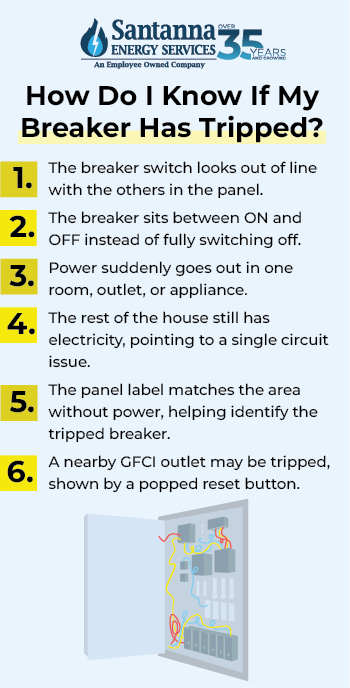
You can usually tell a circuit breaker has tripped by looking for a few clear signs in the panel and around your home:
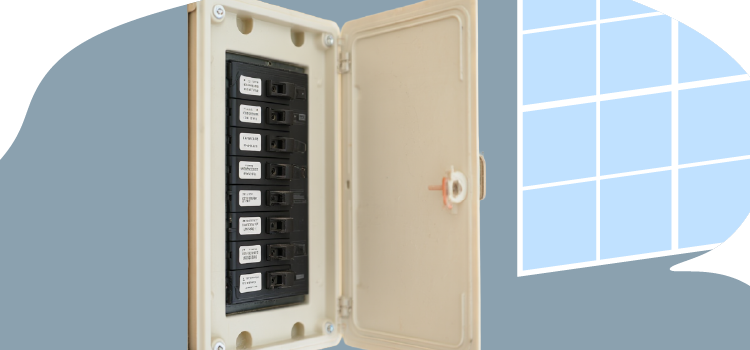
- The breaker switch is out of line with the others: In most panels, all the breakers should look evenly lined up. If you open up your breaker panel and one switch looks slightly shifted or not fully in the same position as the rest, that is often the tripped breaker.
- The breaker is sitting between ON and OFF: A tripped breaker usually does not move all the way to off. Instead, it often rests in the middle position, which is one of the easiest signs to spot when you open the panel door.
- One room, outlet, or appliance suddenly loses power: If the lights go out in one room, the microwave stops working, or certain outlets suddenly have no power, that often points to one tripped breaker rather than a larger outage.
- The rest of the house still has electricity: If your refrigerator, hallway lights, or other rooms still have power, the problem is likely limited to one circuit. That makes a tripped breaker more likely than a full power outage.
- The panel label matches the area that lost power: Many electrical panels have labels such as kitchen, bedroom, garage, or laundry room. These labels can help you identify which breaker may have tripped, especially if only one part of the house is affected.
- A GFCI outlet may also look tripped nearby: In some kitchens, bathrooms, garages, or outdoor areas, the issue may involve a GFCI outlet instead of only the breaker. If you see an outlet with a popped reset button, that can be another clue tied to the power loss.
In most cases, the biggest clue is simple: one breaker looks different from the rest, and the power loss is limited to one part of your home.
How Can I Tell if a Circuit Breaker Has Gone Bad?
A circuit breaker may be going bad if it trips too easily, will not stay reset, feels hot, makes buzzing sounds, or keeps shutting off power even when the circuit is not overloaded.
Circuit breakers do wear out over time, especially if they have tripped many times or have been handling heavy electrical demand for years. A worn breaker may become overly sensitive or stop responding as it should.
Signs a breaker may be going bad include:
- It trips often without a clear reason: If the breaker keeps tripping even when you are not running many devices, the breaker itself may be wearing out instead of reacting to a true overload.
- It will not stay reset: If you switch it off and back on correctly, but it trips again right away, the issue could be a bad breaker, although wiring faults and faulty appliances can cause this too.
- It feels hot or smells burnt: A breaker should not feel unusually hot, and you should never ignore a burning smell near the panel. Warm or discolored electrical parts are warning signs of a serious problem.
- You hear buzzing, crackling, or sizzling: Unusual sounds from the panel, outlets, or switches can point to electrical trouble and should be checked quickly.
- Lights flicker or dim on that circuit: If lights on the same circuit blink, dim, or act unstable, that can be a sign that the breaker or another part of the circuit is not working properly.
- The breaker looks damaged or loose: If the switch does not sit firmly in place, looks damaged, or feels different from the others, it may need inspection. This is not something to test yourself inside the panel.
A bad breaker is not always the cause, since faulty wiring, overloaded circuits, and failing appliances can create many of the same symptoms. If you notice any of these warning signs, the safest next step is to have a licensed electrician inspect the circuit and panel.
Is It Dangerous if a Circuit Breaker Keeps Tripping?
A circuit breaker that trips once in a while is not always dangerous, but repeated tripping should not be ignored because it can be a sign of an overload or a more serious electrical problem.
Circuit breakers are designed to shut off power when something is not safe, so frequent trips usually mean the breaker is responding to a real issue rather than malfunctioning for no reason.
Sometimes the cause is fairly simple, like running too many high-use devices on one circuit at the same time. But if the breaker keeps tripping over and over, especially without a clear reason, it may point to faulty wiring, damaged outlets, overheating, or another condition that needs attention. That is when it moves from annoying to potentially unsafe.
Can a Circuit Breaker That Keeps Tripping Increase Your Electricity Bill?
A breaker tripping does not directly raise your electric bill, but the conditions causing it often go along with heavy electricity use in the home. Circuit breakers shut off power when a circuit goes past a safe level, and that often happens when high-use devices or several large appliances are running on the same circuit.
Frequent breaker trips can be a clue that one circuit is carrying a heavy load, and the more appliances you run at once, the higher your electricity bill can be, even if the breaker itself is not what increases the bill.
So, the bigger takeaway is that if your breaker keeps tripping, it is worth looking at your household electricity use patterns. Spreading out when you run large appliances, replacing aging equipment, and making sure high-use devices are on the right circuits can help reduce both electrical strain and wasted energy.
How To Prevent Breakers From Tripping
In many homes, the breaker shuts off because one circuit is being asked to do too much for too long. Overloaded circuits and repeatedly tripped breakers are recognized warning signs of electrical strain.
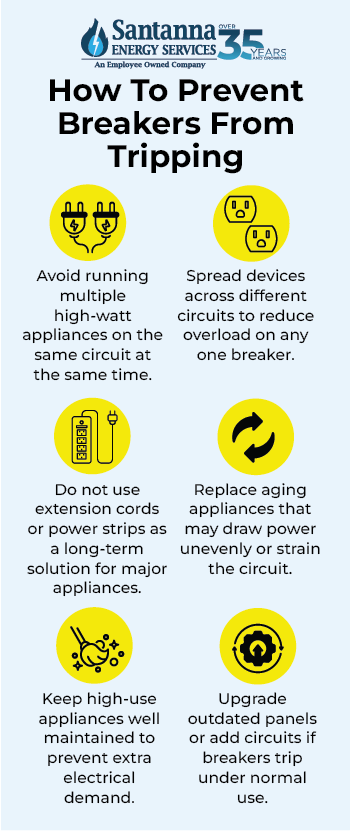
Here are some practical ways to help prevent breakers from tripping and reduce repeated strain on your electrical system:
1. Avoid Running High-Watt Appliances Together
One of the simplest ways to prevent breaker trips is to avoid using several high-watt appliances on the same circuit at the same time. Space heaters, microwaves, toasters, hair dryers, and window AC units can all put a heavy load on a circuit.
Even if each one works normally on its own, the combined demand can be enough to trip the breaker. The Electrical Safety Foundation International specifically advises plugging only one heat-producing appliance into an outlet at a time.
2. Spread Devices Across Different Circuits
It also helps to spread devices across different circuits when possible. In many homes, several outlets, lights, or even nearby rooms may share one breaker. If one area is handling too many devices, moving some of that demand to another circuit can lower the chance of repeated trips and make the electrical load more manageable.
3. Do Not Rely on Extension Cords for Long-Term Use
Extension cords and power strips do not increase how much electricity a circuit can safely carry; they only give you more places to plug things in, which can make overloading easier. The Consumer Product Safety Commission says extension cords should be used only temporarily, not as permanent household wiring, and major appliances should be plugged directly into a wall outlet.
4. Replace Aging Appliances That May Pull Power Unevenly
Older appliances can also contribute to breaker problems. A failing motor, worn heating element, or damaged cord can cause an appliance to draw power unevenly or work harder than it should.
5. Keep High-Use Appliances in Good Working Condition
Inefficient appliances can put extra strain on a circuit. For example, a dirty AC filter, a blocked dryer vent, or a worn appliance cord can make equipment work harder and raise the chance of electrical trouble. Keeping cords in good condition and avoiding unsafe appliance use can help reduce added electrical strain.
6. Upgrade Outdated Electrical Panels or Add Circuits if Needed
In older homes, the panel or existing circuits may no longer match the way the home uses electricity today. If the same breaker keeps tripping under normal use, a licensed electrician may recommend adding a dedicated circuit, more outlets, or upgrading the panel.
Electricians often use the 80% rule for continuous loads, which means a breaker generally should not carry more than about 80% of its rating for 3 hours or longer.
For example, a 20-amp breaker is generally limited to about 16 amps continuously. This does not mean every breaker trip is caused by this, but it helps explain why space heaters, window AC units, or other long-running appliances may trip a breaker when the circuit is already busy.
A simple way to think about prevention is this: if one circuit is doing too much for too long, the breaker is more likely to trip. Spacing out heavy appliance use, watching for repeat problem devices, and getting older electrical systems checked when needed can go a long way toward preventing future trips.
FAQs
Can a Bad Outlet Cause the Breaker to Trip?
Yes, a bad outlet or loose outlet connection can create an unsafe wiring fault that may trip the breaker.
Is It Safe if My Breaker Trips Once in a While?
Usually, yes, if it happens from a temporary overload, but if it starts happening repeatedly or without a clear reason, it should be checked.
How Do I Know if My Breaker Panel Is Outdated?
Frequent breaker trips, flickering or dimming lights, and heavy reliance on extension cords are common signs that your electrical system may no longer meet your home’s current needs and should be inspected.
Why Does My Breaker Keep Tripping in One Room?
A breaker keeps tripping in one room when too many devices share the same circuit, a faulty appliance is connected, or a wiring issue affects the outlets and lights in that part of the home.
Why Does My Microwave Keep Tripping the Breaker?
A microwave keeps tripping the breaker because it uses a large amount of electricity, usually around 1,000 to 1,500 watts, and if it shares a circuit with other kitchen appliances, the combined electrical load can exceed what the circuit can safely handle.
Why Does My Dryer Keep Tripping the Breaker?
A dryer keeps tripping the breaker because electric dryers run on a high-power 240-volt circuit, and issues such as a failing heating element, overloaded circuit, or restricted dryer vent can cause the breaker to shut off power.
Why Does My Water Heater Circuit Breaker Keep Tripping?
A water heater circuit breaker keeps tripping when the unit draws more electricity than the circuit can safely handle, which may happen if the heating element, thermostat, or internal wiring begins to fail.
Why Does My Fridge Keep Tripping the Breaker?
A fridge keeps tripping the breaker when the compressor motor draws too much power during startup, especially if the refrigerator is aging or sharing a circuit with other appliances.
Why Does My AC Keep Tripping the Breaker?
An AC keeps tripping the breaker because the compressor needs a strong burst of electricity when it starts, and problems such as dirty filters, restricted airflow, or an overloaded circuit can increase electrical demand.
When your breaker keeps tripping, it can feel frustrating or even a little concerning. But in many cases, the breaker is doing exactly what it is designed to do. It shuts off power when a circuit is overloaded or when a fault occurs, helping protect your wiring, appliances, and home from overheating or electrical fires.
The most helpful approach is to take the problem step by step. Understanding the common causes of breaker trips can help you recognize whether the issue is related to overloaded circuits, a specific appliance, or a possible electrical fault. From there, simple troubleshooting steps can help you narrow down the cause, and a licensed electrician can inspect the system if the problem continues.
It also helps to pay attention to how electricity is being used throughout your home. High-demand appliances, seasonal heating and cooling, and long-running devices can all increase electrical load and place more pressure on your circuits.
Understanding how your home uses electricity can help improve safety, comfort, and energy budgeting. Once the electrical issue is addressed, you may also want to explore Santanna’s Unlimited Energy plan to help keep supply costs more predictable.*
* Restrictions apply. Enrollment based upon program eligibility. Customers using more than 125% of normal monthly usage as determined by Santanna may be required to switch plans.
Tyler is an experienced energy professional, having worked for Santanna Energy Services, for the past four years. He is passionate about renewable energy and believes that diversifying the energy grid is the key to a sustainable future. Tyler is dedicated to supplying consumers with the best possible energy solutions and works diligently to make sure that Santanna can deliver the highest quality service.