

Why Is My ComEd Bill So High? A Guide for Illinois Customers

by Jenna Mendez
Updated: October 9, 2026
14.4 min read
Key Points of This Article:
- A high ComEd bill can be caused by increased electricity use, seasonal weather, changing supply rates, delivery charges, billing-cycle differences, billing adjustments, or in recent news, AI data centers.
- Across nearly 4,900 Santanna customer accounts in ComEd territory, the average monthly ComEd bill was $87 and the median was $71, providing a useful benchmark for comparing your own bill.
- If your bill suddenly increases, compare your electricity usage, supply and delivery charges, billing days, and previous bills to help pinpoint what changed.
With ComEd historically raising their electricity rates annually, it's natural for you to wonder, "Why is my ComEd bill so high?" And if you have, you're not alone.
Many homeowners assume a higher ComEd bill automatically means the utility raised its prices. In reality, that's only one possible reason.
As an energy supplier who's worked alongside ComEd for decades, we're here to help you understand what may be driving your higher ComEd bill, how to identify the real cause by reviewing your bill, and the practical steps you can take to better manage your electricity costs and understand your electricity supply options in Illinois.
Why Is My ComEd Bill So High?
A high ComEd bill is usually caused by higher electricity usage, seasonal weather, changes to electricity supply rates, delivery charges, a longer billing cycle, or billing adjustments. In many cases, more than one of these factors contributes to the increase.
Below are the most common reasons Illinois homeowners see higher ComEd bills and how to tell whether each one applies to your home:
You’ve Been Using More Electricity Than You Realize
Using more electricity than you realize is one of the most common reasons for a higher ComEd bill. Small changes in your daily routine can gradually increase electricity use without being obvious until your monthly bill arrives.
Even leaving televisions, gaming systems, computers, or other electronics running for longer periods can make a difference over the course of a month.
Hot Summers or Cold Winters Increase Heating and Cooling Usage
During the summer, your air conditioner may run for hours at a time, especially during heat waves or periods of high humidity. During the winter, homes with electric furnaces or heat pumps may also see higher electricity usage as outdoor temperatures drop.
The U.S Energy Information Administration reports that heating and cooling account for nearly 52% of residential energy use. So, if you rely on electric cooling during the hottest month of the year, your air conditioner may be one of the biggest reasons your ComEd bill is so high in a single month.
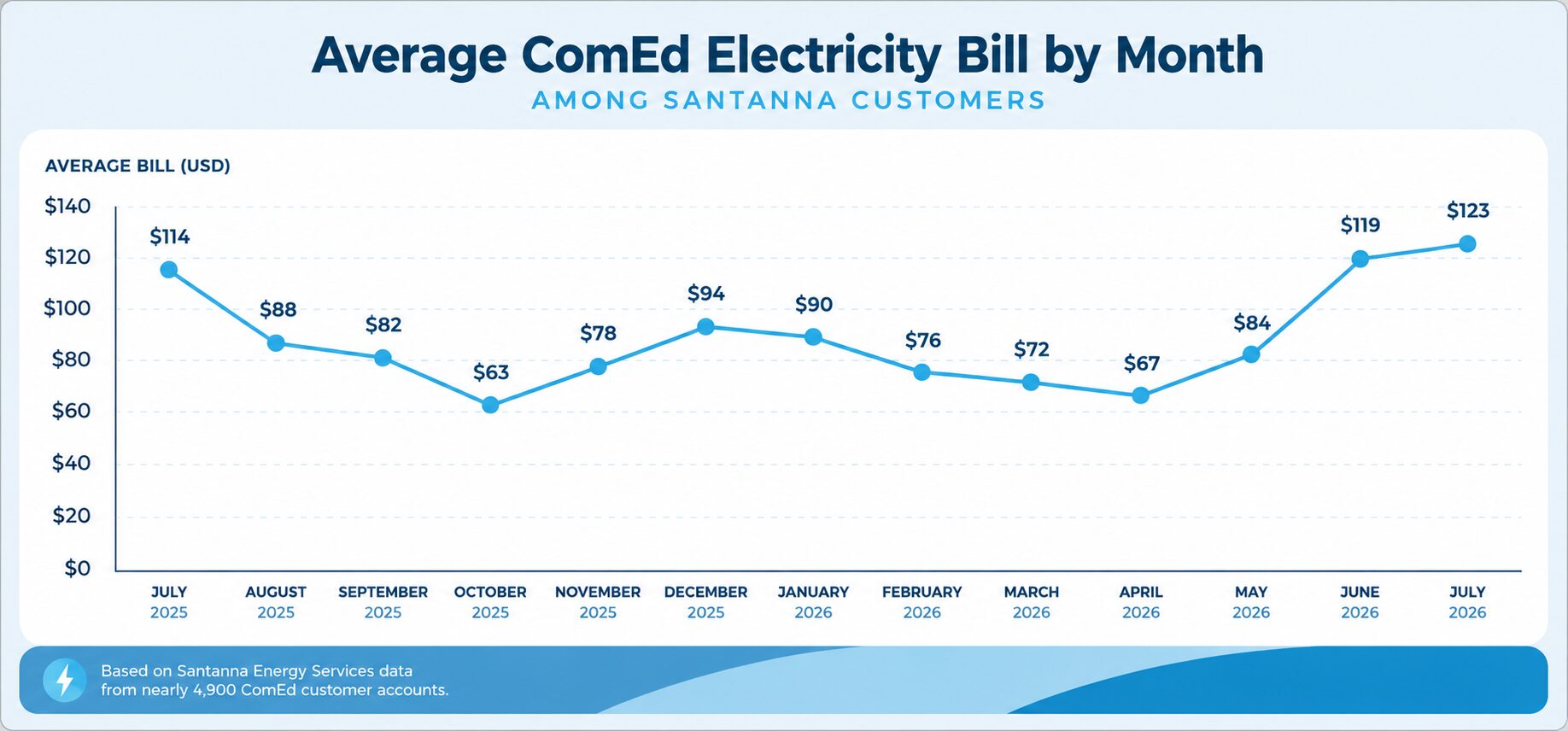
Pulling from our customer data from those within our ComEd utility territory, we found that average electricity usage increased nearly 102% from April 2026 – July 2026; showing just how fast your bill can double because of the changing seasons.
If your higher bill follows a stretch of unusually hot or cold weather, your heating or cooling system is likely a major contributor.
Growing Electricity Demand From Data Centers
According to reporting from the Chicago Sun-Times, growing demand from AI data centers is widely viewed as a factor that may contribute to higher regional electricity and capacity costs over time.
Illinois is seeing rapid growth in electricity demand from large data centers, including facilities that support artificial intelligence (AI) and cloud computing. These facilities require enormous amounts of electricity, placing additional demand on the regional electric grid.
While a single data center won’t directly raise your monthly bill, increasing demand across the grid can contribute to higher electricity and capacity costs over time. As Illinois continues to add more large energy users, these changes may affect the overall cost of supplying electricity to homes and businesses.
Your Electricity Supply Rate Changed
A higher electricity supply rate can increase your ComEd bill even if you used about the same amount of electricity.
ComEd historically adjusts their rate for their supply charge (the portion of your bill that pays for the electricity your home uses) twice a year; and the rate change taking effect in June 2026 – September 2026 is the highest supply change increase ComEd has enacted in the last decade. This 65% increase is enough to signifigantly increase your electricity bill.
Looking for control over your supply charge? Check out our Unlimited Energy plan! For Santanna customers enrolled in an Unlimited Energy Plan, your monthly electricity supply charge remains the same throughout the plan term, helping reduce surprises on the supply portion of your bill.*
If your electricity usage stayed relatively consistent but your total bill increased, reviewing the electricity supply section of your bill can help determine whether a change in your supply rate contributed to the increase.
Delivery Charges Increased
Delivery charges can also cause your ComEd bill to increase. Completely controlled by ComEd and fluctuating on almost a monthly basis, these charges help cover the cost of maintaining power lines, poles, transformers, substations, and other equipment needed to safely deliver electricity to your home.
High energy demand, increased power outages, and seasonal storms during the month can all lead to increased delivery charges on your electricity bill because these conditions can increase the cost of maintaining and operating the local electric grid – the very thing a delivery charge pays for.
Grid Capacity Costs Increased
Your ComEd bill can increase if higher grid capacity costs are passed through to customers. Capacity costs help ensure there’s enough electricity available during periods of high demand, such as extreme summer heat or winter cold, when homes and businesses are using much more electricity.
Utilities within the Pennsylvania-New Jersey-Maryland Interconnection (PJM), including ComEd, announced a $329.17 per Megawatt-day increase in capacity costs from June 1, 2026 through May 31, 2027 to keep up with electricity costs. This increase is about 22% higher than the price that was set last year for ComEd territory and about 11 times higher than what the price was two years ago.
That means even if your household usage stays the same, higher regional capacity costs can still show up as part of the supply-related charges on your ComEd bill.
Your Home Is Less Energy Efficient
A home that’s less energy efficient often uses more electricity because heated or cooled air escapes more easily. Common causes include drafty windows and doors, air leaks around the home, aging insulation, or inadequate attic insulation.
The same is true for even the tiniest of appliances. Leaving phone charges, computers, or other appliances plugged in for an extended period of time can affect the energy efficiency of your home too, leading to why your ComEd bill is so high.
If you’re looking for more ways to make your home energy efficient, check out our blog for some fool-proof tips.
Older Appliances May Use More Electricity
Older appliances often use more electricity than newer models because they become less efficient as they age. Even if they’re still working properly, they may require more energy to perform the same tasks.
Better Homes and Gardens explains that a 15 or 20-year-old fridge can use two to three times the energy of a newer Energy Star model. That’s often an extra $100–$200 a year at typical electric rates.
Air conditioners, refrigerators, freezers, water heaters, clothes dryers, and other large appliances are some of the biggest electricity users in many homes. As these appliances get older, normal wear and tear or a lack of regular maintenance can cause them to run longer and consume more electricity.
More People Are Using Electricity at Home
Changes in your household like a newborn baby, kids home from college on summer break or hosting holiday gathers can increase electricity usage more than you might expect, leading to why your ComEd bill is so high in Illinois. The more people who are home throughout the day, the more lights, electronics, appliances, and heating or cooling are typically used.
If your household routine has changed recently, it could explain why your ComEd bill is higher than usual.
Your Billing Cycle Was Longer Than Usual
A longer billing cycle can make your ComEd bill look unusually high even if your daily electricity usage hasn’t changed. Not every billing period contains the same number of days.
For example, a bill covering 35 days will naturally include more electricity usage than one covering 28 or 30 days because you’re paying for several additional days of electricity use. This can make your monthly bill appear much higher even though your daily habits stayed about the same.
If your bill seems unusually high, compare the number of billing days on your current and previous statements before assuming your electricity usage increased.
A Previous Bill Credit Expired
If you received a bill credit or promotional credit on a previous ComEd bill, your next bill may appear much higher once that credit ends, even if your electricity usage stayed about the same.
ComEd customers felt this effect as recently as May 2026 when a bill credit meant to add some relief from high rates expired. The end of this bill credit, along with increased demand for data centers, resulted in a 12% jump in monthly charges starting in June 2026.
Compare your current and previous bills to see whether any one-time credits, rebates, or adjustments were applied. If a previous bill included a credit that isn’t shown on your current bill, the higher total may simply reflect the expiration of that temporary discount.
An Estimated Bill or Billing Adjustment Changed Your Total
An estimated bill or billing adjustment can temporarily increase your ComEd bill if your actual electricity usage wasn’t recorded during a previous billing cycle. In these situations, your bill may be based on an estimate rather than an actual meter reading.
When an actual meter reading becomes available later, your bill may include an adjustment to correct the difference between the estimate and your actual electricity usage. Depending on the adjustment, this can make one month’s bill appear much higher or lower than expected.
Global Events Can Affect Electricity Prices
Major events around the world, such as wars, trade disruptions, or shortages of fuels used to generate electricity, can affect energy markets. When the cost of producing electricity increases, electricity supply prices may also rise over time.
While global events don’t directly change your ComEd bill overnight, they can influence the electricity supply portion of your bill, particularly if you’re on a plan where supply rates can change. If your electricity usage stayed about the same but your supply rate increased, broader market conditions may be one of the contributing factors.
Is Your ComEd Bill Normal? Let’s Find Out
Santanna Energy Services has worked with customers in ComEd territory for years, helping Illinois households understand their electricity bills, rates, usage, and energy costs. To give you a better idea of what a typical bill may look like, we reviewed data from nearly 4,900 of our ComEd customer accounts.
Our analysis included monthly electricity usage and invoice data from Santanna Energy Services customers within ComEd territory from July 2025 through July 2026. Individual bills vary based on usage, rate or plan, billing period, delivery charges, taxes and other factors.
In our data, the average monthly electricity bill for a ComEd customer was $87; the median bill was $71, which means half of the bills were $71 or less.
A bill around $87 per month is close to the overall average in our customer data and could be considered “normal”, while a bill significantly above that benchmark may be worth a closer look. However, a higher-than-average bill doesn’t necessarily mean something is wrong. Season, home size, electricity usage, your electricity supply plan, delivery charges and the length of your billing cycle can all affect what you pay.
On average, customers used about 660 kWh of electricity per month, while the median usage was 513 kWh.
Your bill can also change a lot depending on the season. For example, Santanna customers in our data paid an average of $67 in April 2026 and $123 in July 2026 – that’s an 84% increase in the average electricity bill in just three months!
Santanna Customer ComEd Benchmarks
- $87 – Average monthly bill
- $71 – Median monthly bill
- 660 kWh – Average monthly usage
- 513 kWh – Median monthly usage
How to Lower Your Future ComEd Bills
Lowering your future ComEd bills starts with addressing what caused them to increase in the first place. Whether your higher bill was driven by seasonal weather, higher electricity use, or changes to your electricity supply, focusing on the biggest contributors can have the greatest impact.
Here are some of the most effective ways to help reduce future electricity costs:
- Focus on Your Heating and Cooling System First: For many Illinois homes, heating and cooling account for the largest share of monthly electricity use. Setting your thermostat a few degrees higher in the summer or lower in the winter when you’re away helps reduce electricity use.
- Stop Your Home From Wasting Electricity: Check for drafts around windows and doors, seal visible air leaks, and make sure your attic has adequate insulation. These improvements help your home stay comfortable longer, so your HVAC system doesn’t have to run as often.
- Pay Attention to Your Biggest Electricity Users: Instead of trying to reduce electricity everywhere, focus on the appliances that use the most. Air conditioners, refrigerators, freezers, clothes dryers, water heaters, and electric heating equipment often have the biggest impact on your bill.
- Build Better Everyday Habits: Turning off lights when you leave a room, unplugging chargers that aren’t being used, running full loads in the dishwasher or washing machine, and limiting unnecessary use of portable heaters or window air conditioners can all help reduce electricity use over time.
- Review Your ComEd Bill Every Month: Reviewing your monthly bill can help you catch changes earlier. Compare your electricity usage (kWh), electricity supply charges, delivery charges, and the number of billing days with previous bills and the same month last year.
- Review Your Electricity Supply Options: Your electricity supply is one part of your bill that you may have a choice over. While ComEd continues to deliver electricity, maintain the power grid, and restore outages, eligible Illinois residents can choose a licensed electricity supplier, such as Santanna Energy Services, for the electricity supply portion of their bill.
If you’re looking for more predictable electricity supply charges, Santanna’s Unlimited Energy Plan can help reduce surprises on the electricity supply portion of your bill.* Delivery charges, taxes, and other utility fees continue to apply separately.
Can You Choose Your Electricity Supplier in Illinois?
Many Illinois homeowners can choose who supplies their electricity, even though ComEd continues to deliver that electricity to their home. This is possible because Illinois is a deregulated electricity market, which gives eligible customers the option to purchase electricity through ComEd’s default supply service or from a licensed retail electricity supplier.
It’s important to understand that choosing an electricity supplier does not change the reliability of your electric service. ComEd still owns and maintains the power lines, delivers electricity to your home, reads your meter, and responds to power outages. The main difference is who provides the electricity supply portion of your bill.
FAQs
Why did my ComEd bill double this month?
Your ComEd bill can double because of significantly higher electricity usage, extreme weather, a longer billing cycle, changes to your electricity supply rate, higher delivery charges, or one-time billing adjustments.
Why is my ComEd bill high even though I wasn’t home?
Your ComEd bill can still be high even if you weren’t home because appliances like refrigerators, freezers, water heaters, or HVAC systems may continue using electricity, and your bill may also reflect changes in electricity supply rates, delivery charges, or a longer billing cycle.
Where can I find my electricity usage on my ComEd bill?
Your electricity usage (kWh), billing period, and billing days are usually listed on the first page of your ComEd bill under your Account Summary, Energy Usage Details, or monthly usage history.
Does ComEd charge more during summer?
ComEd’s electricity supply price typically has separate summer and non-summer rates, and higher summer bills are also commonly driven by increased air conditioning use.
Does choosing another supplier stop ComEd from delivering my electricity?
No. ComEd continues to deliver your electricity, maintain the power grid, read your meter, and restore power outages, regardless of who supplies your electricity.
Many homeowners assume a high ComEd bill automatically means electricity prices went up, but that’s not always the case. In many situations, the increase comes from a combination of higher electricity usage, seasonal weather, changes to your electricity supply rate, delivery charges, or even a longer billing cycle.
Taking a few minutes to compare your electricity usage, review the different charges on your bill, and understand what changed can help you identify the real cause and make smarter decisions before your next bill arrives.
If you’re looking for another way to better manage your future electricity bills, it may also be worth reviewing the electricity supply portion of your service. Santanna’s Unlimited Energy Plan is designed to provide more predictable electricity supply charges, helping reduce surprises on the supply portion of your bill* while ComEd continues to deliver your electricity and maintain the power grid.
Knowing what caused your higher ComEd bill is the first step toward avoiding the same surprise next month.
* Restrictions apply. Enrollment based upon program eligibility. Customers using more than 125% of normal monthly usage as determined by Santanna may be required to switch plans.
Jenna Mendez is an experienced energy content professional who has spent four years researching, writing, and managing authoritative educational content for Midwest energy consumers at Santanna Energy Services. As a lifelong Illinois resident, Jenna brings firsthand knowledge of the region’s climate, communities, and household energy needs to her work.
She specializes in translating complex energy topics into clear, practical guidance about electricity and natural gas costs, appliance energy use, energy efficiency, and everyday home living. Drawing on industry research, Santanna customer data, and insights from experienced energy professionals, Jenna incorporates this knowledge into her content to help homeowners better understand their energy choices and make informed decisions for their households.