

Natural Gas vs Propane Grill: Which Fuel Type Is Right for You?

by Jenna Mendez
Updated: August 4, 2026
14.2 min read
Key Points of This Article:
- Natural gas grills are ideal for frequent grillers since they offer a continuous fuel supply and lower maintenance than a propane grill.
- Propane grills are often easier to set up and move, making them a strong option for occasional grilling, renters, tailgating, or homes without natural gas service.
- Natural gas grills may cost less to operate over time for frequent grillers than propane grills – with a cost difference of around $32–$96 per year.
When shopping for a new grill, it's easy to focus on the size, number of burners, or extra cooking features. But one of the most important decisions happens before you ever light the grill: choosing the fuel source.
Natural gas and propane can both power outdoor grills, but they operate differently, which can affect convenience, fuel availability, installation requirements, and your overall grilling experience.
At Santanna Energy Services, we love using our expertise as a natural gas energy supplier to help homeowners make sense of energy choices, and sometimes those choices show up in places you might not expect, like your backyard grill.
In this guide, we'll explain the key differences between both fuel types and help you determine which option makes the most sense for your home and grilling habits.
What Is a Natural Gas Grill?
A natural gas grill is an outdoor grill that connects directly to your home's natural gas line, so fuel is available whenever you want to cook without needing to refill or replace propane tanks.
The biggest difference is how the grill gets its fuel. Rather than storing fuel in a tank attached to the grill, a natural gas grill receives fuel through the same system that delivers natural gas to furnaces, water heaters, and stoves in many homes.
What Is a Propane Grill?
A propane grill is an outdoor grill that uses a portable tank of liquefied propane gas (LPG) rather than connecting directly to a home's natural gas line.
For many homeowners, propane grills are the most familiar type of gas grill because they are widely available and easy to set up. The propane tank is typically stored underneath or beside the grill and supplies fuel to the burners whenever the grill is in use.
Natural Gas vs Propane Grill: How Do They Compare?
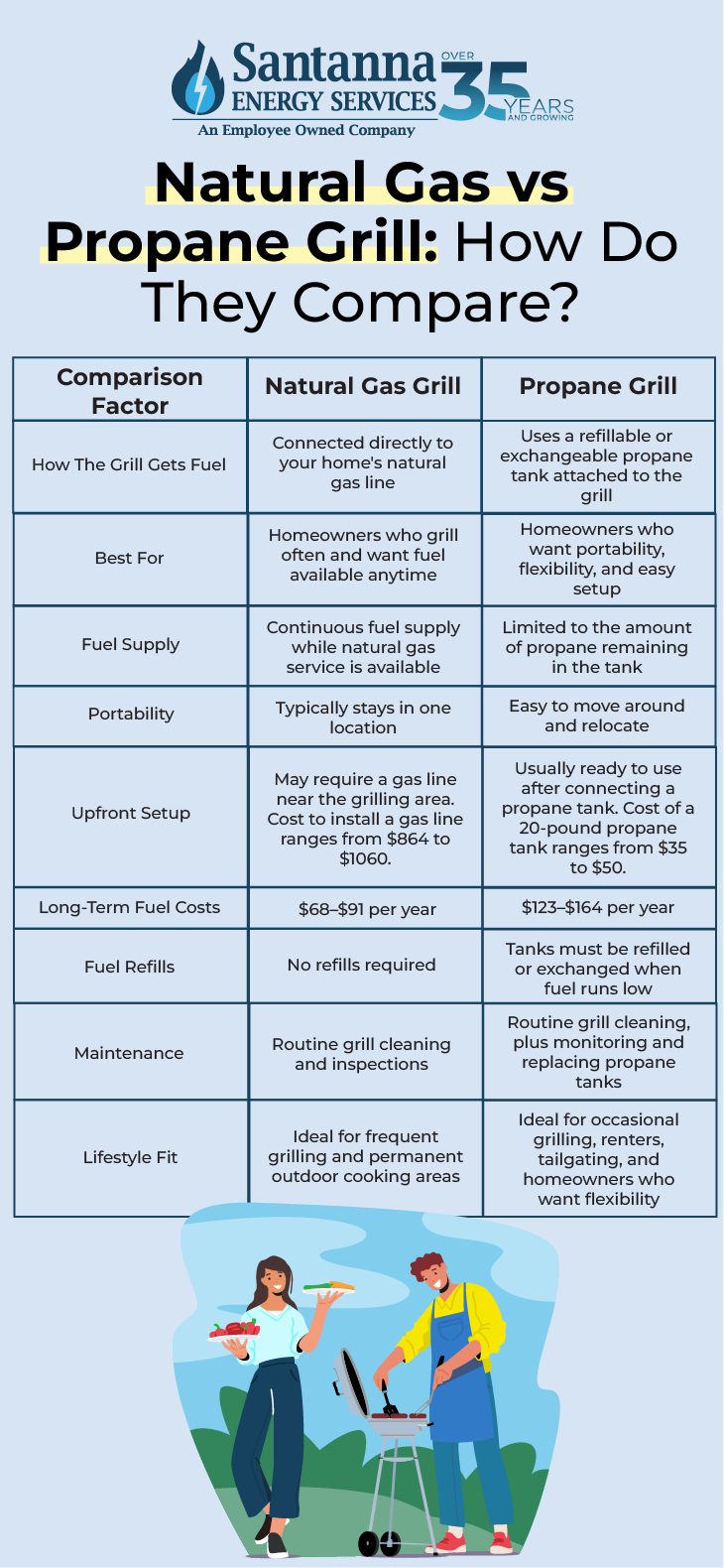
The biggest difference between a natural gas grill and a propane grill is how they receive and store fuel, and that difference can also affect convenience, costs, portability, and long-term use.
Both types of grills provide reliable outdoor cooking, but they fit different homes and lifestyles. Some homeowners prioritize a continuous fuel supply ready whenever they want to grill, while others prefer the flexibility of a grill they can move wherever needed.
The comparison below highlights some of the key differences homeowners often consider when deciding between a natural gas and propane grill.
Natural Gas vs Propane Grill: Side-by-Side Comparison
| Comparison Factor | Natural Gas Grill | Propane Grill |
| How the Grill Gets Fuel | Connected directly to your home’s natural gas line | Uses a refillable or exchangeable propane tank attached to the grill |
| Best For | Homeowners who grill often and want fuel available anytime | Homeowners who want portability, flexibility, and easy setup |
| Fuel Supply | Continuous fuel supply while natural gas service is available | Limited to the amount of propane remaining in the tank |
| Portability | Typically stays in one location | Easy to move around a patio, transport, or relocate |
| Upfront Setup | Requires a gas line near the grilling area. Homes without an existing outdoor gas line may need professional installation. Cost to install a gas line ranges from $864 to $1060. | Usually ready to use after connecting a propane tank. Cost of a 20-pound propane tank ranges from $35 to $50, while the propane inside the tank is estimated at approximately $9.42 to $12.58. Actual refill costs often range from $15 to $20+ depending on location and provider. |
| Long-Term Fuel Costs | Often lower for homeowners who grill frequently, with estimated fuel costs of about $68–$91 per year in our example | May be higher over time due to propane refills or tank exchanges, with estimated fuel costs of about $123–$164 per year in our example |
| Fuel Refills | No refills required | Tanks must be refilled or exchanged when fuel runs low |
| Maintenance | Routine grill cleaning and inspections | Routine grill cleaning, plus monitoring and replacing propane tanks |
| Potential Drawback | Less portable and may require installation costs | Can run out of fuel unexpectedly during cooking if the tank is not monitored |
| Lifestyle Fit | Ideal for frequent grilling and permanent outdoor cooking areas | Ideal for occasional grilling, renters, tailgating, and homeowners who want flexibility |
For many homeowners, the decision is less about how the grill cooks, and more about which fuel source best fits their lifestyle. If convenience and a permanent setup are priorities, natural gas may make more sense. If flexibility, ease of setup, and portability matter more, propane tanks may be a better fit.
Natural Gas vs Propane Grill: Which Is Cheaper to Operate?
For many homeowners, a natural gas grill may cost less to operate than a propane grill, with estimated fuel costs of about $5.00 to $6.75 per month compared to roughly $9.42 to $12.58 per month for propane under similar conditions.
We recently conducted a survey and asked our Employee-Owners whether they consider fuel efficiency or fuel cost when choosing a new grill, and 27% said that they do.
So, if this is also important to you, let's take a closer look at the price difference in our chart below:
Natural Gas vs. Propane Grill Fuel Costs
| Fuel Type | Estimated Monthly Cost | Estimated Annual Cost |
| Natural Gas | $5.68–$7.57 | $68–$91 |
| Propane | $10.25–$13.67 | $123–$164 |
| Difference | Propane costs about $32–$96 more per year |
To create this example, we assumed a homeowner is using a typical grill with about 500 square inches of cooking space for one hour, twice per week. Industry guidelines commonly recommend about 75 to 100 BTUs per square inch of grilling surface, which means a grill of this size may use approximately 37,500 to 50,000 BTUs per hour while operating.
For the natural gas estimate, we used the U.S. Energy Information Administration's April 2026 residential natural gas price of $18.17 per thousand cubic feet. Based on that rate and grilling schedule, the estimated fuel cost is approximately $5.68 to $7.57 per month, or about $68 to $91 per year.
For the propane estimate, we used the U.S. Energy Information Administration's April 2026 residential propane price of $2.458 per gallon. A standard 20-pound propane tank holds approximately 4.7 gallons of propane, resulting in a refill cost of about $12.57 per tank. Under the same grilling schedule, fuel costs are estimated at approximately $10.25 to $13.67 per month, or about $123 to $164 per year.
In this example, the natural gas grill costs approximately $2.68 to $6.10 less per month, or about $32 to $73 less per year, than the propane grill. Actual costs will vary based on grill size, grilling frequency, fuel prices, and local energy rates.
The biggest reason for the difference is that natural gas and propane are purchased differently. A natural gas grill receives fuel directly through your home's natural gas service, while a propane grill relies on refillable or exchangeable tanks that must be replaced when they run low.
How much you spend will depend on several factors, including:
- How often you grill
- How long each cooking session lasts
- The size and heat output of the grill
- Local natural gas and propane prices
- Seasonal grilling habits
For homeowners who only grill occasionally, the difference in annual fuel costs may be relatively small. However, for households that grill regularly year-round, fuel costs can become a more important factor in the decision.
Does Fuel Type Affect Grill Performance or Flavor?
For most homeowners, the fuel type has little impact on how the food tastes, and both natural gas and propane grills can deliver excellent grilling results.
In a blind taste test, most people would be unlikely to tell whether food was cooked on a natural gas or propane grill.
When it comes to performance, propane contains more energy per unit than natural gas, which can help some propane grills heat up faster or reach higher temperatures. However, grill design, burner quality, and temperature control often have a greater impact on cooking performance than the fuel source itself.
What Are the Pros and Cons of Natural Gas Grills?
Natural gas grills can be a great option for homeowners who grill frequently and want a convenient, long-term fuel solution. However, they may not be the best fit for every home or outdoor setup.
Advantages of Natural Gas Grills
- Continuous fuel supply: Natural gas is delivered directly through your home gas line, so there is no need to monitor fuel levels or refill tanks before a cookout.
- No propane tank refills or exchanges: Homeowners do not have to transport, store, refill, or replace propane tanks, which can save time and effort over the life of the grill.
- May cost less to operate over time: Depending on local fuel prices and how often you grill, natural gas may be less expensive than propane for frequent grilling.
- Convenient for regular grilling: Because fuel is always available, it is easy to start cooking without worrying about whether a propane tank is running low.
- Works well for permanent outdoor cooking areas: Natural gas grills are often a popular choice for outdoor kitchens and patios where the grill will remain in one location for years.
- Less storage space needed: There is no need to store spare propane tanks in a garage, shed, or other outdoor area.
Disadvantages of Natural Gas Grills
- Requires access to a natural gas line: Homes without a nearby gas connection may need a new gas line installed before a natural gas grill can be used.
- Higher upfront installation costs: Depending on your home's setup, if you need a natural gas line installed in your home for the first time, this can signifigantly drive up installation costs for a natural gas grill.
- Limited portability: Because the grill is connected to a gas line, it is usually intended to stay in one location.
- Not ideal for renters or frequent movers: Homeowners who expect to move soon may not benefit as much from investing in a permanent gas connection.
- Dependent on natural gas service: If natural gas service to the home is interrupted, the grill cannot be used until service is restored.
- May limit grill placement options: The location of the grill is often influenced by where the natural gas connection is installed.
What Are the Pros and Cons of Propane Grills?
Propane grills remain one of the most popular choices for homeowners because they are flexible, portable, and easy to set up. However, the convenience of portability comes with a few tradeoffs.
Advantages of Propane Grills
- Easy to install and start using: Most propane grills only require a connected propane tank and are ready to use without additional installation.
- Portable and flexible: Propane grills can be moved around a patio, relocated to a new home, or transported for outdoor gatherings.
- No natural gas connection required: Homes without natural gas service can still enjoy the convenience of a gas grill.
- Often lower upfront costs: Many homeowners can begin grilling without paying for gas line installation.
- Available in a wide range of sizes and styles: Propane grills are widely available, making it easy to find options that fit different budgets and outdoor spaces.
- Easy to take with you when moving: Homeowners can typically bring their propane grill to a new home without worrying about gas connections.
- Works well in homes without natural gas service: Propane provides a gas grilling option for homeowners in areas where natural gas may not be available.
Disadvantages of Propane Grills
- Fuel supply is limited by the tank size: If the tank runs out, grilling must stop until the tank is refilled or replaced.
- Requires ongoing tank refills or exchanges: Homeowners need to monitor fuel levels and plan ahead to avoid running out of propane.
- May cost more to operate over time: Depending on fuel prices and grilling habits, propane costs can add up for homeowners who grill frequently.
- Requires propane tank storage: Extra tanks may need to be stored safely if you want a backup fuel supply available.
- Less convenient for frequent grilling: Homeowners who grill often may find it inconvenient to regularly monitor fuel levels, refill tanks, or exchange empty propane tanks throughout the grilling season.
- Fuel costs can be harder to predict: Propane refill and exchange prices can vary by location, season, and supplier.
- Requires keeping a backup tank on hand: Many homeowners keep a spare tank available to avoid interruptions, which can add to storage needs and upfront costs.
Can You Convert a Propane Grill to Natural Gas?
Yes, some propane grills can be converted to natural gas, but only if the grill manufacturer offers an approved natural gas conversion kit for that model.
For homeowners, this can provide added flexibility. Depending on the grill, you may be able to start with propane and later switch to natural gas if your grilling needs change or if a natural gas connection becomes available at your home.
Before purchasing a grill with future conversion in mind, check whether the manufacturer offers an approved conversion kit for that specific model. Not all propane grills are designed to be converted, so confirming compatibility beforehand can help you avoid surprises later.
Can You Use Propane on a Natural Gas Grill?
No, not unless the grill is specifically designed and approved for conversion. Propane and natural gas require different pressure and burner components, so using the wrong fuel can be unsafe.
Natural Gas vs Propane Grill: Which Is Better for Your Home?
Neither a natural gas grill nor a propane grill is automatically better for every home. The best choice depends on how often you grill, how your home is set up, and which features matter most to you.
A Natural Gas Grill May Be Right for You If:
- You grill frequently throughout the year.
- You already have natural gas service at your home.
- You want to avoid propane tank refills or exchanges.
- You prefer long-term convenience.
- You plan to keep your grill in a permanent outdoor cooking area.
- You want potentially lower fuel costs over time.
- You expect to stay in your home for several years.
A Propane Grill May Be Right for You If:
- You want a grill that is easy to set up.
- You prefer the flexibility to move your grill.
- You do not have access to a natural gas line.
- You rent your home or may move to a new home in the near future.
- You grill occasionally rather than several times per week.
- You want a lower upfront investment.
- You want the option to take your grill camping, tailgating, or to outdoor gatherings.
If you grill several times a week and want fuel available whenever you're ready to cook, a natural gas grill may be the better fit. On the other hand, if you value portability and want a grill that can easily move with you, propane may make more sense.
The good news is that you do not have to sacrifice food quality either way. Both natural gas and propane grills can deliver excellent cooking performance when used properly. For most homeowners, the decision comes down to convenience, flexibility, fuel availability, and long-term costs rather than how the food tastes.
Instead of asking which grill is better overall, ask yourself which option best fits the way you plan to use it. The right choice is the one that works best for your home, your budget, and your grilling habits.
FAQs
Does a Natural Gas Grill Use a Lot of Gas?
No, in our example, a typical 500-square-inch natural gas grill uses approximately 37 to 50 cubic feet of natural gas during an hour of grilling, which is relatively modest compared to many other natural gas appliances in the home.
Can a Natural Gas Grill Run Out of Fuel?
Not typically, as long as natural gas service to your home is available and the gas supply is not interrupted.
How Long Does a Propane Tank Last on a Grill?
A standard 20-pound propane tank typically provides about 18 to 20 hours of grilling time on a medium-sized grill, although actual usage varies by grill size and cooking temperature.
Choosing between a natural gas and propane grill ultimately comes down to how you like to grill and what fits your lifestyle best. If you value convenience and a continuous fuel supply, a natural gas grill may be the better fit. If you prefer flexibility and portability, propane may make more sense. Either way, both fuel types can deliver great grilling results, so you can focus on enjoying the food and the people gathered around your grill.
If you're already using natural gas at home, you may also be interested in ways to make your energy choices go a little further. Santanna's Unlimited Energy Plan gives you a consistent supply charge each month no matter how often you grill.*
* Restrictions apply. Enrollment based upon program eligibility. Customers using more than 125% of normal monthly usage as determined by Santanna may be required to switch plans.
Jenna Mendez is a Midwest native with lifelong roots in Illinois and time spent in Ohio during college, giving her a deep understanding of the Midwest region’s people, climate, and energy needs. She brings firsthand experience and local insight to topics that matter to Midwest homeowners, especially energy efficiency, sustainability, and home living. Jenna specializes in writing about eco-friendly living, all things Midwest, renewable energy, and practical ways to reduce energy costs. Jenna brings a trusted, and local hometown voice to every article she writes, helping readers live well, and sustainably, right where they are.