
Do Dishwashers Use Hot Water and Does It Affect Energy Costs?

by Tyler Castle
Updated: September 1, 2026
13.5 min read
Key Points of This Article:
- Most dishwashers use hot water from the home's water heater and may also heat it internally to reach effective cleaning temperatures, typically around 120°F to 150°F.
- Heating water is a major part of dishwasher energy use, so your water heater type, energy rates, and cycle settings can affect the total cost of each load.
- Modern ENERGY STAR® certified dishwashers generally use about 3 to 5 gallons of water per cycle, making them more water- and energy-efficient than hand washing full loads.
- Homeowners can lower dishwasher energy costs by running full loads, using Eco Mode, skipping heated dry, scraping instead of pre-rinsing, and keeping the dishwasher and water heater working efficiently.
Each time a dishwasher runs, it depends on hot water to help break down grease, clean dishes, and support proper sanitation. What many people do not realize is that the energy used to heat that water can have a bigger impact on overall energy costs than the dishwasher itself.
So, the real question is not just whether dishwashers use hot water, but how much that hot water actually affects what you pay on your energy bill over time.
As an energy supplier serving the Midwest for over 35 years, we help homeowners better understand how everyday energy use, like heating water for appliances such as dishwashers, impacts monthly energy costs.
In this guide, we'll explain whether dishwashers use hot water, where it comes from, how it influences energy costs, and what small changes can help improve efficiency without changing how well your dishes get cleaned.
Do Dishwashers Use Hot Water?
Most dishwashers use hot water because it helps break down grease, remove stuck-on food, and clean dishes more effectively than cold water; temperatures typically heat around 120°F to 150°F.
Hot water also helps detergents work better and supports proper sanitation during the wash cycle. It can also help sanitize dishes by reaching temperatures that are more effective at removing bacteria and germs than cold water alone.
In most homes, a dishwasher gets hot water from the same water heater that supplies hot water to showers, sinks, and other appliances.
This means a dishwasher relies on more than just electricity to operate. Because heating water requires energy, the hot water used during each wash cycle can play an important role in the appliance’s overall energy use and operating costs.
Dishwasher Hot Water Quick Facts
- Uses hot water? Yes, most modern dishwashers use hot water supplied by your home’s water heater and may further heat it internally.
- Typical water temperature: Approximately 120°F to 150°F.
- Water used per load: About 3 to 5 gallons for most ENERGY STAR® certified dishwashers.
- Electricity used per load: Approximately 1.8 kWh per standard wash cycle.
- Estimated cost per load: Around $0.33 based on the U.S. average residential electricity rate of 18.44¢/kWh (May 2026).
- More efficient than hand washing? Usually yes, especially when running a full load in a modern dishwasher.
How Does a Dishwasher Heat Water?
Most dishwashers heat and maintain water temperature using a combination of hot water from your home and a built-in heating element inside the appliance.
Here is how the process typically works:
- Step 1: The dishwasher fills with water: When a cycle starts, the dishwasher pulls water from your home’s plumbing system. In most homes, this water comes through the hot water line connected to the water heater and enters the bottom of the dishwasher tub.
- Step 2: The dishwasher begins heating and adjusting the water: Once water enters the tub, the dishwasher works to make sure it reaches the right cleaning temperature. If the incoming water is not hot enough or begins to cool, the appliance adjusts it using internal controls and heating components.
- Step 3: A built-in heating element increases water temperature if needed: Most dishwashers have a heating element located at the bottom of the tub. This component helps raise the water temperature to the level needed for effective cleaning.
- Step 4: The dishwasher maintains temperature during washing: As water is sprayed and circulated across dishes, the dishwasher continues monitoring temperature. If needed, the heating element turns on again to help keep water at a consistent cleaning level throughout the cycle.
- Step 5: Higher-heat cycles add extra heat for sanitizing and drying: Some cycles, such as sanitize settings, increase water temperature to around 150°F or higher to help kill 99.999% of food soil bacteria. Heated dry settings also use additional heat after washing to help dry dishes more quickly.
Dishwashers rely on both your home’s water heater and their own internal heating system. While most cycles start with hot water from your home, the appliance continuously adjusts and maintains temperature to ensure effective cleaning and sanitization.
How Much Hot Water Does a Dishwasher Use?
According to Maytag, a typical ENERGY STAR® certified dishwasher uses approximately 3 to 5 gallons of water during a cycle, while ENERGY STAR® certified compact models average about 2.7 gallons per cycle.
Some heavier cleaning cycles may use up to 9 gallons of water. For homeowners, this means a modern dishwasher often uses a relatively small amount of water to clean an entire load of dishes, especially compared to washing dishes by hand with running hot water.
Water use can vary depending on the dishwasher model, the cycle selected, and the age of the appliance. In general, newer dishwashers are designed to clean effectively while using significantly less water than many older models.
How Dishwasher Water Use Compares to Hand Washing Your Dishes
| Factor | Dishwasher (ENERGY STAR® Certified) | Hand Washing |
| Typical Water Use | 3 to 5 gallons per load | Up to 27 gallons per load |
| Energy Use | Uses 12% less energy | Can use more than twice the energy of an ENERGY STAR® certified dishwasher |
| Water Efficiency | Uses up to 30% less water compared to standard assumptions of hand washing | Uses significantly more water |
| Water Heating Demand | Generally lower because less water needs to be heated | Generally higher when more hot water is used |
| Annual Water Impact | Can save more than 8,400 gallons of water per year compared to hand washing | Uses significantly more water over the course of a year |
| Best For | Full loads of dishes | Small numbers of dishes or delicate items |
Note: Based on ENERGY STAR's estimate of 8,400 gallons of annual water savings and an example of one dishwasher load per day. Actual savings will vary depending on household size, dishwashing habits, and dishwasher efficiency.
For most households, running a full load in a modern dishwasher typically uses less water and energy than washing the same dishes by hand.
Because every gallon of hot water must be heated before it reaches the sink, using more hot water can also increase the amount of energy needed to wash dishes.
For homeowners who regularly wash full loads, a modern dishwasher is often the more water- and energy-efficient option.
Does Using a Dishwasher Increase Your Energy Bill? How Much It Costs To Run It
Using a dishwasher does increase your energy bill; a typical 2-hour wash cycle costs about $0.33 per cycle, which is relatively low for a full load of dishes.
To estimate this cost, we use a standard dishwasher energy profile of 1.8 kilowatt-hours (kWh) for a regular wash cycle that runs about 2 hours. Based on the U.S. average residential electricity rate of $0.1844 per kWh as of May 2026, according to the Energy Information Administration, this results in an estimated cost of $0.33 per cycle including water heating.
However, a significant portion of a dishwasher's energy use is tied to heating water. According to the U.S. Energy Information Administration and the Center for Climate and Energy Solutions, water heating accounts for about 18% of total home energy use in the U.S. and is typically the third largest source of energy use in a home.
Since dishwashers rely on hot water to clean effectively, this makes water heating an important part of their overall energy impact.
In other words, the dishwasher itself uses electricity to run, but it also depends on the home's hot water system to complete the cleaning process.
The exact cost of running a dishwasher depends on your dishwasher model, water heater type, utility rates, wash settings, and how often you run the appliance.
Estimated Dishwasher Operating Costs Based on One Load Per Day
| Time Period | Estimated Total Cost |
| Per Load | $0.33 |
| Daily | $0.33 |
| Weekly | $2.31 |
| Monthly | $10.03 |
| Yearly | $120.45 |
Note: Estimates are based on 1.8 kWh per cycle, one load per day, and an electricity rate of $0.1844 per kWh. Actual costs will vary depending on household usage, appliance efficiency, and selected cycle.
In most homes, dishwasher energy use is influenced not only by the appliance itself but also by how efficiently the home's water is heated and how often the appliance is used.
Does a Gas Water Heater Change Dishwasher Costs?
If you have an electric water heater, most of the energy needed to heat water for your dishwasher is reflected on your electricity bill. If you have a natural gas water heater, however, much of that water-heating cost appears on your natural gas bill instead.
If you have a natural gas water heater, much of the energy needed to heat the dishwasher's water appears on your natural gas bill instead of your electricity bill.
Based on a typical dishwasher using 3 to 5 gallons of hot water per cycle and an average natural gas price of $19.83 per therm as of May 2026, heating the water generally costs about $0.30 to $0.50 per load, depending on the amount of hot water used and your water heater's efficiency.
Can Water That Is Too Hot Increase Dishwasher Energy Costs?
Using water that is hotter than necessary can increase the amount of energy needed to run your dishwasher by as much as 0.44 to 0.73 kWh and can cost $0.08 to $0.13.
Most dishwashers are designed to clean effectively with incoming water around 120°F. If your water heater is set significantly higher, it takes more energy to heat and maintain that higher temperature before the water even reaches the dishwasher.
While the dishwasher can safely use hotter water, consistently heating water beyond what is needed may increase household energy costs without providing noticeable improvements in everyday cleaning.
For most households, keeping your water heater at the manufacturer's recommended setting and reserving high-temperature or sanitize cycles for occasional use can help balance effective cleaning with lower energy use.
What Dishwasher Settings Use the Most Energy?
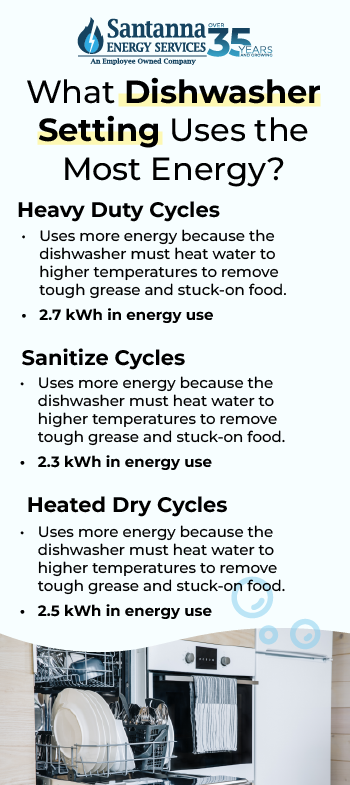
Some dishwasher settings use more energy because they change how much heat is needed, how long the cycle runs, or how much drying is required at the end. These differences can affect how much electricity is used each time you run a load.
- Heavy duty wash cycles use more energy because the dishwasher must heat water to higher temperatures to remove tough grease and stuck-on food. The hotter the water needs to be, the more energy is used to reach and maintain that temperature throughout the cycle.
- Sanitize settings increase energy use even further because they raise water temperatures to levels designed to help reduce bacteria and improve hygiene. These higher temperatures require more heating time and more electricity overall.
- Heated dry cycles are often one of the biggest contributors to energy use because the dishwasher continues running electricity after the washing phase ends. This stage uses heat to evaporate water from dishes, which can add noticeable energy use per cycle.
In general, dishwasher energy use increases anytime more heat or longer drying is required. Understanding these settings can help homeowners choose cycles that balance cleaning performance with lower energy consumption.
How To Lower Dishwasher Energy Costs
Looking to lower your dishwasher's energy use? Check out our tips for doing just this.
Run full loads before starting the dishwasher
Running your dishwasher only when it is full helps you use the same amount of energy and water for more dishes. This reduces how often you need to run cycles, which directly lowers overall electricity use over time.
In a recent survey of Santanna Energy Experts, 67% said they only run their dishwasher when it's completely full, while 20% said they sometimes run partially full loads and 13% said they do both.
Waiting until the dishwasher is full helps maximize every wash cycle, reducing the amount of water and energy used per dish.
Use Eco Mode whenever possible
Eco Mode is designed to use less energy and water by lowering the water temperature and extending the wash time. While it may take longer, it reduces the amount of energy needed to heat water and complete the cycle.
Skip the heated dry option
Heated drying uses extra electricity after the wash cycle ends. Instead, open the dishwasher door slightly after the cycle finishes and let dishes air dry naturally. This simple change can reduce one of the highest energy-use stages in the cycle.
Scrape dishes instead of pre-rinsing
Modern dishwashers are built to handle food residue. Instead of rinsing dishes under running water, simply scrape off leftover food. This helps avoid unnecessary water use and reduces the energy needed for heating extra water.
Clean filters and spray arms regularly
When filters or spray arms are clogged, the dishwasher has to work harder and run longer cycles to clean properly. Regular cleaning helps maintain normal cycle times and prevents wasted energy from inefficient washing.
Use lighter or shorter wash cycles when possible
Not all loads require heavy-duty settings. For lightly soiled dishes, using shorter or normal cycles helps reduce both water heating and electricity use compared to intensive wash modes.
Improve your home's water heater efficiency
Because dishwashers rely on hot water from your home, your water heater has a direct impact on dishwasher energy use. An efficient or properly maintained water heater can reduce the amount of energy needed to heat water before each wash cycle starts.
For most households, dishwasher energy costs are not just about the appliance itself, but about how efficiently hot water is used and produced in the home. By using smarter dishwasher settings and improving how your water heater performs, you can reduce unnecessary energy use and keep everyday operating costs lower over time.
FAQs
Can You Run a Dishwasher Without Hot Water?
Yes, most modern dishwashers can run on cold water because they include internal heaters that raise water to the required cleaning temperature during the cycle, although some older models are designed to work best with a hot water supply from the home's water heater.
Do Dishwashers Use More Electricity When Heating Cold Water?
Yes, dishwashers typically use more electricity when they must heat incoming cold water to reach cleaning temperatures.
Can All Dishwashers Sanitize With Internal Heat?
No, only dishwashers with a sanitizing or high-temperature cycle can reach the higher temperatures needed for sanitization.
Is It Cheaper to Run a Dishwasher at Night?
It can be cheaper in areas with time-of-use electricity rates where off-peak nighttime pricing is lower, but it depends on your local utility plan.
Should You Run Hot Water Before Starting the Dishwasher?
Some manufacturers suggest briefly running the kitchen tap to ensure hot water reaches the dishwasher faster, but running it too long can waste water and energy.
Most dishwashers do use hot water, and that means a key part of their energy use is connected to how your home heats that water. While a single cycle is usually low in cost, factors like cycle settings, drying options, and your water heater's efficiency can all influence your energy use over time. Simple habits like running full loads, using eco mode, and skipping heated dry can help improve efficiency while still keeping dishes clean.
At the end of the day, understanding how your dishwasher and water heater work together can make it easier to see where your energy use comes from. But even with good habits, the cost of heating water can still fluctuate month to month depending on usage patterns and home efficiency.
That is where Santanna's Unlimited Energy plan can help. It offers predictable supply charges, helping reduce the impact of usage swings on your monthly bill*, especially in homes where appliances like dishwashers and water heaters are used frequently.
* Restrictions apply. Enrollment based upon program eligibility. Customers using more than 125% of normal monthly usage as determined by Santanna may be required to switch plans.
Tyler is an experienced energy professional, having worked for Santanna Energy Services, for the past four years. He is passionate about renewable energy and believes that diversifying the energy grid is the key to a sustainable future. Tyler is dedicated to supplying consumers with the best possible energy solutions and works diligently to make sure that Santanna can deliver the highest quality service.