

How Many kWh of Electricity Does a House Use? And How Does Energy Use Affect Your Bill?

by Tyler Castle
Updated: August 12, 2026
15.5 min read

Key Points of This Article:
- The average U.S. household uses about 875 kWh of electricity per month, while Santanna customers averaged 934 kWh based on a year of anonymized electricity usage data.
- A home's electricity usage can vary significantly depending on its size, location, heating system, weather, appliances, and the number of people living there.
- The average electricity usage among Santanna customers averaged 1,040 kWh in summer and 1,023 kWh in winter; with summer usage only about 2% higher.
- Understanding what affects your electricity usage can help you better interpret your electric bill and identify opportunities to manage your home's energy use more effectively.
Many homeowners assume there's a "normal" amount of electricity every house should use each month. So, when they see a number like 800, 1,200, or even 2,000 kWh on their electric bill, it's easy to wonder if something is wrong or if they're paying more than they should.
The truth is every home use electricity differently and total usage can vary. So how do you know whether your electricity usage is typical? That's where we can help.
To provide a more realistic benchmark, we analyzed electricity usage from over 32,000 of our real Santanna customers across Illinois, Ohio, and Pennsylvania, giving you a way to compare your home's usage against real households in your region. Let's jump in.
How Much Electricity Does a House Use?
According to the U.S. Energy Information Administration, the average U.S. household uses about 10,500 kilowatt-hours (kWh) of electricity per year, or roughly 875 kWh per month and 29 kWh per day.
Some households naturally use much less electricity, while others use much more. For example, a small home with one or two people may use only a few hundred kilowatt-hours each month.
A larger home with several occupants, electric heating, a pool, or an electric vehicle may use well over 1,500 kWh each month. That doesn't automatically mean one home is wasting electricity. It simply reflects different energy needs.
Think of your home's electricity use like your monthly grocery bill. Two families shopping at the same store can spend very different amounts depending on how many people they feed and what they buy. Electricity works the same way.
Based on an analysis of over 32,000 Santanna Energy Services customers, we found that households used an average of 934 kWh per month, or about 31 kWh per day based on data from July 2025 – June 2026.
How Much Electricity Does a House Use: National Average vs. Santanna Energy Services’ Customers
| Source | Average Monthly Electricity Usage |
| Average U.S. Household | 875 kWh |
| Santanna Customers | 934 kWh |
National estimates provide a broad benchmark, while Santanna customer data offers a closer look at actual electricity usage among households in our service areas.
Keep in mind that regional climate, home heating systems, and household characteristics can all influence electricity usage, which is why local data often provides a more meaningful benchmark.
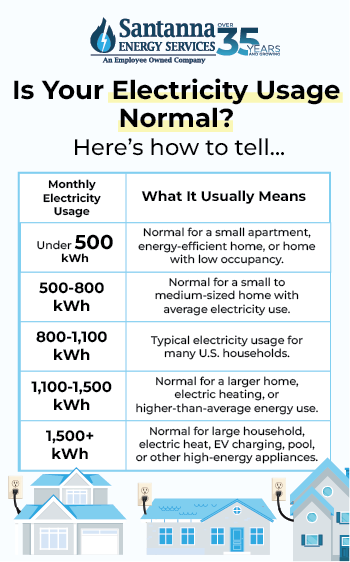
Is Your Electricity Usage Normal?
One of the questions we hear most often is, "Is my electricity usage normal?" While every home is different, we analyzed a year's worth of anonymized Santanna customer data to understand what typical electricity usage looks like across our service areas.
Even experienced homeowners don't always know what's typical. In fact, 65% of Santanna Energy Experts said they've been surprised by how much electricity their own home uses.
We found that there isn't one "normal" amount of electricity every home should use.
But as a benchmark, we did find that Santanna customers averaged 934 kWh per month, while the median household used 709 kWh, showing that many homes naturally use less than the average.
Is Your Monthly Electricity Usage Typical?
| Monthly Electricity Usage (kWh) | Is Your Usage Normal? |
| Less than 500 kWh | Lower than average. Common for apartments, small homes, vacation homes, or 1–2 person households. |
| 500–900 kWh | About average. Around the average amount for many U.S. households. |
| 900–1,300 kWh | Slightly above average. Common for larger homes, more occupants, or heavy AC use. |
| 1,300–1,800 kWh | High, but explainable with electric heat, pools, EV charging, or larger households. |
| More than 1,800 kWh | Very high, and worth reviewing unless your home has known high-energy needs. |
Using less than 500 kWh a month may be typical for apartments, smaller homes, vacation homes, or 1–2 person households, while usage above 1,300 kWh may be normal for larger homes, households with electric heating, pools, EV charging, or multiple occupants.
If your monthly usage is above 1,800 kWh and you don't have a clear reason for it, it may be worth reviewing your home's energy use to identify possible sources of waste. Start by looking for changes in weather, household routines, new appliances, HVAC use, or billing-period length before assuming something is wrong.
The best comparison is not just against a national average, but against similar homes and your own usage trends over time.
Comparing your current kWh usage to the same month last year can help you spot whether a higher bill is part of a normal seasonal pattern or a sign that something has changed.
Your home's electricity use can vary based on its size, the number of people living there, local climate, heating and cooling systems, appliance efficiency, and daily energy habits. That's why a "high" number is not always a problem, especially if your home has known high-energy needs.
Average Electricity Usage by Household Size Nationwide (Based on the U.S. average residential electricity rate of 18.44¢ per kWh as of May 2026, U.S. Energy Information Administration)
| Home Size | Estimated Monthly Electricity Use | Estimated Monthly Electricity Cost* |
| 500–1,000 sq. ft. | 400–700 kWh | $74–$129 |
| 1,001–1,500 sq. ft. | 700–1,000 kWh | $129–$184 |
| 1,501–2,000 sq. ft. | 1,000–1,300 kWh | $184–$240 |
| 2,001–2,500 sq. ft. | 1,300–1,800 kWh | $240–$332 |
| 2,501–3,000+ sq. ft | 1,800–2,300 kWh | $332–$424 |
Actual electric bills vary based on your electricity rate, utility delivery charges, taxes, fixed fees, weather, heating and cooling systems, appliance efficiency, and household energy habits.
Average Monthly Electricity Usage by Home Size (Santanna Customer Data)
| Home Size | Average Monthly Electricity Usage | Estimated Monthly Electricity Cost** |
| 500–1,000 sq. ft. | 697 kWh | $129 |
| 1,001–1,500 sq. ft. | 823 kWh | $152 |
| 1,501–2,000 sq. ft. | 955 kWh | $176 |
| 2,001–2,500 sq. ft. | 1,065 kWh | $197 |
| 2,501–3,000 sq. ft. | 1,145 kWh | $211 |
**Based on anonymized Santanna customer electricity usage from July 2025 to June 2026. Estimated monthly electricity costs use the U.S. average residential electricity rate of 18.44¢ per kWh as of May 2026.
Based on our real customer data, average monthly electricity usage was 934 kWh. At the U.S. average residential electricity rate of 18.83¢ per kWh, that usage would equal approximately $175.86 in electricity costs before utility delivery charges, taxes, fixed fees, and other bill components.
If your monthly electricity usage is close to 934 kWh, your home's energy consumption is generally in line with what we observed among Santanna customers. If your bill is significantly higher or lower than $168, your electricity rate, utility delivery charges, taxes, and other fees may be contributing to the difference and may be worth an evaluation.
Keep in mind that square footage alone doesn't determine electricity usage. Factors such as the number of occupants, heating fuel, appliance efficiency, and daily energy habits can have just as much impact on your monthly electricity use.
Average Electricity Usage by State
Now let's look at how your electricity usage can vary by state. Climate, heating systems, home size, and household habits all influence how much electricity a typical home consumes.
To provide a more regional benchmark, we analyzed anonymized electricity usage from 4,000 Santanna customers across Illinois, 19,000 Santanna customers across Ohio, and 7,000 Santanna customers across Pennsylvania over a 12-month period.
Average Monthly Electricity Usage by State (Santanna Customer Data)
| State | Average Monthly Electricity Usage |
| Illinois | 632 kWh |
| Ohio | 920 kWh |
| Pennsylvania | 1,261 kWh |
Our analysis of Santanna customer data shows that electricity usage can vary dramatically depending on where you live.
Among the states we analyzed, Pennsylvania households used nearly twice as much electricity as Illinois households, while Ohio households used almost half as much energy as residents in Illinois.
Why Does Electricity Usage Vary So Much by State?
It’s easy to assume higher electricity usage means a home is less energy efficient, but that’s not always the case.
Several factors can influence how much electricity households use, including:
- Local weather and seasonal temperatures.
- Electric vs. natural gas heating systems. According to the American Natural Gas Association, powering your home with electricity costs are 3.5 times higher than natural gas.
- Average home size; the bigger the home, the higher the electricity use.
- Number of occupants.
- Air conditioning demand Air conditioners significantly increase summer electricity use, with cooling accounting for about 12% of a typical household’s annual energy consumption in summer.
- Everyday lifestyle and appliance usage
For example, Santanna customers in Pennsylvania averaged nearly twice as much monthly electricity usage as customers in Illinois. That difference doesn’t necessarily mean Pennsylvania homes are wasting energy. It simply reflects that energy needs can vary considerably depending on where you live.
How Electricity Usage Changes Throughout the Year
Electricity usage doesn’t stay the same every month. Electric heating during winter and air conditioning during summer can significantly increase household electricity demand.
Based on Santanna customer data, average electricity usage during the summer months (June through August) was approximately 1,040 kWh per month. During the winter months (November through January) it was approximately 1,023 kWh per month.
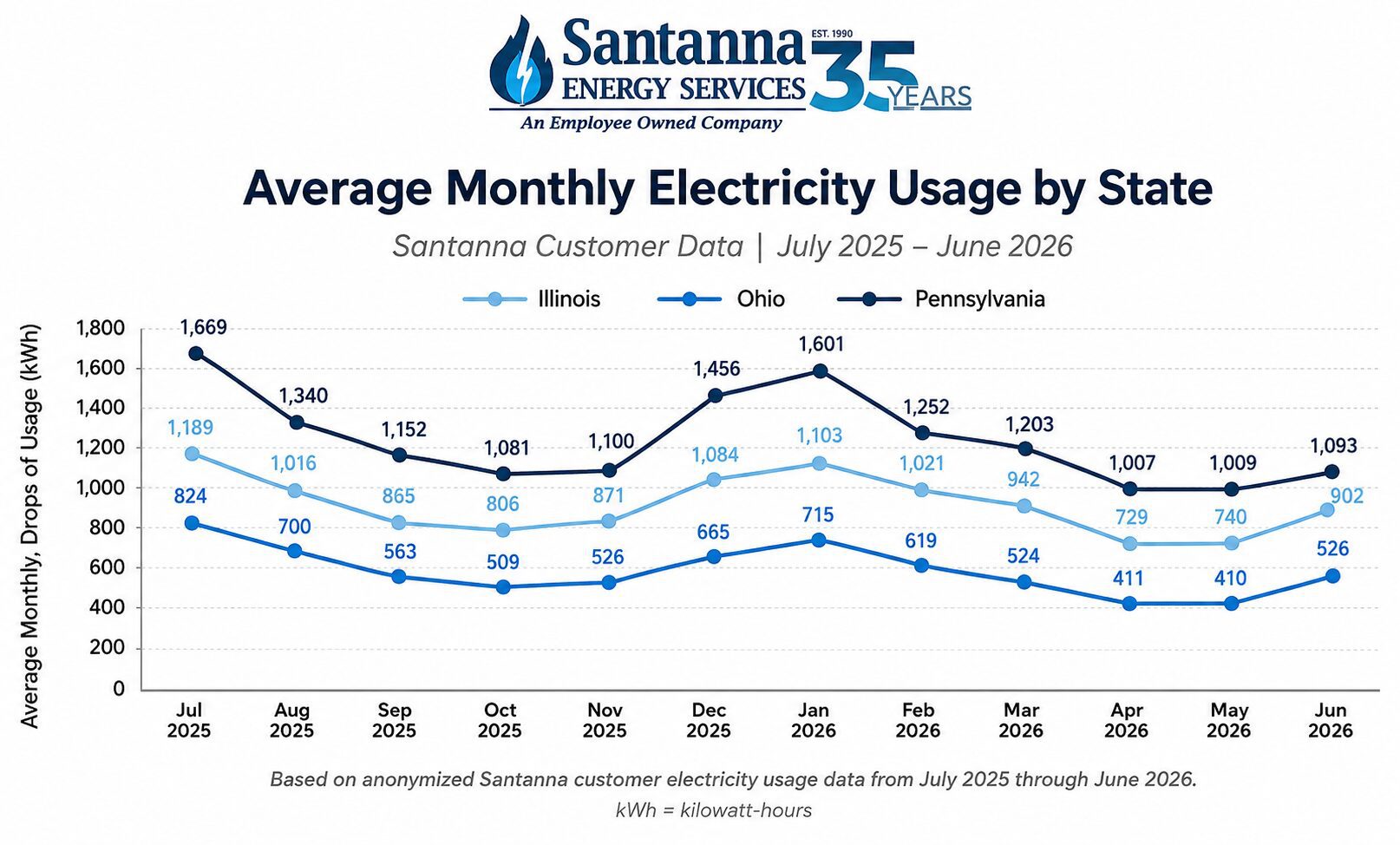
Santanna customer data also shows that electricity usage can shift significantly from one month to the next.
Across the three states analyzed, usage tended to be highest during the hottest summer months and the coldest winter months, while spring and fall generally brought lower electricity demand.
April and May were among the lowest-usage months, likely because many households needed less heating and air conditioning during milder weather.
Interestingly, average summer electricity usage was only about 2% higher than winter usage among Santanna customers.
What Factors Affect Your Home’s Electricity Usage?
Your home’s electricity use depends on much more than its size. Factors like the number of people living in your home, the weather, the appliances you use, and your daily habits all play a role in how many kilowatt-hours (kWh) you use each month.
For example, a family of five will usually use more electricity than someone living alone because there are more lights, electronics, laundry loads, and hot showers each day. Likewise, running your air conditioner during a hot summer or charging an electric vehicle can increase your monthly electricity use.
Some of the biggest factors that affect your home’s electricity usage include:
- Home size: Larger homes often need more lighting and more energy to heat or cool.
- Number of occupants: More people generally means more electricity used each day.
- Heating and cooling: Air conditioners, electric furnaces, and heat pumps are often among the largest electricity users in a home.
- Appliances and electronics: Older or frequently used appliances can increase electricity consumption.
- Weather and seasons: Hot summers and cold winters often lead to higher electricity use.
- Daily habits: How often you cook, do laundry, work from home, or leave electronics running can all make a difference.
Why Two Similar Homes Can Have Very Different Electric Bills
Two homes can be the same size but have very different electric bills because home size is only one factor that affects electricity use. The type of heating system, the number of people living in the home, the appliances being used, and everyday energy habits can all make a significant difference.
For example, imagine House A and House B, both measuring 1,000 square feet. House A has two people living in it and uses a natural gas furnace, resulting in an average monthly electricity use of about 600 kWh. House B is the same size but has four people and uses an electric furnace, increasing its monthly electricity use to about 1,200 kWh.
Even though both homes have the same square footage, House B naturally uses much more electricity because more people are using lights, appliances, electronics, and hot water, while the electric furnace also relies on electricity to heat the home.
This is why comparing your electric bill with a neighbor’s or another home of the same size doesn’t always give you the full picture. To understand whether your electricity use is normal, it’s more helpful to compare homes with similar heating systems, household sizes, appliances, and daily routines rather than square footage alone.
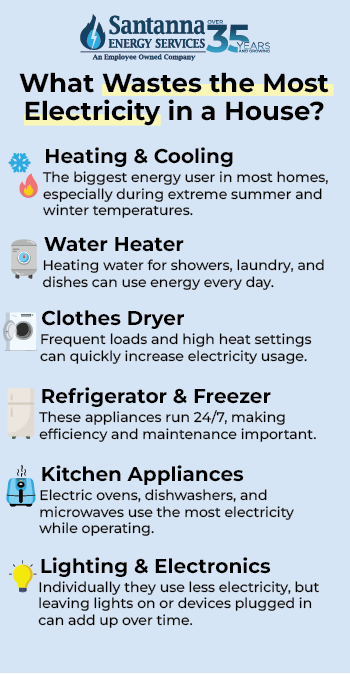
What Wastes the Most Electricity in a House?
Not all electricity use is wasted. In many homes, the biggest source of wasted electricity comes from using appliances and heating or cooling systems longer than necessary or making them work harder than they need to.
For example, running your air conditioner with dirty filters, heating or cooling an empty home, or using an old refrigerator that no longer runs efficiently can all increase your electricity use without providing any extra comfort.
We surveyed Santanna Energy Services’ Employee-Owners and found that 70% said they actively look for ways to save on their own electricity bills.
Here are some of the most common ways electricity gets wasted at home:
- Heating or cooling an empty home: Running your HVAC system when no one is home can use more electricity than necessary. Adjusting your thermostat when you’re away may help reduce unnecessary energy use.
- Dirty HVAC filters: A clogged air filter restricts airflow, making your heating or cooling system work harder and run longer. A dirty HVAC filter can increase energy use by up to 15%!
- Air leaks around doors and windows: Gaps and cracks let heated or cooled air escape, causing your HVAC system to use more electricity to maintain a comfortable temperature.
- Older or inefficient appliances: Older refrigerators, freezers, and other appliances often use more electricity than newer energy-efficient models to do the same job.
- Leaving lights on in unused rooms: Even though LED bulbs are much more efficient than older bulbs, turning off lights when they’re not needed can still reduce electricity use.
- Electronics left on or in standby mode: TVs, gaming consoles, computers, and other electronics may continue using small amounts of electricity even when you’re not actively using them. Unplugging devices in standby mode can save you anywhere from $50-$100 per year.
- Running small loads of laundry or dishes: Washing or drying only a few items uses nearly the same amount of electricity as running a full load, making each item more expensive to clean.
- Using space heaters or portable air conditioners for long periods: These appliances can use a significant amount of electricity, especially if they’re running for several hours each day.
Many of these habits are easy to change. Small improvements, like replacing HVAC filters regularly, sealing air leaks, running full appliance loads, and turning off electronics you aren’t using, can help reduce unnecessary electricity use without sacrificing comfort.
How Can You Tell If Your Home Uses Too Much Electricity?
There’s no single number that means your home uses “too much” electricity. The best way to tell is to compare your electricity use with similar homes and look for unexpected changes in your own usage over time.
For example, if your home typically uses around 850 kWh each month but suddenly jumps to 1,300 kWh without adding new appliances or experiencing unusually hot or cold weather, it may be worth finding out what’s causing the increase.
Here are a few ways to tell if your home may be using more electricity than expected:
- Your electricity use is much higher than homes of a similar size and household.
- Your monthly usage has increased without a clear reason.
- Your electric bill continues to rise even though your daily habits haven’t changed.
- Your heating or cooling system runs much longer than it used to.
- Older appliances or electronics are running more often or less efficiently.
Keep in mind that higher electricity use doesn’t always mean something is wrong. Seasonal weather, guests staying in your home, working from home, or adding an electric vehicle can all naturally increase your electricity use.
Comparing your current usage with the same month last year is often one of the best ways to tell whether your home’s energy use is changing or simply following normal seasonal patterns.
Frequently Asked Questions
Is 1,000 kWh per month a lot?
It depends. While above the U.S. residential average of about 875 kWh per month, 1,000 kWh per month may be normal for larger homes, households with more occupants, or homes with electric heating or cooling. Based on our calculated average, this is above average and should probably be evaluated.
How much electricity does a house use per day?
The average U.S. household uses about 29 kWh of electricity per day, based on annual residential electricity consumption reported by the U.S. Energy Information Administration.
Why does my house use so much electricity?
Homes often use more electricity because of heating and cooling, electric water heating, large appliances, more occupants, extreme weather, or changes in daily routines such as working from home.
Why did my electricity bill increase if my electricity usage stayed the same?
Your electric bill can increase even if your electricity usage stays the same because changes in your electricity rate, utility delivery charges, taxes, fees, or the billing period can affect the total amount you pay.
Does a bigger house always use more electricity?
No, a bigger house does not always use more electricity because factors like the number of occupants, appliance efficiency, insulation, and heating and cooling habits can have just as much impact as home size.
Does natural gas reduce electricity usage?
Yes, homes that use natural gas for heating, water heating, or cooking often use less electricity because those appliances rely on natural gas instead of electricity.
How much electricity a house uses can vary from one home to another, so the national average is only a starting point. The most important thing is understanding your home’s electricity use, what drives it, and how it affects your monthly bill.
Even with efficient habits, your monthly bill can still change because of your electricity rate and other charges.
If you’re looking for more predictable electricity supply costs, Santanna’s Unlimited Energy plan offers the same monthly electricity supply charge throughout your contract term, regardless of how much electricity you use.***
That means you can enjoy your home, whether you’re using more electricity during the hottest days of summer or the coldest days of winter, without worrying about unexpected increases to your monthly supply charge.
Explore whether Santanna’s Unlimited Energy plan is the right fit for your household and enjoy greater peace of mind when it comes to managing your energy budget. When you understand how your home uses electricity, you’re not just managing energy better; you’re gaining greater confidence every time your electric bill arrives.
*** Restrictions apply. Enrollment based upon program eligibility. Customers using more than 125% of normal monthly usage as determined by Santanna may be required to switch plans.
Tyler is an experienced energy professional, having worked for Santanna Energy Services, for the past four years. He is passionate about renewable energy and believes that diversifying the energy grid is the key to a sustainable future. Tyler is dedicated to supplying consumers with the best possible energy solutions and works diligently to make sure that Santanna can deliver the highest quality service.